Three American soldiers are dead. At least 555 Iranian civilians have been killed across twenty-four provinces, with the toll still rising. One hundred and sixty-five girls, at least, are crushed to death in a missile strike on an elementary school in Minab. A drone strike ignited a fire at Dubai’s iconic Burj Al Arab hotel. Airports across the Gulf have closed. Dubai, Doha, Manama and Kuwait have been struck.
The Strait of Hormuz, the needle’s eye for a fifth of the world’s oil supply, is blockaded by Iran. The Iranian Revolutionary Guard Corps (IRGC) has been broadcasting via VHF radio that “no ship is allowed to pass” the strait. Reports indicate that the IRGC has enforced this by firing on at least three vessels that did not comply with orders to turn back. Major global shipping giants, including Maersk, MSC, and Hapag-Lloyd, have officially suspended all transits through the strait until further notice. Regional war has arrived, precisely as every credible analyst, diplomat and international lawyer predicted it would. And Donald Trump is at Mar-a-Lago, posting threats on Truth Social.
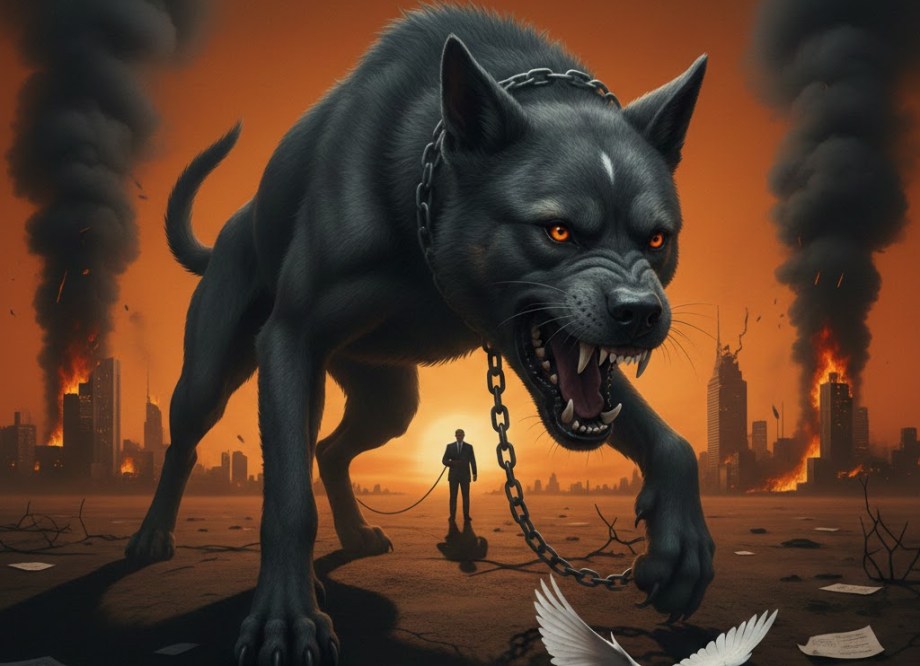
How did we get here? The answer is not complicated. A small, nuclear-armed regional power with a long-standing strategic objective-the permanent military destruction of Iran, found in Donald Trump a president it could manoeuvre. And manoeuvre it did. The tail has wagged the dog again. It has wagged it into the most dangerous Middle Eastern conflagration since the 2003 invasion of Iraq.
And like that catastrophe, this one was illegal, strategically incoherent, and entirely predictable.
Netanyahu’s War, America’s War Powers
Let us be clear about something the American media and propaganda machine, including our ABC, prefers to downplay: the United States had no legal right to join this war. None. Not under international law. Not under its own constitution. Not under the War Powers Resolution of 1973.
The United Nations Charter restricts the use of force to two circumstances: self-defence against an armed attack, or explicit authorisation by the Security Council. Iran had not attacked the United States. Iran’s nuclear program, even in its most alarmist characterisation, was not an imminent threat to the American homeland. The Washington Post cites four intelligence sources in its report that US intelligence assessments found Iran unlikely to pose a direct threat to the US homeland within the next decade. Not this year. Not this decade. Yet the bombs fell on the morning of February 28.
The US Constitution is equally unambiguous. Article I vests the power to declare war in Congress, not the president. Trump did not seek a declaration of war. He did not seek an authorisation for the use of military force. He notified selected senior congressmen, members of the “Gang of Eight” by telephone, shortly before the strikes began. It was not a briefing, not a consultation, but a notification.
“This is an illegal war,” Senator Tim Kaine said on Fox News Sunday. “The Constitution says no declaration of war without Congress. The president has called this war against Iran.” Retired Air Force Lieutenant Colonel Rachel VanLandingham, formerly chief of international law at US Central Command, the very command that carried out the strikes, is blunter still: “Not only does this violate international law in numerous respects, it clearly violates the US Constitution and the War Powers Resolution.”
The dog had no legal authority to run where the tail directed it. It ran anyway.
The Tail Has Form
This is not the first time. The pattern by now has the quality of an orchestrated game-play.
In June 2025, Israel launched a twelve-day war against Iran, striking nuclear facilities. The US joined on the last day. That war ended with Trump declaring victory; Iran’s nuclear capability had been “largely destroyed,” he said. Iran said it had “reconstructed everything.” Eight months later, with the same nuclear file unresolved, the same play was run again, this time on a vastly larger scale.
In between, Iran and the US had been conducting indirect negotiations through Omani mediation, the most serious diplomatic engagement between the two countries in years. By February 27, Oman’s Foreign Minister Badr al-Busaidi was describing a breakthrough: Iran had agreed it would never stockpile enriched uranium, would submit to full IAEA verification, and would downgrade enrichment to “the lowest level possible.” He said peace was “within reach.” The bombs fell the next morning.
Israel has made a calling card of using the prospect of peace as a tactical instrument of war. In June 2025 it killed Iran’s chief nuclear negotiators on the first day of that conflict. In September 2024, when Gaza ceasefire talks were nearing conclusion, it struck Hamas’s political wing in Doha. Now, with the most promising Iran nuclear agreement in a decade literally hours from finalisation, the strikes began. The Jacobin correspondent Arron Reza Merat, writing from Tehran, noted this pattern with precision: Washington and Tel Aviv’s attacks left Iran with “few off-ramps,” with Tehran’s every incentive pointing toward escalation “as a matter of survival.”
And Netanyahu had been lobbying for this moment across four US administrations.
The Lobbied President
Trump’s own chief negotiator, Steve Witkoff, admitted on February 21 that Trump had been surprised Iran had not simply “capitulated” to US demands. That admission is more revealing than Witkoff intended. It tells us that Trump entered these negotiations not as a dealmaker but as a man who had been told by allies, Netanyahu, and Saudi Crown Prince Mohammed bin Salman, that maximum pressure would produce maximum capitulation. It did not. Iran negotiated seriously, made genuine concessions, and was bombed anyway.
The Washington Post, citing four separate sources, reported that MBS had made many private phone calls to Trump in the weeks before the strikes urging military action, despite publicly supporting diplomacy. Netanyahu’s campaign for US strikes on Iran has been open, sustained and relentless. The result is a war launched not because it serves American national interests, it manifestly does not, but because two regional powers, each pursuing their own strategic objectives, found in Trump a president whose vanity, impulsiveness, and contempt for diplomatic process made him the perfect instrument.
The Foreign Affairs assessment, from a former member of Trump’s own NSC Iran negotiating team, was withering: Trump had “no great reason to attack Iran”; sustained economic and diplomatic pressure would have weakened the regime without open conflict; “this president is rarely satisfied with quiet victories.”
The Trap the Experts Predicted
Now the trap has closed. And it is springing exactly as those experts warned.
Responsible Statecraft, whose pre-war analysis has aged like prophecy, wrote that Iran’s generals had understood the only way to break the cycle of manageable US military interventions was to drive the confrontation beyond Washington’s comfortable terrain, into a prolonged regional war where the cost to the United States would become unbearable. Iran has begun executing that strategy. It is not fighting to win in the conventional military sense. It is fighting to make the cost of continuing intolerable: dead American soldiers, closed airports, burning Gulf infrastructure, disrupted oil supply chains, a regional economy in shock, and Trump’s domestic position eroding with every body bag.
Three Americans are dead on day two. Trump says there will “likely be more.” He is right. Iran has surrounded 40,000 US troops across the Gulf states. It has missiles in reserve, according to Atlantic Council analysts. It has Russian-assisted air defences, Chinese anti-ship missiles, and what Responsible Statecraft described as a “full mobilisation for a regional war”; prepared, planned, and waiting for exactly this moment.
The Council on Foreign Relations cut through the triumphalism about Khamenei’s killing with one sentence: “The IRGC is the regime.”
Air wars do not produce regime change. This is not a contested historical proposition. It is settled history. In Germany and Kosovo, the air campaigns were accompanied by ground forces. In 2025, the United States gave up its air war against Yemen’s Houthi government. Bombing has never alone toppled a state that retains its will to resist and its coercive machinery. Iran retains both. Khamenei appointed four tiers of military succession before he was killed. A three-person interim leadership council was functioning within hours. The supreme leader is dead. The Islamic Republic is not.
The Legal Collapse in Washington
In Congress, the picture is equally grim. A War Powers resolution has been introduced to halt the strikes. It will almost certainly fail; pro-Israel Democrats are breaking ranks to oppose it, and even if it passed, Trump would veto it. He has already argued the 1973 War Powers Resolution is itself unconstitutional, a position dismissed by every constitutional scholar who has examined it. The briefings to Congress, scheduled for Tuesday, three days after the bombs began falling, are a formality, not a check. The legislature has been neutered. The Constitution has been violated. And a war of regime change is being prosecuted in America’s name, in service of Israeli strategic objectives, without the consent of the American people or their elected representatives.
Jacobin calls it clearly:
“A core claim of Trumpism was that the Right was turning the page on Bush-era neoconservatism in foreign policy. Today’s attack on Iran is yet more proof of just how false that claim always was.”
The World Watches
China has called for an immediate halt to hostilities and warned that Iranian sovereignty must be respected. It is watching whether this conflict derails Trump’s planned Beijing visit later this month, and calculating what concessions on Taiwan and trade it might extract from a president who has just launched an illegal war and needs cover. Russia has called the strikes “particularly reprehensible” given they were “conducted under the cover of the renewed negotiation process.” Spain has condemned them. The EU has called for “maximum restraint.” The Omani mediator, whose country was itself struck by Iranian retaliation, mourned that “the hope of peace is not extinguished”; the most heartbreaking diplomatic statement of this young century.
The world that Trump claimed he would make safe has been set on fire. The deal that was within reach has been replaced with regional war. The American soldiers whose lives Trump said he valued have begun dying. The girls of Minab are already dead.
The Dog Has No Excuse
In the end, a tail can only wag what allows itself to be wagged. Netanyahu could not have launched this war without Trump. MBS could not have lobbied his way into American bombs without a president who confused flattery with strategy. The AIPAC-aligned Democrats who will vote against the War Powers resolution this week are not being wagged; they are choosing.
Every institution that has looked away while constitutional norms were demolished has made its own choice.
The illegal war is also a failing war. The regime change will not come. What will come; what has already come, is exactly what the experts, the diplomats, the lawyers, the intelligence analysts, and the Omani mediator all said would come: escalation, regional destabilisation, dead Americans, 158 dead schoolgirls, and a trap with no obvious exit.
History is already writing its verdict. The tail wagged. The dog ran. The world is paying the price.
 Urban Wronski Writes
Russia called the commencement of this Middle East regional war reprehensible? Who was the aggressor in its dispute with Ukraine?
LikeLike
Good question Jim, I’d suggest you look a little deeper into the lead up to the russian V Ukrainian conflict.
LikeLike
JimR – may I suggest you look up the 12FEB15 MINSK II Agreement mediated by France and Germany which, among other points, post Maidan 2014, granting special status to separatist-held regions, ie the Donbas & Kershon (Donetsk & Luhansk) oblasts to be followed by a plebiscite by the NATO enabled Zelenskyy government.
The plebiscite was vetoed by the Azov/Bandera ultra nationalists on threat of a coup. In 2022 Merkel & Macron admitted that the Agreement had been just a ploy to allow NATO to further arm & train the Azov mulitias.
Hence 24FEB22 was inevitable.
https://www.reuters.com/world/europe/what-are-minsk-agreements-ukraine-conflict-2022-02-21/
LikeLike
Excuse me, mr angel! Deep diving is a little out of my skilset these days. Getting a little old for that. Back in the day I could have held my breath just a little longer, but thanks for the suggestion.
LikeLike
I have never suggested you “dive” into anything. But the Ukraine brought this conflict on itself, assisted by Joe Biden, who was just looking after his son’s interests.
LikeLike
Just a thought, let’s say the new head cleric of Iran decides to issue a death Fatwa to Trump, Netanyahu and the whole corrupt negotiating team plus all the cheering allies Albo, Starmer and the like. Then these people would have to spend the rest of their lives looking over their chunder just like the Iranians have had to do since 1979. Maybe they wouldn’t be so quick to champion the illegal war.
LikeLike
I doubt many Iranians over the age of 50, would want to return to life under the Shah.
LikeLike
Further to my 28FEB26 comment re the 60cent rise in the petrol price a week before Op Epstein Obfuscation bloomed in flowers of evil.
On the usually sound principle “don’t believe something until it is officially denied” yesterday morning when I heard noted government spokesbot Burke’s assurance that there would be no shortage, no price rise and no gouging I grabbed my two 10L containers and rushed to the local garage to fill them & my tank, even buying a 20L full size jerrican as augmentation.
If it’s unnecessary no biggie, it’ll be handy to have but if, as I expect, skyrocketing prices and empty bowzers eventuate at least I’ll be (slightly more) mobile for slightly longer.
LikeLike