Part Two: Who Else Is Picking Up the Tab?
In Part One of The Receipt, a bloke in a Collingwood jumper stood at the Ararat servo staring at a $255 diesel bill and uttered one word: “bastards!” We followed the money upstream: the war economy, the choked strait, the gas multinationals paying effective tax rates as low as 2-4% on the dollar from resources they don’t own. Today, the receipt gets longer. The pain moves from the bowser into the supermarket aisle, the data centre, and the classroom. The same forces. Different pockets.
The fourth charge on the receipt is the one rung up in every aisle of every Coles in the country.
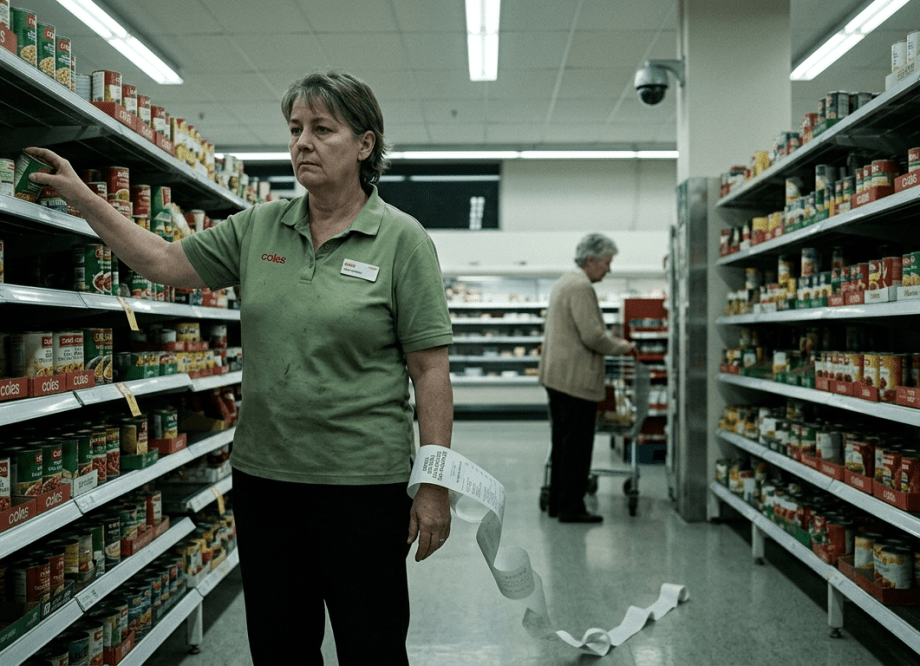
Walk into your local Coles and you are not simply buying milk. You are feeding a surveillance machine processing billions of rows of data through Peter Thiel’s Palantir Technologies (the same outfit that powers ICE deportations, supports IDF targeting operations, and stands accused in a recent UN report of providing AI tools tied to automated decision-making in Gaza).
In early 2024, Coles signed a multi-year deal to deploy Palantir’s Foundry platform across more than 850 supermarkets nationwide, analysing every transaction, every worker’s movement, every shift allocation. Coles aimed to shave $1 billion in costs over four years through this surveillance optimisation, with frontline reports of staff flagged for “inefficiencies” like helping shoppers too long or missing algorithmic targets. Labour gets squeezed while sales hold steady. The system works perfectly if you are a shareholder. For workers, it means you always have a monkey on your back. You have no time for yourself and precious little for others.
Staff are flagged for helping a customer find a product for too long. Rosters are confirmed less than 48 hours ahead. They are forced to skip breaks to meet algorithmic targets. A shelf-stacker is not a person on this platform. She is a data point being optimised toward a margin. When did it become OK for a union to allow this sort of exploitation?
And how did this slide in? Ask the “Shoppies” (The Shop, Distributive and Allied Employees’ Association). It has close ties with the federal government. Their enterprise deals with Coles greased the rails for algorithmic optimisation, trading vigilance for dues and influence. While teachers strike with fury, SDA whispers “partnership,” leaving shelf-stackers to bear the panopticon alone.
The real cut, the one that doesn’t show up on any balance sheet, is the dehumanisation. A constant, low-grade anomie seeps into every shift: the fear, bordering on paranoia, of being constantly watched and judged for efficiency. You stack shelves knowing full well that the extra 30 seconds helping an old lady find the right cat food will flag you as “inefficient.”
Rosters ping at midnight; one slow pallet and you’re penalised. It’s not just optimised margins. It’s souls ground down to data points, trust eroded, human connection rationed by the second. Workers whisper about it in break rooms (if they dare take one): you’re never alone, yet utterly isolated. Palantir doesn’t just track you. It hollows you out. Guts you. And whole communities suffer.
Shoppers are caught up too, swiping Flybuys cards, submitting to behavioural profiling in exchange for cents off a litre of milk that costs more because the gas to produce and transport it costs more (with Woodside, Shell and Chevron raking in their war bonanza). The surveillance economy does not coerce us. It just gives us “loyalty points” in exchange for our personal information.
Woodside, Chevron, and Shell saw shares soar amid the US-Israeli war on Iran, with oil prices spiking from supply disruptions (gains that peaked around early April 2026 before partial reversals on ceasefire whispers). Analyst estimates project billions in extra revenue from those higher crude prices. Yet the same companies faced a senate committee hearing last week with contempt.
Palantir’s ambitions do not stop at the checkout. Scotland Yard uses its AI tools to profile its own officers, tracking illness, absence and overtime patterns. Thirty US lawmakers are demanding answers from DHS and ICE about Palantir tech (facial recognition, social media monitoring, stingray surveillance) deployed against people not suspected of any wrongdoing.
In the US, the Department of Government Efficiency tapped Palantir to build a master database accelerating deportations under the Trump administration. The US Army handed them a contract worth up to $10 billion over ten years. Palantir (a $340 billion behemoth) paid zero US federal income tax in 2025 despite $1.5 billion in domestic income. Zero. It is, in the strict dictionary sense, the perfect corporation: total information, minimal obligation. Maximum embedment in the power elite.
From the supermarket aisle to the immigration detention centre to the battlefield targeting system, this is one continuous web. It just has different branding depending on which end of it you are ensnared in.
The fifth charge is the one that explains why the other four are still on the books.
The AI investment binge is the largest speculative accumulation of capital since the dot-com crash, and it is happening simultaneously with a war-driven energy crisis that those very data centres are making significantly worse. Amazon, Alphabet, Meta and Microsoft alone spent $300 billion on capital expenditure in 2025. US mega-caps are projected to spend $1.1 trillion between 2026 and 2029, mostly on AI hardware and infrastructure.
And yet. MIT Media Lab research finds that 95% of organisations investing in generative AI report zero return on investment despite spending $30-40 billion across 300+ initiatives. OpenAI is on track for $14-17 billion losses in 2026 on revenues less than half that. Goldman Sachs CEO David Solomon expects a lot of capital deployed won’t ever deliver returns. Jeff Bezos calls it an industrial bubble. Sam Altman admits to over-investment and losses ahead. The Bank of England warns of overvaluation risks. The IMF draws dot-com parallels.
That dissociation between corporate belief and measurable reality has its own clinical name, and it isn’t optimism.
But here is what the financial commentary consistently omits: this bubble is not merely financial. It is environmental, and it is neo-colonial in structure. Globally, fossil fuels provide around 60% of data centre electricity. MIT pegs data centre carbon intensity at 48% above the US average. Gas-fired generation for them is projected to more than double by 2035. Woodside and Chevron couldn’t ask for a better customer.
And where are those data centres proliferating (popping up like mushrooms after a spring shower)? Increasingly in nations least equipped to cope with the consequences: countries that have sold their planning regulations, air quality, water and land to house Silicon Valley’s insatiable hunger for compute. Server farms in Southeast Asia, sub-Saharan Africa and South America aren’t powering local prosperity. They’re dumping the environmental bill on communities with the least power to fight back. The rare minerals for chips? Extracted through supply chains predictably gutting fragile, marginalised lands.
The AI boom is strip-mining the physical world to power a digital speculation that cannot pay back most who funded it. It fuels the energy crisis filling Woodside’s coffers and the Ararat tradesman’s dread. It builds the platforms Palantir runs on. And it does all this while the IMF tells “Lucky” Jim Chalmers to tighten his belt. But Jim is a smart cookie. He is banking on no nonsense from the neoliberals on Angus Taylor’s emaciated Liberal Party, unless he cuts the ~$10 billion diesel fuel rebate (where we all subsidise diesel-buying businesses). Nor will he touch the $18 billion yearly public funding to private schools.
Which brings us to the last charge on the receipt. The one we send our children to school with every morning.
On March 24, 35,000 Victorian teachers, principals and support staff walked off the job: the first statewide stopwork in 13 years, backed by 98% of AEU members. They marched from Trades Hall to Parliament, from Wodonga to the western suburbs, not because they’re greedy but because they’ve done 12 hours unpaid overtime weekly while real wages erode, class sizes balloon, and Victoria’s schools rank lowest-funded nationally. Experienced Victorian teachers are already Australia’s lowest-paid. By October 2026, NSW counterparts will earn $15,000+ more annually for the same work.
Teachers are one of Australia’s last big union workforces. Density has crashed to 12.5% from 53% in 1982, gutted by wage suppression, enterprise bargaining silos, casualisation, and gig “optimisation” of labour as a disposable cost.
Half of Aussie workers face employment insecurity: casual gigs, short terms, labour hire, platforms. Inferior rights, lower pay, no entitlements, and no shield when supply shocks hit the bowser.
The Allan government offered 18.5% over four years. The union wants 35%. With real wages down ~10% since 2021, hot inflation, and rock-bottom school funding, that’s not radical. It’s arithmetic.
The AEU’s stopwork isn’t just about pay. It’s a last-ditch defence that work should be secure, remunerated, dignified: mounted with courage by the last group with collective muscle to try.
The teachers’ strike is not a disruption to ordinary life. It is a signal flare fired from the front line of what ordinary life is actually costing people, fired into a sky the surveillance economy, AI bubble, gas multinationals, and war profiteers have filled with smoke.
So there it is. The full receipt.
A war nobody voted for, driving up everything. A choked strait rewriting the monetary order. Gas giants paying pennies on the tax dollar from our seabed. Coles running Palantir surveillance on workers and shoppers. An AI bubble torching gas and rare earths for squat returns. And 35,000 teachers in the street because the system prepping the next generation can’t pay its own preparers.
Chalmers has options. Cut that diesel subsidy. Why subsidise private schools? Impose a serious LNG windfall levy. Revenue from surveillance data harvests. NDIS protection from austerity. The Office of Productivity says investing in welfare sees at least a two-fold return on your investment. A budget wielding the state smartly, not posing for IMF claps. The machinery exists. The revenue sits in the paddock, seabed, Flybuys databases, server farms. Missing in our small-target Labor mob? The guts to grab it.
Out at the servo in the western districts, the bloke in the Collingwood jumper is long gone. But the receipt is still there. Longer than he thinks. We’re all on it.


Truth to Power, David. Thanks very much. I’ve got to contend with another weekly shop this morning, all the while imagining the inhuman indignity being suffered by the hollowed out hulks serving me.
I’ve lived through some of the best of times, now it’s time to endure the crap.
LikeLike
Hang in there, Jim, although it does get to the stage where you must consider wearing dark glasses and dressing down, to help confuse Palantir in its free character assessment of customers, too. Apparently it takes a nanosecond to tag you as a Big Spender or a potential shoplifter. A “stony broke” legend on your T-shirt, might just provoke it. And avoid anything referring to river and sea. You’re likely to be arrested.
LikeLike
Thanks for the advice, David. I wonder what palantir would make of my, “Hi, I’m a suck eggs party kinda voter” tee shirt?
LikeLiked by 1 person