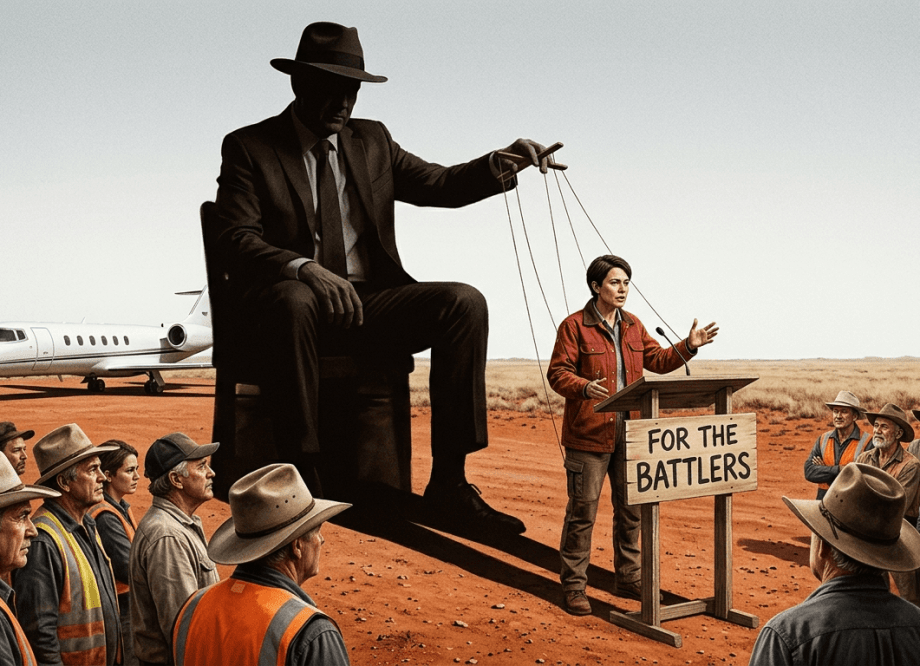
In today’s editorial, The Saturday Paper calls out the hoary myth that Pauline Hanson’s party, One Nation, speaks for the battler. The argument is simple: the party has long posed as the voice of ordinary Australians while quietly aligning with interests that are, for the most part, extraordinarily wealthy and extraordinarily unordinary. What is less often said, but just as urgent, is that this lie is not alone. It is one of many in the party’s farrago of lies. And the others are more toxic, pernicious and enduring than the first.
One Nation has been a blot on the body politic for nearly three decades. It did not arrive uninvited. John Winston Howard, himself no stranger to the debasement of Australian politics, prepared the soil. He sowed a bumper crop of tares. Tares look like wheat while growing but ultimately contaminate the whole crop. Then he set fire to the stubble and stood well back. He helped poison the national discourse in ways that outlasted him. He also rewarded dullards such as the incredibly over-promoted Tony Abbott, while ensuring that those who posed any threat never got near the throne. The result is a Liberal Party that is, of course, entirely underwhelming in the talent department. Other forces are at work too. But Howard’s fingerprints are all over the vacancy.
As they are with his child out of wedlock, One Nation. Long before Hanson entered parliament as a former Liberal-endorsed candidate, Howard had done the groundwork. His “One Australia” rejected multiculturalism outright and questioned Asian immigration. It framed what the ruling class fondly calls social cohesion today. Social cohesion? At best it evokes civic integration. At worst and most often it is heard as assimilation. The language was careful. The dog-whistle was not.
Not only is One Nation a false friend to the battler and the poor worker, it sucks up to the top end of town. A parallel bit of bullshittery: that One Nation is animated by class anger rather than personal and corporate ambition. The pattern is clear enough now. Australia’s richest person, Gina Rinehart, has become a high profile patron of the party, backing its expansion, funding its events, and even donating a private plane to help its MPs travel the country in comfort. This is not some background curiosity; it is a visual and structural rebuke to the party’s battler pose. When the figure described as the country’s most powerful billionaire provides the wings, One Nation’s claim to be a grassroots revolt begins to sound like a very bad joke. Or a cruel hoax.
The class lie is mirrored by a gender lie: the idea that One Nation is simply defending “fathers” and “family” against a hostile system. Pauline Hanson has long targeted the family court, fulminating about alleged bias against men and accusing women of lying about domestic violence. Family violence experts and legal commentators have warned that this kind of rhetoric is not benign; it is a threat to one in four, or 2.3 million Australian women, who already fear speaking up, and it feeds the resentful men who see parenthood and maintenance obligations as a form of persecution.
That anger did not emerge from nowhere. It was given institutional cover by the way the Morrison government stripped the family court of its distinct identity. Christian Porter, as Attorney-General, oversaw the merger of the Family Court into the Federal Circuit and Family Court of Australia, a single, generalist “super court” that many progressive legal-aid bodies and former judges say has diluted the specialist, trauma-informed handling of family breakdown that once characterised the old system. The move was framed as a rational, efficiency‑driven fix, but it effectively hollowed out a once‑lauded, family‑centred institution.
To those who already resent paying maintenance, child support and the equal division of family assets, this was red meat. One Nation senators backed the reform, treating it not as a technical restructuring but as a symbolic blow against an institution that had enforced the very obligations they resented. The party’s rhetoric neatly aligned with the grievance‑driven fantasy that the family‑law system is rigged against fathers — a narrative that makes it easier for embittered divorced men to see child support and asset division as “punishment” rather than the legal expression of shared responsibility. The result is not justice, but more fear, more manipulation, and more political oxygen for people who want to turn intimate breakdown into a recruiting pitch.
There is also the lie of national patriotism. One Nation presents itself as the defender of Australian values, but it has repeatedly flirted with foreign, reactionary actors whose interest in Australia is purely transactional. Its most brazen moment came when it opened talks with the United States’ National Rifle Association about weakening Australia’s strict gun laws. That is not just a policy disagreement; it is a kind of low-grade treason to the Port Arthur era consensus that Australians, across the political spectrum, once shared. The party’s willingness to accept money and influence from a foreign gun lobby to dilute laws built to save lives lays bare the emptiness of its nationalist posturing. A party that claims to love Australia is quite comfortable welcoming in the very forces that would undo one of the country’s proudest reforms.
That disregard for the national interest is mirrored in One Nation’s alignment with powerful transnational industries. The party is not shy about its backing for Big Coal and Big Oil; its platform “embraces” coal as a critical part of the energy mix, backs new gas and petroleum projects, and wants to lift any bans on gas appliances and to end the effective moratorium on offshore exploration. In the Senate, One Nation has repeatedly voted with the Coalition and the Nationals against tightening oversight of the gas industry, including blocking proposals for higher taxes on LNG exports and tougher rules for energy giants. On issue after issue, the party’s “battler” stance dissolves into simple alignment with the hydrocarbon lobby and the deregulatory right.
At the heart of all this is an anti-science, anti-expert habitus.1 One Nation senators have repeatedly questioned the reality of anthropogenic climate change, demanding that climate scientists be summoned before royal commissions and accusing them of “corrupted” data. Pauline Hanson has dismissed climate education as indoctrination, and senators such as Malcolm Roberts have claimed there is no empirical evidence that carbon dioxide causes climate change, a position that scientific bodies have explicitly labelled false. The party’s broader energy platform, ripping out net-zero targets, expanding coal-fired power, and promoting nuclear reactors in regional New South Wales, is built on the assumption that climate science is a kind of political hoax rather than a body of well-established, evidence-based research. That same mindset resurfaces every time One Nation or its allies insist that “we’ve always had floods and droughts,” as if that rhetorical evasion somehow negates the work of the Bureau of Meteorology and the CSIRO.
This anti-science posture is not accidental. It is part of a broader anti-intellectualism that One Nation cultivates and which resonates powerfully with a section of its rural and regional base. For many poorly educated, disaffected voters, “expertise” sounds like a code word for condescension, and the party has learned to weaponise that suspicion. It frames doctors, climatologists, epidemiologists and social scientists as a distant, metropolitan elite whose job is to lecture, shame and restrict. In this sense, the party offers a kind of psychological amnesty: a licence not to believe inconvenient truths, and an excuse to treat complexity as a plot. The trade-off is that the public loses its grip on the realities of climate change, public health, industrial safety and demographic planning. It is a Faustian bargain. We all lose some degree of agency. But most at risk are the battlers whose house is closest to the flood plain, whose lungs breathe the mine dust, whose kids go to the school without airconditioning.
The party’s politics of grievance and division are completed by its alignment with the laughably named Nationals, whose base overlaps heavily with One Nation’s rural and regional supporters. On key issues, especially climate, gas-export policy, agricultural deregulation and the treatment of the family-law system, the two parties often end up voting in similar directions, even if not in identical lockstep. Both share a comfort zone with the agribusiness-linked, resource-sector-backed worldview that equates national interest with the interests of the paddock and the pit.
All of this is not incidental. It is connective. One Nation’s politics rely on a series of coordinated falsehoods: that it is class-based, that it speaks for fathers, that it defends “Australian values” and that it is a purely domestic movement. In practice it is none of these things. It is a grievance shell that converts anger into political capital, weakness into leverage and resentment into revenue. Once you admit that One Nation does not represent battlers, you must also admit that it does not represent justice, equality or safety. It represents a political business model built on the systematic exploitation of the anxious, the lonely and the aggrieved, and a government that has, in its own way, helped hollow out the institutions that might have protected them.
1 In the work of the sociologist Pierre Bourdieu, habitus refers to the durable, often unconscious set of dispositions, attitudes and ways of seeing the world that a social group or institution carries with it.


/ All of this is true, but the voters out there have their brains stuck up their nether regions out of sight of the real world.
LikeLike
It’s true, Mr Stakes, that voters have a serious reverse polarity issue as far as their grey matter is concerned. It appears to be caused by the human engineering, also known as brain washing, invented by the MSM.
There is also an issue with politicians being owned by the wealthy industrialists and ruling class. This would be solved by banning political donations.
LikeLike