Theatre.
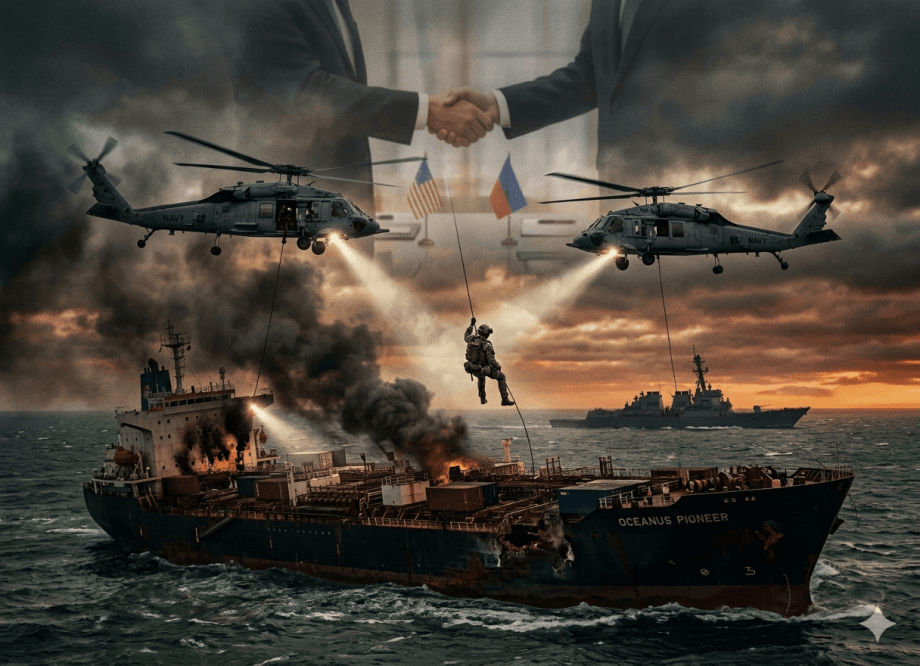
That is the word you need to hold onto as you try to make sense of what happened in the Gulf of Oman on April 19, 2026. The USS Spruance blowing a hole in the engine room of the Iranian-flagged cargo ship Touska. Marines rappelling from helicopters onto the deck. Trump on Truth Social crowing that the crew “refused to listen” and his Navy “stopped them right in their tracks.” Six hours of warnings. Then the guns.
None of it was about a ship. It was never about a ship.
The Touska is a prop. The seizure is a performance. And the so-called peace talks with Iran, the ones supposedly resuming in Islamabad this week, are the most cynical act of diplomatic theatre since Lyndon Johnson used a non-existent attack in the Gulf of Tonkin to drag America into Vietnam.
The Persian poet Saadi got there first: “A tyrant does not need an excuse to oppress, only a pretext to justify.” The Touska is that pretext.
Legal Charade or State-Sanctioned Piracy?
Before you accept the official framing, two things you should know about the Touska.
First: the ship has been under US sanctions since 2018. Its owner companies and managers have been sanctioned since 2012. Nobody is pretending the Touska was an innocent trader going about its business. It was not. The US knew exactly what it was, and had known for years.
Second: the ship loaded in Shanghai and Macau before transiting through Port Klang, Malaysia, on its way to the Iranian port of Bandar Abbas. Western intelligence almost certainly had eyes on that manifest before the Spruance fired a single round. Which raises the question that the official narrative does not answer: if you already know what the ship is carrying, why the gunfire? Why the spectacle?
Because the spectacle is the point.
Under the San Remo Manual on International Law Applicable to Armed Conflicts at Sea, a naval blockade must be publicly declared, effectively enforced, and proportionate. The US has declared its blockade. But disabling a civilian vessel in international waters, a vessel whose crew was warned to evacuate the engine room before the guns opened up, sits in legally treacherous territory. Article 101 of UNCLOS defines piracy as illegal acts of violence or detention on the high seas. Iran called the seizure exactly that: piracy. Iran’s foreign ministry went further, declaring it a violation of the ceasefire that has nominally held since April 9.
Iran then announced it was not sending negotiators to Islamabad.
Funny, that.
Three Audiences, One Ship
Every act of military theatre plays to multiple audiences simultaneously, and the Touska seizure is no different.
The message to China is unmistakable. The Touska’s recent ports of call were Shanghai and Macau. Beijing knows that. Washington knows that Beijing knows that. By intercepting a vessel with obvious Chinese supply-chain connections, the US is broadcasting a warning: we are watching every link in this pipeline, and we will reach into it whenever it suits us. The question is whether Beijing blinks or accelerates its overland supply routes through Pakistan and Central Asia, where the US Navy cannot follow. Chinese President Xi Jinping’s call for “normal passage” through the Strait of Hormuz, made pointedly to Saudi Crown Prince Mohammed bin Salman, was measured. But measured is not retreating.
The message to other shippers is equally clear. Twenty-five commercial vessels have been turned around or sent back to Iranian ports since the blockade began. The footage of Marines rappelling onto the Touska’s deck is not news: it is a deterrence advertisement. Don’t run this blockade. Don’t find out what happens next.
And the message to the American domestic audience? Red meat. Guns blazing, Marines in action, an enemy ship brought to heel. Trump on Truth Social, crowing. This is the “America First” spectacle that plays to a base that wants dominance, not diplomacy. Pete Hegseth, who has now sacked three serving generals in the middle of a war, including Army Chief of Staff General Randy George, fired in an early April phone call for clashing with Hegseth over promotion decisions, is building an officer corps that will do what it is told. Not what the law or strategy requires. What it is told.
The Fake Peace Process
Here is what you need to understand about the talks in Islamabad.
They are not designed to succeed.
Steve Witkoff and Jared Kushner travelling to Pakistan while the US Navy is seizing Iranian ships in the Gulf of Oman is not diplomacy. It is the appearance of diplomacy, which is a different thing entirely. Iran’s foreign ministry spokesperson said it plainly: “There are indications from the American side that there is no seriousness on the side of the US to walk down the path of diplomacy.”
Iran earned nearly five billion dollars in oil export revenue in the month before the US blockade began. The blockade is strangling that income in real time. The ceasefire expires Wednesday. Iran’s military has vowed to retaliate for the Touska seizure. Iran’s President continues to emphasise diplomacy. Iran’s IRGC vows revenge. These are not contradictory signals from a confused government. They are the controlled dissonance of a country buying its own time while watching the other side’s bad faith accumulate into evidence.
When the talks collapse, as they are structurally designed to do, the Trump administration will have its Exhibit A. Iran walked away. Iran wouldn’t negotiate. Iran is the obstacle. The Touska will be the prop they point to.
The Gulf of Tonkin Echo
History does not repeat. But it rhymes with an ugly persistence.
In August 1964, Lyndon Johnson told Congress that North Vietnamese torpedo boats had attacked American destroyers in the Gulf of Tonkin. The evidence was thin. The second attack, the one that passed the resolution, never happened. Declassified documents confirmed it decades later. But by then the war had consumed 58,000 American lives and three million Vietnamese ones. The lie had done its work.
The Touska bears the hallmarks of a similar operation: a real incident, inflated into a pretext, deployed to justify the next phase of escalation. The difference is that this time we can see the mechanism working in real time. We have the manifests. We have the sanctions history. We have the timeline: the ship seized, the peace talks cancelled within hours, the ceasefire expiring Wednesday, the generals fired.
The Turkish Foreign Minister told reporters over the weekend that the ceasefire deadline will have to be extended. Maybe. But the administration currently sacking generals for insufficient loyalty to its war vision, while sending envoys to talks it has no intention of completing, is not an administration looking for an off-ramp.
Sun Tzu observed that all warfare is based on deception. Sun Bin, his successor, went further: he who relies on deception to wage war will perish by his own deception.
The Touska is not the beginning of the end. It is the end of the beginning. Something darker is being prepared, and the theatre of broken promises is running cover while it happens.
Watch what they do. Not what they say.


That whiff of eugenics and social-Darwinism around Anglosphere neo liberalism or ‘segregation economics’ of Koch’s muse and Mont Pelerin Society’s Buchanan.
Joined at the hip with Project 2025 partners, the anti-immigrant greenwashing of Tanton Network, spun off from fossil fuel ZPG Zero Population Growth of late white nationalist John ‘passive eugenics’ Tanton and Paul ‘Population Bomb’ Ehrlich.
Also shows how little analysis and evaluation is applied by government and media, based on science and research, to develop and deliver policy vs preference for platforming &/or following non experts, media and polls down the garden path…..
LikeLike