A satirical analysis in the vein of Martin Amis
TWO KINGS
It began with a tweet. It always does, now. Somehow. The White House’s official account posted a photograph of Donald Trump and King Charles III standing together in the gilded anteroom of American power, and above it, in the caps-lock register that is this administration’s preferred mode of thought, the caption read: TWO KINGS. Crown emoji. The image was intended, presumably, as a celebration of the special relationship. It read, to anyone paying attention, as a confession.
Tacitus, writing of the Emperor Tiberius, observes”
“… the more I think of what happened during his reign, the more does everything seem, in its causes and its effects, mysterious and fatalistic.” Tacitus understood what we are only now relearning: that imperial madness is not a private affliction. It seeps. It contaminates the court, the senate, the applauding mob. It makes accomplices of everyone in the room.
There were five hundred and thirty-five accomplices in the room on April 28th, 2026. They gave the King of England eleven standing ovations.
The Madness of Kings
Before we get to the speech itself, we should pause at the troubled figure it was delivered to. Because Donald Trump, in the spring of 2026, has achieved something genuinely remarkable: a state of political cognition so untethered from observable reality that historians will one day reach for the same vocabulary we use for George III hearing voices in the long corridor at Windsor, for Caligula appointing his horse Incitatus to the Roman Senate, for the parade of purple-draped figures who confused the accident of their power with the architecture of the universe. Or the largely mute Ferdinand I of Austria’s only known command:
“I am the Emperor, and I want dumplings!”
Actually, he called for noodles. History is riddled with misquotation. Noodled. And reductive analysis. But let’s look at the evidence. Asked by reporters about the concurrent catastrophes of Ukraine and Iran, Trump mused. The word is not too gentle, it precisely captures the torpid, self-satisfied quality of his public thinking; that he wasn’t sure which war would end first.
“Maybe they’re on a similar timetable,” he offered, as a man might speculate about the relative ripeness of two avocados on a kitchen bench. Ukraine. Iran. Two countries, two wars, two entirely distinct geopolitical catastrophes with different antagonists, different histories, different nuclear implications. On a similar timetable. The words hung in the Washington air like the smell of one of Don Trump Junior’s big game trophies, another rare and endangered species, strung up too long in the sun.
Trump is not stupid in the ordinary sense. Ordinary stupidity has a kind of innocence to it. What Trump exhibits is something closer to what psychiatrists call reality testing failure: the progressive inability to distinguish between the world as it is and the world as one wishes it to be. Hannah Arendt, writing about the pathology of authoritarian power, well before Trump, noted that the most dangerous leaders are not the ideologically committed; the true believers with their coherent, terrible programmes. The worst are those for whom power is its own sufficient justification, who have no agenda beyond dominance, no map of the territory they are ravaging. They are, in the most precise clinical sense, lost. And they have the nuclear football.
This is the man King Charles III came to address.
Velvet Gloves, Cold Steel
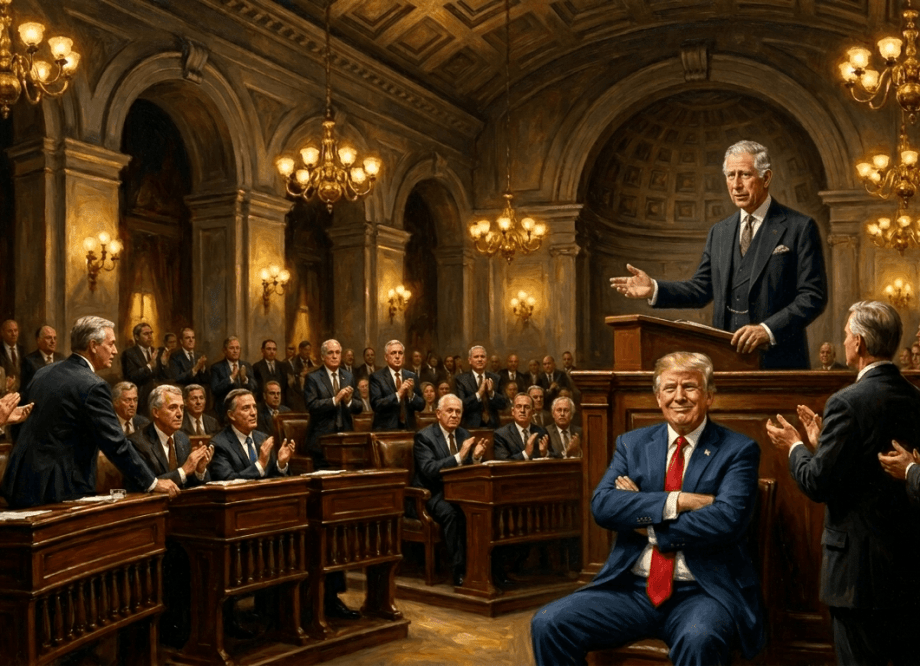
The performance was a thing of terrible beauty. Twenty minutes of perfectly calibrated diplomatic napalm, delivered with the sort of smile that could freeze champagne in the glass. Charles stood before the joint session; the chandeliers throwing their warm, indifferent light, like the hard disinterested energy of the stars, across five hundred upturned faces. And he spoke, in the measured baritone of a man who has spent his entire adult life saying one thing while meaning another, of checks and balances, of executive power being subject to constitutional restraint, of the Magna Carta’s founding principle that even a king is not above the law.
An actual king. Saying this. To a man who has spent a decade trying to become one.
The irony was so thick that you could carve at the state dinner. The U.S. Supreme Court Historical Society has calculated that Magna Carta is cited in at least 160 Supreme Court cases since 1789,” Charles noted, his voice carrying the weight of eight centuries of hard constitutional learning; learning purchased, it should be remembered, in blood and fire and the long, grinding pressure of the governed upon the governors. The applause was thunderous. Bipartisan. Sustained. The MAGA faithful rose to their feet with everyone else, sublimely, magnificently, unaware that they were cheering their own indictment.
Martin Amis, in his essays on political violence and moral vacancy, identified incuriosity as the defining feature of the new barbarism. Not ferocity. Not even cruelty. Incuriosity: the failure to wonder, to question, to follow a thought to its necessary conclusion. Trump’s response to the speech; “He made a great speech. I was very jealous”? That is incuriosity made audible.
Worse. The sentence of a man who heard the ovations and registered their warmth without once asking what, exactly, was being applauded. A man who cannot wonder cannot govern. A man who cannot govern but holds the codes for eight thousand nuclear warheads is something for which our political vocabulary does not yet have an adequate word.
The Art of Royal Shade
The real artistry lies in what Charles did not say, and how. His passionate defence of NATO; “that same, unyielding resolve is needed for the defence of Ukraine and her most courageous people”, was delivered to a man who has spent months threatening to abandon the alliance, who views international cooperation as a protection racket in which America is always the mark. The King spoke of climate change as “our most precious and irreplaceable asset” to a man who has described environmental protection as a hoax perpetrated by the Chinese. He praised the independence of courts; their cool, difficult, unpopular independence; to a president who has spent his career attempting to heat them, bend them, load them with loyal stooges and call it justice.
Each sentence was a surgical strike. Each one landed in the room and detonated quietly, leaving no visible damage except in the minds of those who were listening. Which is to say: not Trump. Donald non compos mentis.
Shelley knew this figure. He gave him a name and a place: Ozymandias, the king of kings, surrounded by nothing.
“Look on my works, ye Mighty, and despair.” The despair, of course, accrues to Ozymandias. The works are sand. The legs, trunkless, stand in the desert. What remains of the great projector’s dream is not power but its echo, the boast, the caption, the crown emoji, the tweet.
The Rubik’s Cube and the Hammer
The week of the King’s visit had already provided a tableau of American decline so concentrated it seemed almost too artfully arranged to be accidental. Trump’s richly performative conversation with Putin, conducted, in what can only be described as a surrealist masterpiece of geopolitical stagecraft, while flanked by astronauts in full flight suits, had revealed a president so comprehensively detached from the structure of the world that he offered to let Russia participate in the management of Iran’s nuclear programme, while simultaneously asking for Russian help in Ukraine. The logic, if that word can be permitted to appear in this sentence, appeared to be that two crises can be resolved by combining them into one larger and more unstable crisis. It was like watching a man attempt to solve a Rubik’s cube by hitting it repeatedly with a hammer, and then, dissatisfied with this approach, setting down the hammer in favour of what the military, in its talent for oxymoron, calls a tactical nuclear weapon.
Tactical. The word deserves a moment of contemplation. A weapon capable of killing hundreds of thousands of people in an afternoon is, in the current Washington vocabulary, tactical. It fits within a strategy. It serves a purpose. It is, in some theoretical framework assembled by men in clean shirts in air-conditioned rooms, proportionate. This is the framework within which Trump’s foreign policy now operates: a world in which the instruments of apocalypse have been rebranded as tools of negotiation, in which the difference between winning and ending has become, in the fog of reality testing failure, difficult to perceive.
Shakespeare’s Edmund, the cold, brilliant bastard of King Lear, the man who sees power whole and wants it entire; at least had a programme. “I must have your land.” Simple, honest, coherent. Trump’s wanting is more primitive still: he wants the feeling of having, the warmth of dominance, the standing ovation in the chamber. And hair. He wanted what Charles got.
“I was very jealous.” There it is. The foreign policy of the United States of America, spring 2026, distilled to five words and a primary-school emotion.
Two Kings
Return, then, to the tweet. TWO KINGS. The White House posted it as triumph. It functioned as diagnosis.
Because Charles, the real king, the man whose gold-heavy role is supposed to represent everything antithetical to democratic values, had just spent twenty minutes arguing, with precision and sincerity, for the principles of constitutional restraint, judicial independence, international cooperation, and the irreversible damage being done to the living world. He had done it with such skill, such lethal courtesy, that even his target was applauding. He had reminded five hundred legislators, and through them a watching world, that democracy is not a birthright but a practice: daily, imperfect, requiring vigilance and the willingness to lose.
And Trump, the elected president, the man whose office is the closest thing the modern world has to a democratic mandate, whose power derives from the people rather than from blood, had spent the same period trying to become a king. Trying to concentrate, to insulate, to make hereditary. To stand beyond the law the way Charles told Congress no one can stand.
TWO KINGS. One of them understood what the words meant. One of them had studied, through decades of protocol and loss and public duty, what it costs a person to subordinate the self to something larger. The other one wanted the crown emoji.
Nothing Beside Remains
In the end, Charles’s address to Congress will be savoured: not a state visit but an intervention, delivered in the idiom of friendship, aimed at the foundations of something the host could not see was crumbling. He had done what no Democratic politician, no editorial board, no parade of generals and former officials had done: he had made Trump look diminished, confused, and profoundly out of his depth, while Trump stood there smiling and feeling the warmth of the room.
That is the most frightening thing of all. Not that Trump was humiliated. Yet he was, comprehensively, in front of his own Congress and the cameras of the world. But rather that he did not feel it. The humiliation slid off him like water from pigskin. He registered the applause and missed the argument. He counted the standing ovations and could not follow the logic that prompted them. “I couldn’t believe it,” he said, of Charles making the Democrats rise to their feet. The incuriosity is total. The wonder is absent. The question — why? what did he say? what does it mean? — simply does not arise.
A man who cannot ask why cannot be reached by reason, by evidence, by the accumulated weight of eight centuries of hard-won constitutional principle delivered by an actual king in the actual chamber of American democracy. He hears the music and misses the words. He sees the ovation and misses its object. He stands in the desert among his works and feels, genuinely feels, the warm glow of a man who is winning.
Nothing beside remains.
The author acknowledges the influence of Martin Amis’s satirical and essayistic style, particularly his technique of finding the moral vacancy at the centre of political spectacle, and his insistence that comedy and dread are not opposites but collaborators.


One thought on “The King’s Speech: A Royal Masterclass in Diplomatic Evisceration”
Comments are closed.