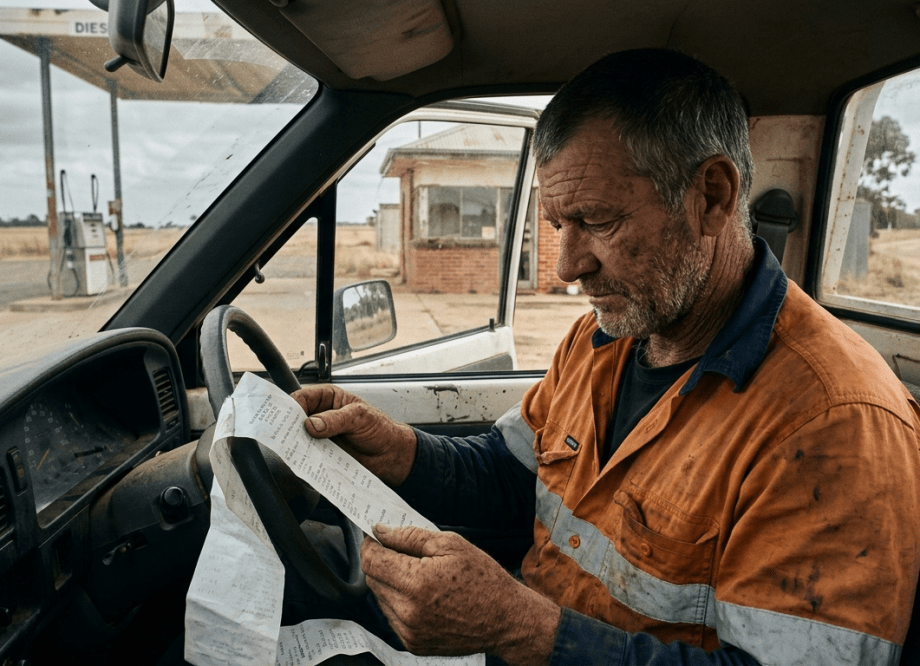
At the Ararat servo last Tuesday, a bloke in a Collingwood jumper
ahead of me in the queue stares at the bowser as if it had just
insulted Jock McHale. Two hundred and fifty-five dollars to fill a
diesel HiLux. “Bastards”, he says back in the cab, still staring at
the bowser, collecting himself. That is the sight and sound of
geopolitics arriving in the Western Districts.
“Lucky Jim” Chalmers flies to Washington for the IMF’s spring gab-fest
at exactly the wrong moment, being a moment that clarifies everything.
The global economy is being knocked side-ways by an American stunt: a
reckless, gratuitously cruel and unwinnable war on Iran, a choked
strait, volatile oil markets, and now the Armageddon chorus from the
same mongrels that would walk over hot coals to defend the top end of
town, but are MIA in the war on ordinary people.
In closely related news of that war, Shell Australia Country Chair
Cecile Wake and Asia-Pacific head of tax Coralie Trotter are
questioned by independent Senator David Pocock. The star executives
are unable to say how much gas the company exports or its total
revenue from local operations in the last financial year.
Adam Smith didn’t call self-interest the invisible hand of capitalism
for nothing.
Are we up shit creek? Australia is not headed for a carbon copy of the
GFC, but it is facing something just as lethal in a different form: a
supply shock that tips inflation higher while grinding growth lower,
landing hardest on the people with the least capacity to absorb it.
There are three bastards driving this. Three elephants in the room. At
least. None of them has been properly named in the respectable
commentary. They are connected. They are large. And they are all, in
their different ways, picking the pocket of the bloke at the bowser.
________________________________
The first is the war economy itself.
The IMF’s slogan against overspending should be treated with caution,
if not derision. The fund’s chief economist tells a flatulence of
finance ministers that governments should refrain from wasteful and
untargeted fiscal measures and that avoiding fiscal stimulus during
rising inflation was essential. The global economic priesthood had
spoken.
Australia is one of the few advanced economies to have avoided both a
major global recession and a full-blown GFC-style collapse this
century, and that was not an accident of fate. It was the result of
governments willing to spend when the system was under stress.
The lesson is not that public support is dangerous in a crisis. The
lesson is that support delivered quickly, aimed at the people who need
it most, can stop a shock becoming a depression. It’s not what the top
end of town wants to hear.
On the other hand, The Australia Institute’s analysis of the Middle
East war is blunt: domestic petrol, diesel, gas and electricity prices
rise, broader prices follow, multinational gas exporters pocket the
windfall, and Australian governments capture very little of it. We
socialise the pain and privatise the profit. The IMF, on cue, is
urging belt-tightening. It always does. The belt it has in mind does
not belong to Woodside, Chevron or Shell.
________________________________
The second force is the Strait of Hormuz, and the fraying of the old
monetary order.
The strait, through which roughly one-fifth of the world’s oil and gas
normally passes, has become something out of a lurid, techno-thriller.
Since mid-March, Iran’s Islamic Revolutionary Guard Corps, depicted in
corporate media as the highwaymen of the high seas, have, in fact,
been running a sovereign tollbooth at the world’s most critical
maritime chokepoint, charging oil tankers up to two million US dollars
per transit, payable in Chinese yuan or cryptocurrency. Iran’s
parliament formalised the arrangement into law on 30-31 March under
the Strait of Hormuz Management Plan.
The toll system could generate twenty million US dollars a day from
tanker traffic alone.
This is not a desperate regime improvising under fire. Iran has
methodically built a sanctions‑resistant financial ecosystem; layering
informal networks, state‑linked intermediaries, Russia‑linked rails,
crypto flows, and an expanding yuan settlement channel, to monetize
its oil and geography outside conventional SWIFT‑dependent,
dollar‑clearing arrangements.
The petrodollar system is not yet dead, but its monopoly is visibly
fraying; bombing Tehran has not restored the old order, and the effect
of sanctions and conflict has instead accelerated the search for
alternative circuits of value that can operate beyond U.S. oversight.
For Australia, that matters immediately. Even a brief disruption at
Hormuz lifts the CPI significantly, shaves growth and regional ute
owners struggle to make rent. And it matters strategically, because we
are a commodity exporter in a changing currency system, and that
demands resilience rather than obedience to Washington’s economic
catechisms.
________________________________
The third force is the one grazing in our own paddock, and it is the
fattest of the lot.
Australia is one of the world’s largest exporters of liquefied natural
gas. The war has sent global LNG prices surging. Australian east coast
domestic spot gas reached $11.05 per gigajoule in March 2026. The
Gladstone export price on the same day stood at $31.74 per gigajoule.
That gap, 186 per cent, is the difference between what Australian
industry pays for Australian gas and what multinationals pocket when
they sell it abroad at wartime prices.
Australia exported $65 billion worth of LNG last year. The companies
doing the exporting, Woodside, Chevron, Shell, Inpex, Santos, paid tax
on almost none of the windfall.
Nothing. Nada. Zip. The Petroleum Resources Rent Tax, is a framework
so riddled with deductions and cost-recovery provisions that the
industry’s own lawyers helped design it, raised less than $1.5 billion
in 2023-24 against revenues that a 25 per cent export levy would have
taxed at $17.1 billion. Less than nine cents in the dollar.
For the second time in five years, as global energy prices spike and
working Australians feel it at the bowser, the multinational gas
industry is harvesting a war dividend that belongs, by any reasonable
moral accounting, to the Australian people.
When challenged on this, Chevron calls reform a knee-jerk sugar hit.
Santos points out that each LNG tanker leaving Gladstone generates
about $4.5 million in royalties to the state.
That is one way of describing it. Another way is that the tanker
carries gas extracted from Australian seabed, refined with Australian
infrastructure, under a tax framework that ensures the company can
defer almost all obligations until it has fully recovered its
construction costs, and for some projects that means never.
Never? Po-faced, Shell’s Australian chair warns against short-term
fixes. The gas industry has a talent for describing the taxation of
its own windfalls as reckless while describing its own
profit-extraction as nation-building.
Small-target PM Albanese has boldly asked the Treasury to model a
windfall tax. The ACTU, IEEFA and the Australia Institute have all
said, in their different keys, that taxing this bonanza is not just
necessary and defensible but bleeding obvious.
The industry says it will deter future investment. It always says
that. It said it was about the mining tax. It said it after the
Ukraine war. It kept investing, because the gas is here and the prices
are good and there is no other paddock.
We own the gas. They take it. They sell it back to us and to Asia at
prices we cannot afford. They pay almost no tax. And when we suggest
they should, they call it ideology.
________________________________
Chalmers still has options. He can replace the broken PRRT with a
serious levy on LNG windfall profits and use the proceeds to shield
households from the energy price shock. He can resist the reflex to
call every crisis a reason to cut public spending. He can recognise
that the proper response to a volatile, multipolar world, (one where
Iran is running a tollbooth on the global oil supply and Woodside is
counting its war dividend), is not to cling harder to neoliberal
dogma, but to use the state intelligently to protect living standards,
sovereignty, and the people who make the country work.
The IMF told him to tighten his belt. The global economic priesthood
has a talent for seeing the sins of the poor with microscopic
precision while remaining strategically blind to the sins of capital.
Out at the servo in the western districts, a bloke is sitting in his
diesel HiLux, staring at a receipt for two hundred and fifty-five
dollars. He is paying for all of it. In Part Two of The Receipt, we
look at who else is picking up the tab, and why the teachers of
Victoria walked off the job to tell us about it.
_______________________________


Good job , David, as I’ve become accustomed to from you.
One observation though, if I’m not mistaken, there are not 2 doors on the driver’s side of the HiLux. Wouldn’t be practical, mate! I guess Mr AI might be pulling a swifty?
LikeLike
Spot-on, as always, Jim. Generally, the iconic models are of corse four door. But I’m reliably informed that the very much cheaper but still offering the essentials and a better tray, Hi-Lux WorkMate is a two-door beast.
LikeLike