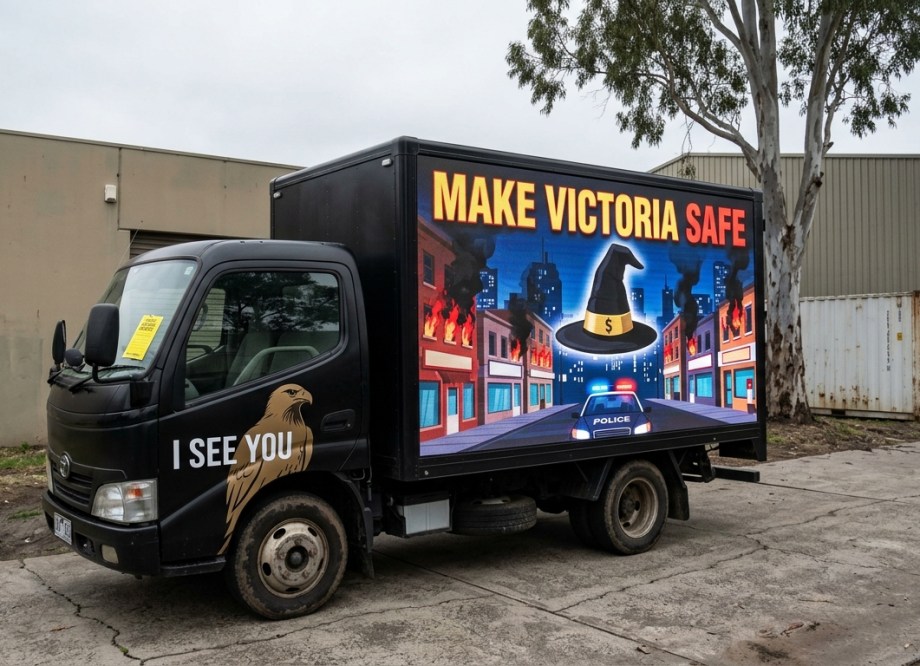
A truck circled Melbourne calling a Premier a witch. Within weeks she was gone. The vendetta was real. So was what Labor did, and what it would not do.
In May, a truck began doing laps of Melbourne.
On its side was Jacinta Allan in a black witch’s hat, beside three words lifted from the placards Tony Abbott stood in front of in 2011:
Ditch the Witch.
An Isuzu truck, its campaign badge hidden beneath magnetic signs, trailed Gotham City promos through the streets. A Melbourne brothel owner said he had part-funded it.
The Prime Minister called it sexist. Julia Gillard issued a rare statement. Pauline Hanson offered the Premier four words of sisterly support on Sky News.
In July, police slapped the truck with a defect notice. Before the month was out, Allan was gone too.
There is a tailor-made tale in that sequence. A woman leads a Labor government. The right reaches for the old misogyny. A hostile press supplies the weather.
Down she goes.
Independent Australia’s Michelle Pini tells a better version of it. She argues that coordinated and consistent media attacks on Allan and Daniel Andrews, not corruption, drove the resignation, and she calls the coverage of the truck “tolerant, if not openly enthusiastic”. She does not blame Murdoch alone. Her target is “the establishment media”. Corruption allegations, she points out, do not reliably bring premiers down; how hard they bite depends on whether you are the favoured pick of the “media club”. She concedes that Allan “did herself no favours” by refusing an inquiry, and she wants a proper one.
That is a serious argument. The scrutiny was selective. The campaign was real, and it was not only Murdoch’s. But the argument turns on one hinge: that the coverage mattered more than what Labor did. That hinge is what this piece tests.
I have some sympathy. I have read the Herald Sun. It arrives unbidden in the staffroom of my local college, pullulating like a wild fungus, and its digital edition is available free through libraries and some tertiary institutions.
But sympathy is not evidence. A woman can be the butt of misogyny and still lead a government with serious questions to answer. Her enemies’ ugliness does not answer them for her. Nor is the Hun the powerhouse that once ran state politics.
The tabloid’s limits
In 2022 the Hun ran what Steve Bracks counted, on election night, as 150 hit pieces on Andrews and Labor. The Sunday edition splashed a year-old fall down some holiday-house stairs across its front page: “the steps that brought down Dan”. Sky After Dark fumed and foretold his doom.
The Hun could campaign against a premier. It could not command the electorate. Its front page was no longer a writ of execution.
Even then, the Herald Sun had only about 150,000 print and digital subscribers, in a state of 6.7 million. The slide has not paused. This year’s Digital News Report finds 40 percent of news consumers have stopped using newspapers.
The Hun is still loud. But it is a megaphone on the mess-deck of the Titanic.
How the mighty are fallen.
The scandal was real
So who brought Allan down? Not a tabloid. A scandal with documents behind it.
The question was not whether Labor faced a campaign. It was whether Labor had given that campaign something real to work with.
From July to November 2024, The Age and the Herald filed more than 90 stories and the AFR about 60 more, by Michael West Media’s count. The reporting alleged that bikies and organised crime had infiltrated the CFMEU and, through it, gained access to Victoria’s Big Build.
Then came the deleted pages.
Barrister Geoffrey Watson SC had been appointed to examine the union. Before his report was published, chapters were removed.
In Watson’s own words, the deleted material alleged that the government “knew and had a duty to know” that corrupt union and underworld figures had infiltrated the Big Build, but chose to do “nothing about it”.
Watson said he was angry that his work had been cut. Administrator Mark Irving KC’s spokesperson said the chapters were removed because Irving was not satisfied that they were well founded or properly tested. Watson said Irving wanted them out because he believed they fell outside the terms of reference of the federal government’s commissioned report and were speculative.
The redacted report was released to Queensland’s inquiry. Irving then sent the full report to police and regulators, amid calls for his sacking led by Liberal Tim Wilson.
That is not nothing. It is a serious institutional story.
After The Age asked him whether the report had been whitewashed, Irving released the deleted chapters: the same chapters he had judged insufficiently tested for publication in his own report. By the paper’s own later account, he responded by immediately releasing the controversial material.
It does not prove motive. But it does complicate the idea that The Age merely received a leak.
Watson estimated that CFMEU conduct may have added about $15 billion to the cost of public infrastructure. But his method was unsound. It was a flat 15 percent applied across the whole program, based on interviews that were not recorded. It was not an audited loss, a criminal finding or a judicial determination. Yet it became the number around which Labor’s enemies could organise a campaign.
What ministers knew
In July, The Age reported that four senior public servants had tried to warn Allan in a June 2023 briefing, when she was transport infrastructure minister.
A cabinet memo summarising that briefing was later tendered to the royal commission. Allan was named in the memo, but the signature box beside her name was empty.
The next day, she signed a companion briefing that referred to anecdotal reports of criminal elements potentially becoming involved in state construction projects.
That cuts deeper than the denial. She may not have seen the first document. But she signed a document that acknowledged the possibility of criminal involvement.
Knowing of a document and knowing of the conduct it describes are not the same question. But neither is signing a warning the same as confronting the problem.
What warnings reached ministers? What did they do with them? Who was minding the public’s money while bikies were allegedly at the gate and an April 2022 letter, logged in October and not passed to Allan until January 2023, had already been sitting in the system for months?
Those questions do not become Murdoch propaganda because a Murdoch paper also wants the government gone.
The wedge
What Allan would not do was call a royal commission. She refused it consistently.
It is easy to say that she should have called one. It is less easy to pretend that a royal commission is simply a neutral machine for establishing truth.
Australian royal commissions have often been instruments of political warfare as well as public inquiry. The Royal Commission into Trade Union Governance and Corruption, chaired by former High Court justice Dyson Heydon, cost taxpayers about $46 million. Its charges were laid against nine people, all of them union officials or employees. The Howard government’s Cole royal commission cost about $60 million, and ministers talked up the prosecutions that would flow from its confidential volume. None did.
Allan was entitled to remember that history.
But she was caught flat-footed by a campaign that had already decided what the story meant: more than 150 Nine stories in four months, a $15 billion “corruption scandal” adopted by the Liberals as campaign language, and a press gallery primed to treat every new document as a smoking gun.
The Liberals, of all people, know how this game ends. In 2017 their leader, Matthew Guy, was caught at a lobster dinner with Tony Madafferi, a man long accused of mafia links and never charged. Lobster with a Mobster, ran the headlines. Guy referred himself to IBAC. IBAC said the matter fell outside its jurisdiction.
The watchdog had been built in 2012 by the Liberal government Guy served in, and critics had called it a toothless tiger from birth. Nine years later, Labor’s premier sent her own referral down the same de-fanged maw.
The tactic is as old as your father’s jokes. Put a Labor government before a scandal involving a union, add allegations of bikies and criminal money, and wait.
If Labor defends the union, it is soft on crime. If Labor attacks it, it is betraying workers. If it calls a royal commission, it validates the opposition’s premise and gives the press a rolling inquiry. If it refuses one, it is hiding something.
Allan should have refused the premise, not the principle of an inquiry.
A whole-chain inquiry was available. The Allan government refused to allow debate on legislation that would have expanded the powers of Victoria’s anti-corruption watchdog. The reforms were supported by crossbenchers, the Coalition and the Greens, and would have clarified IBAC’s jurisdiction over publicly funded projects delivered by private contractors.
Her own referral had already gone nowhere. She was told in October 2024 that it was outside IBAC’s jurisdiction, though the watchdog did not confirm that it had dismissed the referral until 16 February 2026.
Allan may have judged that a royal commission would do less to establish the truth than to manufacture a years-long political spectacle. She may have been right. But she had a credible alternative within reach, and she declined it.
The whole-chain inquiry Labor eventually got, examining lead contractors, subcontractors, labour-hire firms, industry bodies and public authorities, was the remedy it could have chosen before Allan became the price of choosing it.
Instead, Labor chose delay, denial and referrals that let the government point elsewhere. It left the field to its enemies.
That is not a media execution. It is a government declining to test allegations against its own conduct until the political cost became unbearable.
The coup that bought nothing
The caucus needed no help from the Hun.
On 16 June, Carroll ruled out a challenge. He wanted his young daughter to grow up “knowing that I supported Jacinta Allan to be a world-class premier”.
On 27 July a cross-faction delegation, six ministers among them, told Allan she had lost the party room. On the 28th she resigned. Carroll explained that “circumstances changed”.
Then he faced the cameras.
“I am not Daniel Andrews. I am not Jacinta Allan.”
No. He was a minister under one and deputy premier under the other. He could distinguish himself from his predecessors without pretending he had been visiting from interstate.
He sat at the cabinet table for everything he is now running from.
Voters noticed. The coup bought no bounce. Labor has slid further since. DemosAU has it on 18 percent, one point ahead of the Greens. Labor MPs are telling the ABC, “we can’t win, but we can save the furniture.”
Across the chamber, the Liberals are already scratching the born-to-rule itch: cock of the walk, drunk as lords on power they have yet to win and have done little to merit. They should ask Jeff Kennett how that goes. In 1999 his victory was so widely assumed that the Sunday Herald Sun reported it before the votes were counted. Steve Bracks became premier.
Do not mistake workers for crooks
The real offence is older than any headline.
Two years ago Kos Samaras, once Victorian Labor’s deputy campaign director, said one of the party’s biggest failures over a decade was ignoring its traditional base of lower-income workers. “They’re going to pay a price for it.” This year he added the lockdowns, a “deep psychological trauma” that Labor dodged in 2022 only because it was still too close.
No count of hostile front pages disposes of that.
But neither should we accept the other parody now on offer: that the men and women who build Victoria’s hospitals, schools, tunnels and railways are the natural accomplices of bikies, gangsters and corrupt officials.
That is the bosses’ game.
It lets governments and developers turn every worker who asks for a fair wage, a safe site or a union presence into a suspect. It lets them treat the CFMEU’s failures as proof that workers should have less power, not that public contracts need cleaner rules, stronger oversight and unions free of criminal capture.
The workers are not the scandal. The scandal is that a Labor government allowed the worst elements around a union to flourish in the public works it boasted about, while the workers it forgot began looking elsewhere for someone to speak for them.
Victorian Trades Hall’s Luke Hilakari expects One Nation to win between 20 and 25 seats. That is the labour movement telling Labor where its base has gone.
Here, then, is the charge sheet. Allan was warned. She sent the matter to a watchdog that could not take it, then blocked the bill that would have let it. The inquiry came only after she was gone. A tabloid barked and changed little. A broadsheet called an unsound estimate “bombshell findings”. Labor’s ministers, its caucus and its refusal to submit to scrutiny did the rest.
Call the misogyny what it was. Call the journalism what it was. Then judge the government on what it did.
The media ran the campaign. The silks supplied the brief. Labor ditched the witch.

