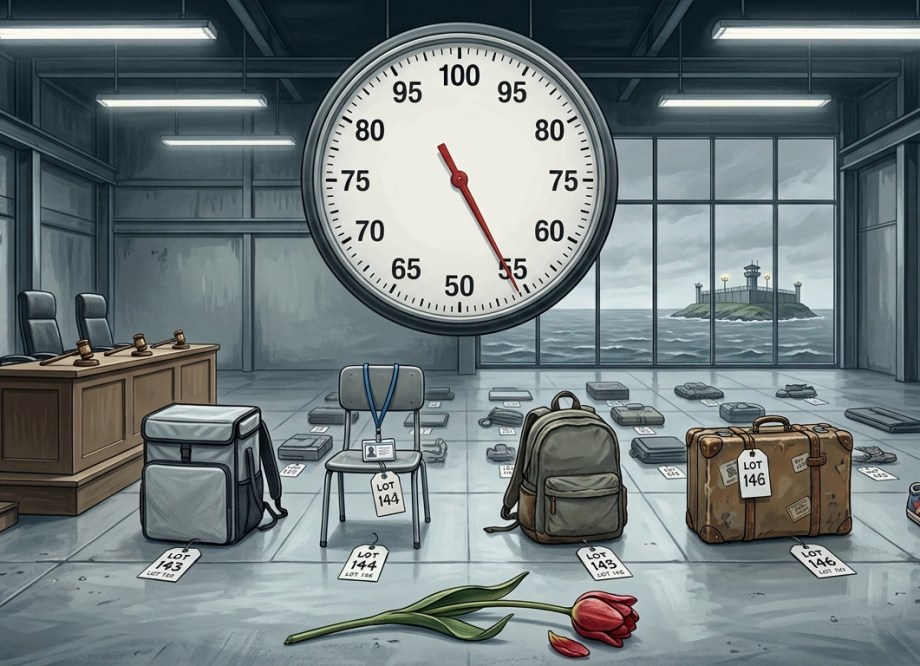
Labor, the Coalition and One Nation are calling the migrant intake down like lots on a falling clock. Nobody at the podium will ask what we owe the people on the block.
Daylight saving robbed us of an hour last Sunday, on the pretext of productivity and against sound evidence. When the clocks were stretched for the Sydney Olympics in 2000, economists Ryan Kellogg and Hendrik Wolff found it had no effect on overall electricity consumption. An LSE study that followed 30,000 people for three decades found the spring switch brings worse sleep, more heart attacks and a less productive Monday.
Canberra has found a bolder use for the clock. It is winding it back to the good old days of Tampa, “illegals” and boat-stopping. So, of course, the May budget cut $9.4 million from the Human Rights Commission.
Other savings flow on. In Stop the Boats 2.0, no boats are needed. Just a Dutch auction of our humanity.
At the Aalsmeer flower auction outside Amsterdam, the clock runs backwards. Beneath harsh neon lights, damp green stems bead the air with peppery scent; crates of tulips crowd the floor, their petals still cool from the night. The price starts high and falls. Buyers lean over their buttons, eyes flicking from the descending numbers to the blooms.
Speed is everything: hesitate, and someone else gets the bunch; or the tulip wilts and is worthless.
Australian politics has borrowed that clock. The lot on offer is people.
You wouldn’t know it from the carefully choreographed corporate media narrative: the Murdoch empire is always quick to beat the anti-immigration drum, so readily do we all fall into march in step.
It is by no means confined to Murdoch, however, nor to either of our major political parties.
What is preposterous about the “debate” is its premise: that our humanity is a lever, and the only question is how hard to pull it. Student and skilled numbers, it is true, are set by policy. But our duty to others is not ours to auction. People who flee persecution and reach us are owed a hearing and safety.
That duty is the floor, and it is what the bidders are cutting through.
It does not help that the whole show opens in the shadow of the Trump regime’s ICE, or that our talkback is infested with the same pernicious talk of “illegals”, a species invented for dog-whistling. Seeking asylum is not illegal. The Migration Act does label anyone without a valid visa an “unlawful non-citizen”. Parliament can make a thing lawful. It cannot make it moral. And that is before we reach the cruelty of offshore detention.
Labor opened the bidding. Treasury forecasts net overseas migration of 245,000 in 2026-27, falling to 225,000 in 2027-28. The Australian Bureau of Statistics puts the year to March at 292,100, down from 309,500 the year before. The record, 547,300 in 2023, is long gone.
That is a real cut. It was made quietly, which in this market counts against it.
One Nation stopped the clock first. On 14 September Pauline Hanson promised three years of net-negative migration, more than 750,000 temporary visas gone, then a ceiling of 130,000. International students and the families of skilled workers would carry most of it. Hanson blamed “the Labor-Liberal political cartel”.
She was taking aim at the Labor-Liberal duopoly, even if “cartel” is the wrong word. Her point will not be lost on anyone. She knows the duopoly from the inside. In 1996 the Liberals disendorsed her in Oxley over a letter attacking Aboriginal and Torres Strait Islander people, too late to reprint the ballot papers.
She won the seat with “Liberal” still printed beside her name.
Thirty years on, the party that dumped her is photocopying her homework.
The fine print is worse than the headline. The 80,000 people One Nation says are here “illegally” would get three months to leave. Stay longer and they face “immigration enforcement” and a ban on ever coming back. No migrant at all could come from a country on the government’s do-not-travel list.
There are twenty-six. They include Ukraine, Venezuela, Palestine and Lebanon.
The day after Hanson’s announcement, the Coalition’s immigration spokesman, Jonathon Duniam, said he would not be copying One Nation’s homework.
Do I hear lower?
Three weeks later Angus “Watergate” Taylor handed that homework in. On 6 October the current Opposition Leader announced net migration of 100,000 a year for two years, rising to 160,000 by year four. About 650,000 temporary visa holders would go. Humanitarian places would halve to 10,000. International student enrolments would fall to 240,000 and the temporary graduate visa would be abolished, Reuters reported. Like One Nation, the Coalition would make applicants leave the country to lodge a new visa. Back in April it had already promised a list of “safe” countries whose citizens could not apply for protection at all.
Taylor called it “the biggest cut to immigration in the history of this country.”
Hanson said he had turned up “waving a photocopy of One Nation’s immigration policy.”
Not every lot goes under the hammer. Members of foreign forces covered by a status of forces agreement, and their civilian staff, are taken to be granted a visa “by operation of law”. No form, no fee, no queue. In May the government updated Australia’s visiting forces rules for troops from Papua New Guinea and the United Kingdom. The student who wants to stay on must leave the country to ask.
On Sunrise the next morning Taylor was asked whether officials would be knocking on doors, and whether this was an ICE squad. “Well, it’s not about that,” he said. “We’re using existing agencies to do their jobs. The Federal Police, Border Force, ASIO.”
Do I hear lower?
The official charge against the migrant is pressure. Taylor read out the charge sheet at his launch: pressure on “roads, schools, infrastructure and housing.”
The real offence is visibility. She is the vulnerable young woman, exhausted by working double shifts, with the delivery bag on the 86 tram. He is the third applicant in the queue at the Footscray rental inspection, holding a folder of payslips. They are easy to see. A planning scheme is not.
Charity begins at home, so let’s start with housing. In his May budget reply, Angus Taylor promised to cap net migration at the number of homes completed. Abul Rizvi, a former Immigration department deputy secretary, points out that the Migration Act contains no power to cap net migration at all.
Visas can be capped. People movements cannot. Legal and business publisher Mondaq notes that tying intake to housing completions could raise migration rather than lower it.
Shadow housing minister Andrew Bragg blows his bags: net migration, he blathers, is well above the 170,000 annual completions. That assumes every arrival is a household. Silvia Salazar of the Bankwest Curtin Economics Centre says most temporary migrants share houses with a lot of people.
It also assumes every Australian can afford to make rent. In 2021, an estimated 7,325 Australian women aged 55 and over were experiencing homelessness; the number forced to live in their cars is not known nationally.
Six students in a three-bedroom weatherboard in Mascot are not six dwellings.
The logical error here is to confuse things that happen at the same time, contiguity, with causation. Rents rose while the planes landed, therefore the planes raised the rents. The student in the share house did not write the negative gearing rules. She did not zone the suburbs or let twenty years of supply fall behind.
She arrived during an acute and distressing housing shortage, helped hugely by negative gearing and by the capital gains tax discount a Liberal government under John Howard enacted in 1999.
Before we know it, “standards”, the first resort of scoundrels, is back on talkback. In April, Taylor said migrant numbers were “too high” and standards “too low.”
Asked which countries produced the bad ones, he named Iran and declined to name another. This week he put it plainly: “We can’t have people coming to this country who don’t believe what we believe in.”
This fallacy is equivocation. “Standards” enters stage right impugning visa integrity, the checking of documents and the policing of dodgy colleges. It exits smearing the character of the people holding the visas. Nothing is argued. The word is simply slid across the stage.
Do I hear lower?
None of the bidders dares ask the auctioneer the obvious question. Who does the work?
Unemployment was 4.6 percent in August, with participation at 67.1 percent. Job vacancies stood at 325,000. Natural increase added 100,600 people in the year to March; migration added 292,100. Australian women had 1.48 babies each in 2024, a record low.
The cradle is not rocking the payroll.
Higher learning has long been flogged like any other commodity. Nobody is even shocked any more. Universities Australia counts international education as a $55 billion export sector supporting 250,000 jobs. Its chief executive, Luke Sheehy, calls the contest “a political race to the bottom on international students.” No government would treat iron ore as a lot to be knocked down for applause.
The party of the bean-counters, the self-proclaimed “better economic managers”, has yet to produce a price list. The Coalition will not release costings until closer to the 2028 election, once the government it wants to replace has supplied the forecasts. It claims a budget gain of about $260 million on estimates it will not disclose.
There is a history here, if Taylor could only hear it. Rizvi has shown that the post-pandemic surge ran hot on settings a Morrison government put in place before May 2022.
Students and working holidaymakers, plus a tight labour market, drove net migration past 500,000. The man calling the clock down helped build the spike he now rails against.
All of that is true. All of it is also a price.
The business lobby, the vice-chancellors and the economists answer the bidders in the bidders’ own currency. Nurses. Export dollars. Taxpayers for an ageing country. It is the right answer to the wrong question.
It still values a human being by what she is worth to us. A refugee is not a skills shortage. What we owe her does not depend on whether she can lift a frail man from his bed at three in the morning.
Australia signed up to the Refugee Convention in 1954. Article 33 forbids sending a refugee back to a place where her life or freedom is threatened. Article 31 forbids punishing her for how she got here. Article 14 of the Universal Declaration of Human Rights says everyone has the right to seek asylum from persecution. These are obligations, not lots. We would owe them if we had never signed.
UNHCR counted 117.8 million people forcibly displaced at the end of 2025, 41.6 million of them refugees. Resettlement places fell sharply from 188,000 in 2024 as the Trump regime simply walked away.
Into that, the Coalition proposes to halve Australia’s humanitarian intake to 10,000. Labor promised 27,000 places in its platform and the latest budget does not deliver them, the Asylum Seeker Resource Centre notes. One Nation would bar entry from Ukraine and Palestine.
Offshore processing is in its fourteenth year. The forward estimates set aside $1.8 billion over four years to keep it going: at least $5.8 million a head each year, by the ASRC’s arithmetic.
A woman held there told a Senate inquiry this year: “I have no trust in the police, or the accommodation providers or anyone responsible for them.”
Labor has paid Nauru $408 million up front, and $70 million a year, to take non-citizens it wants gone.
“Anyone who doesn’t have a valid visa should leave the country,” Tony Burke said. In May the High Court unanimously upheld one removal under the deal. Yet it also left open whether arguments framed differently could show such removals are punishment, and so unconstitutional, the Human Rights Law Centre notes. A law that has survived one challenge has not been proved just.
Nobody at the podium is bidding to protect the floor. They are bidding through it.
Rents are high. It’s no Daily Mail fiction. The 7.42 from Sunbury is full.
What the grievance needs is a scapegoat, and our corporate media are in it like a rat up a drainpipe.
A decade of not building enough homes has no face. A care sector that relies on casual, part-time workers on temporary visas has no face. Universities pushed onto fee income by funding cuts have no face. The arrival has a face, and a name that is hard to pronounce on talkback.
Each policy concession ratifies the premise. Labor trims to look responsible. The Coalition halves to look serious. One Nation goes below zero to look pure.
Nobody asks the two questions that would stop the clock. How many nurses, carers and chippies do we need? And what do we owe the people knocking at the door who are none of those things?
At Aalsmeer the clock stops when someone buys. Here it stops when someone wins.
Do I hear lower.
On Nauru this fortnight, about a hundred people will each be paid $260. Canberra will not say how many.

