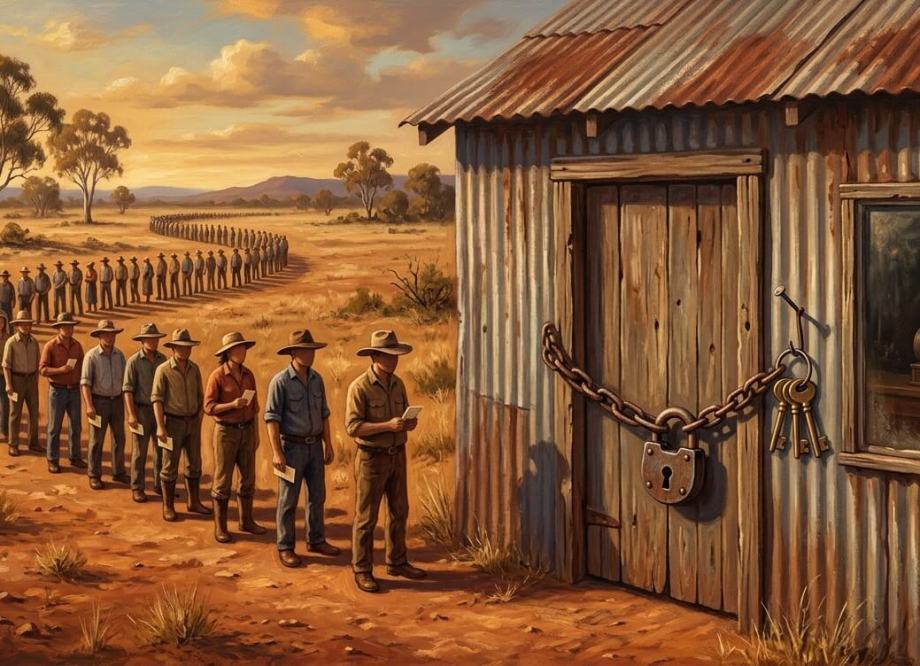
This is the second part of a series. A note of candour: part one promised the mining paddock. In researching and fact-checking this instalment, the author found the Two Davids needed a part of their own. Hugh Morgan, Mabo and the miners’ money come in part three. First, the men who built the shed.
Nobody’s Business
In the winter of 1998 a Liberal MP rose in the House of Representatives to warn the nation about a liar. Two liars, in fact. Or three, if you count Tony, as he did, to Kerry O’Brien on the ABC 17 May 2010.
“I say in this parliament that Oldfield and Ettridge are chronic and habitual liars,” Tony Abbott told the adjournment debate on 1 July 1998.
One of the liars had been his chief adviser.
Abbott had more.
“The puppet master might have withdrawn behind the curtains, but he is clearly still pulling the strings.” David Oldfield, he said, was “using Pauline Hanson as his personal Trojan horse to enter the Senate.”
Then Abbott read into Hansard a line from the other David, as reported in The Australian. Why could One Nation’s members not see the party’s membership details? David Ettridge had the answer.
“It’s nobody’s business but ours.”
Nobody’s business. Remember the phrase. One Nation was built on it.
Much of what follows was said in the House, under privilege, by a man who had hired one of them. Weigh it accordingly. Then weigh what the courts and the cheques say.
The Two Davids
Part one showed a party assembled by a Liberal staffer, a marketing man and a mailing list. Sheer genius. No Allen key required. Meet the assembly crew.
David Oldfield was a Manly man. He ran a diving shop, sat on Manly Council from 1991 and joined Tony Abbott’s staff in April 1994, soon after Abbott won Warringah. He rose to be Abbott’s chief adviser. In 1995 he stood as the Liberal candidate for the state seat of Manly and lost to an independent by 243 votes.
Wouldn’t it rot your socks?
Two hundred and forty-three votes. Australian politics can turn on a dime.
David Ettridge was a different kettle of flathead. Born in Adelaide in 1945, though exactly where nobody seems able to say, he sold himself as a marketing man. Ask where the money came from, and the story slips through your fingers. In 1998 World Vision’s name came up. “I did not receive any money from World Vision,” Ettridge told the Australian Financial Review. World Vision, he said, had contracted with a company called Global Communications. He was merely “an overseas principal”. The owner was “Mr Ross Boland who is an expatriate living in Vanuatu.”
Abbott’s office rang World Vision. Yes, it had paid Global Communications, which Abbott called Ettridge’s company. Every cheque had gone to PO Box 775 in Manly. “World Vision did not send cheques to Vanuatu,” Abbott said. He asked the corporate regulator to investigate whether the Vanuatu company was “a device to get around Australian bankruptcy law”. I can find no record that anything came of it.
Every age gets the impresario it deserves. Ours came with a post office box in Manly and a principal in Vanuatu, and he sold a woman from an Ipswich fish and chip shop to eighteen thousand people who never once got to see the books.
Ettridge knew how to persuade strangers to part with money for a cause they would never control. It is a knack that serves people well at the top in the land of Oz: in politics, society and the corporate boardroom.
Oldfield brought the politics. Ettridge brought the till. Hanson brought the face, the voice, and two words that captured a nation: “Please explain.” Has any party ever been so profoundly well-endowed at birth?
Peter Archer, once a One Nation organiser in New South Wales, summed up the division of labour. Abbott quoted him: “Oldfield is in it for power, Ettridge is in it for money and Hanson is in it for ego.”
That is not my verdict. It is the verdict of a man who ran one of their branches.
A Club With No Members
Groucho Marx famously opined that he would not join any club that would have him as a member. It’s a gag you can hear him trying on at the Pearly Gates. One Nation solved Groucho’s dilemma. Everyone was welcome but no-one was ever really a member.
Under Ettridge, a crew set up about 350 branches and signed up about 18,000 members. Members of what, exactly, kept lawyers busy for six years. On paper, as Hansard records for 2 July 1998, the party’s management committee had “complete and total control”. It had three members: Hanson, Ettridge and Oldfield. Behind it stood One Nation Ltd, a company with three directors and five members. Everyone else was an affiliate who paid fees and had no role.
Branch office holders had to sign a “pledge of loyalty” and an undated resignation letter. The letters were not decorative. Six members had already been removed with them.
The faithful paid their subs. They letterboxed. They sat in draughty halls from Gympie to the Hunter Valley. They thought they had joined a people’s movement. They had joined a customer base.
It’s nobody’s business but ours.
Follow the Subs
The price of admission was modest. The Queensland Court of Appeal later set out the tiers. Full membership cost “of the order of $40/$50”. For $5 you could become a “Pauline Hanson One Nation supporter”, with no voting rights at all.
Five dollars and no vote. In a democracy the vote comes free. One Nation charged you for its absence.
The seed money was small. By his own account, Bruce Whiteside’s support movement had about 6,000 members, 40 branches and some $12,000 in the kitty by February 1997, the month it was taken over.
The harvest was not. After One Nation’s eleven seats in June 1998, Queensland paid Hanson, as the party’s agent, $225,000 on 2 September and another $274,000 three weeks later. Close to half a million dollars of public money. After the federal election in October, the Australian Electoral Commission paid One Nation just over $3 million, at $1.62 a vote.
Who minded the till? Not the members. Abbott also quoted the superbly named Ted Bricks, a former Queensland treasurer of the party who had resigned over its accounts. Bricks told the Sydney Morning Herald that donations of $5,000 and $7,000 had gone unreceipted, into “associated” accounts he could not identify. The financial records, he said, were “virtually non-existent”.
Abbott went further: Ettridge, he said, stood to collect 12.5 percent of any federal public funding. True or not, the members had no way of finding out.
The battlers bought the badges. The taxpayers bought the campaigns. Three people held the cash register.
Official Charge, Real Offence
Someone at last blew the whistle. In August 1999 the Queensland Supreme Court found One Nation had been wrongly registered: the names on its registration list belonged to the support movement, not the party.
In August 2003 a jury convicted Hanson and Ettridge of electoral fraud. Chief Judge Patsy Wolfe sentenced each of them to three years in jail, with no recommendation for parole. Hanson had been convicted, too, of dishonestly obtaining close to $500,000 in electoral funding.
They served eleven weeks. In November the Court of Appeal quashed both convictions and they walked free. The appeal judges found that the people on the list had more probably joined both the party and the support movement.
Ettridge says police had advised the prosecutors that no offence had been committed. Whatever the truth of that, the appeal court found the Crown could not prove its case.
Fair enough. Acquit them.
But look at what the acquittal leaves standing. The real offence was never illegal. It was the design. A party that sold memberships without a vote for $5, and memberships with one for $50 in an outfit where three people held “complete and total control”, is not a crime. No. It is a business model.
It’s nobody’s business but ours.
Closing Time
Business partnerships can end very badly. This one erupted like the front bar of an Oodnadatta pub at closing time, in the middle of a long, hot dry.
In February 1999 five of One Nation’s eleven Queensland MPs walked out, in protest at the executive’s iron grip and the influence of fringe far-right groups. They didn’t come back. In December they formed a party of their own. On 14 January 2000 Ettridge resigned all his posts, citing business opportunities in Asia. How did he keep a straight face? Asia is a big place.
Six days later police raided One Nation’s offices in Queensland and New South Wales.
Oldfield lasted until October 2000. Hanson accused him of abusing his authority, usurping power and setting up alternative parties under his control. When she had him expelled, Oldfield then proceeded to set up an alternative party under his control, “One Nation NSW”. Worse. In 2002 he registered it with the New South Wales Electoral Commission. Hanson’s own party could no longer use its name at state elections there.
He had not just learned the trade. He kept the shopfront. And the cash register.
Where Are They Now
Oldfield served out his term in the New South Wales upper house and moved into talkback radio. 2GB hired him in 2007. By 2009 he was Sydney’s top-rated overnight voice. 2GB let him go in 2010. 2UE took him on and suspended him three days later over a riff about asylum seekers: “We’ll turn on the electric fences, we’ll stop them from coming.”
In his memoir, Before You Judge Me, he wrote tenderly of the woman whose party he built: “I felt Pauline was never up to the job and failed miserably day after day.”
Ettridge went to jail with Hanson, came out with her, and spent years trying to get his money back. He paid for his own defence on the understanding that One Nation would repay him. It never did. In 2017 he told the ABC he had put a $150,000 claim to the party. The party rejected it and asked him to stop contacting it. Cease and desist. The case, he says, cost him his house.
His verdict on his old partner: “she is out of her depth, doesn’t really understand what she’s doing and how to do it.” The party, he said, had become “a Pauline Hanson dictatorship”.
Spare a thought for the man who once demanded pledges of loyalty from branch office holders. He has since learned what loyalty is worth in One Nation.
Ettridge did not stay out of politics. In 2014 AAP reported that Clive Palmer had sought him out at a Palmer United Party rally in an Adelaide hotel and floated a role in South Australia. Ettridge was by then a member of Palmer’s party. “Nothing bigger than a state role,” he said. The man who built a party for a fish and chip shop owner had found his way to one owned by a mining magnate.
Payback
In April 2013 Ettridge sued Tony Abbott for $1.5 million in the Queensland Supreme Court. He alleged Abbott had acted unlawfully in 1998 by backing the litigation that brought One Nation down. Abbott, then five months from becoming prime minister, told Canberra radio: “This is just a bit of payback.”
Ettridge also served papers on two of Abbott’s associates from the Australians for Honest Politics trust. By July he had withdrawn the Brisbane action, saying he would restart it in the Federal Court. No ruling has been reported.
Those two associates deserve a closer look.
Peter Coleman was a former Liberal MP, a former editor of Quadrant and the father-in-law of Peter Costello. Ettridge identified him as the man who wrote the trust’s cheques. Coleman later explained his motive in The Australian: “I saw One Nation as a threat not so much to civilisation as to the Coalition.”
Not so much to civilisation? Funny man.
Trevor Kennedy, a former Packer executive, gave the trust $10,000. His verdict on Hanson: “a great menace to this country, but a crook as well.”
The Court of Appeal disagreed with Mr Kennedy on the second count. On the first, history is still taking witness statements.
Who Holds the Keys
Here is the thread back to part one.
The establishment did not bring down One Nation to protect anyone from racism. Coleman said as much. It brought One Nation down to protect the Coalition’s vote. John “Children Overboard” Howard kept the tune anyway.
The template outlived its founders. A party owned by a handful. Funded by people who get no say. Led by someone who answers to no branch. In 1997 the money came from battlers paying their subs. In 2026 it comes from Hancock men in half-million-dollar lots, and a plane.
Ettridge built a machine that takes money from people who will never control it. Thirty years on, it takes money from people who have no need to.
Three people held the keys in 1997. Two were shown the door. One still has them.
“It’s nobody’s business but ours,” said David Ettridge.
He was half right. It was always a business.
But it was never ours.
Coming in part three: the paddock. In October 1992 a mining chief warned that Mabo had put property rights at risk “throughout the whole community”. Four years later, a woman from an Ipswich fish and chip shop rose in Parliament to sing the same tune. Who taught it to her, and who has been paying for the encore ever since?

