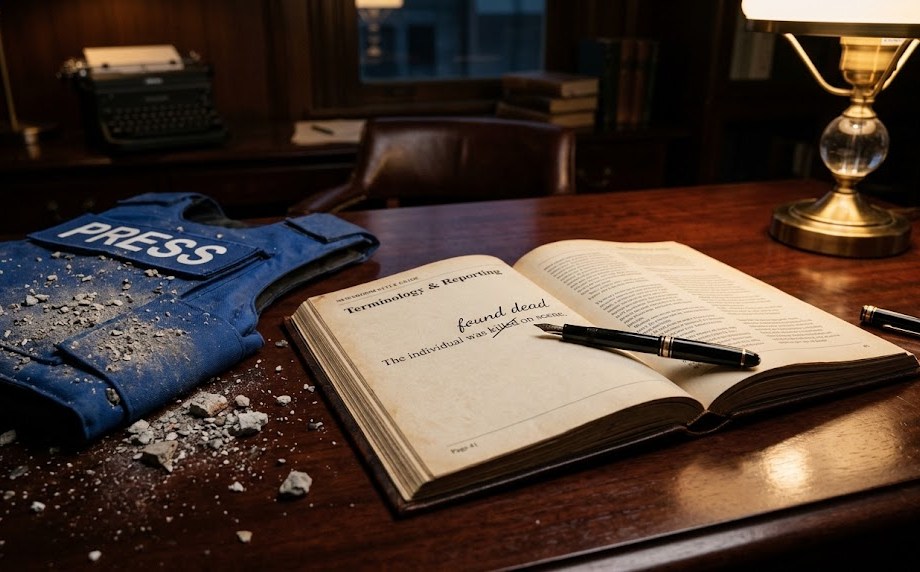
A senior keeper of the words explains why territories are disputed, why Palestine is a special-occasion word and why, in the last three years, almost 300 dead journalists were simply found.
Dawe: Thanks for coming in.
Clarke: Pleasure, Bryan. Good to be here.
Dawe: You chair the joint editorial standards committee for the BBC, the New York Times, CNN and our own ABC.
Clarke: That’s right. We look after the words.
Dawe: You act as censors?
Clarke: Heavens above, no. We see ourselves more as caretakers. Words need a lot of looking after, Bryan. They end up in the front bar and over the back fence. It’s a huge responsibility.
Dawe: All of them?
Clarke: The important ones. We keep them in a style guide. “Words of Concern”, we call them. Take “killed”. Now that’s a word you have to watch. “Killed” could hurt somebody.
Dawe: Hurt somebody?
Clarke: Hurt anyone. Everyone. We prefer something with a bit of protective gloss on it. It’s like a Rolls Royce. A Rolls Royce never breaks down. It simply fails to proceed.
Dawe: There’s a new UN report on media coverage of Gaza. It’s by Francesca Albanese, the UN Special Rapporteur on the occupied Palestinian territory.
Clarke: We’ve been in touch. Lovely woman, Francesca. Very thorough. She named us in her report. Must be a fan, Bryan. Nobody studies you that closely if they don’t love you.
Dawe: The BBC style guide describes the West Bank and Gaza as “disputed” territories.
Clarke: That’s the Israeli government’s preferred description, Bryan. We like to use the preferred description. It’s a courtesy.
Dawe: The International Court of Justice found Israel’s presence there unlawful.
Clarke: Yes, and that’s disputed.
Dawe: By whom?
Clarke: By the people whose preferred description we use. Everything is disputed by somebody, so we say so.
Dawe: CNN told its staff to remind audiences that Hamas caused the conflict.
Clarke: Context is very important, Bryan. We like to start it on the seventh of October.
Dawe: The New York Times told its journalists to use the word “Palestine” only in very rare cases.
Clarke: Correct. It’s a special occasion word.
Dawe: What’s a special occasion?
Clarke: Oh, a map of the ancient world. A pub quiz. You bring it out the way you’d bring out a bottle of Grange. Not every night of the week.
Dawe: Then there’s “human shields”.
Clarke: Beautiful phrase. Does a lot of work. A bit like “double-tap”. Or the clean-as-a-whistle word “strike”.
Dawe: Between October 2023 and August 2025 the New York Times used “human shields” 176 times. The BBC used it 81 times.
Clarke: The BBC is publicly funded, Bryan. It has to ration.
Dawe: The report found the BBC left out Israeli responsibility in 83 percent of relevant headlines.
Clarke: That’s our house style. We prefer the passive voice. It’s calmer. People are reading this over breakfast.
Dawe: What about the other 17 percent?
Clarke: We’ve set up a working group.
Dawe: The BBC headline on Hind Rajab says she was “found dead in Gaza days after phone calls for help”.
Clarke: Which is accurate.
Dawe: She was six years old. The report says she was killed by Israeli forces.
Clarke: You can’t put everything in a headline, Bryan. You’d never get it on the phone.
Dawe: The report also names the ABC, for dismissing Antoinette Lattouf after she reposted a Human Rights Watch report on starvation in Gaza.
Clarke: We didn’t dismiss her, Bryan. We relieved her of the remainder of her week.
Dawe: The Federal Court found it was unlawful.
Clarke: And that finding cost us over two and a half million dollars.
Dawe: To lose.
Clarke: You don’t get a finding like that for nothing.
Dawe: The court found senior management had acted to appease the pro-Israel lobbyists.
Clarke: That’s very unfair. We’d have appeased anybody. We’re a public broadcaster. We serve everyone. Frank and fearless, Bryan. Within reason.
Dawe: Ms Albanese wrote to twelve of the outlets for comment. Three replied.
Clarke: That’s a very strong response rate for us.
Dawe: She uses the word “mediacide”.
Clarke: That’s not in the guide.
Dawe: What would you say?
Clarke: A tightening of the local talent pool.
Dawe: Under the Geneva Conventions, journalists are civilians.
Clarke: Unless they’re terrorists.
Dawe: Who decides they’re terrorists?
Clarke: The people who killed them, Bryan. Usually afterwards.
Dawe: The Committee to Protect Journalists says Israel killed two thirds of all the journalists killed in the world in 2024. And again in 2025.
Clarke: That’s a very strong market share.
Dawe: What has the Australian government said?
Clarke: Oh, the Foreign Minister was very firm.
Dawe: She said she was “deeply concerned” about the reports.
Clarke: Deeply concerned. Straight out of the guide, Bryan. Top of the range. You can’t get more concerned than that without doing something.
Dawe: Doing something?
Clarke: Yes. You’d be on the verge of moving to “profoundly” within a press cycle or two.
Dawe: When Israel ruled out charges over the killing of Australian aid worker Zomi Frankcom, she summoned the Israeli ambassador and said Australia was outraged.
Clarke: That’s different, Bryan. Zomi was one of ours.
Dawe: Israeli forces have killed nearly 300 journalists since October 2023. More than the American Civil War, both World Wars, Korea, Vietnam and Afghanistan combined.
Clarke: Found dead, Bryan.
The facts Dawe puts to Clarke are on the record: Francesca Albanese’s report to the UN General Assembly, A/81/249, the BBC style guide, the International Court of Justice advisory opinion, CNN’s instruction to staff, the New York Times memo, the BBC’s Hind Rajab headline, the ABC’s own tally of its Lattouf legal costs, the Committee to Protect Journalists’ record of press killings, the Costs of War comparison, Penny Wong’s “deeply concerned” and her summoning of the Israeli ambassador over Zomi Frankcom. The rest of Clarke’s answers are satire.
A tribute to John Clarke (1948 to 2017), whose method this borrows and whose genius it cannot. With thanks to Bryan Dawe.
The Clarke and Dawe format and characters remain the work and property of John Clarke (Roderick Willows Pty Ltd) and Bryan Dawe. This sketch is an independent homage, written and published by Urban Wronski, and is not affiliated with or endorsed by them.


Another gem, David. The other very impressive performance aspect of Wong’s work is the slightly furrowed brow to accompany the serious concern with which she is constantly weighed down. A class act. I fully expect, in order to bring the remaining members of cabinet up to scratch, Albo will appoint a Special Minister of State for Weasel Words, with specific oversight of Our ABC. Cheers, David B.
LikeLiked by 1 person
Thanks, David B.
You right on target. The furrowed brow is the whole performance. Penny Wong can express grave concern about a famine with exactly the same face she uses to express grave concern about a sanction she won’t impose. The concern is the policy.
But I’d save the government the expense of a new portfolio. A Special Minister of State for Weasel Words could simply be rolled into Tony Burke’s Home Affairs, where everything else ends up anyway. Home Affairs is no longer a ministry so much as a state within the state: immigration, Border Force, cyber, citizenship, and whatever else gets loose from a filing cabinet after dark. Burke already holds the Arts as well, so the poets and Border Force report to the same desk. Weasel words would simply be filed under creative industries. They’d be issued a lanyard, a security clearance and a mission statement promising to keep Australians safe in this space.
As for Our ABC, it needs no oversight. It’s been minding its own language for years
LikeLike
Without going all Fookow or Derrisidiaot and ending up as a shoe or thong waving out of un terrier de lapin, Eric “Orwell” Blair’s Syme (his alter ego from wartime service as a BBC propagandist) worked to systematically limit first the number then range of words, often assigning them new, opposite meanings.
As humans we live within & by stories (”narratives'”in NuSpeek) that culture/s construct, rather as history is written by victors.
Once Up a Time the base line was observed (not necessarily understood) quotidian events – weather, natural phenomena and animal behaviour – which became myth before degenerating into religious dogma, when the first con-artist met the first fool (apols. to S. Clemens).
Fortunately we now have whizzbang meeja disseminated at the speed of light to inform, entertain & offer glimpses beyond ourselves.
This could have brought knowledge for the Enlightenment of our species had it not been anathema to certain folk – small in number but nigh on omnipotent, thumbs never far from pressure points of our collective circulatory system.
In T.Rump’s 2015/6 campaign oldskool journos. made the mistake of transcribing the akshal word-thingies (or their nearest equivalents) he used as if they contained mutually agreed meanings.
The error was taking his expectorations literally but not seriously whereas the target audience took him seriously but not literally.
It was found that he had a working vocabulary of fewer than 200 words in general but barely half that paltry total ever showed up in his demagoguery – spectacle without content.
Syme’s aim in limiting the spoken word was not simple censorship but intended to limit the thought that could result from this constriction.
T.Rump not only uses few words but in patterns that most teachers would consider to be a red flag in a 10-12yr old of seriously impaired development.
In Hanson’s case, the massive increase in attention received most of this year does her no favours – the Press club speech was the equivalent of Biden’s appearance at the first/last debate of the 2024 campaign, the final nail in a coffin that should have been in the ground for months.
The more Hanson speaks the greater the damage she does to PHONie among sentient voters – when the Rootbeater has to be, serially, wheeled out to clean up her latest ravings one has gone beyond farce.
LikeLike
Amphibious,
You’ve written the column for me, and the Zito line is its hinge. Salena Zito put it in The Atlantic in 2016: the press took Trump literally but not seriously, while his supporters took him seriously but not literally. It’s still the best single sentence anyone has written about him, and it applies equally well to Hanson.
Consequently, I’m less sure than you that the Press Club speech is the final nail.
Syme is the right guide here. His dictionary wasn’t about fewer words for their own sake. It was about fewer thoughts. Strip out the words you’d need to think otherwise and you don’t have to ban the thought. It simply never arrives.
That’s the part of Newspeak that came true, and it didn’t need Trump. Look at what our own political class did to the vocabulary over forty years. Citizens became taxpayers. Patients and students became customers. Insecure work became flexibility. Cuts became reform. Labor quietly retired “working class” and replaced it with “working families”, and once the class was gone from the language, so was any obligation to it. Nobody banned solidarity. They just let the word wither until saying it made you sound like a museum piece. Its replacements arrive from the pitch deck. Ministers no longer have a policy on housing; they are active in this space. Nobody is sacked; there is a conversation going forward with stakeholders.
That’s why discourse matters as a blueprint. The language comes first and the policy follows it in like a removalist’s truck. “Budget emergency” was laid down years before the cuts. “Dole bludger” did the groundwork for robodebt. By the time the bulldozer arrives, the plan has been on the wall so long that nobody thinks to ask who drew it.
So, Hanson. Yes, the more she speaks the worse she sounds to anyone listening for sense. But her voters aren’t listening for sense. They’re listening for the grievance, and the incoherence is part of the brand: proof she isn’t one of the slick ones. Trump’s mangled sentences were supposed to finish him too. They became his brand. Farce is only fatal when the audience is laughing at the performer, not with the performer at everyone else.
What finishes a demagogue isn’t exposure. It’s a better story, told in words people can use about their own lives. That’s the job the left keeps leaving vacant. Or contracted out, decades ago, to comms-unit spivs fluent in neoliberal.
PS. You’ve set me collecting. I’m putting together a pocket glossary of the new Newspeak for the novice: each word pinned to the board beside what it was hired to hide. Watch this space. Contributions welcome.
LikeLike
Looking forward to the glossary.
LikeLike