The Bunyip Aristocracy’s Favourite Battler, Part Three (final)
This is the third and final part of a series. Part one asked how Pauline Hanson reached Canberra. Part two followed the men who built her party. A reader asked for the dates to be pinned to the wall. They are, in order.
Where the Hell Do I Go?
At 5.15 pm on 10 September 1996, the new member for Oxley rose in the House of Representatives with a quaver in her voice and a question for the nation.
“I am fed up with being told, ‘This is our land.’ Well, where the hell do I go?”
She had the answer off pat. “Like most Australians, I worked for my land; no-one gave it to me.”
It went down like a cold XXXX on a hot Saturday in Ipswich. It had gone down a treat in mining boardrooms for twelve years.
The words were Hanson’s. The tune was not.
Part one acquitted the conspiracy theory. Nobody planted Pauline. Part two showed the shed the two Davids built around her. This part goes out to the paddock, where the soil had been turned for a decade before she came up through it.
Start in 1984.
The Songwriters
In 1983 Brian Burke, Labor premier and future face of WA Inc, commissioned Paul Seaman QC to inquire into Aboriginal land rights. Seaman reported in September 1984, and he didn’t hedge. Land rights, he said, must include a veto over mining.
Big Mining went ballistic. Their hostile publicity, the National Film and Sound Archive records, bullied Burke into a bill that diluted Seaman’s proposals. The upper house threw it out anyway. Burke then warned Robert James Lee Hawke not to try a national land rights law.
In October 1984 Hawke dropped the mining veto from his national model and promised not to override Western Australia. By 1986, Hawke had walked his talk away from national land rights altogether.
Labor folded. It’s become its default position in today’s politics.
The campaign’s most quotable voice belonged to Western Mining’s managing director, Hugh Morgan. In 1984 Morgan joined the board of the Atlas Economic Research Foundation, now the Atlas Network: a think tank that breeds think tanks. He was also closely involved in founding the Centre for Independent Studies, as historian Jeremy Walker has documented.
Mark Atlas on your Hanson Bingo card.
That same year the documentary Couldn’t Be Fairer filmed the Pilbara’s iron ore baron, Lang Hancock, on what he called “the Aboriginal problem”. His solution was to bring the “half-castes” to a central point to collect their welfare cheques.
“I would dope the water up so that they were sterile and would breed themselves out in the future, and that would solve the problem.”
Hancock Prospecting was his company. His daughter, Gina, runs it now.
The Decision
Eddie Koiki Mabo died of cancer in Brisbane on 21 January 1992. He was 55. The verdict was five months away.
Lang Hancock died on 27 March.
On 3 June 1992 the High Court found, six to one, that the Meriam people were entitled “as against the whole world” to their lands on Mer. Terra nullius, the legal fiction that this continent had belonged to nobody, was dead.
Mabo took nobody’s home. Native title survived only where the Crown had never wiped it out. Freehold extinguished it. Whether a lease did depended on the rights the lease conferred. Your quarter-acre block in Ipswich was just as safe as it had been the day before.
None of that mattered.
In October 1992 Hugh Morgan announced that Mabo “puts at risk the whole legal framework of property rights in Australia”. Murdoch’s The Australian reported him saying the High Court had thrown property law into chaos and given substance to the ambitions of “the Bolshevik left”.
That spring Morgan delivered the Joe and Enid Lyons lecture at the Australian National University. His theme was that the High Court had got it wrong. In the eighteenth century, he argued, Aboriginal people had been too primitive to negotiate a treaty, so the land had been there for the taking. Two Aboriginal people in the audience told him what they thought of that.
Then, Crispin Hull reported, Morgan hurried out to a white limousine.
And off.
His remedy followed. Repeal the Racial Discrimination Act, Morgan urged, so the states could extinguish native title for themselves.
In April 1993 he took the show to the centenary conference of the Australasian Institute of Mining and Metallurgy. There, Green Left Weekly reported, he accused the Keating government of putting prosperity at risk with policies of separatism and “black suffering, white guilt”.
Yet the industry’s own peak body sang a different tune. Geoffrey Ewing, assistant director of the Australian Mining Industry Council, said he did not expect Mabo to have a dramatic effect on mining.
So the scare was never really about the law. It was about who got a say over the dirt, and who got the front page.
Paul Keating went to the Mining Industry Council and told it to its face he was committed to Mabo. The Native Title Act passed four days before Christmas 1993, after what was then the longest debate in the Senate’s history.
Keating held. The scare did not need him to fold. It only needed time.
The Singer
Three years. Then a fish and chip shop co-owner from Silkstone walked into Parliament.
Lay the songbook beside the speech.
Morgan, 1993, as Green Left reported him: the Keating government was promoting separatism.
Hanson, 1996: “Present governments are encouraging separatism in Australia by providing opportunities, land, moneys and facilities available only to Aboriginals.”
Morgan, 1992: Mabo put “the whole legal framework of property rights in Australia” at risk.
Hanson, 1996: “Well, where the hell do I go?”
Morgan, 1993: “black suffering, white guilt”.
Hanson, 1996: “the privileges Aboriginals enjoy over other Australians”, which she called “a type of reverse racism applied to mainstream Australians”.
Then the money. The millions spent on native title since Mabo, Hanson said, had gone “into the pockets of grateful lawyers and consultants”.
“Not one native title has been granted as I speak.”
Not one. Four years of the Bolshevik left, and not a single backyard to show for it. She meant it as a complaint. It was the miners’ case falling over in her hands.
She needed no briefing note from Western Mining. That is the point. A scare campaign that works never has to hire the singer. It plays the song on high rotation until someone in Ipswich starts humming it.
Nobody planted Pauline. They planted the song.
Less than a fortnight after the speech, John Howard told Queensland Liberals that the “pall of censorship on certain issues” had lifted. A loyal reader of this series, Deb Campbell, has called it the stalking horse strategy. She tells me she said so in a letter to The Age in 1998.
Extinguishment
On 23 December 1996, three months after the maiden speech, the High Court decided Wik.
By four to three it found that the Queensland pastoral leases before it did not necessarily extinguish native title. The two could coexist; where rights clashed, pastoralists’ rights prevailed. No grazier lost a sheep. No lease was torn up. The backlash came anyway. Tim Fischer, deputy prime minister, promised “bucketloads of extinguishment”.
In May 1997 Howard released his Ten Point Plan. The Wik decision, he said, had “pushed the pendulum too far”. His plan would push it back.
In 1998 Hanson called native title a “scam” and vowed to “abolish the nonsense and inequity that is native title”.
Now watch the two clocks.
On 30 September 1998 Howard’s amended Native Title Act came into force: the Ten Point Plan, written into law.
On 3 October 1998 Hanson lost Blair on preferences. Labor, the Liberals and the Nationals had all preferenced against her. Tony Abbott’s trust, with an Institute of Public Affairs board member among its donors, was already paying lawyers to take her party apart.
The song made the statute book. The singer lost her seat. Nobody in the boardrooms sent flowers.
Peter Coleman, who wrote the trust’s cheques, put it plainly. One Nation was a threat “not so much to civilisation as to the Coalition”.
The establishment had no quarrel with the tune. It wanted the royalties.
The Bunyip Aristocracy
In 1853 the larrikin orator Daniel Deniehy laughed William Wentworth’s plan for a colonial peerage out of Sydney. He called it a “bunyip aristocracy”. This series borrowed his phrase. Here is why.
Skip to October 2022. Donnell Wallam, an Indigenous netballer, was uneasy about wearing the Hancock Prospecting logo on her Diamonds dress. Hancock Prospecting pulled its $15 million sponsorship. Calls for Gina Rinehart to disown her father’s words about the water went unanswered.
In October 2023 Australians were asked to give First Peoples a Voice to Parliament. Walker calls the proposal minimalist: it carried no land rights the quarry economy could object to.
It was beaten anyway.
Advance led the No campaign. The IPA and the Centre for Independent Studies, both Atlas houses, argued the No case alongside it. Morgan’s old network, forty years on, still trading.
In the six months before the vote, The Klaxon reports, the No side’s biggest funder was Bryant Macfie, a Perth doctor and one of three honorary life members of the IPA. Another is Gina Rinehart. Marius Kloppers, former chief executive of BHP Billiton, chipped in $100,000.
Let’s be fair dinkum about this. BHP, the corporation, did not fund No. Woodside, the big banks and Woolworths put millions into Yes. The listed miners have learned to live with native title; they negotiate with traditional owners because the law makes them.
The money that never made its peace is private, dynastic and Western Australian.
Deniehy laughed his bunyip aristocracy out of the room. We have one now. It runs on iron ore.
Hanson called the Voice “Australian apartheid”. She was among the loudest voices for No.
Then the money stopped hiding.
The Plane
In 2024-25 Hancock Prospecting was Advance’s largest disclosed donor. It gave $895,000.
In November 2024 Rinehart flew Hanson to a mining gala. A year later Hanson flew on Rinehart’s private jet to Mar-a-Lago, where both attended Donald Trump’s Halloween party.
In December 2025, aboard the cruise ship The World, where Rinehart keeps a penthouse, a dinner with Trump at Mar-a-Lago was auctioned for One Nation. It raised $300,000. Hanson and Barnaby Joyce billed taxpayers more than $3,000 to attend.
In March this year Hanson travelled on a plane owned by Rinehart’s S. Kidman and Co during the South Australian election. One Nation’s Cory Bernardi later repaid the company more than $40,000 to comply with state law. Hanson said she was merely a passenger.
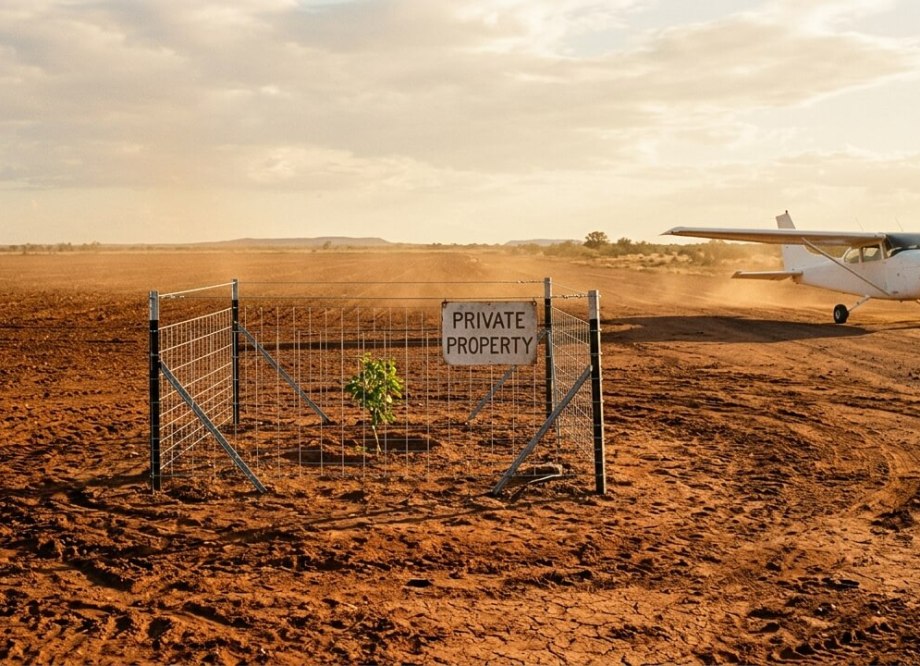
In April a Rinehart company gave One Nation a Cirrus G7. Spokespeople for both confirmed the gift. Hanson was delighted.
It was new, but not the latest model. Cirrus had announced the newer G7+ in May 2025, adding Safe Return emergency autoland as standard. For One Nation, with its history of political crash landings, the irony writes itself.
Farm Online’s headline called it a private jet. It isn’t. It has a single prop. So does the party.
“Yes it was donated. Yes I’m super happy. Yes it’s fast. Yes it’s amazing. Yes it’s going to annoy the Guardian.”
In the same post she thanked stockbroker Angus Aitken and his partner Sarah for $1 million, and Adam Giles and Ian Plimer for $500,000 each. Giles runs Hancock Agriculture. Plimer works for Hancock Energy. Two employees of companies in the Hancock group gave a further $500,000 between them.
Tot it up. That is $2.8 million in cash for One Nation from Rinehart’s circle, her payroll and her floating penthouse. Add Hancock’s $895,000 to Advance and the tally sits close to $3.7 million, before anyone puts a price on the plane.
Nobody says she signed every cheque. She didn’t need to.
Jim Chalmers called Hanson “a wholly owned subsidiary of Gina Rinehart”. His evidence is her vote, whenever workers’ interests are on the table.
That same week Rinehart called for stricter limits on who can be let into the country. Five months later One Nation promised three years of net-negative migration.
Upton Sinclair observed that it is difficult to get a man to understand something when his salary depends on his not understanding it. Harder still when the party’s plane does.
The Franchise
Remember Atlas? Bingo.
The Institute of Public Affairs is an Atlas house. In 2016 it said 91 percent of its donations came from individuals. That year Hancock Prospecting paid it $2.3 million, almost half its income. The next year, $2.2 million.
Nobody would have known, except that Gina Rinehart’s own children took her to court and a schedule of the donations was handed to their lawyers. The IPA had made Rinehart an honorary life member. Asked about the money, it said no comment.
In 1998 a trust with an IPA board member among its donors paid lawyers to take One Nation apart.
On 4 June this year an IPA research fellow told readers of the Financial Review that One Nation was “the only mainstream political party in Australia”.
In the early 2010s the IPA scolded Julia Gillard and Tony Abbott for fretting aloud about high immigration. On 14 September, when One Nation promised three years of net-negative migration, the IPA called the policy “a game changer”.
Its elder sibling, the Centre for Independent Studies, the one Hugh Morgan helped found, sent its supporters a newsletter. The headline: “Pauline Hanson falls in line with CIS policies!”
Fifteen years ago the franchise wanted the gates open. Now it wants them shut.
The product changed. The shareholders didn’t.
Who Pays for the Encore
Part two closed with a question. Who taught Pauline the words to her song, and who has been paying for the encore ever since?
Nobody taught her. Nobody had to. Morgan wrote it in 1992, Fischer and Howard turned it into law, and it was on high rotation long before she bought a ticket to Canberra.
As for the encore, the receipts are on the public record: the Electoral Commission, the parliamentary registers, the newspapers. Nobody needs a source in an underground car park. The plane is on the tarmac.
Gardeners have a word for a plant nobody sowed. A volunteer. It comes up on its own, out of soil somebody else has turned. Then the owner of the paddock decides what happens to it.
In 1998 they let it be slashed. By 2026 they had fenced it, fed it and given it a plane to fly over the crop.
Nobody planted Pauline.
They didn’t need to. They owned the paddock.
This series ends here. In the works, for a few weeks from now, is a fourth article that stands on its own: the network behind the franchise. A fortune made from battery chickens. Tobacco money, ExxonMobil and the Koch foundations. CPAC at Mar-a-Lago. And the spectacle at CPAC Australia of One Nation, the Liberals and the Nationals sparring over who gets to lead a three-way coalition. Not how One Nation was bought. How the network works everywhere.

