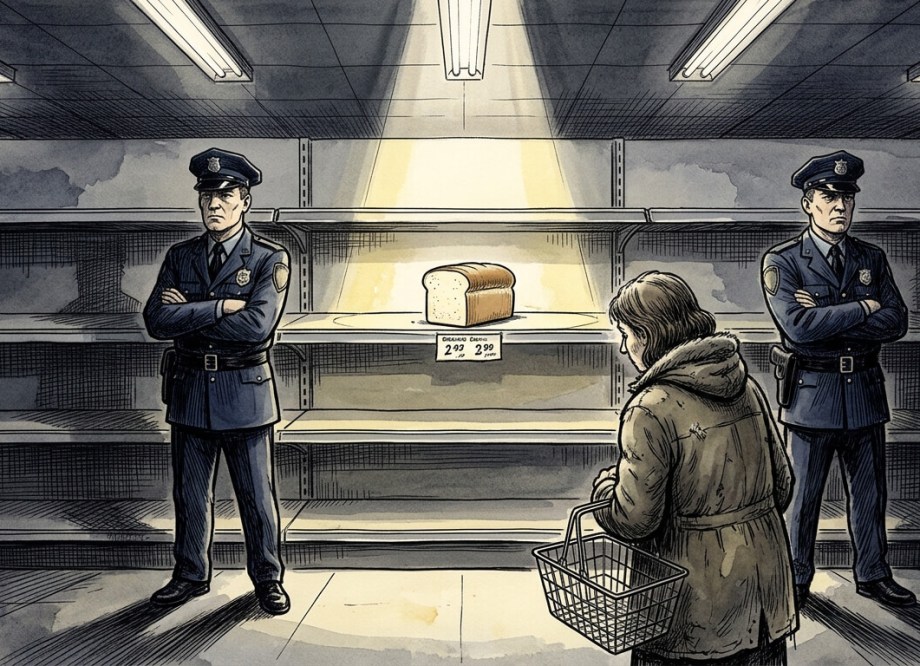
Every day since December, police and Protective Services Officers have patrolled four of Victoria’s biggest shopping centres, in rotation. Highpoint. Fountain Gate. Northland. Southland. Five more besides. A high-visibility operation, they say, designed to reassure shoppers and deter offenders.
They call it Operation Pulse. Heartbeat was already taken, by a nostalgic television series about community policing. Perhaps we should check our own pulse if we imagine that armed men and women in uniform are any kind of answer to hunger.
By August, Operation Pulse had made 1,766 arrests and laid 3,562 charges. Just over half were for shop theft.
Coles’ head office is at 800 Toorak Road, Hawthorn East. No PSO patrols it.
Victoria recorded 37,398 thefts from retail stores in the year to June, a record. Who is doing the stealing? Not the gangs of the Herald Sun’s imagination. When the theft boom began, Victoria Police found half the shoplifters were first-timers, and blamed the cost of living. The Crime Statistics Agency’s chief statistician says shoplifting is led by adults in their thirties. Youth offending is falling. Adult offending is rising.
Some are career criminals. Police have caught prolific thieves and people carrying weapons. Good. Retail workers are entitled to a safe workplace. Nobody disputes that.
But most shoplifting is not the work of organised criminal empires. Some of it is committed by people standing at the self-service checkout, being informed by a disembodied voice that there is an unexpected item in the bagging area. Increasingly, the unexpected item is something they cannot afford.
The Foodbank Hunger Report 2026 puts the national food insecurity rate at one in three households, 3.6 million households in all. Among renters it is one in two. Among households with children it is nearly one in two. Food insecurity among households with part-time or casual workers has reached 42 percent. Almost half of food-insecure households say embarrassment or shame keeps them from asking for help.
Shame, but not a PSO, follows them out of the shop.
I know something about school breakfast programs. Some years ago, I volunteered for a term at a local primary school on the wrong side of the tracks. The best part of the experience was helping serve breakfast. Half the school would turn up for a free feed. I also worked alongside the kids in the kitchen garden. There was something rather satisfying about watching children grow food and helping them understand where breakfast came from.
There is something utterly unforgettable about the look on a youngster’s face when you give her what may be her only meal of the day. It is something beyond mere gratitude. Something that reaches into a place we are all equipped at birth with: the instinct to care for one another.
It is difficult to reconcile that simple human instinct with a society increasingly organised around the opposite principle: everything has a price, everybody is a customer, and even the roof over your head is an opportunity for someone else to extract a little more.
Who told us we had to build an economy in which everything is a negotiable transaction, except the price of being poor?
Both the breakfast program and the garden have since disappeared. Locals tell me the funding was cut. I haven’t established precisely why they closed. But cutting funding doesn’t cut a young child’s hunger. It merely removes one place where that hunger was being answered.
I grew up in New Zealand, where governments subsidised bread and milk for decades. The wheat and flour industry was regulated to keep the price of a standard loaf affordable. The retail price of liquid milk was similarly supported by government subsidy. These were deliberate cost-of-living policies, not charitable handouts. The underlying proposition was that basic food should remain within reach of ordinary households.
The milk subsidy ended in 1985. The Wheat Board, which had set the price of a loaf since 1936, followed in 1987, during the great market-liberalisation experiment.
Perhaps that seems impossibly quaint now. But there was a time when governments considered the affordability of bread and milk a legitimate responsibility of government, rather than leaving families to negotiate the supermarket checkout with whatever happened to be left in their wallets.
Tony Abbott has a different theory. As employment minister in 2001 he told Four Corners that poverty can’t be abolished, because “poverty in part is a function of individual behaviour”. Drinking. Gambling. As prime minister in 2015 he called life in a remote Aboriginal community a lifestyle choice the taxpayer shouldn’t have to subsidise. He is now federal president of the Liberal Party.
He was answered at the time. Green Left Weekly pointed out that low wages were a major cause of poverty, and an underrated one, and that the working poor were a growing class. That was twenty-five years ago. This year Foodbank found more than a third of middle-income households going short of food. They are not drinking the grocery money. They are earning it, and it isn’t enough.
Greg Jericho, the Australia Institute’s chief economist, has the better answer: poverty is a policy choice. Governments are not innocent bystanders to it.
Melbourne’s median weekly rent for a house or unit is around $600. Victoria’s unemployment rate has been running at about five percent. This is the precariat state: the renter, the casual, the gig worker, the young, the mortgaged fringe, the regional town where the last mill shut years ago.
Lock up the hungry.
Now the other side of the checkout.
In March last year, the ACCC found that Coles and Woolworths operate in an oligopolistic market, rank among the most profitable supermarket businesses in the world, and had increased their product margins while grocery prices climbed. Some of those price increases went straight to profit. The ACCC never said price gouging. It didn’t need to.
In August, Coles reported a full-year statutory profit of $1.09 billion. That was after setting aside $235 million following a Federal Court judgment concerning the underpayment of its own staff. Its dividend to shareholders increased by 13 percent.
Woolworths made $1.138 billion, up from $963 million. Its chief executive, Amanda Bardwell, told reporters shoppers had moved into a “new reality of entrenched value-seeking”.
Value-seeking. That’s what a supermarket calls it when you can’t afford the food.
The Federal Court found that the two chains had failed to keep proper records of the hours worked by nearly 30,000 salaried staff. The bill to put it right is heading for $1 billion. Woolworths’ then chief executive, Brad Banducci, had denied that the scandal was “wage theft”.
When the groceries go missing, it’s a crime wave. When the wages go missing, it’s an underpayment. One gets Operation Pulse. The other gets a line in the annual report headed “significant items”.
Lock up the hungry.
Who speaks for the worker at the register? Start with the man who used to stand at one.
On his first full day as premier, Ben Carroll went to Kmart. Not to shop. For the backdrop. He started there at fourteen and joined the Shoppies. Now he stood beside the state secretary of the shop assistants’ union, the SDA, and announced orders to ban abusive customers from the store.
Fair enough. Nobody should cop a spray at the register. Nor should a young casual worker be expected to endure threats or abuse as part of the job.
But ask the register what else it remembers.
In 2016, a Coles worker named Duncan Hart took his employer and his own union to the Fair Work Commission. The SDA had signed off on a deal covering 77,000 Coles workers. The Commission found that it left a substantial number of them worse off than the award. On his own roster, Hart was up to $2,504 a year behind.
Out of those fights came a small union run by young retail workers. Two weeks after Carroll took the premiership, his government introduced a bill to allow Consumer Affairs to wind it up. It sailed through the lower house in sixteen days. It stalled in the upper house and died there when Parliament was dissolved for the election.
The shop. The shop’s union. The party. All on the same side of the counter.
Lock up the hungry.
Now ask the parties what they would do.
Labor’s answer is already on patrol. “We have new solutions to keep you safe,” then premier Jacinta Allan announced in March, “with PSOs in shopping centres, violence reduction in our schools, and Adult Time in the law.”
Carroll has funded 150 more PSOs and extended Operation Pulse, with patrols reaching further into suburban shopping strips.
The Liberals want to outbid them. A year ago, Brad Battin promised, “My government will put PSOs into shopping malls.” Jess Wilson’s plan promises PSOs back at 119 stations, with 200 more recruited. This month she promised to fast-track the same orders Carroll announced at Kmart.
One Nation promises Victoria will become Australia’s toughest state on crime. It won’t say what that costs.
Do I hear 250?
Count the guards. Then count the policies on the price of bread.
Only the Greens have asked the Parliamentary Budget Office to cost a rent freeze. The major parties are arguing over who can put more uniforms between the hungry and the shelves.
Not one of them proposes to post a PSO at 800 Toorak Road.
A uniform can intervene in a theft. It cannot make the rent affordable, turn casual employment into secure work or put breakfast on a child’s table.
Hunger is certain, and no sentence has ever cured it. A woman who steals nappies because the rent took the nappy money will steal them again next month. The rent will still be $600.
Now the public purse, which pays for the guards and could pay for the bread.
There is money in Victoria. There is always money in Victoria. The interesting question is who gets to spend it, who gets to waste it, and who gets told there isn’t enough.
The royal commission into the Big Build spent its first week of evidence on one level crossing: Gap Road, Sunbury. It examined a CFMEU stoppage there in June 2022 and the meeting that followed at union headquarters. Ben Carroll had promised that nothing would be off limits.
The commission heard that briefings prepared for the minister, Jacinta Allan, warned that paying the union’s rates for traffic management across the Big Build would cost well over $400 million. That is the bill for minding the gap. Nobody has yet been asked who ordered it. Even fewer will be asked how we are going to pay for it.
It heard that a senior Rail Projects Victoria official, Peter Wilkinson, received “feedback from the minister’s office” through the then chief executive, Evan Tattersall: if the rail alliance, John Holland and CPB, couldn’t handle the industrials in Victoria, it couldn’t expect any more state work. Wilkinson took that to mean Allan’s office. He passed the message to the alliance manager, Joe Aygur.
Aygur’s evidence was consistent on the substance. He recalled being told of a view in government, from the minister’s office. A former union organiser, Paul Tzimas, separately recalled his colleague Joe Myles telling the builders that the union had a “direct line” to Allan’s office. Myles is also alleged to have said the union’s influence could cost them future work, the Airport Rail Link included.
On the evidence so far, the message that brought the alliance to heel was important enough to travel through two layers of senior public servants and into a commercial decision worth millions of dollars. Yet somehow it left no fingerprint. No note. No email. No name. The pivotal meeting of 7 June 2022 left no reliable record of what was agreed. When the government’s own delivery authority handed over its notebook on the stoppage, the pages were blacked out. Convenient. The commission still has to find whose hand, if any, wrote it.
Fair pay is not in dispute. What is in dispute is whether union mates got better rates through avenues of access unavailable to other labour sources.
Allan has denied seeking to pressure the alliance to give way to the union. Her spokesman says she will answer whatever questions the commission puts to her. The allegations remain allegations, and the commission has yet to determine what happened.
On Monday the commission did not sit. It was reading documents the government had handed over late. The premier who promised that nothing would be off limits says he is angry.
The report is due on 20 August 2027. The election is on 28 November 2026.
Robert Redlich, the former IBAC commissioner, says the commission must start where the problems started. In August, he and Deborah Glass, the former ombudsman, urged it to look beyond the crooks on site to the government’s own failures. No proper business case. No consultation. No transparency. Their absence, they said, “contributed to the risk of corruption and misconduct”.
Take the Suburban Rail Loop. Labor took it to the 2018 election and won. A mandate, its defenders say.
“We won elections, for Chrissake,” one Labor insider told Dr Margaret Simons.
Glass, who examined the loop as ombudsman, asks what kind of mandate it is “when the public didn’t know the key facts”. It was conceived in secret, without a business case. Simons calls it grey corruption: not criminal, not in the public interest.
Where there is corruption, Glass says, there is always a loser. In Victoria it is the public purse.
Transurban pitched the West Gate Tunnel in 2015 at $5 billion, with no cost to the state. It cost $10 billion, and Victoria paid $4 billion of it. The North East Link was costed at $10 billion. Its projected cost has since risen to $26 billion.
Every billion borrowed for a blowout carries interest. What the state then finds for a food bank, a rent subsidy or a public house is a choice, and Victoria’s governments have made theirs.
Canberra, which issues the currency, could fill the gap tomorrow. That is a choice too.
The purse is held in trust. The hungry hold the first claim on it. It is not a party’s to rifle.
Now count everyone who had no say in 2022.
More than one eligible Victorian in a hundred wasn’t on the roll. One enrolled voter in eight didn’t vote, the lowest turnout since 1945. One ballot in eighteen was informal, with the rate highest in the northern and western suburbs.
Put together, nearly one eligible Victorian in five, about 800,000 people, cast no vote that counted. Those missing from the electoral process were disproportionately young and renting. Some had simply moved house and dropped off the roll.
Labor won 56 of 88 seats that year on 37 percent of the primary vote.
So every party chases the voter who still turns up and still counts: older, mortgaged, frightened of the shopping centre car park. Yet Millennials and Gen Z are now nearly half the national electorate. Every party can count.
The PSO vote turns up. The hungry, mostly, don’t.
And those who do turn up?
In Prahran and Caulfield, Labor is running an open ticket. It asks for a 1 and says nothing about who comes next. After months of warning about a Liberal and One Nation government, it will not tell its own voters to put a Green ahead of a Liberal.
The Greens’ leader called it unforgivable. A voter in Prahran could be forgiven for asking what a Labor vote is for.
A precariat that does turn up to vote for more of this is a mob of turkeys voting for Christmas.
Don’t blame the turkeys. Both parties that can form government are offering them Christmas.
Lock up the hungry, then. Lock up every one of them.
The bread will still be dear.
Part 3 of 3 on the Victorian election. Part 1: The Witch, the Ditch and the Born to Rule Itch. Part 2: Law and Order by Mail.

