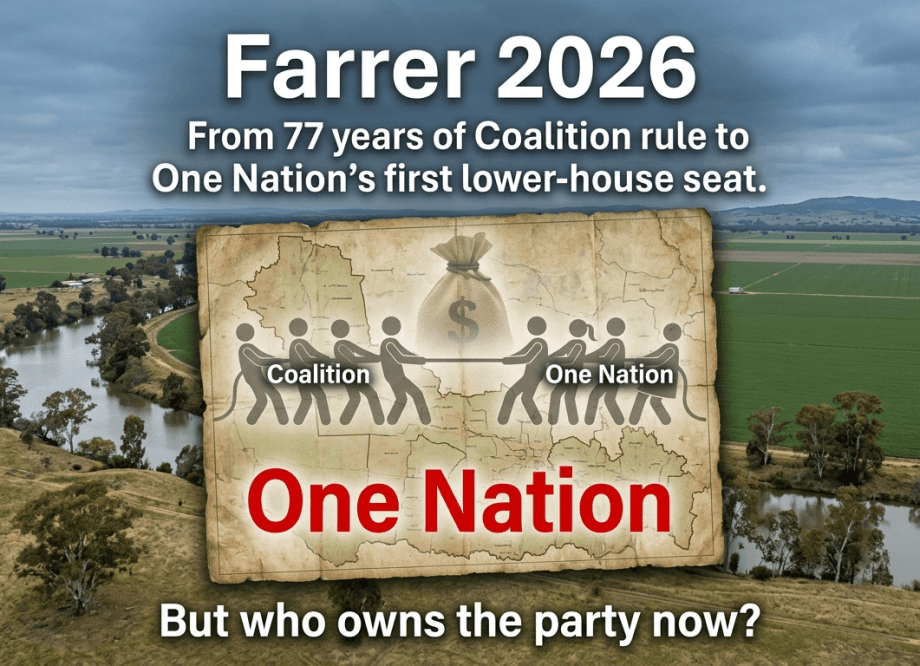
One Nation steals the Coalition’s lunch in the poisoned long‑grass heartland. But mind the millionaires who hold its purse.
One Nation has won Farrer.
Let’s dwell on that a while.
From the top end of town, David Farley, a Narrandera‑based agricultural commodity trader and former CEO of the Australian Agricultural Company, has taken a seat the Liberal Party held without interruption since 1949. Primary‑vote figures put One Nation’s swing into Farrer at about 35 points and the Liberal collapse at roughly 31 points. The Coalition, in a deliberate move widely criticised by the Prime Minister, preferenced One Nation ahead of the independent candidate Michelle Milthorpe on its how‑to‑vote cards. Barnaby Joyce and Pauline Hanson appeared together at the election‑night party in Albury. The Abbott suppository riff came earlier in this series, but if ever a week needed two, this was the week.
Australia’s Regime Media calls it historic. It is historic, in the way that a Category 4 cyclone making landfall in a location where cyclones do not usually make landfall is historic: worth noting, worth studying, but not self‑evident proof that the climate has permanently changed. Commentators at The AIMN, The Conversation and Crikey, who have been tracking this pattern since the South Australian state election in March, argue that voter anger and fragmentation can produce spectacular by‑election results, but that history suggests the insurgency rarely lasts.
One Nation has been here before. In 1998, after its Senate breakthrough, the machine moved against it. Optional preferential voting was introduced in Queensland in 1992, as part of the Fitzgerald Inquiry driven electoral reforms, well before One Nation existed. The real anti‑One Nation manoeuvre came in 2001, when former premier Peter Beattie ran a Just Vote 1 campaign to exploit OPV and exhaust Coalition‑One Nation preferences. That, in effect, worked for a time.
The structural problem for One Nation is the same structural problem it has always had. Australia’s electoral geography does not favour populist insurgencies. Roughly 85 per cent of the population lives in cities. The seats where One Nation polls strongest are rural and outer‑suburban. DemosAU’s October‑November 2025 MRP central forecast projected 12 lower‑house seats for One Nation: eight clearly rural, one outer‑metropolitan (Canning, in Perth), and three others in the broader regional band. All 12 are currently held by the Coalition.
What One Nation is doing, in other words, is not breaking through to new territory. It is cannibalising the conservative vote in seats the conservatives used to own. That is a very different thing from becoming a governing force.
And here is the structural trap that no one in the mainstream coverage seems willing to name plainly.
One Nation cannot grow into a major party without being taken prisoner. This is not a prediction. It’s what happened in the US. There is more than a cautionary tale, written in the history of the American Republican Party.
The Republicans once had a base that overlapped significantly with One Nation’s: rural, deindustrialised, culturally conservative, economically abandoned, and angry about it. The billionaire donor class, beginning with the Koch brothers and accelerating through the Citizens United era, identified that anger as a vehicle. They did not share the anger. They funded it. They directed it. They ensured it remained pointed at immigration, at cultural elites, at the cosmopolitan cities, and away from the boardrooms and the tax arrangements and the wage suppression that had actually stripped those communities of their economic dignity. The Republican Party did not take over the billionaires. The billionaires took over the Republican Party. What remained was a vessel: the rage was genuine, the politics was purchased.
The process is already underway in Australia.
In December 2025, when Barnaby Joyce announced his shift to One Nation, he publicly confirmed that Gina Rinehart, Australia’s wealthiest individual, was providing funding to the party. Rinehart has also lent Hanson use of her private jet for campaign travel, including flights connected to the South Australian election campaign. Those arrangements have been reported as raising questions about compliance with South Australian donation laws, and former senator Cory Bernardi has said he would repay the cost of the flights he took. The party that presents itself as the voice of the battler, the small farmer, the forgotten Australian in the long‑grass seats of regional New South Wales, is now partly funded by the nation’s richest mining billionaire.
Rinehart is not the Veblen‑style voter she is funding. She is not the man in the long white shirt, nursing a grievance about the cities and the elites. She is the elite. Her interests, on wages, on resources taxation, on environmental regulation, on labour law, are structurally opposed to the interests of the people pulling the One Nation lever in Farrer. She is not an aberration in this story. She is the story. She is what happens when populist anger becomes an investable asset.
The tech‑billionaire class of the United States, Musk, Thiel, Andreessen and the rest, figured this out earlier and with greater sophistication. They are what Gordon Gekko becomes when he has had 30 more years to compound, when he has moved from junk bonds to platform monopolies, when he has decided that democracy itself is an impediment to the rate of return. Gekko at least had the honesty to say greed is good in a room full of shareholders. This cohort funds the demolition of regulatory frameworks, the capture of political parties, the purchase of influence over governments, and they do it while presenting themselves as disruptors of the very establishment they have long since absorbed. They are atavistic, the robber baron stripped of his top hat and dressed in a hoodie, still extracting, still consolidating, still moving the levers so that the cost falls on the workers and the return accrues to the capital.
Australia has not caught up to this yet. But Rinehart’s funding of One Nation is the early signal. The private jet to South Australia. The donor network that Barnaby Joyce brought with him from his National Party years. The corporate interest in a party that will deregulate water, deregulate labour, and deregulate the resource extraction that Rinehart’s fortune depends on, while its voters are told their problem is immigration.
As Crikey’s analysis of the South Australian result put it cleanly, when the commentariat expresses shock at One Nation’s rise, it reveals a faith in a fantasy version of Australia. This country has always had this constituency. The party that represents it has always been vulnerable to corporate capture, because its voters, legitimately aggrieved and economically precarious, have neither the resources nor the institutional backing to resist it. The anger is theirs. The direction of the anger is up for purchase.
Bernard Keane’s earlier observation still holds. This is as good as it gets for One Nation as a genuinely populist force. From here, the trajectory is either stagnation or capture. The seats it can win in a general election are limited by electoral geography. The money it needs to compete nationally comes with conditions attached. And the conditions, as the Republicans discovered, eventually consume the party.
David Farley has won Farrer. One Nation has its first lower‑house seat won at a general election. Pauline Hanson and Barnaby Joyce celebrated in Albury. Gina Rinehart’s private jet was elsewhere.
The roughie, it turns out, got up.
The question is who owns it now.


Shows how stupid country people are, Following Trumps nonsense with Poorline. True they have been bought, and will be discarded when no longer useful. Or have become a liability.
LikeLike
David Farley’s no fool. ON may have got themselves a wolf for all seasons.
LikeLike