This is Part 3 of The Great Digital Enclosure. Part 1: The Great Digital Enclosure examined how Google’s AI is strip-mining the economic foundations of independent journalism. Part 2: The Invisible Press examined the state’s systematic legal persecution of those who tell the public what the powerful prefer kept quiet.
Hannah Arendt sits in what was built as a theatre and has been converted, for the occasion, into a courtroom. The Beit Ha’am, the House of the People, in Jerusalem. April 1961. To reach her seat she must pass through a security fence ten feet high, be frisked in the wooden barracks erected in the front courtyard, weave between armed police guarding the building from roof to cellar. Inside: 750 journalists, diplomats, survivors and observers press into seats built for plays, and the blazing heat of television lights (this is the first trial in history to be televised) bears down on a stage where three judges sit bareheaded in black robes on a raised platform. Below them, in a specially built bulletproof glass booth, a gaunt, bespectacled man in a dark suit follows the proceedings through headphones, fidgeting with papers. He looks, by every account in the room, like a mid-level clerk summoned to explain a discrepancy in the petty cash receipts.
She will call what she sees there the banality of evil.
The phrase has been misread, misrepresented and misappropriated ever since. Not that evil is ordinary. Or unimportant. But that the most systematic evil is produced not by monsters acting on diabolical intent, but by functionaries: people doing their jobs, following procedures, operating within systems they did not design, need not understand, and bear no individual responsibility for having produced. Nobody in the chain requires the intention. The system produces the outcome regardless.
She was not writing about Australia. She did not need to. But she might have been. For four years, this country ran Robodebt: an automated debt recovery scheme that issued nearly half a million false notices to welfare recipients and drove some of them to their deaths.
A royal commission found it unlawful. The prosecutions have been few. The functionaries were following procedures. The system produced the outcome regardless.
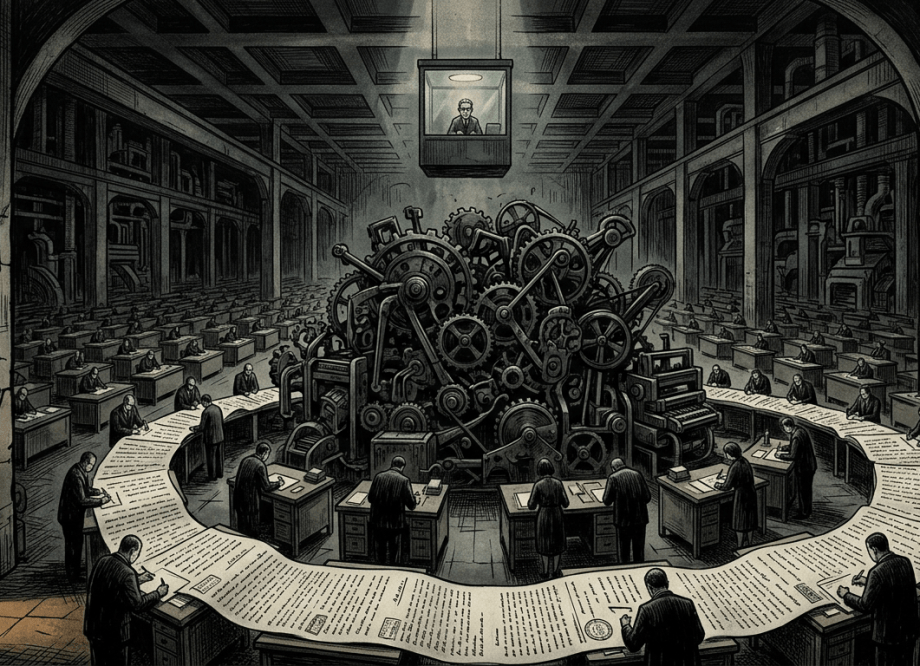
What has been done to Australian journalism over the past quarter century operates by the same logic. It is not a conspiracy. Conspiracies require coordination, a room, a plan, people who know each other’s names and have agreed on an outcome. What Australia has instead is something more durable and far harder to oppose: a set of systems, each internally coherent, each individually defensible, each operated by people who would be genuinely affronted by the suggestion that they bear any responsibility for the result. The attorney-general who prosecutes the whistleblower is upholding the law. The media proprietor who runs a political operation dressed as a newspaper is exercising commercial freedom. The defamation solicitor who files the SLAPP suit is representing his client. The Google engineer who designs the AI Overview is solving a user experience problem. The parliamentary drafter who writes the seventy-fifth piece of national security legislation is protecting the national interest.
None of them are wrong, exactly. All of them are operating the machine.
The machine is killing Australian journalism. This is the third and final part of an account of how.
The Floor That Isn’t
Any honest account of the machine must begin with what Australia chose not to build.
The United States has the First Amendment. Britain has the Human Rights Act. Canada has a Charter of Rights and Freedoms. Germany, France, the Nordic countries: all have frameworks that create a constitutional floor beneath which the freedom to speak, to publish, to inform cannot legally fall. These are not perfect instruments. But they are instruments. They create obligations. They give journalists and whistleblowers something to invoke when the state turns its machinery in their direction.
Australia has what the High Court discovered, somewhat to its own surprise, in 1992: an implied freedom of political communication, derivable from the text and structure of the Constitution. It is not a right. It is not individual. A journalist facing prosecution cannot invoke it directly. It is a limitation on legislative power: governments cannot pass laws that too severely burden political speech.
The word “too” is carrying the weight of an entire constitution in that sentence. It has not always been enough. And every government since has known it.
A floor that depends on judicial inference is not a floor. It is a trapdoor. Since 2001, Australia’s Parliament has passed roughly seventy-five pieces of counter-terrorism and national security legislation whose cumulative effect has been to layer legal risk, systematically and without interruption, onto the journalist, the commentator, the source, the whistleblower, the editor considering whether to publish, the lawyer considering whether to defend. Seventy-five acts. In twenty-five years. Each one reasonable on its face. Or so it is billed. Each one narrowing the available space by a margin that, in isolation, seems trivial.
A journalist researches and writes her story. Rings a lawyer. “I wouldn’t,” she hears. She understands at once. The story doesn’t run. No prosecution required. No statute cited. Just the arithmetic of risk, done in a phone call. Billed at four hundred and fifty dollars an hour.
The architecture is not an accident. It is a system. Systems have designers. Designers have intentions. But in a deniability machine, the intention never needs to be stated. The outcome is achieved through the accumulation of individually defensible decisions, none of which, standing alone, could be called the cause.
Nobody designed the trapdoor. They simply, collectively, removed the floor.
Democracy Dies in the Invoice
Beyond the Harrow and its prosecutions, the powerful have a softer instrument, one that leaves no marks at all.
Australian defamation law is not a system designed for the pursuit of justice. It is a system that the pursuit of justice occasionally navigates successfully, when the defendant has the resources, the time and the institutional backing to withstand years of attrition. For everyone else, it functions as a cost-infliction mechanism available to any corporation, politician, developer or aggrieved member of the propertied class who can afford a solicitor’s letterhead, a legal lunch and an afternoon’s worth of threatening correspondence.
You do not need to win a defamation suit to silence a critic. You need only to threaten one. Convincingly. The defendant calculates: three years of legal fees at commercial rates against the mortgage, the school fees, the paltry sum the piece will pay. The calculation is done in a flash. The small publisher, the independent critic, the regional reporter who filed something true and damaging about someone with money: they go silent. No court required. No finding required. The silence is achieved through the credible threat of a process the other side cannot afford.
A silence everybody pays for, in the end.
This is SLAPP litigation (Strategic Lawsuits Against Public Participation) and it is a growth industry in a country that has declined to legislate meaningfully against it. A public interest defence exists on paper. Whether it will hold under sustained and expensive challenge remains, for most small publishers, a theoretical question they cannot afford to have answered in practice.
The solicitors filing SLAPP suits are not conspiring against democracy. They are representing their clients. The clients are not conspiring against democracy. They are protecting their reputations, their interests, their right, as they always say, to have their day in court. The system that makes this possible was not designed to silence journalism. It was made for other purposes and has been adapted. Nobody is responsible. The invoice arrives regardless.
The Proprietor’s Settlement
Parts one and two of this series show the state and the algorithm. A complete account of the machine requires a third element: the media ownership structure that determines, before any of the other mechanisms are applied, whose voice is amplified and whose goes unheard. Forever.
Australia suffers one of the biggest press monopolies in the democratic world. Top dog on the tuckerbox is News Corp, the Australian arm of a global operation controlled by a family that is not Australian, registered in Delaware, whose outlets have operated, decade after decade, as a political project with a media company providing the cover. This is not a controversial observation. It is a structural description that the company’s own conduct has made available to anyone willing to look.
Unwilling to bite the hand that feeds, Liberal and Labor have competed to court rather than combine to confront this obscene over-concentration of extraordinary power. Kevin Rudd is correct to see the Murdoch Press itself as an anti-Labor political party. That is the measure of his power: even his most reliable target has concluded that a Murdoch mauling beats a Murdoch silence. The accommodation has been bipartisan, consistent and mutually beneficial: News Corp receives regulatory forbearance and, as snug as a bug in a rug, the run of the place; the political class receives coverage calibrated to their usefulness. The ménage à trois is not stated. It does not need to be. Deniability is the point.
The consequence for independent journalism is not primarily that it is attacked, though it sometimes is. It is simply not heard. The independent journalist publishes the investigation on Tuesday. By Thursday, the corporation being investigated has issued a rebuttal. The major mastheads run the rebuttal. The investigation’s readership is a rounding error on the corporation’s communications budget. This is not suppression. It is amplification infrastructure, and it belongs to someone else. The concentration of that infrastructure means that journalism without access to it operates at a structural disadvantage that no volume of quality, accuracy or moral seriousness can bridge. You can be fully present and completely eclipsed. Ralph Ellison understood the mechanism even if he was describing a different application of it.
Name them plainly, because the deniability machine relies on them never being named together.
The legal Harrow processes those who push past the line entirely: the whistleblowers, the sources, the journalists who publish material the state has decided is too dangerous to be public. It does not require a conviction. The process is the punishment. The lesson is legible to everyone watching without a word being said aloud. This is Part 2.
The defamation mechanism and the SLAPP suit process those who approach the line from a safer distance: the commentators, the regional journalists, the small publishers who have found something true and damaging about someone powerful and are reconsidering the cost of saying so. It does not require litigation. The threat is the instrument. The silence is achieved in the calculation rather than the courtroom.
The digital starvation (Part 1) finishes the work on those who have stayed well within every line and simply kept publishing: the independent voices, the subscription-funded outlets, the writers who have found a way to exist economically outside the concentration. Google’s AI Overviews intercept the search query, serve the summary, and the click never comes. The traffic that sustained the operation disappears. No law is broken. No intent is required. The structure simply operates.
Three mechanisms. No common room. No shared plan. No general. The outcome is identical to what a conspiracy would have produced.
The Suicide Note Has Many Authors
The deniability machine works because its authorship is distributed. No individual author can be held responsible for the whole document, and the whole document is what matters.
Google signed one page. It was solving a user experience problem. Parliament signed seventy-five. Each act was billed as a reasonable response to a genuine security concern. The courts signed several more. They were applying the law as written. The defamation solicitors are signing merrily, at their usual rates, in the reasonable exercise of their professional obligations. The media proprietors are running commercial operations in a free market. The attorneys-general are upholding the rule of law. The algorithm is optimising for relevance.
Nobody wrote the suicide note. Everyone signed it.
This is the architecture of deniability, and it is more effective than censorship precisely because it leaves no censor to identify, no order to challenge, no decision to reverse. Censorship has an author. The deniability machine has only functionaries, each of them, in their own estimation, simply doing their jobs.
Arendt watched Eichmann in his glass booth and understood that this was the truly terrifying thing: not that he was a monster, but that he was not. He was a bureaucrat who managed logistics and did not think of himself as evil. In the narrow sense of his own intentions, he was not wrong. The evil was in the system he served, which required nothing of him but his continued, efficient cooperation.
Australia has not committed anything approaching Eichmann’s crimes. The comparison is one of mechanism, not of scale, and the mechanism is this: a system can produce outcomes that no individual within it intended, chose or will be held accountable for. The journalists are in prison. The whistleblowers are bankrupt. The independent outlets are going dark. Nobody did it. Everybody did it. The distinction, in practice, means that nothing changes.
The Underground, Still Lit
Ralph Ellison’s invisible man ends the novel in a basement he has illuminated with 1,369 lightbulbs, running off power stolen from the Monopolated Light & Power Company. Underground. Surrounded by his own light. Thinking. He is not destroyed. He is not finished. He is preparing.
I am not complaining, he says, nor am I protesting either. It is sometimes advantageous to be unseen, although it is most often rather wearing on the nerves.
The Australian journalists and whistleblowers who have survived the machine (those who have not been imprisoned, bankrupted, litigated into silence or algorithmically starved) are exactly this. Operating underground. Throwing stolen light. Invisible to the official apparatus that would prefer them to stay that way, and visible to the readers who need them, who know where the basement is, who keep coming back.
The question is whether the basement can hold enough people to matter.
A democracy that loses the institutional and economic capacity for genuine dissent (not comfortable dissent, not licensed dissent, not dissent that has been cleared by a QC and filed in triplicate with the risk-management committee, but actual dissent: the kind that names names, follows money, holds power to account even when power has counter-terrorism legislation, defamation solicitors, a concentrated media landscape and a structural algorithm on its side) is not a democracy that has matured. It is a democracy in decline.
The deniability machine runs on cooperation. Arendt calls this out for what it is: the functionaries cooperate, each in their own lane, each with their own smug self-denial, and the machine runs. The first act of resistance is to name it: not as a series of unrelated accidents, each regrettable, each defensible in isolation, but as a system with a function and a product. The product is your silence. Name it that, out loud, with your name attached. Power has always depended on the assumption that most people won’t. It is still depending on it.
It doesn’t design itself out of existence. That part is ours to do.
This is the third and final part of The Great Digital Enclosure. Part 1 examined how Google’s AI is strip-mining the economic foundations of independent journalism. Part 2, The Harrow, examined the state’s systematic legal persecution of those who tell the public what the powerful prefer kept quiet.


I don’t know about Democracy dying!! I believe Democracy is in fact dead.
LikeLike