Part 2, The Harrow
Part 1 of this series — “The Great Digital Enclosure” — examined how Google’s AI is strip-mining the economic foundations of independent journalism. This piece examines what the state has been doing in the meantime.
“I am an invisible man.” Ralph Ellison begins his masterpiece with a declaration that has never lost its charge or its dark, grievous wit. Not a ghost. Not a metaphor. A man of flesh and bone and soul, fully present yet completely eclipsed. He’s unseen because society had organised itself, through custom and law and the quiet violence of institutional habit, to even refuse him the dignity of being perceived.
The invisibility was not in him. It was in them. Those for whom the black man was not human.
What Ellison understood applies with uncanny similarity to the condition of independent journalism in Australia in 2026. You can be fully visible, pilloried, prosecuted, extensively spied on, your home raided, your underwear drawer wrenched open on national TV, your files seized, your phone data extracted, your legal bills compounding fit to ruin you, your name in every Murdoch rag.
Yes. All of this, and you will still be invisible. Seen by everyone. Acknowledged by none. Your democratic flame snuffed out by the same state that attends international conferences and delivers speeches about the importance of a free press and a rules-based order.
That is the prison Australia has built for us to choose to live inside, in Doris Lessing’s phrase. Not suppression that leaves marks anyone can photograph. Something more rat-cunningly refined: suppression by process, suppression by cost, suppression by the slow, grinding, spirit-breaking machinery of a legal system deployed not to establish guilt but to establish a price.
The price of telling the truth in Australia is now higher than it has ever been. Your life is at stake.
Australia began as a penal colony. Not metaphorically. As a matter of founding fact. The British Empire, having misplaced one set of colonies in another fit of madness and needing somewhere to dispose of the poor and working class people it wished to be rid of, selected a continent already occupied by at least three-quarters of a million people — some estimates now put the figure considerably higher — it did not intend to consult, and began shipping its unwanted there.
Convicts, radicals, the unruly, the poor who had become a pest, were all transported to the edge of the known world, from which return was, for most, unthinkable and silence was enforced.
Two hundred and thirty-eight years later, we imprison military lawyers for informing the public about alleged war crimes. We prosecute tax office whistleblowers for exposing illegal debt recovery dodges. We are now pursuing through the courts the lawyers of those we have already pursued. Not the accused. The lawyers.
The penal colony never really ended. It merely changed its dress code.
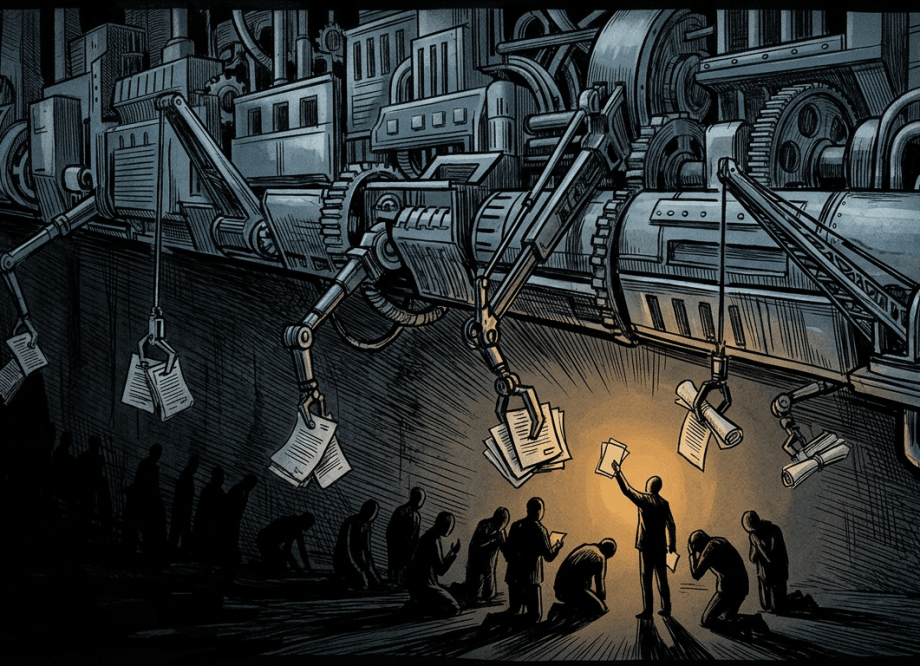
Franz Kafka wrote a story about a penal colony. In it, a machine called the Harrow inscribes the law on the body of the condemned, with needles. It takes hours, in a script of increasing intricacy and pain. The condemned does not know, before the process begins, what law they have broken. They are not told. The law is written on their body as the punishment is administered, and this, the officer in charge explains, is precisely the point:
“Enlightenment comes to the most dull-witted. It begins around the eyes. From there it radiates.”
The Australian Harrow does not use needles. It uses bail conditions, suppression orders, national security legislation, counter-terrorism statutes and the slow drip of a pre-trial process that can run for years before a single day in open court. Those condemned do not bleed visibly. They become, over time, financially stricken, publicly invisible, professionally erased. The lesson to everyone watching is unmistakable. And not a word need ever be said. Aloud.
The Harrow does not need a conviction. The process is the punishment. Kafka understood this. So does the Department of the Attorney-General.
David McBride was a fine military lawyer. Decorated. Distinguished. Decent. He did two stints in America’s war on Afghanistan, witnessed alleged war crimes being buried while lesser misconduct was prosecuted for show, raised his concerns through the chain of command, was ignored, went before oversight bodies, got the glassy-eyed ignore, and in desperation gave documents to the ABC.
An unwise move. Those papers became the Afghan Files. The journalism was unimpeachable. The public interest was unambiguous. The democratic function of a free press was served.
For this, McBride got six years in gaol in 2024. The public interest defence was rejected. The conviction was upheld on appeal. The first and only person imprisoned in connection with alleged Australian war crimes in Afghanistan is not a soldier accused of an unlawful killing.
It is the lawyer who helped expose them.
The law the Harrow inscribed was not you permitted atrocities. It was you told people about them.
Witness K revealed that Australia’s intelligence services secretly bugged the cabinet rooms of Timor-Leste during oil and gas negotiations — on the personal authorisation of Foreign Minister Alexander Downer — conducted shortly after that newly independent nation had barely drawn its first post-colonial breath.
K received a suspended sentence. His lawyer, Bernard Collaery, a decorated Canberra barrister, former ACT Attorney-General and a man whose standing in his profession is impeccable, was prosecuted separately. Not for spying. For the act of defending his client. The prosecution ground on for years before the Albanese government finally dropped it, by which time it had accomplished its real work: financial ruin, reputational attrition, and a message delivered, in language every lawyer in the country could read, to anyone considering the defence of the next person who knew too much.
Alexander Downer was Australia’s Foreign Minister in 2004 when he authorised the Australian Secret Intelligence Service to install listening devices inside Timor-Leste’s cabinet room, under cover of an aid project, no less. The bugging was not conducted in the national interest. The primary beneficiaries were Woodside Petroleum and ConocoPhillips. The Greater Sunrise field they were negotiating over has been valued at between forty and fifty billion dollars. In 2007, one year after leaving politics, Downer established his lobbying firm Bespoke Approach and promptly registered Woodside as a client. No law prevented this. No consequence followed. Downer was never charged with anything. He continued attending functions.
Richard Boyle exposed predatory and illegal debt-recovery practices inside the Australian Tax Office. Independent inquiries later confirmed what he had said. He raised concerns internally and was ignored. He went to oversight bodies and was spurned. He went to journalists as a final resort. He now faces charges that could see him locked up for decades. The Tax Office whose illegal conduct he exposed faces no charges at all.
The Harrow writes asymmetrically. It always has.
In 2019, AFP goons raided the home of News Corp journalist Annika Smethurst, seizing data from her phone and laptop. The High Court later unanimously ruled the warrant invalid and the search unlawful. The following day, those same officers raided the Sydney offices of the ABC, fossicking through thousands of files, drafts, digital notes and raw footage.
The ABC’s news director said it should send a chill down every citizen’s spine.
It did not send enough of a chill. The government of the day faced no political consequence. There was an inquiry. An inquiry is what Canberra holds instead of a reckoning.
Julian Assange watched WikiLeaks publish classified documents about American military conduct in Iraq and Afghanistan. The documents revealed, among other things, the killing of civilians and Reuters journalists in a helicopter gunship attack the military had classified as something else entirely. For publishing information in the public interest, which is what investigative journalism must do or the word democracy becomes a lie, he spent years in Belmarsh Prison in conditions the UN Special Rapporteur on Torture described as meeting the threshold of psychological torture.
Those with the temerity to question just what Australian governments were doing for Assange were fobbed off, throughout, with assurances that the matter was being raised privately, through appropriate channels.
DAWE: Julian Assange is an Australian citizen who has spent years in a British maximum-security prison. What has the government done?
CLARKE: We have been raising this matter at the highest levels.
DAWE: Which levels, specifically?
CLARKE: The highest ones. I can’t stress that enough.
DAWE: And what has that achieved?
CLARKE: Well, it’s achieved a raising of the matter. At the highest levels. Which we’ve done consistently.
DAWE: He’s still in prison.
CLARKE: He is, yes. That’s a matter for the relevant jurisdictions.
DAWE: He’s Australian.
CLARKE: He is. And Australia takes the welfare of its citizens extremely seriously. That’s why we’ve been raising it.
DAWE: Through the appropriate channels.
CLARKE: Correct.
DAWE: Which haven’t worked.
CLARKE: They’ve been very appropriate, though.
DAWE: Is that the main thing?
CLARKE: In terms of the channels, yes. You want to be in the right channels. That’s fundamental.
When Assange was finally freed, it was through a plea deal requiring him to admit guilt for doing what journalists have done since Gutenberg. He spent years in a high-security British prison for publishing things that were true. The governments that claimed to represent him continued attending functions.
The prosecutorial record is only part of the kit. The Harrow is one instrument in a larger machine. A constitutional silence helps no end, as does a defamation system weaponised as a cost-infliction device, and a digital economy restructured to starve the voices the Harrow hasn’t yet reached.
That machine, and the system of deniability that makes it work, is the subject of Part 3.


One thought on “The Invisible Press, Part 2”
Comments are closed.