“Every gun that is made, every warship launched, every rocket fired signifies, in the final sense, a theft from those who hunger and are not fed, those who are cold and are not clothed.”
*Dwight D. Eisenhower, 1953*
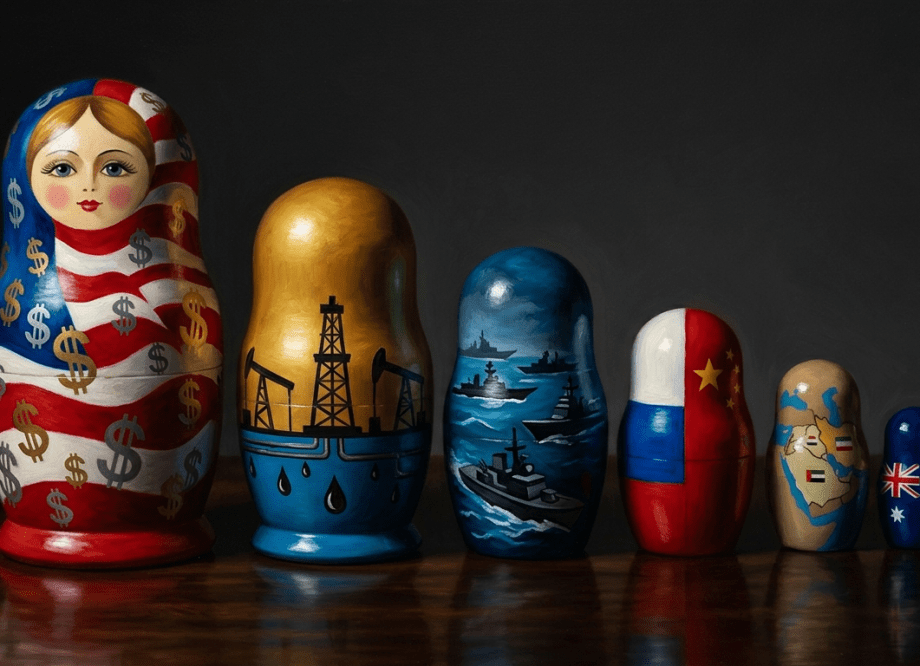
To make sense of this war, imagine a Russian babushka doll.
The outer doll is the story we are fed in Australia: a daily Pentagon briefing, wrapped and rebroadcast by News Corp, sanitised by the ABC into something almost unrecognisable as news. We are told that Donald Trump is pursuing “productive talks” with a repressive Iranian regime to protect “the noble Iranian people” and stabilise a volatile region. We hear next to nothing about Russian and Chinese mediation, about the island war-gaming in the Strait of Hormuz, or about the way a single, half-successful Iranian missile strike that reaches as far as Diego Garcia can rattle an entire alliance system. This surface narrative is thin, moralised and strangely weightless. When you prise it off, a heavier, uglier doll sits inside.
The next layer is money, and the dates and numbers tell their own story more clearly than any adjective. After leaving the White House, Jared Kushner set up Affinity Partners in 2021 and secured a two-billion-dollar investment from Mohammed bin Salman’s Public Investment Fund despite internal Saudi objections about his lack of track record. That is not a detail; it is the hinge of Kushner’s fortune. MBS, for his part, is gambling his own survival on Vision 2030, a plan that assumes hundreds of billions in foreign investment will flow into Saudi projects so long as he can deliver oil prices in a “Goldilocks” range and a reputation for being ruthless but ultimately controllable. Into this mix walks Trump, who has been planning new Trump-branded resorts, golf courses and luxury housing in Saudi Arabia and the Gulf, and whose post-presidency wealth is now directly entangled with the goodwill of petro-monarchs.
The Epstein files are still in the archives. The war is cheaper, for now, than the truth.
None of these men can afford a war that spooks investors for years. None of them can afford to admit that they have already lost control of it.
This is why Trump’s sudden talk of negotiations sounds less like diplomacy and more like market management. Messages have indeed been passed through “friendly countries” such as Pakistan, Egypt and Turkey; officials on both sides have admitted that intermediaries tested the ground for a direct call. That is enough raw material for a president to announce that “consensus is growing” and that a “deal” is near, preferably just before the New York markets open. Yet Iran’s parliament speaker, Mohammad Bagher Ghalibaf, has stated flatly that no negotiations have been held with the United States, and has accused Trump of inventing talks to manipulate oil and equity markets and wriggle out of a quagmire of his own making. Both positions contain shards of truth. Trump needs the appearance of movement to calm traders and voters; Tehran needs to project unbending resistance to maximise the economic pain that serves as its main deterrent.
What we are watching is not a peace process. It is a duel of narratives, each carefully timed to screens and indices rather than to any plausible ceasefire.
Behind the rhetoric sit hard proposals. The United States has floated a sprawling, 15-point framework heavy on inspections, missile constraints and regional behaviour clauses. Iran has countered with five conditions that strip the situation down to first principles: an end to aggression, concrete guarantees against future attacks, war reparations for the billions of dollars in damage already inflicted, a comprehensive halt to hostilities across all fronts including proxy wars, and recognition of Iranian sovereignty over the Strait of Hormuz. That last demand, which would formalise Tehran’s control over a waterway through which roughly a fifth of the world’s traded oil passes every day, is anathema to Washington. The gap between fifteen points and five is not a negotiating margin. It is an alibi factory for both sides.
*“In war, truth is the first casualty.”*
*Aeschylus*
Before we go further inside the doll, we need to stop and look, with clear eyes, at what this war actually is. Not what CENTCOM says it is. Not what the Pentagon press release calls it. What it is.
On the morning of 28 February, a missile struck the Shajareh Tayyebeh girls’ elementary school in Minab. Iranian media reported 180 killed. Later that same day, a sports hall in Lamerd was bombed during a girls’ practice session. At least 18 civilians died, most of them children. These were not collateral damage in any meaningful sense of that already obscene phrase. They were the first hours of a campaign that, by its own internal logic, had decided that Iranian society rather than Iranian military capacity was the target.
By the seventh day, the World Health Organisation had identified 13 Iranian health infrastructure sites struck during the war. By the end of the second week, HRANA, the Human Rights Activists News Agency, had confirmed at least 1,407 civilian deaths, including 214 children. Iran’s own health ministry said 210 children had been killed and more than 1,500 people under the age of 18 injured. Three hundred health and emergency facilities had been damaged. By day 18, US-Israeli strikes had hit at least 178 cities across 25 of Iran’s 31 provinces. By day 25, HRANA’s count had risen to 6,530 killed including 640 civilians, with 3.2 million people internally displaced.
Six thousand five hundred and thirty. Say it slowly.
This is not a war fought on the field of Mars. There are no opposing armies facing each other across a contested plain. There is no front line. The “military” targets include a girls’ school in Minab, a sports hall in Lamerd, the Yas Nabi Girls’ Elementary School in Tehran, a paper factory in Malayer, the 12,000-seat indoor arena at Tehran’s Azadi Stadium, a seminary in Qom, a judiciary building in Zarrin Shahr, a hospital in Bushehr. By early March, the Iranian Red Crescent was reporting 6,668 civilian units struck, including 5,535 residential buildings, 1,041 commercial premises, 14 medical centres and 65 schools.
Sixty-five schools.
Hannah Arendt, writing about a different atrocity in a different century, observed that the most disturbing feature of mass violence is not the monsters who order it but the ordinary functionaries who administer it without apparent moral distress, the people she called the embodiment of the “banality of evil.” Pete Hegseth announces strikes from the Pentagon briefing room. Karoline Leavitt describes them as going “extremely well.” The actuaries of annihilation filing their reports with the cheerful efficiency of men and women who have learned not to look at what their numbers represent.
What makes this war qualitatively different from even the worst of its predecessors is precisely this: it is not a contest between armed forces. It is the systematic destruction of a civilisation. Iran is a country of 93 million people and one of the oldest continuous cultures on earth. Persepolis. The poetry of Hafez and Rumi. Universities, hospitals, factories, apartment blocks, stadiums, schools. The campaign against it is not surgical. It is obliterative. The logic, stated openly by Israeli Brigadier General Amir Avivi, is to “dismantle all the Basij bases and the Revolutionary Guards” while simultaneously “attacking in Tehran Basij forces who are standing in junctions, monitoring society,” with the explicit goal of creating conditions for popular uprising. The theory is that if you bomb a society comprehensively enough, it will turn on its own government. The evidence of history, from Dresden to Hanoi to Fallujah, is that it does not. It hunkers down. It endures. It mourns its children.
*“The death of one man is a tragedy. The death of millions is a statistic.”*
The remark is attributed to Stalin, which is itself instructive: the people most willing to speak about mass death with clinical detachment are usually the people most willing to produce it.
Prise off the money doll and beneath it sits metal, geography and the stubborn arithmetic of force. The Strait of Hormuz is barely 40 kilometres wide at its narrowest point; supertankers thread through two shipping lanes, each only a few kilometres across, flanked by Iranian coastline and a scatter of small islands. US military planners know that as long as Iran can threaten that choke point with missiles, drones, mines, fast boats and coastal batteries, no amount of presidential triumphalism will move the actuaries. This is why the war-gaming has so often centred not just on Iran’s mainland but on islands like Kharg, Larak, Qeshm, Hormuz and Hengam.
Kharg Island, which once handled up to 90 per cent of Iran’s crude exports, is the obvious public target. Tehran has moved additional troops, air defences and man-portable air-defence systems onto it, expecting an assault and preparing ambushes for any Marine landing force. Former US Army Major Harrison Mann, writing for Responsible Statecraft, calls a Kharg assault “a suicide mission”: a landing that would cost hundreds of American lives and still fail to neutralise Iran’s ability to threaten shipping in the strait. Consequently, more serious planning turns to the smaller islands that control the radars and missile sites overlooking the actual lanes: Larak, Hormuz, Qeshm, Hengam. War games conducted over past decades by US Navy and think-tank analysts often begin with attempts to take or neutralise these islands in the first phase of any campaign, because control of them could, in theory, reduce Iranian strike options against tankers.
Iran is not naïve. It has quietly developed an alternative shipping channel north of Larak, broadcasting to anyone willing to look that it sees that island in particular as a live node in the contest for Hormuz. Ghalibaf has warned publicly that “enemies” are preparing to occupy one of Iran’s islands with support from a “regional country,” and has threatened that the vital infrastructure of any such collaborator, power stations, desalination plants and export terminals in states like the UAE or Bahrain, would face “continuous and relentless attacks.” The ambiguity is strategic. Tehran does not name the island or the partner, but the message is unmistakable: if you lend your territory or ports to a US assault, your own gleaming glass skyline and air-conditioned malls are one missile flight away from darkness.
At the same time, the United States has reinforced the region with two Marine Expeditionary Units, roughly 6,000 to 7,000 Marines and sailors, on top of the 50,000-plus personnel already in theatre, along with elements of the 82nd Airborne Division. Military and shipping experts warn that truly “securing” the strait against Iranian attacks would probably require ground troops on multiple islands and parts of the coastline, and could drag on not for months but for years. The difference between tolerating sporadic attacks and promising a “zero-risk” corridor is the difference between airstrikes and occupation.
Inside this military doll sits another pair, like twin figures carved back to back: Russia and China. Neither is formally a combatant. Both have skin in the game.
Moscow sees in Iran a partner that has bled for it in Syria and a convenient anvil on which to wear down Western arsenals. Every US cruise missile launched at an Iranian radar, every interceptor fired at an Iranian drone, is one less round that can be pointed at Kaliningrad or the Donbas. In a world where Washington’s stockpiles of precision munitions are not infinite and take years to rebuild, a grinding war in the Gulf is, from the Kremlin’s point of view, a form of cost-effective attrition. Russian oil and gas revenues benefit from every sustained upward pressure on prices. If Hormuz jitters add ten or twenty dollars a barrel to Brent over a season, that translates into tens of billions of extra income for a Russian state trying to fund its own war machine.
Beijing’s interests look different but rhyme. China buys roughly half its imported crude from the broader Gulf region; any disruption of Hormuz is therefore a direct threat. Yet Beijing also understands leverage. A United States bogged down in a high-intensity confrontation with Iran, burning through missiles, attention and diplomatic credit, is a United States less able to focus on the South China Sea, Taiwan, or the economic strangulation of China’s own rise. Chinese mediation offers and quiet support, financial, diplomatic, sometimes technical, to Tehran serve a double purpose. They help keep Iran from collapsing, preserving a partner that can threaten US supply lines. They signal to the rest of the Global South that when Washington tightens the screws, it is Beijing, not Brussels, that turns up with alternatives.
Every month those destroyers patrol Hormuz rather than the Taiwan Strait is a month Beijing banks for free.
For both Russia and China, then, this war is a controlled burn on the edge of the American empire. Too much heat and it could ignite a global conflagration that would scorch Moscow and Beijing as well. Too little and an opportunity to sap US power and prestige would be wasted. Their aim is not to see Iran annihilated or the strait closed indefinitely, but to see the United States revealed as overstretched and unreliable, its vaunted “rules-based order” reduced to a tangle of self-serving exceptions. Every billion dollars in missiles and interceptors expended on a war that yields no clear victory is a billion that cannot be used to contain Russian or Chinese ambitions elsewhere.
Nested within these layers of oligarchic money, military geography and great-power manoeuvre sits an even smaller, more deranged figure: the fantasy of a single, purifying blow.
*“How is it possible,” asked Sigmund Freud in his 1932 correspondence with Albert Einstein, “for a small clique to bend the will of the majority, who stand to lose and suffer by a state of war, to the service of their ambitions?”*
Freud’s answer was that war satisfies instincts and offers excitement and a release from the grey tedium of peace. He was writing to Einstein about the First World War. He could have been writing this morning about Fox News.
Benjamin Netanyahu has made a career out of arguing that Iran cannot be contained, only broken. From his cartoon bomb at the UN to his persistent lobbying for pre-emptive strikes on Iranian nuclear and missile facilities, his preference has always been for stand-off power, stealth aircraft, cruise missiles, cyber-attacks, that can devastate infrastructure without putting Israeli boots into a grinding ground war. He presses Washington not for patience or diplomacy but for “decisive action” that would, in his mind, reset the regional chessboard. It is not hard to find his admirers in Washington. Pete Hegseth, catapulted from Fox News into Trump’s cabinet, has built his brand on railing against “politically correct wars” and demanding “maximum lethality,” as though restraint were merely a bad habit picked up in the Obama years.
This rhetoric matters. When leaders and their chosen propagandists persuade themselves and their publics that lethality is virtue, law is weakness and missile defence is near-infallible, the imagined costs of escalation fall away. Ted Postol has spent a career demonstrating that real interception rates slump into the single digits under combat conditions, far below the 90-per-cent fantasies that politicians sell. If you believe your shield is almost perfect, the temptation to swing your sword first becomes overwhelming. In a region where at least one state already has nuclear weapons and others have the capacity to sprint for them, that kind of delusion is not a marginal technical error. It is an invitation to a second nuclear-armed state in the Middle East and to a permanent state of hair-trigger terror.
There is a word for the psychological mechanism by which ordinary people, and their leaders, persuade themselves that mass killing is not only necessary but righteous. William James called it “the war-fever,” that sudden collective infection by which moral imagination contracts, the enemy ceases to be human, and the calculus of suffering becomes abstract. He was writing in 1906, eight years before the catastrophe that would kill 20 million people and convince the survivors, briefly, that humanity had learned its lesson. It had not.
And then, at the very centre of the babushka, smaller than it should be, is us.
Australia appears in this story mainly as a reflex. We host joint facilities; we send frigates to “freedom of navigation” missions; we echo, almost word for word, US talking points about “holding Iran to account.” Our media diet is dominated by American officialdom and US-aligned wire services. Even the ABC, which likes to imagine itself as a balm against Murdochism, too often frames Iran as a caricature of repression and menace, and treats US and Israeli actions as essentially defensive if occasionally “over-zealous.” The possibility that Washington and its partners might be the primary drivers of risk, or that we might have interests distinct from theirs, barely gets airtime.
Sixty-one per cent of Americans now oppose this war. Sixty-three per cent believe world war is likely within four years. The outer doll is losing its audience even at home, and still the ABC presents it with a straight face.
And yet somewhere in the ruins of this there are 65 schools. There are 214 children confirmed dead. There is a sports hall in Lamerd and a girls’ school in Minab and a seminary in Qom and a paper factory in Malayer and 3.2 million people without homes. There is, in Tehran, a graduate student who told a reporter: “There have been some days when the bombings are so intense you can’t do anything.” These are not statistics. They are the substance of a civilisation under obliteration, and the silence in our media about them is not neutrality. It is complicity.
James Baldwin, writing about a different form of organised violence, put the obligation plainly: “Not everything that is faced can be changed, but nothing can be changed until it is faced.”
Yet if we trace the layers honestly, what we see is not a noble democracy reluctantly forced to act but a failing empire trying to trade a fake peace for a real war: oligarchs and in-laws trying to protect billions parked in Gulf and Wall Street funds; regional strongmen pushing for strikes that could unleash nuclear proliferation; rival great powers quietly feeding the fire because every US missile that explodes over Bandar Abbas is one less missile aimed at Belgorod or Hainan. The stench rising from this is not the smell of courage. It is the sour reek of desperation, of a system that has run out of ideas except more force, more secrecy and more financial engineering.
We do not have to accept our assigned role as the tiniest doll, silently nested around a rotten core. We can insist that any Australian involvement in operations around the Strait of Hormuz be debated and voted on in parliament rather than nodded through by executive reflex. We can decide that no Australian ship or aircraft will be committed to enforcing a chokehold that serves US hegemony more than global stability. We can support journalism that is not content to regurgitate Pentagon lines but actually listens to Iranian, Gulf, Russian, Chinese and independent experts. Most of all, we can treat the risk of nuclear escalation in our wider region as a first-order concern, not as a footnote buried under alliance etiquette.
If we do none of this, we will continue to drift along inside the babushka, comforted by the outer doll’s smiling face, even as the inner layers rot. If we choose instead to crack it open and look at what is actually inside, the money, the fear, the vanity, the depleted arsenals, the missiles pointing at crowded cities, then the question for Australia becomes unavoidable.
Do we want to hitch our wagon to a desperate, flailing empire in the hope that some of its power will rub off on us? Or do we finally accept that the tiniest doll in somebody else’s babushka is no place for a country that fancies itself a good international citizen?
*“In the end, we will remember not the words of our enemies, but the silence of our friends.”*
*Martin Luther King Jr.*

