Thomas Hobbes said a frightened people will hand a strongman the right to end their arguments about the truth. Trump worked out he doesn’t need to end the argument. He just needs to own the facts in it, and the forty years of dying that made the offer irresistible.
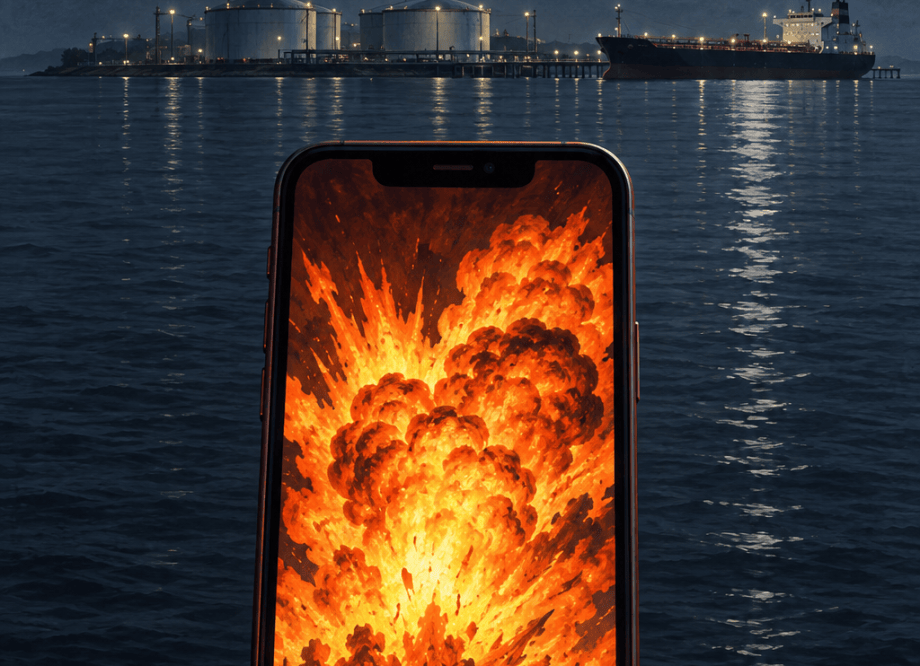
Kharg Island did not explode on the last Sunday of August. Nobody there was hurt. No missile fell on the terminal that loads ninety per cent of Iran’s oil exports, no fireball rose over the eight thousand people who live and sleep on it. It happened, in full, on Donald Trump’s phone. He posted the footage himself, captioned “Kharg Island being blown to smithereens!!!”, and by the following Monday, the Pentagon was quietly explaining that the actual strike, the real one, had landed on a different island entirely, and that the video the president of the United States had shared as war footage was generated by artificial intelligence from nothing at all. Asked to explain it, Vice President Vance did not say his boss had been fooled, nor did he say he was sorry. He said Trump was “sending a message to the Iranians.” Not reporting an event. Sending a message. The distinction is the whole story.
The official charge against Trump and his smithereens, the scattered, unrecognizable remains of a once-shared reality, isn’t that he lies. He does, constantly, and badly, in ways even a sleep-deprived Year Nine, up all night playing Fortnite, simply couldn’t miss.
At his own party’s midterm convention this month, he told the hall he had “won the presidency three times.” He has won it twice. Whoever wrote that line, or whoever simply believes it now, cannot do the arithmetic of his own biography. But cataloguing the lies, the way the wire services do, misses the real offense: it flatters him. The charge sheet says Trump gets the facts wrong. The truth is worse. Trump has stopped submitting facts for correction at all. He has appointed himself the office that used to do the correcting.
Thomas Hobbes spent the seventeenth century working out why a person frightened enough will trade freedom for the promise of order, and why the sovereign he chooses gets to be the final word on what a dispute even means. Hobbes wanted that final word to end civil war, to stop neighbours killing each other over whose account of an insult was true. It’s a reasonable trade if the sovereign actually keeps the peace. Trump worked out the trade is available without the peace. He announced the doctrine eight years ago at a veterans’ convention in Kansas City, when he told the crowd, “what you’re seeing and what you’re reading is not what’s happening.” At the time, it read as a boast about tariffs. It was a founding document.
Since then, the doctrine has had eight years to find its instruments, and this year it found the one it always wanted: a fact-checking apparatus that answers to him personally. In August last year, the Bureau of Labor Statistics published a soft jobs report. Trump did not dispute the number the way a normal president disputes a number, by arguing with the methodology. He fired the commissioner, Erika McEntarfer, and told reporters her figures were “phony,” “rigged,” and posted on his own platform that she had “faked the Jobs Numbers before the Election to try and boost Kamala’s chances.” Former commissioners, including men appointed by his own party, explained patiently that the numbers are locked into the system before any commissioner sees them, that nobody can rig what nobody can touch. It made no difference. McEntarfer had been confirmed by the Senate eighty-six votes to eight in January 2024. JD Vance voted to confirm her. So did Marco Rubio. Neither man has been asked to explain what changed about her arithmetic.
The same instinct now presides over the Federal Reserve, where Trump has spent months threatening to sack Jerome Powell for the crime of setting interest rates according to inflation data rather than according to what would flatter him. To Fox Business, he put it simply: Powell “is doing a bad job” and should cut rates regardless.
In September last year, American strikes began hitting boats in the Caribbean on suspicion, not proof, of drug smuggling. The US magazine The New Republic put the toll at eighty-six dead so far, some of them killed in a “double tap,” a first strike followed by a second one on survivors, filmed by the military that carried it out. No trial. No court. So it goes.
In December, Trump told a reporter the footage would “certainly” be released, “no problem.” Five days later, asked about that promise, he said: “I didn’t say that. That’s, you said that, I didn’t say that. This is ABC fake news,” and called the journalist who had simply repeated his own words back to him “the most obnoxious reporter in the whole place.” In May, he did it again over Iran. A Colorado television station caught him denying, on a Saturday, a sentence about diplomacy he had said on camera the Friday before. “I didn’t say that. You said that.” It is not a defence. It was never meant to be a defence. It is a loyalty test, and everyone in the room knows which answer keeps them in the room.
Kharg Island is where the test graduates into something new. Denying your own recorded voice at least concedes that there is a recording, a real event, a truth being fought over. The AI video concedes nothing. It doesn’t ask you to disbelieve what happened. It hands you an event that never happened at all and dares you to prefer your own eyes to his. Hannah Arendt, watching an earlier and worse version of this machine at work, wrote that the ideal subject of totalitarian rule is not the convinced believer but the person for whom the distinction between fact and fiction, true and false, has simply stopped mattering. She wasn’t being poetic. She was describing a technique. And the technique has just found its ultimate instrument: the video generator.
None of which explains why it works. And this is where the Hobbesian reading usually collapses into contempt, into the tired verdict that half a country has gone soft in the head, fallen for a con any child could see through. That verdict is comforting. It is also wrong. And worse, it is lazy. Look instead at what the truth has actually been telling these people for forty years, delivered by every institution Trump now stands accused of undermining. In 1992, an American with a university degree could expect to outlive one without a degree by two and a half years. By 2021, the gap was eight and a half years, more than tripled, and the single biggest driver of it has a name economists coined without irony: deaths of despair. Suicide. The bottle. The needle. That is not a metaphor about decline. That is the Bureau of Labor Statistics, the Centers for Disease Control, the Federal Reserve: every certified, peer-reviewed, institutionally sober source Trump is charged with attacking, agreeing for three decades that if you didn’t get the degree, the system had quietly stopped needing you to survive it.
That is the opening Hobbes actually describes, and it has nothing to do with stupidity. When the institutions of fact have spent your whole adult life certifying your own disappearance, a man who walks in and says none of that is real, that the numbers are rigged against you and always were, is not selling you a lie instead of the truth. He is selling you a truth that finally has room for you in it. It doesn’t need to be accurate. It needs to be his, because his is the only version where you were never the surplus. That is the sovereign’s real offer, and it was never security. It was authorship. Believe me, and you are not obsolete. You are besieged. There is a difference between the two that a drowning man will not stop to examine.
Hobbes thought the sovereign kept the peace by settling, once and for all, what was true, so the fighting could stop. Trump has found something cheaper. He keeps his peace by making sure nothing ever has to be settled at all. And a country that has spent forty years losing every argument the truth allowed it to lose will hand him that peace, and call it relief.
 Urban Wronski Writes