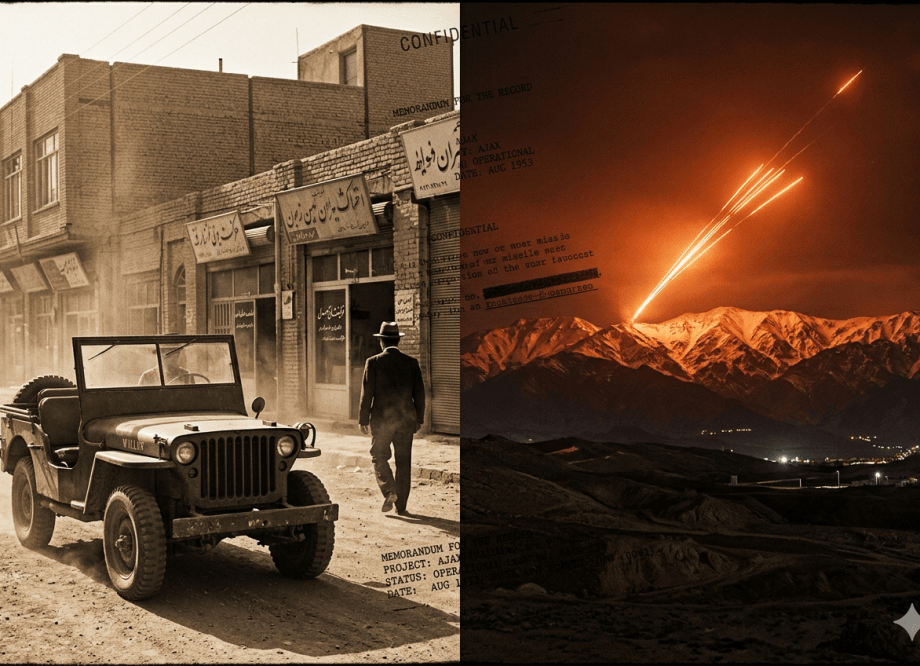
Made in Langley: How the United States paved the way for the Iranian theocracy it is now bombing.
Mohammad Mosaddegh was not some fire-breathing radical. He was a 71-year-old lawyer, Iranian nationalist, democrat, and constitutionalist who wore a camel-hair coat and wept in parliament. His crime? He had the temerity to suggest that Iranian oil should belong to Iran. What was he smoking? Imagine if Woodside, BHP or Shell had got a whiff of that.
The Anglo-Iranian Oil Company had stolen Iranian oil under contracts the nationalists knew were fraudulent. It later renamed itself The British Petroleum Company, then simply BP; Britain’s empire having sunk below the yard-arm in the interval, leaving only the initials behind. A particular bone of contention was the infant BP’s refusal to allow an audit to determine whether the Iranian government was even receiving the royalties it was contractually owed. When Mosaddegh discovered the answer was no, he nationalised the industry in 1951. The Iranian parliament voted for it overwhelmingly. On the streets of Tehran, in the last cold days before Nowruz, people danced the raqs-e Tehrani in the winter sunshine.
The word is نه — pronounced na.
One syllable. Flat. Final. The same weight in Persian as it has in English, and considerably older.
Mosaddegh said it to the Anglo-Iranian Oil Company when they refused to open their books. The parliament said it by voting unanimously to nationalise. The streets said it by erupting in celebration.
The CIA spent a million dollars making it unsayable.
London was apoplectic. Anthony Eden, Foreign Secretary, matinee idol, varnisher of fingernails, early champion of Picasso and Cézanne, holder of a first-class Oxford degree in Persian, described by Mussolini as “the best dressed fool in Europe,” by his Oxford contemporary Chips Channon as “mild, aesthetic, handsome and cultivated,” and by his own Cabinet colleague R.A. Butler, a keen student of bloodlines, as “half mad baronet, half beautiful woman”, reached for the amytal.
Britain set out to do the only fair and reasonable thing: weaken and destabilise Mosaddegh. When that grew into a coup, little Britain, not terribly keen to shoulder responsibility alone, persuaded the US to join forces by playing up Cold War fears that Mosaddegh, an avowed anti-communist, was somehow aligning himself with the Iranian Communist Party.
It was, patently untrue, if not outrageously preposterous. But of course, it didn’t need to be anything else.
It was, nonetheless, still a bad lie. CIA analysts did not believe it. A 1952 CIA study concluded that a Tudeh communist coup was not imminent, and a 1953 report reached similar conclusions. Did it matter? The Dulles duo: brothers, Allen running the CIA, John Foster running the State Department, wanted the operation green-lit. Nepotism? It’s OK if you keep it in the family.
On 4 April 1953, CIA Director Allen Dulles approved $1 million to be used “in any way that would bring about the fall of Mossadegh.” The bounty was to lead to three hundred Iranian bodies in the street, after a farcical first-time failure.
Kermit made it work. Into Tehran, in July 1953, walked Kermit Roosevelt Jr., grandson of Theodore Roosevelt, senior CIA operative, and architect of the dirtiest trick of the twentieth century. Trickery? It ought to be an Olympic event.
Kermit’s caper involved suitcases bulging with cash to manufacture an opposition movement: hiring desperadoes from the athletic clubs and slums of South Tehran to protest, bribing newspaper editors to print disinformation — real fake news — and creating a sham communist party to act as a straw man. Fabulous attention to detail. No-one ever said a good coup has to be subtle.
CIA operatives, pretending to be socialists, threatened Muslim leaders with “savage punishment” if they opposed Mosaddegh, giving the impression that Mosaddegh was cracking down on religious dissent. Very similar stunts are still pulled today.
Whether they wore berets, in 1953, is not recorded. The Che Guevara T-shirt would not be invented for another fifteen years. The religious community rose against him. The press reviled him. The streets revolted. None of it was organic. All of it was bought.
Several hundred thousand dollars from the CIA’s slush fund were handed out to thugs from athletic clubs. Other recruits were found in the slums of South Tehran, eager to take Yankee dollars to put bodies on the street. It was a recipe for disaster. It worked so badly that the use of conscripted agents, rough-heads and louts as provocateurs was set back at least for a fortnight.
But let’s be fair. The operational record of the first coup fiasco is a masterclass in imperial incompetence. The man sent to arrest Mosaddegh at four in the morning was himself arrested, by four tanks that had been quietly positioned outside the PM’s residence by a young Imperial Guard soldier who happened to moonlight for the communist Tudeh Party. You can’t make this stuff up.
The designated replacement prime minister, General Zahedi, spent the interlude moving between safe houses. As you would.
The Shah fled the country in a blind panic, convinced he was finished, and holed up at a hotel in Rome with his fetching young second wife Soraya, the Bakhtiari princess in the Christian Dior wedding gown whose bikini photograph had been banned in Iran, convinced his reign was finished. All was going swimmingly at home, apart from the mobs which tore down his father’s statues in Tehran’s public squares and chanted “Yankees go home.” But you do get a bit of that with your CIA coups.
The spooks were spooked. CIA headquarters cabled Roosevelt to abort the entire operation. Roosevelt filed the cable in the bin. He had not come all this way… On 19 August, he retrieved Zahedi from his safe house at noon and stage-managed his emergence on to a public street corner at 4:30pm, where the designated prime minister of Iran mounted a tank. The pro-Shah mob had been augmented with tumblers doing handsprings, well-oiled wrestlers displaying their biceps, and weightlifters twirling iron bars, led through the streets by Shaban Jafari, known to all Tehran as Shaban the Brainless, a mob boss on the CIA payroll whose nickname tells you everything you need to know about the intellectual calibre of the operation. Back in his safe house, Roosevelt was playing “Luck Be a Lady Tonight” from Guys and Dolls on repeat. This was the liberating force. This was democracy, delivered.
The first attempt was a disaster. Mosaddegh had been tipped off. Key conspirators were arrested. The Shah, spineless and terrified, fled first to Baghdad, then to Rome. CIA headquarters sent word to abort. Roosevelt ignored it and pushed forward anyway.
The second attempt, 19 August 1953, succeeded.
By nightfall, after a day of violence that left between 200 and 300 people dead, the figure Stephen Kinzer, author of All the Shah’s Men, and Britannica both settle on, the prime minister had fled. They were workers, students, Mosaddegh supporters, bystanders; shot and beaten in streets that had been deliberately set alight with CIA money. Nobody was tried for their deaths. Nobody answered for them. They simply vanished into the accounting of empire.
Mosaddegh surrendered the next day. He was arrested, tried, and sentenced first to death; later commuted to three years of solitary confinement. He used the time to write his memoirs. The first Iranian to hold a European doctorate in law, educated at Sciences Po in Paris, he spent his imprisonment composing the undefeated legal and historical case for everything the CIA had just destroyed.
Then house arrest at Ahmadabad until he died in 1967. When the sentence was handed down, he had said, with the calm sarcasm of a man who understood exactly what he was watching: “The verdict of this court has increased my historical glories. I am extremely grateful you convicted me. Truly tonight the Iranian nation understood the meaning of constitutionalism.” He spent his last fourteen years under the guard of the government his own people had elected him to lead.
The Shah ultimately returned from his Roman holiday, “purring like a giant cat”1. He signed over forty per cent of Iran’s oil fields to American companies. The CIA trained his secret police. SAVAK was established with CIA assistance. What followed was a generation stripped of political freedom; dissidents tortured, opposition banned, whispers turned into arrests.
Roosevelt reported back to the CIA, then worked for the Agency until 1958, when he became a Washington lobbyist. Among his clients was the Iranian government he had helped put in place. He later published a memoir, Countercoup, which one analyst described as pompous and self-congratulatory. Roosevelt told the Shah: “You owe me nothing at all. Except thanks.”
He was not prosecuted. He was not censured. He was celebrated.
What was lost? Iran’s first and only functioning democracy. A generation of civic institutions. The secular, constitutional path that Mosaddegh represented; educated, moderate, nationalist but not theocratic.
The hostage crisis of 1979, the ayatollahs, the revolutionary guards, the nuclear standoff, the entire architecture of US-Iran hostility that has defined the Middle East for half a century, traces its origins to four days in August 1953 when a grandson of a president arrived in Tehran with suitcases of cash and bought himself a coup.
The Eisenhower administration ballyhooed Operation Ajax as a success. And a template. Overnight, the CIA became a central part of the American foreign policy apparatus, and covert action came to be regarded as a cheap and effective way to shape the course of world events. Guatemala fell the following year. Then came the Bay of Pigs. Then Chile. The template held.
They called it a bargain.
The documents are declassified. They sit in the National Security Archive at George Washington University, in the CIA’s own reading room, in the flat, metallic, bloodless directness of a 1954 operational history written by CIA officer Donald Wilber, a chap who knew exactly what he had done and wrote it down anyway.
Iran is still paying the bill.
1Stephen Kinzer — award-winning journalist, Boston University professor, and author of All the Shah’s Men, the definitive English-language account of the coup. Kinzer describes the coup as the CIA’s first major successful overthrow of a foreign government and the template for everything that followed.
 Urban Wronski Writes
Iran and Israel, both problems created by the interference of the West.
LikeLike
Than you, jonangel. You’re not wrong, but the two cases are worth separating or the argument loses its edge.
Israel was created by a specific sequence: the Balfour Declaration of 1917, in which Britain promised a homeland in Palestine to one people while simultaneously promising independence to another; the Holocaust, which gave the project its moral urgency and its political irresistibility; and the 1948 partition, which the UN brokered and the Arab states rejected militarily. Western interference, yes — but also a confluence of catastrophe, guilt, geopolitics and genuine refugee crisis that makes the simple framing incomplete.
Iran is a cleaner case precisely because the interference is documented to the day, the hour, and the dollar amount. August 19, 1953. One million dollars authorised. Three hundred dead in the streets. A democracy dismantled, a torturer’s charter installed, and the secular space systematically liquidated until only the mosque was left standing. The Islamic Republic didn’t emerge from ancient hatreds or competing nationalisms. It emerged from a specific decision made in Langley and Whitehall, whose operational history sits declassified in the National Security Archive.
Both problems, yes. But Iran is the one where the West can’t even claim good intentions, competing interests, or the fog of a world war as mitigation. They knew what they were doing. They wrote it down. They filed it.
The receipts have been declassified. Nobody has paid the bill.
LikeLike