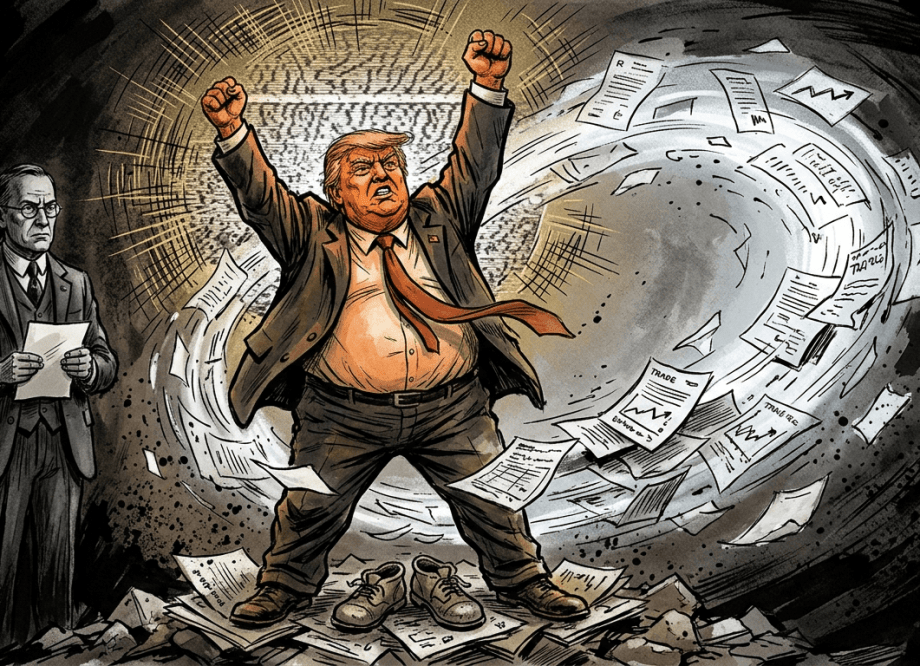
This piece is written as a tribute to the late Martin Amis, who found moral depravity widespread but never ordinary: a thing to be anatomised, mocked, named, and held up to the cold light of language. Any echo here is offered in homage to his savage moral clarity, his comic disgust, and his refusal to let euphemism launder cruelty.
Bombing a country on the other side of the globe will not make the Epstein files go away.
Thomas Massie said it, which is inconvenient, because Massie is not some blue-haired MSNBC Cassandra, not a faculty-lounge Bolshevik, not a vegan with a placard and a piercing. He is a Republican congressman from Kentucky. The sort of man the commentariat normally treats as safe furniture. He helped force the Epstein files issue through Congress, then made the mistake of saying the quiet part in a human voice.
War is not an eraser. It is only a louder noise.
Then came the noise at the Washington Hilton.
A man called Cole Tomas Allen, thirty-one, from Torrance, California, allegedly arrived at the White House Correspondents’ Dinner with firearms, knives, and the tiny private end-of-days of a manifesto. He called himself, with a phrase so American it ought to come shrink-wrapped with a coupon and a flag pin, a “Friendly Federal Assassin”.
Friendly. Federal. Assassin. Three words in a trench coat, stalking the ballroom.
He did not kill Trump. On the public record so far, he did not even fire at Trump. He fired at a Secret Service agent, who lived because the bullet found the vest and not the flesh beneath it. Allen was arrested. The president was hustled away. The dinner dissolved into the usual American liturgy: gunfire, panic, prayer, footage, panel discussion.
By midnight, Trump was doing what Trump does after near-death. He was metabolising it.
The danger had already become property. The terror had become content. The president invoked Abraham Lincoln, because of course he did. Trump has never met a martyrdom he could not franchise. There he was again, the orange Lazarus of Mar-a-Lago, rising not from the tomb but from the motorcade, powdered, grieving, aggrieved, radiant with self-pity.
This is his third brush with political violence in less than two years: Butler, the golf course, now the Hilton. Each episode is real enough. Blood is real. Fear is real. The Secret Service agent’s bruised torso is real. But the mythology that follows is also real, and more durable. After Butler, the image was instant: fist raised, blood on the ear, the Iwo Jima pose in a red tie. The theology arrived before the wound had dried. God had saved him. God had chosen him. God, that tireless campaign operative, had intervened in Pennsylvania.
A man saved by God three times does not answer to Congress. He answers to the merchandise table.
And while America watched the hotel carpet, other things slid down the screen.
The Epstein files, for one. NPR reported that the Justice Department had withheld or removed material relating to allegations that mention Trump, including what appear to be more than fifty pages of FBI interviews and notes. The DOJ Inspector General has now opened an audit into whether the department complied with the Epstein Files Transparency Act. This is not a rumour. It is not a meme. It is the slow machinery of records, omissions, redactions, signatures and fear. The terrible patience of paper.
There is a woman in a room somewhere, or the memory of a woman in a room. Fluorescent light, stale air, a federal agent asking questions. She has told them what she says happened. She has sat through the interview. She has reached the point beyond outrage, beyond hope, beyond the civic fairy tale in which power is answerable to truth. Asked whether she will provide more information about Trump, she asks what the point would be.
What would be the point?
That is the sentence which ought to be carved over the entrance to Washington.
Then there is the trading scandal. The arithmetic with a pulse. Reuters reported that more than $500 million in oil-futures bets were placed shortly before Trump posted about Iran talks. Congressman Steven Horsford has put the pattern into the Congressional record: eighteen minutes here, forty-seven minutes there, huge positions before market-moving announcements. No one has yet proved who knew what. That is why the question matters. The market moved before the public knew. Somebody, somewhere, appears to have heard the future clearing its throat.
The old corruption wore a cigar and a pinkie ring. The new corruption wears fleece, stares at six screens, and turns foreknowledge into liquidity. It does not need a brown paper bag. It has an exchange, a shell, a server, a wallet, a minute hand.
And then there is Iran.
Operation Epic Fury was sold as precision, which is the word empires use when they want you to admire the weapon and ignore the wound. Precision is a beautiful word. Surgical. Clean. Calibrated. It belongs to stainless steel and white coats. Then the Tomahawk lands on a primary school.
A school in Minab. Children inside. Children who had names, pencil cases, quarrels, hair clips, sums half-finished, little tyrannies of friendship, morning hunger, fear of mathematics, favourite teachers, shoes with dust on them. Amnesty says 168 people were killed, including more than 100 children. UN experts said the victims were mainly girls aged between seven and twelve. The Guardian reported that a preliminary US military inquiry found Washington responsible for a Tomahawk strike caused by a targeting mistake. The ABC reported that the US was bombing an adjacent Iranian base and that outdated targeting data may have treated the school building as part of that military site. (The Guardian)
This is what “targeting error” means when translated out of Pentagonese. It means a child becomes old data. It means a classroom is killed by an archive. It means the map remembers a barracks and forgets the murals, the sports field, the small shoes, the lunch boxes. It means the obsolete intelligence was more alive to the machine than the children were.
Then comes the ugliest phrase in the modern military lexicon: double tap.
The first strike kills. The second strike kills the rescuers, the survivors, the parents running towards the smoke, the children moved from one room to another because the adults still believed in the existence of a safer place. Middle East Eye reported testimony of a double-tap strike at the school. Iranian accounts have alleged three strikes. Call it what the lawyers will eventually call it. Call it mistake, negligence, recklessness, atrocity, war crime, fog. The children do not rise for the terminology.
This is the obscene genius of the age: everything can be renamed before it is mourned.
Children are not killed. They are civilian casualties. Schools are not bombed. They are misidentified structures. Parents are not shredded while running towards the rubble. They are collateral persons in a dynamic targeting environment. And the missile is never a missile for long. It becomes an incident. The incident becomes a review. The review becomes a delay. The delay becomes the archive. The archive becomes nobody’s fault.
Meanwhile Trump says Iran did it.
Of course he does. The lie is not a deviation from policy. The lie is policy in its most portable form. It travels faster than the correction, fits better on television, arrives camera-ready, and demands only that the dead be unavailable for comment.
Now return to the Hilton.
The man with the gun is useful because he is comprehensible. He has a face, a name, a manifesto, a mugshot, a childhood, a LinkedIn page, a house in Torrance where agents can stand in the dark with torches. Television understands him. Television can loop him. Television can invite former profilers to discuss his isolation, his radicalisation, his knives. Television can say America is broken, then cut to an advert for a pharmaceutical product whose side effects include suicidal ideation and anal bleeding.
But the files are harder. The trades are harder. Minab is harder. A dead child under a Tomahawk is morally simple and politically unbearable, which is why the machinery starts at once. Doubt, blur, delay, dispute, misdirection. Was it the United States? Was it Israel? Was it Iran? Was it bad intelligence? Was it the building? Was it the base? Was it unfortunate? Was it legal? Was it, in the final anaesthetic phrase, under investigation?
The question is not whether Trump is bullet-proof.
Physically, he has been lucky. Politically, he has been armoured by money, spectacle, cowardice, theology, institutional rot and the American addiction to sequels. He has been saved by the camera more often than by God. He has been protected by the inability of the republic to sustain attention for longer than a news cycle, unless the story comes with blood on the lens.
But he is not document-proof.
He is not audit-proof. He is not arithmetic-proof. He is not immune to the fifty missing pages, the eighteen minutes, the forty-seven minutes, the $500 million in oil futures, the dead schoolgirls of Minab, the missile fragments, the timestamp, the investigator, the journalist, the congressman who refuses to shut up.
Bullets make noise. Files wait.
That is the problem for Trump. Not the broken man with the shotgun. Not the hotel panic. Not the saint cards printed before the carpet is dry. The danger is quieter and more lethal. The record. The ledger. The witness. The girl who did not come home from school. The number in the margin that refuses to become mist.
War can bury a scandal for a day. A shooting can bury it for a weekend. Cable news can bury almost anything until the next bright object flashes across the national cage.
But paper has no pulse to stop. Arithmetic does not flinch. The dead do not recant.
And Thomas Massie is still talking.
 Urban Wronski Writes
And still the world just looks on!!
LikeLike