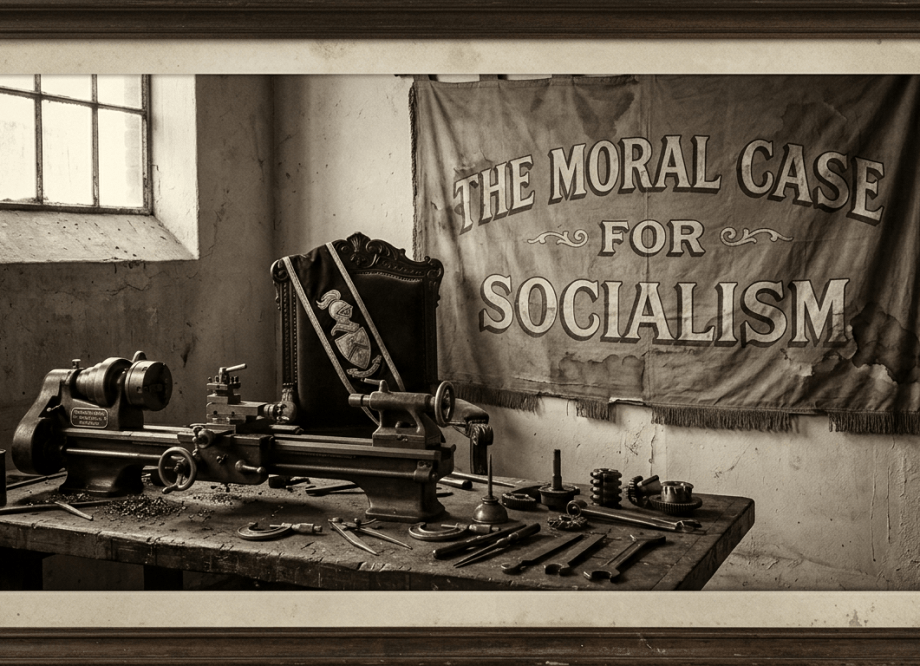
A political obituary for Sir Keir Starmer, 2020 to 2026: the man who climbed out of the working class and then, with the impeccable timing that only the truly committed can achieve, pulled the ladder up behind him.
Glossary of Terms
(for the reader who wishes to follow proceedings)
AUTHENTOCRACY, n. The system by which a politician’s origins are cited as evidence of his convictions, the frequency of citation varying in inverse proportion to the survival of the convictions themselves.
PRAGMATISM, n. The philosophical position that what is right is what is possible, and what is possible is whatever does not inconvenience the people who matter; distinguished from cowardice by the addition of a press release.
TOUGH CHOICES, n. pl. The category of decisions that are tough for other people.
SMALL TARGET, n. The strategic posture of a man who has noticed that convictions are electorally dangerous and has therefore hidden his; also the approximate size of the social programme that survives contact with government.
England, 2020 to 2026
It is a truth universally acknowledged that the further a British Labour leader travels from his origins, the more obsessively he will refer to them. Unlike most political truths, this has the advantage of being demonstrably, outrageously, and unequivocally true.
Keir Rodney Starmer came into the world on 2 September 1962, his name a type of tribute to Keir Hardie, the great Scottish agitator and Labour founder who had once been expelled from his own parliament for opposing a popular war. His naming would prove a cruel barb. Hardie is astonishing precisely because he was radical on issues that were still deeply unfashionable: he backed workers, supported women’s suffrage, opposed empire-minded complacency, and became an outspoken pacifist. The naming was the most radical act the Starmer family would perform for the next six decades. After that, everything moved, with the agonisingly slow momentum of a glacier that has decided to go somewhere else, in precisely the opposite direction.
Let us follow Starmer’s path. Reigate Grammar School, which at least had the decency to convert to fee-paying while Starmer was still a pupil, as though the institution itself wished to illustrate a point. Then Leeds, first class. Then Oxford. The bar. Queen’s Counsel. Director of Public Prosecutions. A knighthood. The Labour leadership on a platform of ten socialist pledges. The abandonment of the pledges. The abandonment of the word socialist. The abandonment of the man who had given him the leadership. Downing Street. Twenty-three months of studied vacancy, during which the country was governed with the conviction and energy of a man who has been asked to hold a room while the real speakers are located. Then the door, closing behind him, as Beethoven’s Ode to Joy played on the street outside. It was the anthem of the European Union, the restoration of relations with which had been a founding premise of his government.
He wept. His wife held him. He had accepted the arithmetic with good grace.
This is what the English professional class calls resilience.
Through all of it, the biography had one fixed coordinate, one recurring landmark in the fog of advancement: his father was a toolmaker. Forty-four times, he reminded us. Eleven times in June 2024 alone, the frequency of a man who has been prescribed a course of tablets and intends, by God, to finish them. He told the TUC that his father had felt looked down upon for working on the factory floor. He did not mention, on each of those forty-four occasions, that the factory floor belonged to his father. Rodney Starmer ran the Oxted Tool Company from a rented workshop on a Surrey industrial estate, sole trader, no managers, no foremen, no one to look down on him except the overhead costs and the occasional difficult client.
The toolmaker owned his tools. This is called the petit bourgeois condition, when sociologists are being precise, and working class, when politicians are being strategic.
A Sky News debate audience laughed. Not with cruelty, exactly: more in the manner of people who have heard the same joke so many times they have achieved a complete understanding of its mechanism while having entirely ceased to find it funny. Starmer looked momentarily hurt, the way a man looks when the particular truth he has repeated until it became indistinguishable from fact suddenly encounters an audience that has been keeping count.
There is a website, mydadwasatoolmaker.uk, that exists for no other purpose. It stopped counting in 2024.
Nobody has built a website to count how often Keir Starmer mentioned Keir Hardie.
The silence is the biography.
What the toolmaker-mention achieved, and here we must, with reluctance, admire the craft, was the creation of a moral exemption. The Crown honour, for instance. Sir Keir Starmer, Knight Commander of the Bath, accepted in 2014 for services to criminal justice from the Crown that his party existed, in theory, to hold accountable. Sir. The title sits in the sentence the way a monogrammed ashtray sits on the desk of a man who has given up smoking: vestigial, slightly inexplicable, and telling you something precise about the life that preceded the current arrangement.
Starmer neither challenged the furniture of hierarchy nor defended inherited privilege. He inhabited it, the way a careful tenant moves into an already furnished flat and never quite gets around to removing the previous occupant’s paintings.
But what of his pledges? A moment’s attention is due their original form, since they have not otherwise been available since 2023.
He would nationalise rail, mail, energy, and water. He would abolish Universal Credit. He would raise income tax on the top five per cent. He would invest £28 billion annually in green industries. He would defend free movement. He would close the immigration detention centres. This platform, he saw as the moral case for socialism. He put his name to it. The membership voted for him on the strength of it, and then he won the general election on the strength of the Conservatives having made the membership’s decision look sensible by comparison.
In January 2020, he had described himself as a socialist driven by “a burning desire to tackle inequality and injustice.”
By December 2021, asked whether he still considered himself a socialist, he replied: “What does that mean?”
The nationalisation plan was abandoned. The income tax pledge was dropped. The green investment was pruned. Tuition fees were to be “moved on from.” Universal Credit was tweaked, not abolished. The detention centres remained open. The free movement commitment was not mentioned again in polite company. In 2023, the ten pledges were expunged from his website, as quietly as a landlord removes a previous tenant’s name from the letterbox when the tenant has been gone long enough for the neighbours to stop asking.
Each abandonment had an explanation. The economic situation. The fiscal inheritance. Reality. Political necessity. The management of the vase, a metaphor employed by his own advisers to describe the need for delicate handling, the vase arriving intact at its destination containing, by that stage, nothing whatsoever.
This, too, is an English type: the man for whom pragmatism is always, always, always the same direction.
Now to genocide in Gaza. Here, his words themselves become the evidence, requiring no further commentary or gloss
On 11 October 2023, in the fourteenth day of the Israeli siege of Gaza, water cut, power cut, bombs falling on the camps, children under the rubble in the white dust that settles on everything after a strike, Nick Ferrari of LBC asked Starmer directly. A siege. Cutting off water. Cutting off power. Was this appropriate?
“I think that Israel does have that right,” said Sir Keir Starmer, Knight Commander of the Bath, Leader of His Majesty’s Loyal Opposition, son of a toolmaker. “It is an ongoing situation. Obviously everything should be done within international law.”
The Labour Muslim Network informed him that collective punishment was a war crime. Amnesty International provided the same information in somewhat more formal terms. His office said he had been answering a prior question. The tape said he had not.
He clarified. He moved on.
Fifty-six of his MPs defied his ceasefire abstention. He managed them. The Speaker of the House of Commons was, by various accounts, subject to pressure that produced an unprecedented procedural breach, allowing Labour’s weakened amendment to kill the stronger ceasefire motion. RAF Akrotiri flew more than two hundred surveillance sorties over Gaza by May 2024, the footage from the days British aid workers were killed by Israeli strikes remaining, as these things do, classified. When his own Foreign Secretary finally said, in March 2025, that Israel’s blockade of humanitarian supplies was a breach of international law, the first time any member of the British government had said so in public, Starmer’s office indicated that Lammy might wish to apologise.
The Prime Minister instructed his Foreign Secretary to apologise for the suggestion that starving civilians might be illegal.
Mencken understood that the most devastating sentence is the one that requires no elaboration. He would have stopped there, too.
Let us, then, move freely to the freebie season. The freebie season was the administration’s most technically accomplished passage. Here is the list: the objects, their provenance, their cost, their context, set down in the order they arrived.
September 2024. The winter fuel payment cut came into force. Two and a half million pensioners lost between £200 and £300 a year. The charity Centre for Ageing Better found that a quarter of those affected lacked sufficient income for what the researchers called “a dignified standard of living.” The Prime Minister, describing this as a tough choice made necessary by the fiscal inheritance, asked the nation to tighten its belt.
It then emerged that the Prime Minister had accepted more in gifts than any other MP since 2019. The total was £107,145.
There were six Taylor Swift concert tickets, from Taylor Swift’s team, at the moment his Home Secretary was being asked whether she had pressured the Metropolitan Police into providing top-level security for Taylor Swift’s London shows, the same security normally reserved for senior politicians and the Royal Family, after cabinet members received those tickets. There were four Arsenal fixtures. Coldplay seats. £2,435 worth of spectacles, and suits, and a clothing rental arrangement for his wife, and accommodation, and a personal shopper, and clothing alterations, before and after the election, from Waheed Alli, Baron Alli, Labour peer, the parliamentary watchdog announcing an investigation into the Baron’s own interests the same week.
He paid back £6,000. He said all MPs accepted gifts. He said he attended the concerts for security reasons.
He was, it should be noted, the man who had told television audiences that his family’s phone had been cut off because they could not pay the bill. He moved on. He always moved on.
Keir said he had to go to the Taylor Swift concert because of the security arrangements, which anyone could see was very sensible. He did look smart. The new glasses suited him.
On 22 June 2026, a Manchester by-election, the first arranged specifically to provide a parliamentary seat for a challenger since 1965, concluded. Andy Burnham, the King of the North, the Mayor of Cottonopolis, the man who had spent nine years governing Greater Manchester with the missionary conviction of someone who had watched Keir Starmer govern the country and concluded that he could hardly do worse, won the Makerfield seat by a margin that left very little room for interpretation.
He won it including in areas where Reform UK had just swept the council elections. He won it in a constituency that had been engineered into existence specifically to give him a platform from which to bring down a Prime Minister who had been brought down already in every sense except the procedural one.
The arithmetic was clear. Starmer accepted it with good grace, which had by that point become his most reliable characteristic.
He stepped outside the black door, composed himself, and spoke.
He said that walking up the street two years ago had been the proudest moment of his life. He said the country he was leaving was far stronger and fairer than the one he had inherited. He said he would give his successor his full and unequivocal support. He said that every decision he had taken had been about putting the country he loved first.
And then, in the final minute, after the prepared text had done its work, the lawyer in him stepped aside and something else arrived. His voice broke. It broke, specifically, on this:
“When I leave the biggest job in the country, I shall spend more time on the most important job: being the best husband I can to my fantastic wife Vic, who has been a rock by my side through good times and bad, and being the best dad I can to my beautiful children, who are my pride and my joy.”
This is the sentence that demands a definition:
MOST IMPORTANT JOB, n. The position a man discovers he holds immediately upon losing the one he actually wanted; characterised by its sudden visibility, its impeccable timing, and its complete immunity to parliamentary scrutiny.
Sir Keir Starmer, Knight Commander of the Bath, who had accepted the furniture of hierarchy without rearranging a single armchair, who had endorsed the siege of Gaza, who had taken £107,000 in gifts while stripping pensioners of their winter fuel allowance, who had expelled Jeremy Corbyn and been beaten by him anyway, who had removed ten socialist pledges from his website as quietly as a man removes a parking ticket from under his wiper in the hope that nobody saw it arrive: that man, in his last public act as the leader of a movement founded on the collective interests of working people, announced that his true vocation was helping with the homework.
He wept. Victoria held him. The door closed.
The Beethoven played. The European Union’s anthem, for the Prime Minister who had promised to rebuild the relationship with Europe and had not, quite, somehow, done anything at all about it.
The King of the North was already on the train from Manchester.
The man for whom Starmer was named had opposed a war that killed 715,000 British servicemen and wounded more than twice that number; that destroyed a quarter of Britain’s overseas assets and a tenth of its domestic ones; that drove the national debt from £650 million to £7.7 billion in five years; that consumed 44 per cent of all government expenditure for a decade in interest payments alone; that stripped Britain of its position as the world’s largest overseas investor and handed it to the United States, where it has remained ever since. The officer class, the educated young men who led the infantry out of the trenches and into the wire, died at nearly twice the rate of the men they commanded. A generation of the people who might have built something different went into the mud at the Somme and did not come back.
Keir Hardie knew this would happen. He said so. Parliament howled him down.
The toolmaker’s son, named for that man, served his full term without opposing anything popular, and was expelled by his own party for the failure. There is a joke in there, somewhere, but it is too sad to tell. Too soon to dwell.
Part II, The Steward’s Son, on Anthony Albanese, publishes shortly.


David, a deservedly forensic examination. History will not smile upon the toolmaker’s boy. His government’s treatment of sign-carrying advocates of Palestinians’ rights as criminal supporters of terrorism is not just absurd, but dangerous. Starmer will not be missed.
LikeLike
Thanks, David. Couple of observations. No mention of an early warning sign that he lies through his teeth when it suits. He was stupid enough to tell the camera, while laying a hand on Jeremy Corban, that he was Jeremy’s friend. Not long after that, in a second interview, he denied ever saying that.
Secondly, the intro to this latest chapter mentioned 3 comments. There was only one. Mine actually makes it two.
Jim R
LikeLiked by 1 person
An ethical void in an empty suit, about to replaced by an…ethical void in a tee-shirt.
LikeLike