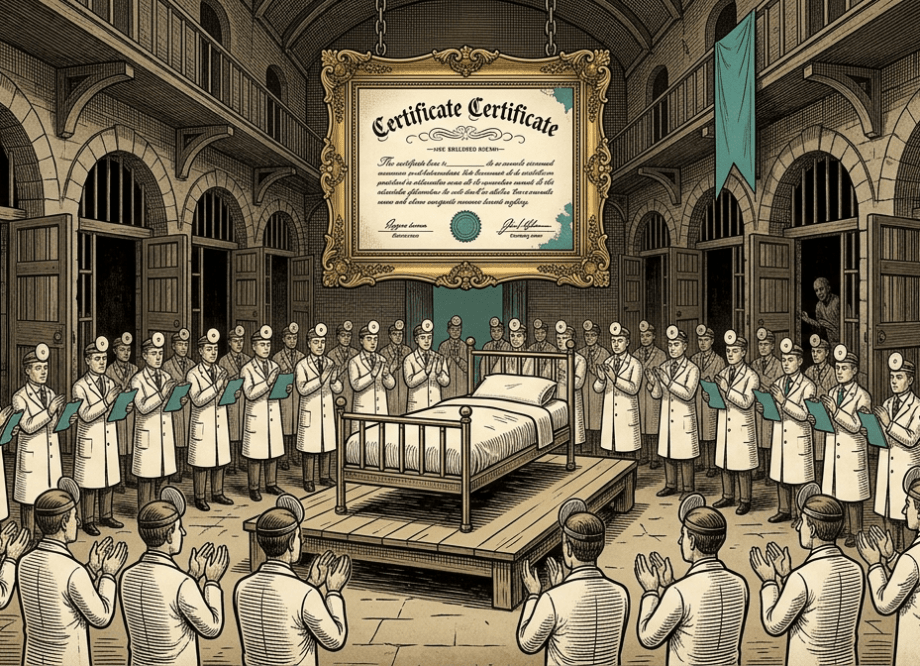
New Bedlam
Joseph Heller’s Catch-22 was the trap no rational mind could escape: merely reaching for an off-ramp was proof you had to stay. The clause specified that fear of dying in combat was the mark of a rational mind. Captain John Yossarian, Heller’s bombardier, whose entire war aim was to stay alive, proved by asking to be grounded that he was sane; and a sane man had to fly.
Heller was on to something. The madness was real.
The exit slammed shut just as you lunged toward it. Robert Brustein, reviewing the novel in 1961, saw in Yossarian’s condition the logic of sheer survival, a sanity so pure that everyone around him concluded he was mad. Captain Yossarian took his medal standing naked in formation; his uniform had been spattered with his dying gunner, and he declined ever to wear one again.
Donald Trump, turns 80, having spent eighteen months building the same machine in reverse and wedging himself into the gears. Yossarian showed his sanity by trying to escape duty. Trump demonstrates his unfitness by refusing to. A man confident of his faculties does not sit a dementia screening four times. He does not announce each perfect score in capitals on his own social network, like a boy sprinting home with a spelling test. Above all, he does not keep count.
Trump keeps count. One hundred and twenty correct answers out of one hundred and twenty questions, he reports, across four sittings of a ten-minute screen built to spot cognitive decline, on which naming a camel and drawing a clock face are the summit of difficulty. Twenty-two doctors were consulted for May’s physical, according to the memo released, in the honoured tradition of good news, late on a Friday night. Twenty-two on the record. Forty in the first retelling. By his birthday it reached 122, every one of them unanimous, the largest panel of physicians ever assembled in the history of medicine, period, possibly of crowds.
Trump knows the score. He tells the Wall Street Journal he regretted October’s advanced imaging, because taking the scan implied there was a question. It gave them, he says, a little ammunition. There it is. The proving is the symptom. He orders more proof.
Heller had flown the missions. Sixty daylight runs through the flak over Italy and southern France, and twice over the bridges at Avignon, in 1944, where the dying gunner, who became Snowden, bled into the back of his plane. Trump’s war was averted by five deferments and, by every fond account, a podiatrist’s accommodating note about bone spurs.
Kurt Vonnegut has a yarn that measures the whole distance between them. At a billionaire’s party on Shelter Island, Vonnegut asks Heller how it felt that their host had probably made more money the previous day than Catch-22 had earned in its entire history. Heller answers that he had something the billionaire could never have: the knowledge that he’d got enough.
Trump is also that billionaire. There is no number he can land on, of dollars, of doctors, of perfect scores, of terms in office, because enough is the one word he can never say. According to clinical psychologist Mary Trump, his niece, the president’s mother, Mary Anne MacLeod of the Isle of Lewis, nearly died when he was a toddler and was never afterwards able to give the boy the assurance a child cannot do without.
His father, Fred, meanwhile, drilled rat cunning into him: the world divides into killers and losers, winning forgives the method, and to lie, to cheat, to game the law and the taxman is not a sin but the mark of a winner. He prized in this son a hunger that no amount of mere winning could ever fill. Trump felt rebuffed at one parent’s bosom and ingested poison at the other.
That is pity’s full ration, and it pardons nothing. Most unloved children grow up to harm no one. Mary called her book Too Much and Never Enough. Vonnegut, wrote a poem about the billionaire under just the last word. Enough. The counting is not a symptom of the condition. The counting is the condition, and it has been running since the nursery.
So why has the trap never closed? Because Heller’s catch needed a sane system to enforce it: a Doc Daneeka with a clipboard, a rulebook, somebody keeping score. Trump abolished the scorekeepers and staffed the bench with patients.
Call it the New Bedlam. The original began as the Priory of St Mary of Bethlehem, a house of hospitality founded at Bishopsgate in 1247. By 1403 it held lunatics. By the eighteenth century it held crowds: Londoners gawking at the inmates, their suffering the day’s entertainment. Bethlehem became Bethlem, then Bedlam: the town of the Nativity twisted into the English word for chaos. The modern version has no gate. The ward roams free, and the public is the exhibit.
Consider the wards. Robert F. Kennedy Jr. holds public health, a man who sacked all seventeen members of the CDC’s vaccine advisory panel in a single afternoon and restocked it to taste. This is not an administrative reform. It is a grotesque regression. It is the elevation of superstition over evidence just when the republic most needs the opposite.
Pete “Lethality” Hegseth holds Defence, a man who appears to believe that saying warrior ethos in what he hopes is a testosteronic voice is the same thing as understanding how to command. In a functioning government, Defence is where vanity goes to be corrected by reality. In this one, vanity is all. Howard Lutnick plays tariff prophet, delivering trade policy like a sermon in a casino chapel: tariffs as toughness, taxes as triumph, the arithmetic never audited because the volume never drops. And the family drawn to it all; an hereditary extension of the same logic. Don Jr. especially is a mobile argument for why dynasties should make democracies nervous. There is an old American word for it, a snollygoster: a man who wants office regardless of party, platform or principle. Trump & Co Inc is its apotheosis. The result is not a bad administration. It is a conclave of the terminally unfit, each pontiff infallible in the eyes of the rest.
The joke stops at the agency. In April, masked men surround a man inside Seattle’s immigration courthouse, during his own asylum hearing. Not even a deportation order. Nine plainclothes agents walk him to a service elevator while his wife weeps on camera, her grief the only unmasked thing in the room. Across the country, legislators report neighbours watching through windows, unable to tell whether they are witnessing an arrest or a kidnapping. Old Bedlam’s cruelty belonged to the sane: the spectators who paid to gawk, the keepers who chained the afflicted for sport. The spectators were in their right minds, and that was the scandal. And so it is with ICE. There is nothing deranged about a mask; it is a rational instrument of impunity. The persecution of the other, the foreigner, the asylum seeker, the wrong-coloured neighbour, is not a symptom of the patient’s condition. It is the administration’s most lucid policy, executed daily and on schedule, and madness must never become its alibi.
The republic’s own manual offers a remedy for an unfit president. The 25th Amendment, Section 4, requires the Vice President and a majority of the cabinet to certify the incapacity. Read that sentence again, then read the cabinet again. The constitution asks the inmates of the asylum to certify the doctor. The mechanism actually in use, meanwhile, resembles nothing in America’s founding document. It’s closer to Article 48 of Weimar’s: government by emergency, one decree at a time, each one slightly louder than the last, until rule by exception is simply the weather.
Heller, at least, allowed his hero an exit. On the last pages Yossarian deserts, lighting out for neutral Sweden, the one sane act the system could not countermand. A republic has no Sweden. It must recover its reason where it stands, or live in the ward.
Step back far enough and the Bedlam resolves into something colder. The United States was the Enlightenment’s one full-scale field trial: a republic reasoned into existence in 1776 on the proposition that self-evident truths exist, can be stated, and can govern; that reason might stand as the permanent antidote to the dictates of faith, custom and superstition. Madison built the machinery out of reason’s own scepticism. If men were angels, he wrote, no government would be necessary; so the Constitution assumed knaves and engineered against them. Tom Paine named the whole project The Age of Reason and was buried, for his trouble, with six mourners. The country has quarrelled with the inheritance ever since, through revivals and awakenings and Scopes. Faulkner spent three novels naming the force that would outflank the quarrel altogether: a clan of rapacious grafters loyal to neither scripture nor evidence, whose patriarch acquires everything and believes nothing. The quarrel, at least, assumed there was a true and a false to quarrel over. What the framers never engineered against was a polity that stopped keeping the distinction.
That is the quagmire in which the machinery now stands. Oxford Dictionaries crowned “post-truth” its word of the year in 2016, the year of his first election: circumstances in which objective facts matter less than appeals to emotion and belief. His counsellor coined “alternative facts” within days of the first inauguration, in a dispute, fittingly, about the size of a crowd. The Washington Post’s fact-checkers tallied 30,573 false or misleading claims across the first term before retiring the count. Truth isn’t truth, his lawyer explained, on television, to no consequence whatsoever. In this element the cabinet are more than inmates of the New Bedlam. They are its shock-troops, the infantry of unreason, each portfolio a salient: superstition has seized public health, performance has seized defence, bluster has seized trade, and loyalty has replaced evidence as the unit of account. They do not merely fail the Enlightenment settlement. They are dismantling it, department by department, and calling the demolition renewal.
Next month, three weeks after the patient’s birthday, the republic turns 250. The semiquincentennial of the wager that human beings could govern themselves by reason will be presided over by a man certifying his sanity in instalments, 22 doctors at a time. The framers feared kings, mobs and standing armies, and built locks against all three. It never occurred to them to fear a patient with the keys.
This is how it all merges into one political fact. Trump is caught, because every attempt to prove his sanity advertises its fragility. He is protected, because the surrounding folly absorbs the evidence into ambient noise. And the republic is exposed, because machinery built to convert reason into government has no setting for a country that has stopped requiring the conversion. The court launders unreason through repetition, turning scandal into routine and routine into something that resembles authority: a travelling exhibit in self-deception, touring as a government. Heller’s trap was logical, and caught one bombardier in the language of sanity. Trump’s is theatrical, and has caught a republic in the language of spectacle. In both, the counting goes on long after the point has been made.
A man need not appear sane when he is surrounded by enough lunatics to make sanity look optional. In old Bedlam, it is said, the public paid a penny at the gate to watch. The new one has dispensed with the gate but not the bill. The world pays daily for this peerage of misrule, and the instalments will keep falling due long after the patient has popped his clogs.
The Scots got there first. When he visited in 2018, to no small amount of booing and jeering, the banners in Edinburgh crowned him the Radge Orange Bampot. Radge? An east coaster’s word for the violently unhinged. Bampot? Glasgow’s for a fool. Orange needs no translation. A nation that has practised the art since Dunbar flyted Kennedy for the sport of James IV’s court required no panel of 122 doctors and no fourth sitting of the test. One banner did it. His mother’s people. They know exactly who and what he is.


One thought on “Catch 22”
Comments are closed.