A response to Bernard Keane, Crikey, with a nod to Martin Amis
There is a particular kind of political insanity that masquerades, with remarkable persistence, as strategic vision. It wears a Grammar Old Boys tie. It speaks in the measured cadences of defence briefings. It is, above all, happy. Richard Marles grins.
“We’re really comfortable that AUKUS is on track,” he tells Sky News, and one imagines him settling his ample, grain-fed hams deeper into his ministerial chair as he says it, aglow with a beatific halo, the contentment radiating outward in concentric rings while, somewhere across the globe, British parliamentary committees huddle in draughty, dilapidated, decaying rooms to document welding shortfalls, housing crises, substance-abuse epidemics and absent submarines.
A man more superbly insulated from his own portfolio would be difficult to locate in the whole of Australian public life. Marles has achieved something genuinely unusual in contemporary politics: the sublime serenity of the comprehensively uninformed.
The programme Marles is so comfortable with functions as a kind of national pregnancy test for the strategic ambitions of Australian governments, except that it is the UK and the US who keep returning the result, brisk and unambiguous: no submarines for you. The extraordinary secrecy that has shrouded the programme since its midnight announcement means that Australians learn the condition of their own multi-hundred-billion-dollar defence arrangement not from their government, not from the Department of Defence, but from the House of Commons and the Congressional Budget Office.
Internally, when the Australian Submarine Agency was FOI’d on whether a Plan B exists, it released talking points — talking points — and suppressed the rest. Greens Senator David Shoebridge observes, with admirable restraint, that treating the Australian public like mushrooms is not a viable long-term political strategy. The practice, however, continues to thrive.
Credit where it is due. Shoebridge and former senator Rex Patrick, a man who actually served on a submarine, a qualification that distinguishes him from almost every other person involved in this debate at the political level, have used Senate estimates, FOI requests and sheer dogged persistence to prise open the pressure hull and look AUKUS straight in the conning tower. Patrick’s work with Michael West Media established what the government will not say aloud: that there are internal discussions about what happens when it all goes, as he put it, “to hell in a nuclear handbasket.” The duopoly’s response was characteristic. Labor and the Coalition joined forces in the Senate to vote down an AUKUS inquiry, sleepwalking together through a $365 billion commitment with the bipartisan serenity of people who have agreed, in advance, that no one will be blamed.
This brings us to the man whose face turned back a thousand ships. In his memoirs, possibly. Or his dreams.
Scott Morrison, the self-styled ScoMo, the architect, the founder, the man whose own website describes him with the unironic grandeur of a Pharaonic inscription, conceived AUKUS as prime minister and has since leveraged that founding role into a post-political career of baroque elaboration. Morrison is, simultaneously: Advisory Board Chairman of Space Centre Australia, strategic adviser to American Global Strategies alongside former US Secretary of State Mike Pompeo, adviser to DYNE Maritime, member of the Strategic Advisory Boards of the International Democracy Union, the Center for a New American Security and the Hudson Institute China Center, and principal of his own private consulting firm, Triginta Advisory. He has also received a Companion of the Order of Australia, with AUKUS cited explicitly among the grounds for the honour.
For completeness, there’s his book, Plans for your Good, in which the Almighty was on Team ScoMo: “God provided the headspace for me to lead through those very difficult days and we were able to save a lot of lives.” Especially his own.
Morrison is the latest in a raft of politicians profiting from AUKUS that includes Christopher Pyne, Joe Hockey and Joel Fitzgibbon; a prime minister, a defence minister and a treasurer, all with Morrison to thank, all with their snouts comfortably in the AUKUS trough. The revolving door does not merely spin; like a black hole in the common weal, it generates its own anti-matter. And it is a nice little earner. At $368 billion, that is $32 million every day for thirty-two years. There is more than enough for consultancies, advisory boards, strategic partnerships and faith memoirs. The submarines themselves remain optional.
But Barrow-in-Furness is skint. The northern English town is decaying with wet and dry rot, beset by unemployment approaching twenty percent, and what the House of Commons defence committee terms “health and substance-abuse issues.” Yet it will jump up like Lazarus to be the life and soul of Australia’s nuclear-powered future. The submarine that will project Australian sovereign capability across the Indo-Pacific is to be assembled here, in a BAE Systems yard that needs to produce a vessel every eighteen months, in a town the committee itself concedes requires “regenerating” as a precondition for AUKUS success. And which the committee concedes is not being regenerated with anything approaching “the urgency required.”
There is nowhere for workers to live. There are “critical shortfalls” in welders. A short circuit of sparkies; electrical engineers. The committee minds the gaps. They are “a major hurdle.” It’s the parliamentary equivalent of pointing at a man without legs and opining that his running a marathon might pose a bit of a challenge.
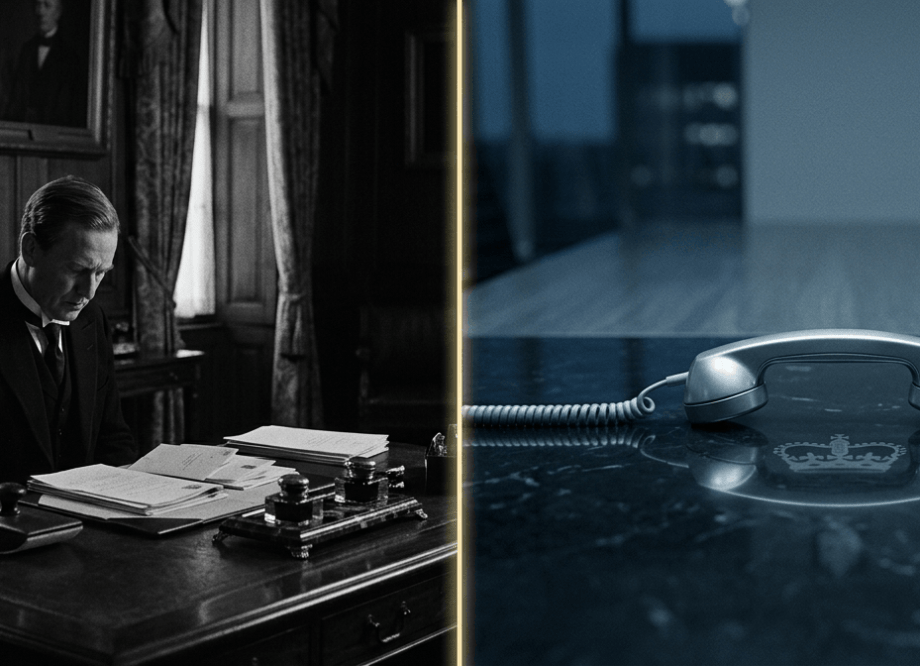
This is Blackadder Goes Forth — not with mud, but with the gutted plants and decaying towns of British industrial decline. The whistle is being blown by an evermore friendless and forlorn Keir Starmer, who arranged for King Charles to personally spruik the programme to Donald Trump in what is, surely, among the more surreal diplomatic transactions in recent memory: the King of England telephoning the American president to reassure him about a submarine deal for Australia, the people he betrayed in 1975, as documented by Professor Jenny Hocking, a country that does not yet possess the submarines in question.
Now add the AUKUS visa.
The same parliamentary committee, having noted that there are too few workers in Barrow and not enough houses to put them in, proposes a dedicated tripartite visa to move specialist engineers, welders and nuclear-qualified tradespeople between the UK, the US and Australia. Sheer genius.
Australia is already short an estimated 110,000 skilled trades workers, competing for the same pool of talent as every large infrastructure and energy project on the continent. The existing Skills in Demand visa has waiting times of up to seven months. The AUKUS visa would feature pre-approved security clearances and mutual recognition of qualifications, which sounds refreshingly straightforward until you learn that the three partner nations each operate different immigration regimes that their own governments have spent years simultaneously tightening, and that the committee simultaneously fears the imported workers will simply emigrate to Australia; which is, of course, precisely why Australia needs to import them.
The circularity is complete. It is a Little Britain sketch in which the answer to every question is the same question, delivered with increasing bureaucratic confidence. Britain, it should be noted, was once capable of producing the odd boat. Those days, like the available housing stock in Barrow, are some distance behind us.
The Americans contribute their own chapter. The Congressional Budget Office reports that Virginia-class submarines are, on average, four years behind contracted delivery dates. Production has averaged 1.1 submarines per year against a purchasing rate of 2.0 per year. The discrepancy compounds annually into something approaching geometric despair.
The Australian billions gushing into American yards is not accelerating production. The Navy Secretary has been sacked. Even the Trump administration, not previously distinguished by sober institutional self-criticism, has concluded that building fewer ships than you are buying, at four years’ delay, while collecting Australian taxpayer funds, constitutes a suboptimal arrangement. And, as of this week, the situation has deteriorated further still: it is now, in Keane’s sober assessment, extraordinarily difficult to see how Australia receives any Virginia-class submarines on schedule at all.
Buck up. It has provided inspiring, if not iconic, theatre. The grandiosity of the original announcement: three leaders, one podium, the midnight press conference, the forever partnership. How good is that trinity? More front than Myers. It all now reads as a communiqué from another shameless civilisation; one that never learned to be embarrassed.
The gap between the theatre of geopolitical ambition and the gripping reality television hunt for Barrow’s missing welders, the absent Virginia boats, the seven-month visa queue and the suppressed Plan B documents is so vast it generates its own weather system, its own postcode, and a peculiar atmosphere of institutional delusion through which defence officials still move, blithely and untroubled, murmuring that everything is on track. Happy as a bastard on Father’s Day. Comfortable.
Clearly, we have been asking the wrong question. The question is not why AUKUS continues despite the evidence. The question is why we continue to be surprised that it does.
AUKUS can only exist, can only persist, can only metastasise into advisory boards and consultancies and Companions of the Order of Australia while the submarines remain theoretical, on one precondition: a ruling class possessed of an unfathomable serenity. Marlseian will enter the language, in time, to describe the vast depth and breadth of such detachment from reality.
A class so securely insulated from consequence, so sublimely unconcerned with the lives it administers, that the gap between announcement and delivery, between promise and performance, between the midnight podium and the Barrow housing shortage, registers not as failure but as the ordinary weather of governance.
They are not troubled by the gap. They live in the gap. The gap is where the consultancies are.
Scott Morrison, like all social gate-crashers, is this class rendered in its most virulent form. Here is a man hell-bent on grotesque self-parody, who arrived in public life via the NSW Liberal Party machine and the assistance of the Daily Telegraph, rose through the theology of marketing, secretly accumulated ministries the way a suburban investor accumulates negatively geared properties, and when finally given the arse, having been comprehensively rejected by the Australian electorate in 2022, rated by historians as among the least distinguished prime ministers since Federation, described by at least one prominent journalist as easily the worst, full stop — proceeded, without pausing for breath or reflection, to convert his single most consequential act in office into a personal revenue stream of baroque elaboration.
The act itself, AUKUS, produces no submarines. Morrison’s exploitation of AUKUS produces American Global Strategies, DYNE Maritime, Triginta Advisory, Space Centre Australia’s Cape York spaceport, the Hudson Institute, the Center for a New American Security, the International Democracy Union, and a Companion of the Order of Australia. Plus the faith memoir. One imagines the submarines, had they materialised, would have been a mere footnote.
This is not corruption in any legal sense. It is something far more interesting and far more durable: it is the system working exactly as designed. The private schools and the law firms, (still, in the twenty-first century, the principal recruiting grounds of Australian political life), do not produce MPs who expect to be held accountable. They produce people who expect to be rewarded, and who carry the networks, the confidence, and the magnificent incuriosity about their own contradictions to ensure that they are.
Morrison did not engineer AUKUS as a post-political investment vehicle. He engineered it because men of his ilk genuinely believe that agreements of this kind are the new Holy Grail; grand, Anglospheric, heavy with the vocabulary of sovereignty, deterrence and national interest. That the submarines do not exist is, from this height, a detail.
That the consultancies do exist is not irony. It is continuity.
This is the precondition without which shared delusions on the scale of AUKUS cannot be sustained. Not stupidity; there is genuine intelligence distributed throughout this class. Not malice, precisely, though it is always somewhere in the mix. But a serenity so profound, so structurally guaranteed, that the distance between governing and being governed ceases to register as a moral fact. The plebeians get the mirth and the farce: the Blackadder of Barrow, the Little Britain of the AUKUS visa, the perpetual non-arrival of submarines that were supposed to be on their way; all of it serving as some small, non-fungible compensation for the bill.
The ruling class gets the Companion of the Order of Australia and a seat on the board: the minister remains comfortable.
Marles? He always was. He always will be. Looked after.
Coda: The Crown’s Long Game
There is one detail in the AUKUS story that does not belong to farce. It belongs to something older and darker.
When Keir Starmer arranged, in 2026, for King Charles to telephone Donald Trump and personally commend the AUKUS programme, the gesture was presented as a diplomatic asset. The Crown deployed in the service of the alliance, reassuring an unpredictable American president that the submarines were worth waiting for. It was reported as an achievement. Nobody appeared to find it remarkable.
Professor Jenny Hocking might.
Her decade-long legal battle to prise open the Palace Letters, the secret correspondence between Sir John Kerr and Buckingham Palace in the months before and during the Dismissal of November 1975, established, in the teeth of the Crown’s resistance, that the Palace was not a neutral bystander to the removal of Gough Whitlam. The letters, released only when the High Court ordered it in 2020 against the explicit wishes of the Palace, the National Archives, and the federal government, showed that the then-Queen, Prince Charles, and the Queen’s private secretary Sir Martin Charteris were all aware, as early as September 1975, that Kerr was contemplating dismissing the elected government and that he had not warned Whitlam of that possibility. The Palace knew. Whitlam did not.
What had Whitlam done to attract this concentrated vice-regal and royal attention? He had threatened to renegotiate the Pine Gap intelligence facility. He had recognised North Vietnam. He had disturbed, in short, the settled arrangements of the Anglo-American alliance in the Pacific.
In 2026, the same Crown, wearing a different face but carrying the same structural role, is telephoning the American president to smooth the path of an arrangement that deepens Pine Gap’s reach indefinitely, that binds Australia into American strategic planning for a generation, and that has been kept from meaningful parliamentary scrutiny by a government that responds to FOI requests with talking points.
The actors change. The Crown’s structural relationship to Australian strategic sovereignty does not. As Hocking’s research makes plain, and as the Palace Letters confirm, what presented itself in 1975 as constitutional procedure was in fact the operation of a deeper loyalty, one that ran not to the Australian people but to the Anglosphere and its permanent interests.
Fifty-one years on, nobody had to dismiss anybody.
The submarines will do.
 Urban Wronski Writes
I think increasing numbers of us are unable to find the words to adequately describe our utter disbelief and increasing anger at the lies, dishonesty and stupidity of our alleged leaders. The detail you have provided, David, is excruciating. ‘Australia, the DUMB Country’ should be on every number plate. This message will take years to recover from. The perpetrators (perpe’traitors’?) will retire in comfort, blissfully unconcerned at the damage they have wrought.
LikeLike