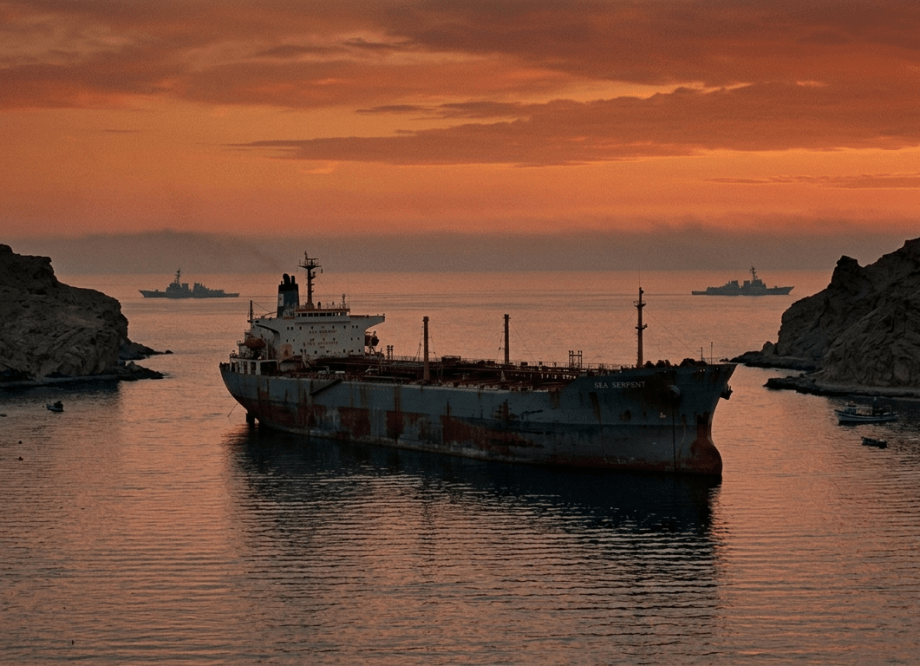
A note on length: This piece is shorter than the war’s supply chain disruptions, but longer than the attention span of the man who started it. If you want the sanitised version, Fox News is still on. If you want the truth, it’s going to take about thirteen minutes—roughly the same amount of time it took for the US Navy’s blockade to be mocked by a drone and a radio message.
So. Here we are.
The most powerful navy in human history has announced a blockade of a strait it cannot enter without being told to leave. The president who ordered it is on Truth Social, calling it a “tremendous success.” The admiral who oversaw it is calling it a “turning point.” Somewhere in Tehran, the people who pointed a drone at two destroyers and watched them turn around are also calling it a turning point, though their version involves a lot less caps lock anger and far more laughter.
Welcome to the Strait of Hormuz, April 2026. Where the gap between what is announced and what is actually happening is so vast, it requires its own shipping lane.
The Announcement: A Masterclass in Self-Delusion
The news, as with all the most reckless decisions of this administration, arrives via phone. At dawn on Sunday, Donald Trump posts to Truth Social that the US Navy will “immediately” blockade the Strait of Hormuz, after peace talks in Islamabad collapse over Iran’s refusal to dismantle its nuclear programme. “It’s going to be all or none,” he tells Fox News. “Any Iranian who fires at us, or at peaceful vessels, will be BLOWN TO HELL.”
This is also the week Trump posts AI-generated images of himself as Jesus Christ. No crown of thorns, just robes, a beatific glow, as he ministers to a man whose face looks alarmingly like his old pal Epstein. The saviour of a world that does not appreciate him.
By Monday, CENTCOM formalises the blockade. Oil prices surge. Brent crude jumps 7%. Tanker traffic halts. One ship, the Rich Starry, broadcasts its status as “drifting” off Qeshm Island, apparently deciding that drifting in international waters is preferable to picking a side.
We are all adrift now, thanks to Trump and his team of grifters, cranks, and sycophants who mistake a phone for a strategy.
The Audition: A Dress Rehearsal for Disaster
Two days before the blockade, the US Navy stages what CENTCOM calls an “historic turning point.” Iran calls it a provocation. The rest of us call it a farce.
The USS Frank E. Petersen and USS Michael Murphy, two Arleigh Burke-class destroyers, visit the Strait of Hormuz on April 11. CENTCOM hails it as the beginning of a new passage. Trump posts that America is “clearing out the Strait as a favour to countries all over the world, including China, Japan, South Korea, France, Germany, and many others.”
You can almost hear the cheers from Beijing.
What actually happens is priceless. The IRGC challenges the destroyers. The destroyers stand by to repel all borders.
A radio exchange, recorded by a civilian ship and shared with the Wall Street Journal, captures the moment:
“This is the last warning. This is the last warning,” says the IRGC.
“Passage in accordance with international law. No challenge is intended to you, and I intend to abide by the rules of our government’s ceasefire,” replies the US ship, with all the confidence of a man trying to sound calm while his pants are on fire.
Iran launches a drone. The destroyers turn around. They nip back flat chat, at thirty knots; twin plumes of spume in their wake as they retreat, full steam ahead, through the strait to the Gulf of Oman.
CENTCOM describes this as “setting conditions for mine clearing.” The mines, it turns out, are still there.
Trump calls it a huge success. The admiral calls it a turning point. In a technical sense, they’re right: the ships did enter the strait, and they did turn around. It’s just not the turning point anyone intended.
And yet the humiliation on the water only raises the obvious question: why launch this spectacle anyway?
The Patsy and His Puppeteers
Trump launched this war on February 28 without congressional authorisation, without allied support, and against the advice of every analyst who has spent more than five minutes studying Iran. He was warned. He did it anyway. He had three men in his ear. Men who have every reason to want this war and every means to flatter a president who responds to TV coverage, historic deals, and the promise of a legacy that doesn’t involve indictments.
Benjamin Netanyahu has been agitating for American military action against Iran for two decades. Mohammed bin Salman cultivates Trump with investment deals, flattery, and the occasional golf cart ride, all while dreaming of a weakened Iran. And Rupert Murdoch’s media empire amplifies every case for war and buries every argument against it, feeding Trump’s late-night Fox News diet of dopamine, disinformation, and delusion.
His foreign policy isn’t just Foxified; it’s an imaginary reality TV show where the stakes are real, but the script is pure fantasy. Hold the AI-Jesus image alongside the “BLOWN TO HELL” post. They come from the same place: a man who has cast himself as both the wrathful God of the Old Testament and the martyred redeemer of the New, and who is now conducting foreign policy from inside that delusion.
None of the three “Trump Whisperers” will pay the price at the pump. None will face the food inflation from fertiliser shortages. Trump, who seems to believe he’s been handed a soluble problem by people acting in good faith, is now discovering what it means to be the patsy in someone else’s forever war. The bill is coming due. The destroyers have already turned around once. The blockade begins on Monday, and is defied by a sanctioned tanker the same afternoon.
What He Says vs. What the World Does
Trump tells Fox News the UK is sending minesweepers. Keir Starmer tells the BBC: “We’re not supporting the blockade.” Trump tells MPs the strait must reopen with “no conditions and no tolls.” Starmer clarifies that the UK will send minesweepers—after the war ends, as part of a multinational mission. In other words: “Maybe. Later. If we feel like it.”
Senator Mark Warner, in a moment of understatement so profound it should embarrass everyone involved, tells CNN: “I don’t understand how blockading the strait is going to push the Iranians into opening it.” Six weeks into this war, and the policy still hasn’t grasped the basics.
Iran’s armed forces call the US action “piracy.” The IRGC adds: “If the war continues, we will unveil capacities that the enemy has no idea about.” Given that Iran has already turned two destroyers around with a drone and a radio message, this might be worth taking seriously.
Then the Middle Kingdom speaks.
China Draws a Line—In Ink
Chinese Defence Minister Admiral Dong Jun issues a statement that is not diplomatic hedging. It’s a dare:
“Our ships are moving in and out of the waters of the Strait of Hormuz. We have trade and energy agreements with Iran. We will respect and honour them and expect others not to meddle in our affairs. Iran controls the Strait of Hormuz, and it is open for us.”
The word “meddling,” applied to the United States Navy, does a lot of heavy lifting here. China isn’t asking for permission. It’s declaring its shipping exempt from American interdiction and daring Washington to stop a Chinese vessel in international waters. This is what happens when you announce a blockade of a strait through which a third of China’s oil travels—from Truth Social, on a Sunday morning, without consulting anyone.
The oil market gets the message immediately. When China defies the blockade, Brent crude slides back below $100. Enforcing the blockade against Chinese ships isn’t a naval problem. It’s a confrontation with a nuclear power. The US has two aircraft carrier strike groups in the region and two destroyers that have already demonstrated their willingness to turn around when spoken to firmly. The arithmetic is not encouraging.
The Coalition of the Unwilling
While Trump announces his blockade on Truth Social, the rest of the world organises a conference. Macron announces a peaceful multinational mission. Starmer confirms a summit of world leaders. A NATO official tells CBS News that the UK is leading a coalition of more than 40 nations to reopen the strait.
Forty nations. That’s the size of the coalition that has declined to join Trump’s blockade. Forty nations that, between them, represent most of the world’s naval power, most of its diplomatic weight, and all of its patience for being told—from a phone, on a Sunday morning—that they are receiving a favour.
The Geography Lesson No One Wanted
The Strait of Hormuz does not read Truth Social.
It’s 33 kilometres wide at its narrowest navigable point, with two shipping lanes, each 3.2 kilometres across. An oil tanker moves at the speed of a bicycle, about 18 knots. This isn’t a metaphor. This is the actual speed of the vessels carrying a fifth of the world’s energy supply through a corridor patrolled by Iranian fast-attack boats, drone swarms, cruise missiles, and an unknown number of mines whose locations Iran has lost track of.
Slow a warship to escort a tanker through these waters, and you’re not projecting power. You’re presenting a very expensive, very flammable target.
Retired Admiral James Stavridis tells CNN that the Pentagon would need two aircraft carrier strike groups and a dozen surface ships outside the Gulf to patrol the strait, plus at least six destroyers inside it. Trump has sent two destroyers. They’ve already turned around once. This isn’t a logistical oversight. It’s what happens when foreign policy is conducted by a man who thinks a phone is a strategy.
The Minefield—Literally
Iran has lost track of how many mines it planted in the Strait of Hormuz. It cannot, therefore, fully reopen the strait, because it cannot find everything it put there to close it.
The US, meanwhile, is blockading the strait to force it open—but lacks the mine-clearing capability to do so. The destroyers sent to begin the clearing turned around after being buzzed by a drone.
General Joseph Votel, former US Central Command chief, describes mine-clearing as “very deliberate, very slow, very frustrating.” This is the understatement of a man who has thought carefully about sending sailors into water filled with weapons whose locations have been misplaced by the people who planted them.
The Aegis combat system, designed for ballistic missiles, faces a swarm of $20,000 kamikaze drones. Million-dollar interceptors versus disposable weapons, until the ship is depleted and left making radio calls about abiding by the rules of a ceasefire it didn’t negotiate.
The scenario the Pentagon cannot admit: one dramatic loss; a destroyer struck and burning in the Strait of Hormuz, would turn Trump’s show of strength into a Suez moment for American naval power. Every admiral knows it. The two destroyers that turned around know it. The president, it seems, has not been informed.
The Bill Comes Due
This isn’t a temporary disruption. It’s the largest supply shock in the history of the global oil market. The US Energy Information Administration warns that “full restoration of flows will take months.” The global market is running a structural shortage of 6–12 million barrels per day. Analysts predict that up to 2 million barrels per day of production capacity may be permanently lost.
The UN Food and Agriculture Organisation warns of a global food crisis. Fertiliser isn’t moving. The spring planting season won’t wait for peace talks. The clock is ticking.
The deep irony? Trump is blockading a strait to punish Iran for restricting oil supply—and the blockade is restricting oil supply further.
Australia: The Bystander Who Isn’t
Anthony Albanese says Australia isn’t involved in offensive action and hasn’t been asked to join the blockade. He’s travelling to Brunei and Malaysia to discuss energy and food security; a trip you take when you’re not involved, but your fuel reserves are draining toward five weeks of supply.
Vice Admiral Mark Hammond, incoming ADF chief, confirms the navy’s readiness in careful, conditional language: “We’ve got 10 surface combatants right now, eight of them are at sea today. The question of contribution is one for consideration by the Australian government should they receive a request, and there’s been no such request as yet.”
Translation: We’re not going in. But we could. The gap between those two sentences is where Australian foreign policy lives—a position of studied ambiguity that costs nothing to maintain, until the Liquid Fuel Emergency Act is triggered.
Australia sends 80% of its LNG exports through or near the Gulf. One of the last two tankers carrying pre-war oil is heading here. The Yuan Ju Wan is scheduled to deliver jet fuel to Australia this Sunday. After that, we’re burning fuel refined from oil sourced after the war began.
Pine Gap processes targeting data for the strikes. Australian-made F-35 components are in the payload. A country whose intelligence helps guide the missiles and whose factories build the weapons doesn’t get to claim the comfort of the uninvolved—no matter what the press releases say.
The Verdict: A Blockade Built on Bluster
Fatih Birol, head of the International Energy Agency, calls this the worst energy shock the world has ever seen. Daniel Yergin of S&P Global agrees: “There has never been anything of this scale.”
Into this, Trump introduces a naval blockade:
- Contradicted by its closest ally within hours.
- Defied by China’s Defence Minister the same day.
- Rejected by a 40-nation coalition.
- Predicated on mine-clearing capability the US has neglected.
- Enforced by destroyers that have already turned tail at the sound of a drone.
- And without any theory of victory beyond “all or none.”
The IRGC said, “This is the last warning.” The destroyers turned around. The blockade began on Monday. A sanctioned tanker went through it the same afternoon.
The finest navy in the world is blockading a strait it cannot safely enter, in service of a policy it cannot explain, on behalf of a president who was handed this war as a gift by men who will not be there when the bill arrives.
The Messiah does not blockade straits. He parts the waters. Performing miracles, unfortunately, requires a different kind of power than two destroyers and a Truth Social account.
The Strait of Hormuz has seen empires rise and fall. It will outlast this administration, too. But it has already delivered its verdict: with a drone, a radio message, and two destroyers so rapidly pointing themselves back toward the Arabian Sea, it has made it clear that it does not give a fig what the Great Satan may choose to post on Truth Social.


One thought on “Mission Impossible”
Comments are closed.