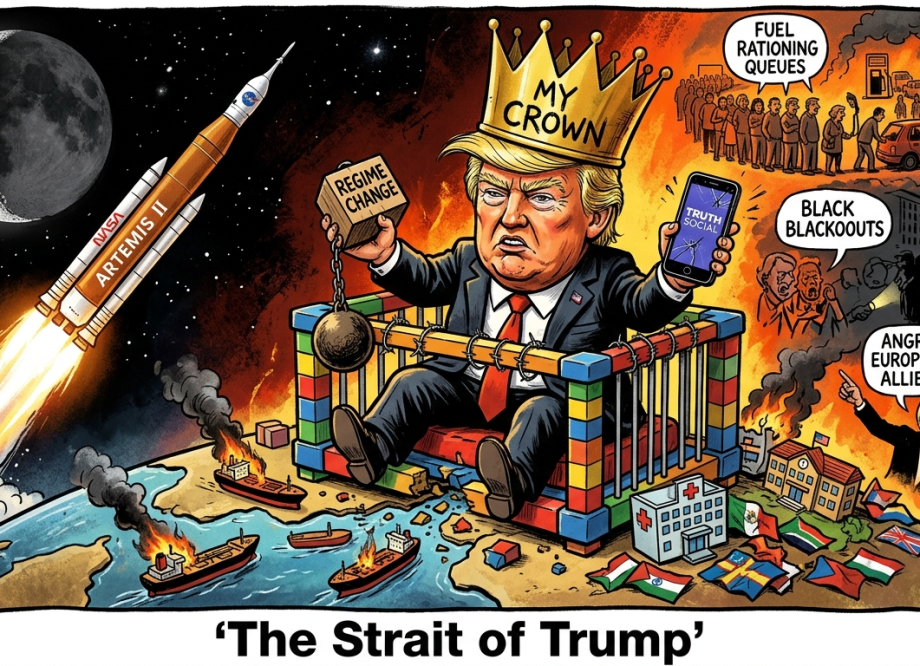
In reply to Bernard Keane, Crikey, The Regime Change we Need? Remove Trump in Washington, 2 April 2026
Bernard Keane puts it neatly: Donald Trump is either a toddler who has tired of his own game and flings away his toys, or a vandal who wrecks other people’s toys for sport. But after this week, even that framing feels too kind. On April 1, 2026 (April Fools’ Day, no less) Trump did not simply toss his toys aside. He ascended his playpen throne like a bored demiurge, surveyed a world too small to matter, and declared the Strait of Hormuz someone else’s problem.
“I don’t think about it, to be honest,” he said, shrugging off the worst energy disruption since 1973. “When we leave, the strait will automatically open.”
Then, as allies scrambled amid fuel rationing and power blackouts, he told them to build up some delayed courage, go to the Strait, and just TAKE IT. The United States, he added, won’t be there to help you anymore.
The Non-Address Address
Trump’s prime-time speech was a masterclass in anticlimax: twenty minutes of reassurance for war-weary Americans, tough talk for the cameras, and nothing (absolutely nothing) of substance. Markets listened more closely than his cabinet. Stock futures dropped as he finished speaking, reversing two days of recovery on Wall Street. Oil prices jumped nearly four percent, as traders read the address not as a signal of resolution but as confirmation that the war would drag on, and the chaos with it.
If George W. Bush was America’s Miscommunicator-in-Chief, selling a fabricated WMD case for Iraq with at least the semblance of a plan, Trump is the World’s Biggest Liar, segueing effortlessly from babbling stream-of-consciousness to flashes of leadership genius such as “We’ll see what happens.” Bush, at least, believed his own lies long enough to commit to them. Trump improvises his from one press conference to the next, and the nuclear question is the most damning proof.
One day, the Florida Golfer-in-Chief insists thwarting Iran’s nuclear capabilities is the central justification for the war, the reason thirteen American service members have died. The next, he tells Reuters he isn’t remotely concerned about Iran’s stockpile of enriched uranium: “That’s so far underground, I don’t care about that.” And the day before that, he had declared in the Oval Office: “They will have no nuclear weapon, and that goal has been attained. They will not have nuclear weapons” only to immediately hint that some future president might need to revisit the issue a long time from now.
Three contradictory positions in forty-eight hours.
This is not policy. It is improvised theatre, with live ammunition and a body count.
Regime Change as Absurdist Comedy
Trump’s regime change claim is its own genre of farce. Having repeatedly said he never sought regime change, he declares mid-speech that he had achieved it anyway. “We never said regime change, but regime change has occurred because of all of their original leaders’ death (they’re all dead),” he said. The new group is less radical and much more reasonable.
The more reasonable leader he has in mind? The incoming Iranian Parliament Speaker, a former Islamic Revolutionary Guard Corps commander responsible for brutal crackdowns on student protesters. This, apparently, is Trump’s definition of moderation.
And then there is the Artemis detail. In the hours before his war talk, Trump had been flooding Truth Social with posts about the Artemis II moon launch: “We are WINNING, in Space, on Earth, and everywhere in between. Economically, Militarily, and now, BEYOND THE STARS.” Seriously? The rocket lifted off at 6:30pm Eastern. The war talk followed three hours later. Did Trump himself know which was the main event? It doesn’t matter. The moon shot is to remind Americans, however briefly, of a time when the United States did something that looked like victory.
“We are on track to complete all of America’s military objectives shortly, very shortly,” he lies. He has never spelled them out. “We are going to hit them extremely hard. Over the next two to three weeks, we’re going to bring them back to the Stone Ages, where they belong. In the meantime, discussions are ongoing.”
Trump abuses US allies for not rushing to the aid of a United States in irretrievable decline, presided over by the Commander-in-Chief of indecision, degeneration and the mass murder of innocent civilians. The war machine, having run out of clean military targets, is now forced to obliterate hospitals, schools, ambulances and power stations. Three thousand five hundred and nineteen Iranian civilians are confirmed dead at last count (a figure the administration has not disputed and shows no sign of mourning).
This is no toddler in tantrum. It is the deity of dereliction, smashing the stage props of the world he once claimed to command, calling the wreckage proof of his own omnipotence. As Yanis Varoufakis reminds us, the problem is not that Trump has no Plan B. Trump has never had a Plan A.
The Strait of Trump: A Trap of His Own Making
The Iran war is Trump’s masterpiece of self-sabotage. Shipping through the Strait of Hormuz, through which about a fifth of global seaborne oil trade normally flows, has been effectively shut since Iran closed it following the US-Israeli strikes of February 28. Trump launched the war. Iran played its one trump card. Now, top administration officials have privately acknowledged they cannot both achieve their military objectives quickly and vow to reopen the strait within the same timeline.
The result is a global energy crisis of the administration’s own manufacture, with US crude oil settling above $100 per barrel for the first time since July 2022.
Trump’s response? He took to Truth Social to tell allies to build up some delayed courage, go to the Strait, and just TAKE IT, adding: “You’ll have to start learning how to fight for yourself. The U.S.A. won’t be there to help you anymore.”
This from the man who started the war, walked away from the consequences and is now billing the victims for the ambulance.
Saudi Arabia: The Humiliation and the Handshake
On March 27, five days before his April 1 address, Trump stood on a stage built with Saudi money at the Future Investment Initiative Priority summit in Miami (a Saudi sovereign wealth fund event attended by 1,500 delegates, including the kingdom’s most senior economic policymakers). There, he told the assembled room that Crown Prince Mohammed bin Salman didn’t think he would be “kissing my arse.” He then added, for good measure: “He better be nice to me.”
The remark was no slip. It was a public declaration of hierarchy, delivered on Saudi-branded turf, using Saudi hospitality as the backdrop for MBS’s ritual humiliation. The Saudi Royal Court and state media issued no response. In Riyadh, silence is the dignified face of fury.
What Trump apparently does not grasp (or does not care about) is that in the Gulf, face is not a sentiment. It is a strategic currency. And the cost of losing it gets paid in procurement contracts.
Saudi Arabia had already been diversifying its arms suppliers before Trump’s FII performance, but the trajectory has accelerated sharply since the Iran war began. Since February 28, Riyadh has signed, accelerated or activated arms agreements with at least seven nations (the United States, China, South Korea, Turkey, Ukraine, the United Kingdom and France) spending an estimated $20 billion in the first quarter of 2026 alone. That’s roughly equal to the kingdom’s entire 2024 defence budget, compressed into weeks.
Turkey has been among the principal beneficiaries. Saudi Arabian Military Industries has signed MOUs with Baykar, the Turkish drone company whose Bayraktar TB2 became famous in Ukraine and Nagorno-Karabakh, and with the defence electronics firm ASELSAN. The flagship deal, for 60 Bayraktar Akinci unmanned combat aerial vehicles worth an estimated $2 billion, includes a local production line inside Saudi Arabia, with projections that more than 70 percent of components will be manufactured in the kingdom by the end of the year. Riyadh is also in discussions to join Turkey’s Kaan next-generation fighter jet program.
No American defence contractor has come close to matching those technology transfer terms.
This does not mean Saudi Arabia is abandoning American weapons systems: Patriot batteries and THAAD interceptors are not something you swap out during a shooting war. But the direction of travel is unmistakable. The oil-for-security compact that has governed the US-Gulf relationship since Franklin Roosevelt met King Abdulaziz on the USS Quincy in 1945 is being quietly dismantled, contract by contract, MOU by MOU, one Ankara handshake at a time. Trump’s genius for the crass remark or the totally inappropriate public insult is accelerating a process that will outlast him indefinitely.
The Strait of Trump? The Toxic-Narcissicist-in-Chief briefly floats renaming the Strait of Hormuz after himself, calling for Iran to open up the “Strait of Trump, I mean, Hormuz,” adding that there are no accidents with him. On that last point, at least, he may be telling the truth. “Trump of Hormuz,” however, may be how future historians will remember him.
Syria: The Jihadist Turned Plumber
The most arresting geopolitical diversion of the week did not come from Washington or Tehran but from Damascus. Syria’s post-Assad government (all spruced up and respectable, its budget nearly tripled to $10.5 billion, with energy infrastructure as its centrepiece) is formally pitching itself as the world’s energy saviour.
What was once Al Qaeda in Syria is now offering to reroute the Trans-Arabian Pipeline to its Mediterranean coast, proposing a new line capable of pumping up to four million barrels per day from northeastern Saudi Arabia to the Syrian ports of Baniyas or Latakia. There are also plans to extend a Qatari natural gas pipeline through Syria to Turkey and Europe.
The Tapline is not new. Built between 1947 and 1950 by Aramco as the world’s longest oil pipeline, it ran 1,214 kilometres from Saudi Arabia’s Abqaiq fields to Lebanon’s port of Sidon, crossing Jordan and Syria. It was designed to bypass the Suez Canal and operated for three decades until the Lebanese civil war shut it down in 1983. Now, the pipeline that Aramco built to bypass Suez is being pitched in 2026 to bypass the clogged Strait of Hormuz.
Washington is not indifferent. US Special Envoy Tom Barrack bragged at a recent energy forum that Syria could serve as an alternative to the Strait of Hormuz in the future through the construction of pipelines, noting that earlier Syrian infrastructure plans envisioned the country as a junction connecting the Arabian Gulf, Caspian Sea, Mediterranean and Black Sea. Saudi Arabia, Qatar and the UAE are already moving. Saudi companies Taqa, Ades, Arabian Drilling and Arabian Geophysical and Surveying agreed in December to provide technical support, while the UAE’s Dana Gas entered a tentative deal with Syria’s state petroleum company. Overnight, the UK Prime Minister met Syrian President Ahmad al-Sharaa in Downing Street, discussing the need for a viable plan to reopen the Strait of Hormuz and agreeing to work with others to restore freedom of navigation.
But is it a real game changer? The obstacles are not trivial. Syria’s infrastructure is war-ravaged, sanctions are only partially lifted and the World Bank estimates reconstruction costs at $216 billion. Even the existing pipeline alternatives fall well short of replacing Hormuz. The combined capacity of existing bypass pipelines, including Saudi Arabia’s East-West line and the UAE’s Abu Dhabi Crude Oil Pipeline, amounts to around 9 million barrels per day against the 20 million that normally transit Hormuz. Syria’s offer, however real its potential, is measured in years and investment horizons, not weeks.
Yet the pitch reveals something Keane’s piece gestures toward without quite landing: Trump’s vandalism is reorganising the world’s geography of power in ways that will long outlast his presidency. When a reconstituted Syria, led by a former Al Qaeda jihadist turned pragmatic statesman, can walk into Downing Street and credibly offer Europe an energy lifeline that Brussels cannot refuse to consider, the old order is not declining. It is already dead.
The Tariff Rampage: Chaos as Policy
Trump’s tariffs and the uncertainty surrounding them have sent shockwaves through the global economy while failing to achieve a single stated aim. They do, however, represent the largest US tax hike since 1993, amounting to an average increase of $1,500 per US household in 2026. Moody’s Analytics Chief Economist Mark Zandi calls it plainly: “The US is pulling away from the world, and the rest of the world is now pulling away from the US.”
Zandi is right that tariffs are a tax on consumers. But he is wrong to say they simply ruin trade. What they do is change the nature of trade from an unregulated race to the bottom on labour and environmental costs to a managed system that, in theory, prioritises domestic stability. In practice, under this administration, they prioritise chaos.
Keane is correct to note that the United States Studies Centre crew at the Financial Review would rather Australians fear China than the country whose actions have inflicted the actual energy and economic shock. This is the ideological laundering operation that Pine Gap makes literal. While the Australian public buys the official line that it is only a big radar station, the centre is increasingly being used to provide the intelligence the United States requires to target infrastructure across Iran. Canberra, meanwhile, maintains the polite fiction that its involvement is purely defensive.
Regime Change in Washington? Wishful Thinking
What Keane’s argument finally arrives at (regime change in Washington) is commendable but wishful thinking. Calls for the 25th Amendment have been creeping into conservative as well as Democratic circles since the Iran war began, with prediction markets now putting the probability of its invocation at 33 percent, up from 15 percent at the start of the year. Democrats have introduced multiple impeachment resolutions, including seven articles covering obstruction of justice, abuse of trade powers, international aggression, bribery, corruption and tyranny. None will pass a Republican House.
What remains? The November midterms. The courts. Sustained popular pressure. And the growing reality that while Washington dithers and blusters, some of the world’s energy architecture is quietly rerouting itself through Damascus.
The Strait of Hormuz may not rename itself. But it may yet make itself irrelevant. That, ultimately, is the most damning verdict on what Trump and Netanyahu have wrought: not just that they broke the old order but that they handed the blueprint for the new one to Ahmad al-Sharaa.
Unless, of course, it is all a piece of diversionary theatre and a convenient way of getting back at Tehran that nobody in Washington quite planned for either.
In Part Two, we’ll explore how Australia’s alliance with the US is reshaping its own energy and security calculus and why Canberra’s silence on Iran may be its loudest statement yet.


Ozymandias in his playpen
LikeLiked by 1 person
Trump and Netanyahu have succeeded in giving the world a kick in the guts. What I find sickening, is the fact that the world does nothing about it!!
I wonder, just what Trump and Netanyahu have to do, before the rest of the world takes some action?
LikeLike