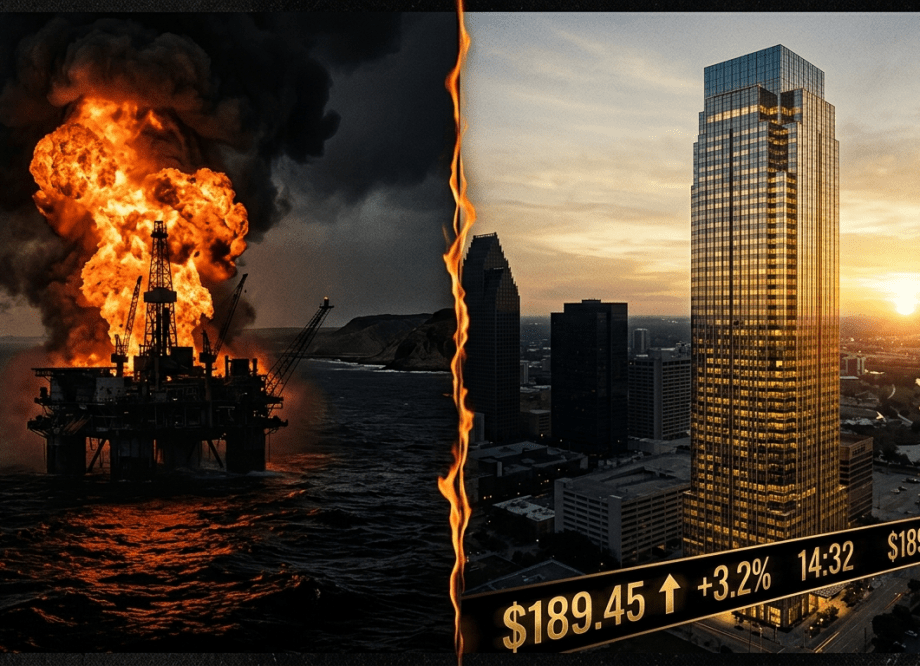
Windsock politician, Senator Lindsey Graham is many things, none of them good, but he can be useful in the way that a broken clock is useful: twice a day, and usually unbidden, he tells you the time. On Fox in early March, a week after Mad King Donald kids himself he merely let Israel talk him into bigging himself up with a quick regime change in Tehran, Graham spills the beans on Operation Epic Fury with the guileless candour of a man who simply forgets that the cameras are rolling.
“Venezuela and Iran have 31 percent of the world’s oil reserves,” he tells Maria Bartiromo. “We’re going to have a partnership with 31 percent of the known reserves. This is China’s nightmare. This is a good investment.”
“When this regime goes down, we are going to have a new Middle East, and we are going to make a tonne of money.”
Graham has been lobbying for war with Iran for over two decades. The Wall Street Journal details his breakthrough. In the weeks before the February 28 strikes he is back and forth to Israel to meet Mossad, because, “they’ll tell me things our own government won’t tell me,” and coaches Netanyahu personally on how to lobby Trump for military action. His remarks on Fox are not a gaffe. They are a mission statement delivered by a man who has achieved his life’s work and wants credit for it.
The mainstream press covered the remarks briefly, expressed mild discomfort, and moved on. Independent media did not. They had been saying exactly this since before the first strike landed. The financial evidence is now so comprehensive, and the pattern so precisely executed, that continuing to treat it as coincidence requires a deliberate act of not looking.
The Windfall, Quantified
Common Dreams calculates it in early March, when the scale of the opportunity was first becoming clear: US LNG giants stood to pocket up to twenty billion dollars in monthly windfall profits from the Iran war. The Qatari shutdown, which pulled roughly twenty percent of global LNG supply off the market, was the engine of that figure. Qatar had been the world’s second-largest LNG exporter. Its Ras Laffan facility, which processed virtually all of its production, had become in the years since Russia’s invasion of Ukraine the single most important alternative gas source for a Europe desperate to break its dependence on Moscow. That dependence was now switched, if not snatched, swiftly, by Houston.
The shares of Cheniere Energy and Venture Global, the two largest US LNG exporters, surged immediately US Tomahawk missiles were killing civilians in Tehran. Not in the days that followed. On the day. The market understood immediately what the war meant for American gas producers, even as its crafty architects were careful to frame their illegal attack as a surgical strike to halt Iran’s race to make its own nuclear weapons, boost regional security and liberate its people from the Mad Mullahs.
Public Citizen’s energy analyst Tyson Slocum spelled it out for NPR: “What this means is a massive financial windfall for US LNG exporters.” The Washington Post confirmed that US gas exporters were going to do very well out of a vicious and dirty war, with the Trump administration actively leveraging the shortages to push American LNG on desperate Asian and European buyers.
US Energy Secretary Chris Wright spent an entire week in Houston during the war’s third week, meeting with energy executives, promoting natural gas as America’s “superpower.” Morningstar analysts published a formal report concluding that buyers would now prioritise “jurisdictional stability, contractual certainty, and diversified supply chains, criteria that strongly favour North American LNG.”
Taiwan announced it would increase LNG imports from the US starting in June. South Korea capped fuel prices for the first time in thirty years while its president described the war as “a significant burden on our economy.” Bangladesh shut its universities to conserve energy. India began rationing natural gas. And Cheniere Energy’s CEO Jack Fusco told the CERAWeek conference in Houston that he was “literally answering phone calls of ‘Help!’ from Asia.” Answering them at premium spot-market prices.
You do not need a conspiracy theory when you have a balance sheet.
The South Pars Sequence
On March 18, Israel strikes the treatment plant at Asaluyeh, the onshore processing hub for South Pars, the world’s largest natural gas field. South Pars sits beneath the Persian Gulf, straddling the maritime boundary between Iran and Qatar, which calls its side the North Field. 51 trillion cubic metres of recoverable gas. Iran relies on it for 70 to 80 percent of its domestic supply. Qatar relies on it for all of its LNG export industry, which at the time of the strike was supplying roughly one-fifth of all LNG traded globally.
Iran retaliates within hours against Qatar’s Ras Laffan Industrial City, causing what QatarEnergy described as “extensive damage.” The repairs, QatarEnergy’s CEO told Reuters, would sideline 12.8 million tonnes of annual LNG production for three to five years. The company declares force majeure on long-term contracts for customers in Italy, Belgium, South Korea and China. QatarEnergy had already halted all LNG production earlier in the conflict. Now the halt has a five-year horizon.
The Middle East Council on Global Affairs describes the Asaluyeh attack as crossing “a threshold that energy strategists have warned would transform a regional conflict into a global supply crisis.” The Oxford Institute for Energy Studies confirms benchmark gas prices had returned to levels last seen in January 2023. Wood Mackenzie says the attacks “fundamentally reshape the global LNG outlook.” The American Prospect notes that three US LNG export facilities, including Cheniere’s Corpus Christi terminal, were already slated for expansion in 2026, their financing now enormously more secure.
Trump maintains the US “knew nothing” about the South Pars strike. A US official then tells NBC News that Israel had informed the US in advance, and that the US and Israel had been coordinating strikes and targets throughout the war. The confirmed documentary record, now incorporated into Wikipedia’s account of the attack, shows that while the US initially opposed Israeli strikes on Iranian oil facilities, it subsequently approved and coordinated the South Pars strike as “a message to Iran” over the Hormuz closure. Trump, a world champion liar, then denied knowledge again. But the record of events speaks for itself.
Israel strikes South Pars. Iran retaliates against Qatar’s competing LNG infrastructure. Twenty percent of global LNG supply goes offline for five years. American exporters fill the gap at premium prices. Trump denies knowledge. US officials confirm coordination. Trump denies knowledge again. And again the record flatly contradicts him.
ExxonMobil holds a 34 percent stake in one of the damaged Qatari LNG trains and a 30 percent stake in another. ExxonMobil is also a partner in the new Golden Pass LNG facility on the Texas Gulf Coast, which was coming online as the war began. The company’s senior vice president tells the Morgan Stanley Energy and Power Conference, while the bombs are falling, that ExxonMobil had “a big trading operation” and “a large, long-term charter fleet” enabling it to “move feed and products around the world to optimise around this situation.” Optimise. Around this situation.
The language of a man reading from a prepared script he did not think would receive much scrutiny.
From Iraq to Venezuela to Iran: The Long Game
The independent analysts who saw this coming were not making predictions. They were reading history.
Antonia Juhasz, investigative journalist, Rolling Stone contributor and author of “The Tyranny of Oil,” tells Democracy Now! that the Iran war is the continuation of a fossil fuel agenda running unbroken from the 2003 invasion of Iraq. “US oil interests lobbied aggressively to pursue oil on their terms in Iraq and Iran, driving the invasion of Iraq, lobbying aggressively to see a second front in the war in Iran,” she says.
“As I have written repeatedly about war in the Middle East, oil is a key agenda. But driving a country like the United States to war is never a simple thing, and it’s never just one thing. It’s meeting a series of interests by a series of players.” She identifies the key interests clearly: not “securing oil wealth for the US” in some national sense, but securing oil wealth for oil companies.
This is a distinction our political masters consistently, conveniently conflate. When Graham says “we are going to make a tonne of money,” he does not mean those American households now forking out $4 a gallon at the pump. He means Cheniere. He means Venture Global. He means ExxonMobil. He means the donors who have funded his Senate campaigns for a quarter of a century.
Economist Michael Hudson, distinguished research professor at the University of Missouri and author of “Super Imperialism,” draws the structural picture meticulously. Rising world oil prices, he tells Democracy Now!, represent a windfall for US domestic oil and gas companies while simultaneously creating a debt crisis for Global South countries paying in dollars for energy they can no longer afford.
“The rise in world oil prices is a windfall for the United States,” he said. “The United States’ balance of payments is in very good terms.” The pain is being exported. The profit is being retained. This is not a side effect of the war. It is its engine.
Hudson also points to a longer strategic frame ignored in the Australian press. His book “Super Imperialism,” he notes, is “basically the guide for the Defense Department’s move with OPEC way back in 1974.” The precedent matters. In 1973, the Arab oil embargo created a supply shock that threatened the dollar’s global dominance. Henry Kissinger’s response, over the following year, was to engineer an arrangement whereby Gulf oil would be priced in dollars and the resulting petrodollar surpluses recycled back through US financial markets and Treasury bonds. The dollar’s reserve currency status was secured not by American productivity but by American control of the global energy price mechanism. The Iran war is, among other things, an assertion that this control will be maintained, by force if necessary, against any challenger, whether Iranian, Qatari, Russian or Chinese.
Graham says it is China’s nightmare. He is not wrong about that either.
The Superpower That Runs on Other People’s Disasters
The Trump administration’s own language on this has been remarkably unguarded. “Energy dominance” is not a phrase invented by critics. It is the administration’s stated policy. The Department of Energy boasted in a formal fact sheet that the US is “producing nearly as much natural gas as Russia, Iran and China combined.” It credits Trump’s Day One reversal of the Biden LNG export ban as “delivering prosperity at home and peace abroad,” the latter claim requiring a very specific definition of peace that excludes the two thousand people killed in Iran in the four weeks since “peace” began.
The American Prospect points to what this means in practice for American and Australian consumers: “If you’re worried about paying your utility bills, pay attention to what’s happening in the Strait of Hormuz.” The more the US exports LNG, the more domestic natural gas prices are tied to global market swings. It is US consumers bidding against global consumers for the same gas, and losing. The Public Citizen analysis found that Americans paid twelve billion dollars more for natural gas in the first nine months of 2025 than in the same period of 2024. Trump’s war will not improve that figure.
The National’s energy analyst identifies the longer-term irony with some elegance: the very crisis the US has engineered will ultimately accelerate the global transition away from fossil fuels, with the biggest long-term beneficiary being China, which is installing more renewable and nuclear capacity than any other nation on earth and whose overland energy routes from Russia and Central Asia are entirely insulated from Persian Gulf disruption. “US energy dominance,” the analysis concluded, “is based on creaking 20th century technology. Within a decade, its mirage of energy dominance will become energy depression.” The Iran war has given American LNG exporters a few very profitable years and handed China a generation.
Who Benefits, Who Knew, Why It Matters
Nothing in this analysis requires the assertion of a single conspiracy with a planning document and a smoking gun. What it requires is the simple application of the question all journalists used to pursue, unbidden: who benefits?
Follow the money. American LNG exporters benefit. Their shares said so on the day the war started. American energy companies with stakes in Qatari infrastructure benefit by redirecting their positions to US domestic production. The dollar benefits, as global energy purchases continue to be denominated in it. The defence industry benefits: Lockheed Martin hit an all-time share price high in March, Northrop Grumman recorded double-digit gains, RTX surged twenty-two percent. The senators and congresspeople whose campaigns are funded by these industries benefit. Rupert Murdoch’s media empire benefits from the audiences that wars reliably deliver and from the proximity to power that warmongering provides.
Who does not benefit? The 1,937 Iranians killed as of last week. The twenty thousand seafarers stranded off the Strait of Hormuz. Monstrous new trade winds have becalmed these modern types of the Ancient Mariner. Likewise, their world ravaged by the dogs of war, the Qatari workers at Ras Laffan whose facility is offline for five years. The European households paying fifty percent more for gas than they were in January. The Indian government rationing natural gas to its industries. The Bangladeshi students whose universities are closed to save power. The American families paying more at the pump to fund a war that is delivering, in Graham’s precise formulation, a tonne of money to the people who needed it least.
Antonia Juhasz got the structure right: it is never just one thing, and it is never simple. The war serves Israeli security interests, or at least Netanyahu’s political interests, which are not the same thing. It serves Trump’s monstrous ego and his handlers’ media management needs. It serves the fossil fuel industry’s quarterly earnings reports. It serves the defence contractors’ order books. It serves the dollar’s reserve currency status. These interests do not require coordination because they are structurally aligned. They do not need a plan because the plan is the system.
Lindsey Graham said it was a good investment. The balance sheet agrees. The question that the mainstream press has consistently failed to ask, and which the independent analysts cited in this piece have been asking for weeks, is not whether the war serves these interests. It clearly does. The question is whether those interests drove the decision to start it.
That question has not been answered. It has barely been asked. But the Kissinger playbook from 1974 is sitting in plain sight, and Michael Hudson has read it. Antonia Juhasz has traced the line from Iraq to Venezuela to Tehran. Lindsey Graham has told a national television audience that this is China’s nightmare and a tonne of money.
And the shares of Cheniere Energy went up on the day the first bombs fell.
Draw your own conclusions. The evidence is compelling.


A sad tale, but true.
LikeLiked by 1 person