John Birmingham can’t remember who sold him his first cricket bat. But he knows in a flash who broke it.
It is a fine opening: intimate, funny, a little melancholy, and entirely characteristic of Another Country, his Quarterly Essay on the rise and rise of Pauline Hanson. Birmingham returns to Ipswich, the city that made him, to ask how Australia came to embrace Hanson and her politics of grievance, nostalgia and betrayal.
The answer, he suggests, lies partly in the stories we tell ourselves about the past. Those stories feel solid because we need them to be solid, even when they are not.
Was the bat bought at Voglers? Or Goleby’s? Birmingham cannot remember. The old shops are gone. Voglers sold guns. Goleby’s had a life-size horse in its saddlery. Two chapters later, his oldest mate settles it: Strudwick’s. Phil remembers the two-for-one coupons.
The bat was broken by Craig McDermott, who would soon wear the baggy green for twelve years before giving cricket away for the property game. When Bridgecorp collapsed in 2007, owing some 14,000 investors, its biggest Australian debtor was a former Test fast bowler. Within a year, he was bankrupt.
It is a neat bit of supporting cast. Birmingham’s Ipswich is not a museum piece. It is a place where the past keeps turning up in unexpected forms: in a broken bat, a dead mine, a railway workshop turned museum, a disability scheme, and a mate on a walking frame.
Phil is bent over by scoliosis. One eye is blind. His body is failing, but his memory is the best in the essay. He corrects Birmingham on the year of the Box Flat mine disaster: 1972. His next-door neighbour died in the explosion, along with sixteen other sons, husbands and fathers.
The man who remembers best is Phil, the bloke the state now looks after: his chair, his bathroom, five weeks in a hotel while it is built, and his carer, Ron. Ron is in his late fifties but has made a go of things. Birmingham gives him “a crushing handshake and the build of a former front-rower”.
Surely he is not a Pauline Hanson fan?
What Birmingham Gets Right
Another Country is the most complete account yet of how Australia got Hanson. It is also one of the best. It is a rattling good read, and it deserves to be read widely. More than that, it deserves a fair hearing before it gets an argument.
Birmingham is an Ipswich boy with a keen eye, and he takes the reader on a well-observed journey back to his childhood home to assess the modern miracle of neoliberalism: an economy in which a man can be his brother’s keeper, and often has to be. The NDIS is where the work is. The workshops and factories that once made things in Ipswich are long gone.
Why? Because we cannot compete with overseas wages, we are told. But must we accept that? We wedded ourselves to free trade and called it reform. We buy cheap now. We sold ourselves cheaper.
Birmingham follows the money with a deft history lesson. In flashback, Keynes has bested Hayek, and the long post-war peace belongs to him, until the neoliberal brotherhood gets a leg up. We are up Mont Pèlerin on April Fool’s Day in 1947, where, as Birmingham puts it, “the prophets of standing on your own two feet” fly in “on somebody else’s dime”.
The free-market geeks cannot agree on a name, so they borrow the mountain’s. Luckily, someone else’s money does the talking. We see the Credit Suisse cheque, and Antony Fisher’s battery-chicken fortune paying for the think tanks that taught both sides of politics to say “economic rationalism” with a straight face.
Birmingham reminds us that Hawke and Keating were the Labor heroes who, in Milton Friedman’s phrase, made the politically impossible politically inevitable. They hastened the transfer of wealth from worker to shareholder. By the bucket-load.
They did not start it. The Australia Institute puts the workers’ share of GDP at its peak in 1975, at more than 58 percent. Hawke and Keating sped up the slide. By mid-2022 it had hit a record low of 44.1 percent, while a record share went to profits. It has crept back since. It has never come home. Birmingham gives the 44.1 as today’s figure. It was the 2022 trough. Almost 90 percent of the fall, the Institute’s Centre for Future Work found, went into corporate profits, and more than half of that went to the finance sector.
Last financial year, Coles and Woolworths each banked a net profit of about $1.1 billion.
Ron reckons Gina Rinehart, Pauline Hanson’s patron, pays her taxes. He is right. Hancock Prospecting counts itself among Australia’s largest corporate taxpayers, with $3.9 billion in taxes paid in 2024. But that is only part of the story. The legitimate criticism is not that Hancock pays no tax. It is that a company can be a major taxpayer and still arrange its workforce so that the people who do the work have less security and less say.
Take the train drivers at Roy Hill, Rinehart’s flagship mine. To win the haulage contract, the labour-hire firm Railtrain set up a subsidiary, Karijini Rail. In 2018 it put a non-union agreement to a vote. Two drivers voted. Both were on probation, still in training, and never told they were covered by the Mining Industry Award.
The deal paid less than Railtrain’s existing Pilbara drivers earned. The rest of Railtrain’s Roy Hill drivers were then moved onto it.
In 2021 a full bench of the Fair Work Commission quashed it, for the second time. It found “corporate manipulation”, and said the agreement “lacked moral authority“.
Two trainees voted for a whole roster. That is the labour-hire model. It is the railway again, too. Roy Hill runs its own, and hires its drivers through somebody else.
And do not think One Nation is coming to the rescue.
Birmingham calls Hanson “basically a neoliberal shill”, and her voting record backs him: welfare cuts, the cashless debit card, tax cuts for high-income earners, and a vote against the Robodebt royal commission. He notes her silence when Albanese and Taylor gave a public that wanted a gambling-ad ban more gambling ads.
He has Barnaby Joyce, star recruit from the National Party circus and One Nation’s Treasury spokesman, defending the plan to let workers spend their super on rent by explaining that only morons would use it.
The algorithm, Birmingham writes, “does not lie so much as agree with its user”.
I would go further. It colludes.
Not with Ron, who thinks he is checking his facts, but with his circuit of reinforcement. Every glowing post is a small reward. Every one tells him he was right all along, that he is one of the few who can see through it. The machine does not just feed his appetite. It buys it a round of drinks on the way home.
Flattery is the oldest con in the game. The algorithm simply runs it at scale, on a billion marks at once. It never gets bored. It never needs a coffee break.
Ron checks four or five channels on the internet before he believes anything. He is duped. All of them were picked for him by the same code. He does the “research”. His dopamine signs off on it.
Birmingham has Ron’s feed telling him Albanese gave the Mufti $670 million for a mosque in exchange for votes. It never happened. Weeks later, the government was caught spending some $560 million on community grants that looked, in Birmingham’s phrase, to have been picked with a Magic 8 Ball. That did happen.
The lie does not need to be believed. It only needs to sit beside the truth until Ron cannot tell them apart. Labor keeps supplying the feed with true stories that look like the false ones.
Phil leaves ABC radio on for company and never scrolls. He ends up with the best defence in the essay. He does not engage, and nothing on the radio tells him how clever he is.
That is the dopamine economy on one back deck. Ron’s diligence is the hook. The flattery is the bait. Phil’s loneliness is the shield.
So the case is made. It is a fine essay.
What follows is what it leaves out, and where it loses its nerve.
The Receipt in Ron’s House
Ron is Phil’s carer. Ron got Phil onto the NDIS. Ron’s wife, Birmingham tells us, left cleaning to provide care services through the NDIS. Ron’s idea of retirement is caring for Phil and people like him.
Ron’s household runs on the scheme. Phil’s home depends on it. Even Brisbane Street does now. Birmingham walks it. The saddler and the cooper are gone. The biggest businesses on the street now deal in government-funded care.
Ron is voting One Nation, “just to try and break the monotony”. But he is backing the wrong horse, and not the one in Goleby’s saddlery.
On 18 August 2026, the Senate passed the NDIS Amendment (Securing the NDIS for Future Generations) Bill, the largest contraction of the scheme since it began. Every Labor senator in the chamber voted for it. So did three of One Nation’s four: Sean Bell, Malcolm Roberts and Tyron Whitten. Hanson was absent.
The government’s target is $37.8 billion in savings by the end of the decade. About 240,000 people are expected to be moved off the scheme. Cuts to social and community participation budgets began rolling through plans on 1 October.
Birmingham’s list of Hanson’s votes is accurate. It just stops short of the one that lands on the deck where he is drinking instant coffee.
Phil’s party wrote the cut. Ron’s party voted for it. The man voting to break the monotony is voting for the senators who voted to shrink his wife’s line of work and his best mate’s support.
None of it is hidden. In 2023, Hanson’s social media ran a cartoon calling the NDIS a “scam” and a “rort”. People with Disability Australia called it “repugnant, hateful and discriminatory”.
Birmingham proves Hanson is a neoliberal shill in the abstract. Ron’s house is where it gets specific.
Jim Chalmers calls Hanson a wholly-owned subsidiary of Gina Rinehart. On 18 August, the subsidiary’s senators voted for his NDIS cut.
The Railway
Birmingham writes beautifully about the coal: Box Flat, seventeen men, the mine sealed with the bodies inside, and Hanson at the Press Club promising power from coal “at the world’s cheapest price”.
He says less about the railway. And the railway is Phil’s father.
Phil’s father was a carpenter who built carriages. The North Ipswich workshops were the city’s largest employer for most of the twentieth century, with more than 3,000 staff in the 1950s. They built more than 13,000 carriages. Their operations officially closed in 1997, the year after Ipswich sent Hanson to Canberra.
Today they are the Queensland Museum Rail Workshops. Ipswich no longer builds carriages. It exhibits them.
In June 2009, three months after an election at which it was never raised, Anna Bligh’s Labor government announced the sale of QR National, the state’s coal and freight railway. The float raised $4.6 billion.
Birmingham indicts Hawke and Keating. Queensland Labor gets off without a mention.
Phil’s grandmother tore up every how-to-vote card but Labor’s. Labor sold the railway her son built carriages for.
The Counterfeit
Birmingham catches “Comrade Hanson” in her first speeches: against privatisation, against the world bankers, against economists with their heads in textbooks. He treats it as cartoon populism, since dialled back.
Look closer, and it is a costume.
In chapter one, Birmingham quotes her lost Australia: the big industries, Ford and Holden, and Arthur Calwell, “a great Australian”. But is he the poster boy she thinks he is? Calwell was Labor’s leader, and also the immigration minister who joked in 1947 that “two Wongs do not make a White”.
Her maiden speech in 1996 was performance art as tantrum: the politics of whataboutme. “I believe we are in danger of being swamped by Asians.” Twenty years later, back in the Senate, it was Muslims. The Others change. The promise does not.
Give her the country back, and fairness and decency will follow as surely as night follows day?
That is the rebirth myth, the one historians of fascism start with.
Public ownership, protection, full employment and White Australia. That is not a vague golden age. It is the Labor platform of 1949. In 1998, One Nation opposed the Telstra sale, and John Howard complained that Labor and One Nation were “much closer to each other on economic policy” than either was to him.
Hanson sells a counterfeit of a Labor Party that Labor stopped making in 1983. The old label is on the bottle. The IPA’s product is inside. And the racism, the one ingredient Labor finally threw out, she kept.
That is why the economic populism faded while the Others multiplied. Birmingham calls it the flexible Other. It is also the flexible label.
Scholars learn to live with doubt: the standing chance that the next fact will disprove them and their work. Scoundrels cannot afford it. They tender a counterfeit coin called certainty, drawn on the Bank of Nostalgia, which takes deposits in a simpler, better country that never existed.
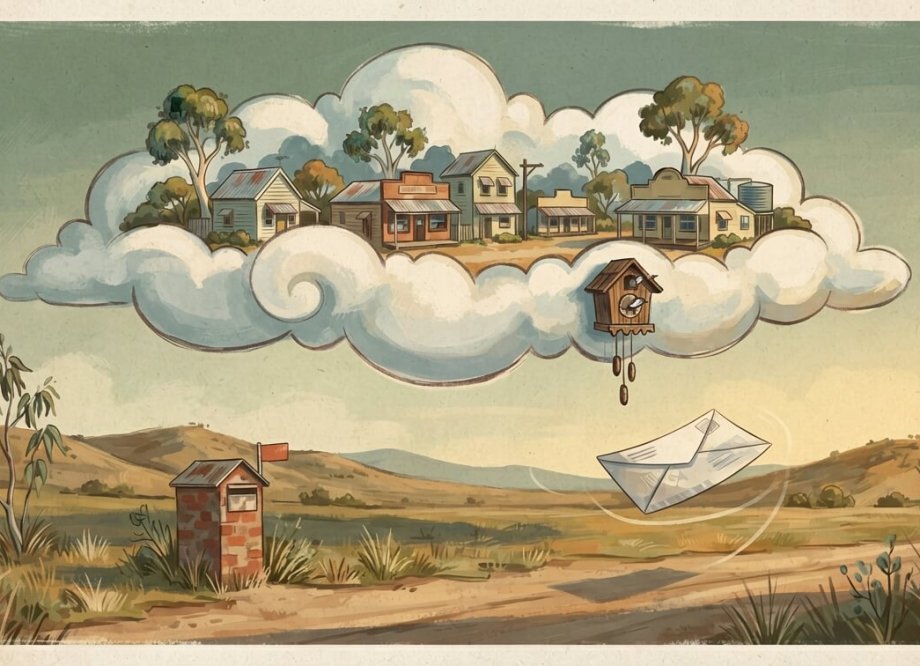
Birmingham calls it the Kingdom of Again. Hanson has run up a thirty-year overdraft there. The bank is offshore. Not with the gnomes of Zurich. In Cloud Cuckoo Land.
Ron is the guarantor.
Not Luck
Birmingham’s best idea arrives with its working shown. He tries geometry first, a Venn diagram, and throws it out. Then chemistry. Millions of Australians “marinating in cortisol” make a supersaturated solution. Thomas Sewell’s handful of Nazis are the seed it crystallises around. Hanson, he suspects, wants to be the catalyst.
She is the wrong candidate. A catalyst speeds the reaction, takes no part in it and comes out unchanged, ready for the next batch.
That is the feed.
Birmingham has it in the same chapter, in a Yale study of 12.7 million tweets: outrage rewarded with likes, and more outrage the next time. It works on any solution. The same stress sends Gen X to Hanson and Gen Z to the Greens, and the platform takes its cut from both.
He even sees the feed at work at the March for Australia, channelling the marchers. He just gives it the megaphone’s job and Hanson the chemist’s. It is the other way round.
He leaves out the heat, too. A solution does not supersaturate itself. Someone boils off the water.
Birmingham has the figures: more than a million Australians working second jobs; the richest 200 holding 23.7 percent of GDP, up from 8.4 percent. Policy turned up the burner.
Hanson just bottles what crystallises, and sticks the old label on it.
Birmingham calls Hanson “an ignorant grifter who got lucky three times”. Howard’s vetting error. Turnbull’s double dissolution. An epistemic collapse that arrived on schedule.
Luck is what the owners of the paddock like it to be called.
The Hobart novelist Robbie Arnott once had a season like that. His league swapped the red ball for the white, which swings less and goes soft early. Scores soared. Bowlers were smacked all over Hobart. A few innings went his way, and a “frazzled captain” decided he was an all-rounder and promoted him from number nine to six.
At six, he graduated to the spot where the real sledging starts.
Birmingham writes that, as the party grows, sophisticated actors “will move to align their interests with hers”. Future tense.
Hancock Prospecting paid the IPA $2.3 million in 2016, almost half its income. In September, the IPA called One Nation’s net-negative migration policy “a game changer”. The jet to Mar-a-Lago was Gina Rinehart’s.
Birmingham traces the money from Mont Pèlerin to the IPA, then stops one step short of One Nation’s door.
The alignment he predicts is already here.
Nowhere Else to Go
Then comes the ending, where the essay loses its nerve.
Birmingham tells us he drafted questions for the nation’s leaders, then filed them away unsent. There was no point, he decided. Albanese appeases. Taylor, in his phrase, “has already sheathed his sword”.
So he looks to the young. Gen Z breaks for the Greens. They have no memory of a better past, so they are “forever banished from the Kingdom of Again” and must build the future, “there being, for them, simply nowhere else to go”.
He even concedes, in the next breath, that every failed generation hands its mess to the young.
That is the hand-off, and it should not be made.
Thirty thousand words diagnose fifty years of deliberate policy. But be not dismayed. The younger generation will fix it. They always do. Mix in one converted Tory and a line of Auden. Shake, don’t stir.
The young are not a breakwater. They are the people who will be handed the bill.
He ends with the Sirens: Hanson pipes the tune and we pull for the rocks. He forgets how the story goes. The crew rowed past. Odysseus had their ears stopped with wax and himself lashed to the mast. Nobody waited for a younger crew.
He stops his Auden in the haunted wood, too. The poem does not stop there. It ends on an affirming flame.
The prescription was on Phil’s back deck the whole time. Ron gave it, unpaid: governments sold the profit-producing assets, so now the only place left to get money is from people like him.
Birmingham found the thesis adjacent to his own. It is the same thesis, put more plainly.
If the problem is a state stripped of what it owned and the power to say no, the answer is not a younger electorate. It is a state that owns things again and uses them.
In Ipswich, that would look like carriages built where Phil’s father built them. A disability scheme that answers to Phil, not to a savings target. A gambling-ad ban three-quarters of the country asked for.
None of that needs a time machine. It needs a Labor Party with the nerve to be the original, not the counterfeit.
Ron wants to break the monotony.
The monotony voted on 18 August. Three of its votes were One Nation’s.

