Operation Epic Fury and the Physics of a Global Grave
In 1944, Jean-Paul Sartre wrote a short play about three people locked in a room together for eternity. The door was occasionally unlocked. Nobody left. They had become, each of them, the condition of the other’s existence. He called it Huis Clos. We know it as No Exit. The most famous line; “Hell is other people”, is usually taken as a witticism. It is not. It is a diagnosis. And it has never been more accurate than it is today.
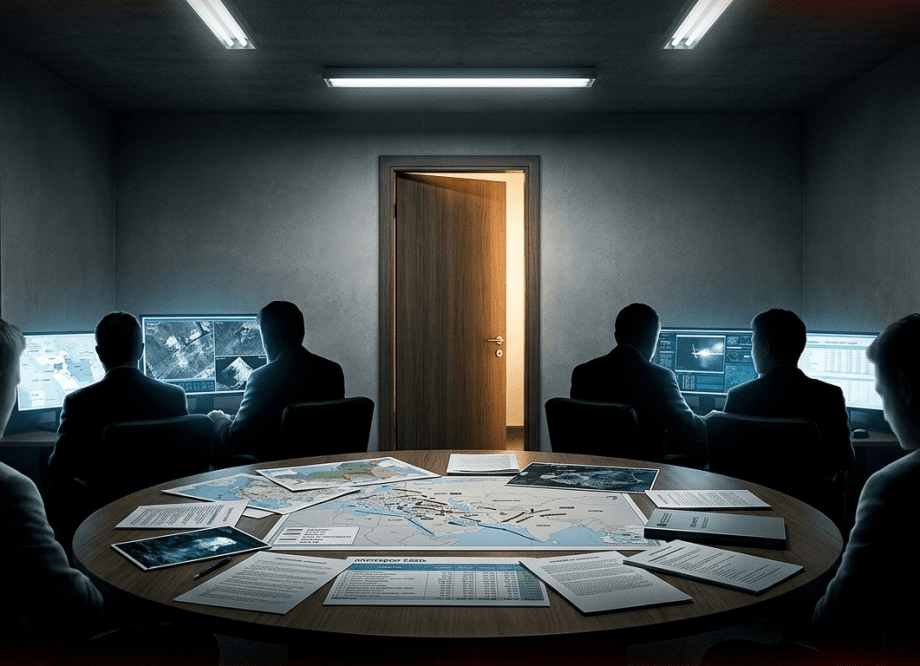
The Room With No Door
The headlines tell us of surgical strikes and regime decapitation. They speak of a new Middle East, delivered at the point of a cruise missile. A tomahawk-double-tap incinerating scores of screaming schoolgirls- survivors who seek to escape the horror of a first blast that kills most instantly, an attack that results in a massive death toll of 168.
But if you listen to the physicists and the independent analysts, the ones not tethered to a Pentagon press pass, the reality is far more chilling. We are not watching a contained regional cleanup. We are watching the opening scene of a play nobody intended to write, in a room nobody intended to enter, from which nobody now knows how to leave.
Washington needs Israel to remain its regional enforcer, its forward base, its domestic political anchor. Israel needs American precision munitions-that lawn doesn’t mow itself you know-diplomatic veto power at the Security Council, and the legitimacy of appearing to act with civilised-world consent. Iran needs the confrontation to validate its revolutionary identity, to rally a fractured population behind the flag of resistance; a flag that has been flying, with varying degrees of conviction, since 1979.
Russia needs the distraction of American assets pouring into the Middle East while its ambitions elsewhere go under-resourced, under-watched and unpunished. China needs the slow over-extension of American strategic reach to accelerate the transition to a post-dollar, post-American century it has been engineering, with incredible patience, for three decades.
Nobody in this room wants to leave. The door is unlocked. It has always been unlocked. But walking through it would require each party to surrender the identity the conflict provides. That is the catastrophe: not that war was forced upon them, but that it was chosen, collectively and incrementally, by actors who have persuaded themselves they have no choice.
The Mirage of the Shield
Dr Theodore Postol of MIT has spent decades exposing the physics of false confidence. Israel’s Arrow-3 system burns through its stockpile intercepting ballistic threats at exo-atmospheric altitudes, while lower-tier systems face saturation from Iranian drones that cost a fraction of the missiles sent to stop them. Postol’s core argument is not complicated: any competent engineer can defeat a mid-course ballistic defence with simple decoys. The geometry of the problem does not favour the defender. By the time the coalition realises its shield has been saturated, the sword will already have struck.
A million-dollar interceptor destroying a ten-thousand-dollar drone is not a victory. It is a ratio that, compounded across weeks of sustained exchange, describes a coalition bleeding itself white. We are betting the stability of the Western world on a defensive architecture that fails the most basic laws of physics and economics.
A Note on Mindsets
Before going further, it is worth pausing on something the Western commentariat always gets wrong: the assumption that the people on the other side of this conflict are essentially like us, moved by the same calculus of rational self-interest, restrained by the same fear of consequences, susceptible to the same pressure points.
They are not.
Iranian political culture is shaped by a specific and serious historical experience: the 1953 CIA-backed coup that overthrew Mosaddegh, twenty-five years of the Shah’s American-backed autocracy, the eight-year war with Iraq in which the West armed both sides, and four decades of sanctions that have made economic resilience a point of national pride rather than a vulnerability. When Western strategists calculate that crippling economic pressure will produce political capitulation, they are projecting a Western political psychology onto a society that has spent seventy years proving the opposite.
The assumption that the death of a Supreme Leader would trigger a Persian Spring; that the Iranian people would greet their carpet bombers, religious leader-and-entire-family assassins and the calculated sadism of elementary school destroyers as liberators, is not merely a strategic miscalculation. It is a category error. A type of madness. The nationalist surge consolidating around Mojtaba Khamenei in the wake of his father’s death is not an unpredictable consequence. It is the entirely predictable consequence that every serious regional analyst had predicted, and that every decision-maker chose to discount because it did not fit the template.
Russia and China are different cases, but the same error applies. Putin’s Russia is not a rational Western actor who will eventually respond to the right incentive structure. Xi’s China is playing a game whose time horizon is measured in decades, not news cycles. The West keeps expecting these actors to eventually behave like members of a club they have never wanted to join and were, in many cases, actively excluded from. And would never be accepted as members.
The Axis of Attrition
While Washington and Tel Aviv count the rubble in Tehran, the real beneficiaries are watching from Moscow and Beijing. They are the unseen scaffold holding the Iranian resistance together, and they are under no obligation to enter the room.
Russia has transitioned from diplomatic ally to technological anchor, a fellow cyber-warrior. Its Khayyam satellite, launched for Iran in 2022, and the broader Kanopus-V Earth observation network are reportedly feeding targeting data into Iranian operational planning, though analysts remain divided on how much of that feed Tehran actually controls.
What is not in dispute is the strategic value of Russian satellite architecture legitimising Iranian precision: it allows strikes on American facilities to claim an accuracy that Tehran probably would not have achieved alone.
China’s role is quieter but even more consequential. Beijing has been weaning Iranian military navigation off (US-based) GPS dependency toward the encrypted BeiDou-3 constellation for several years. It has supplied radar systems marketed, at minimum, as capable of detecting Stealth Bombers; technology designed to degrade the operational invisibility that American F-35s depend upon. In the Strait of Hormuz, through which roughly twenty percent of the world’s oil and a quarter of its liquefied natural gas passes daily, Beijing is positioning itself as arbiter of passage. A selective blockade; Russian and Chinese vessels moving freely while others queue, is no longer a scenario being war-gamed. It is a policy being stress-tested.
China is treating this conflict as a rehearsal for a post-American century. It does not need to fire a shot. It needs only to watch the West bankroll its own strategic bankruptcy.
The Locked Room Goes Global
The economics of the abyss are not abstract. Hormuz is plumbing, not symbolism. The supply chains of Japan, South Korea, India, Germany, and Australia run through it. A contested strait does not merely delay the war’s protagonists; it transmits the cost of American strategic overreach to every economy on the planet that heats a home, delivers groceries or fills a tank.
The human ledger is not abstract either. Already, independent monitors estimate more than 40,000 Iranian civilians killed, a figure the Western press has largely declined to feature on its front pages. The ancient city of Isfahan, a UNESCO World Heritage site of extraordinary Persian architecture; its mosques, its bridges, its bazaars, has sustained damage that conservators describe as irreversible. Field hospitals report that burn units across three provinces are operating beyond capacity, treating wounds consistent with thermobaric munitions. These are not collateral footnotes. They are the central fact of the war, and the central reason that no amount of Western messaging about liberation and precision will produce the political outcome the coalition imagined.
The Pacific dimension is already being written. As American carrier groups and air assets pour into the Middle Eastern theatre, the strategic vacuum in the Indo-Pacific widens. The door that China has been patient enough to wait for is not being opened by Beijing. It is being opened by Washington, one redeployed asset at a time. The war sold as a demonstration of American resolve is demonstrating, with clinical precision, the limits of American reach. Worse. Its credibility, authority and good faith are shredded.
Australia sits up pertly in this landscape like Skippy, with a particular, parochial and largely unacknowledged exposure. Pine Gap the joint facility outside Alice Springs that processes signals intelligence for American and Israeli targeting operations, makes Australia a co-combatant under any serious reading of international law. The Albanese government has not said this. It will not say this. It rattles a few pearls of diplomatic concern while the cyber-spying, guiding and eavesdropping does its work in the desert night, the kill chain running through sovereign Australian territory toward targets in sovereign Iranian territory, and nobody in Parliament is asked to vote on any of it. The locked room, it turns out, has an annex in the Northern Territory.
This Is The Way The World Ends
This is how world catastrophes are made: not with a single explosion, but with a series of steps, each one following from the last with an internal logic that only becomes visible as horror in retrospect.
The miscalculation began with the assumption that the death of a Supreme Leader would trigger liberation. It assumed that a nationalist people, bombed from the air by the US and Israel, would respond with joyous, gratitude rather than fury. It assumed that Russia and China would just look on; as if they have no skin in the game. It assumed that the shield would hold. It assumed, above all, that the other people in the room wanted what we want, feared what we fear, and would eventually see reason.
None of these assumptions survived contact with reality. All of them were made anyway.
Sartre’s three characters in Huis Clos are not monsters. They are ordinary people who have made themselves into the conditions of each other’s damnation through choices that each seemed reasonable at the time. The door opens, briefly, in the second act. Nobody moves. To move would be to become someone else. And they do not know how to be someone else.
The US cannot relinquish its Israeli commitment without dismantling a domestic political architecture built over half a century. Israel cannot accept a negotiated settlement without Netanyahu facing jail. Iran cannot de-escalate without invalidating the revolutionary identity on which the regime depends. Russia cannot step back without losing its most valuable lever against Western attention. China cannot stop it without abandoning the strategic patience posture that is its greatest advantage.
We are no longer on the brink. We are in freefall. The Epic Fury unleashed on Tehran is not an end; it is a spark. Unless the anatomy of this situation; the mutual imprisonment, the drift into collective irresponsibility, the procedural paralysis of institutions that exist to process catastrophe rather than prevent it, the fatal habit of projecting our own psychology onto people with entirely different histories and entirely different reasons to resist, is named and confronted, this war will not stop at the Iranian border.
It will follow the logic of its own escalation until the entire globe is set on fire by a coalition that refused, at every point, to walk through the unlocked door.
The door is still there. It has always been there.
Hell is not that the door is locked.
Hell is that nobody moves.


Well researched article vs glib or shallow ‘analysis’ provided by much of the RW MSM & indie media who lazily follow US talking points on Mid East, Asia and Europe.
The same indie is ‘framing’ by focusing upon Netanyahu and Trump only, but disappearing their ally Putin and also Epstein, so as not to contradict their US centric faux anti-imperialist talking points; running protection for perps and low empathy for victims.
Taking the ‘logic’ further, it’s like deferring to US media & analysis on events in NZ and other neighbours; cultural cringe that has been developed to influence many of the middle aged and older….?
LikeLiked by 1 person
Thank you, Andrew. Thank you — you’ve put your finger on something that doesn’t get nearly enough critical attention: the way ideological convenience shapes what gets named and what gets disappeared.
The selective framing you describe is a tell. Any analysis that can spotlight Netanyahu and Trump while quietly sidelining Putin’s role in the same geopolitical architecture, or that treats Epstein as a footnote rather than a load-bearing pillar, isn’t following the evidence ; it’s managing a narrative. That’s not anti-imperialism; it’s a competing imperialism with better branding.
The cultural cringe dimension is sharp and underappreciated. We’ve spent decades being told that the serious analysis — the frame-setting, the agenda — originates in Washington or New York, and our job is essentially to receive and relay. It’s a form of epistemic colonialism that flatters the recipient by making them feel cosmopolitan while actually narrowing what they’re permitted to think.
The victims disappear. That’s always the giveaway. When your ‘anti-establishment’ media consistently produces low empathy for the people on the receiving end of power while running protection for the powerful; just a different set of powerful -you’re looking at capture, not dissent.
Glad the research shows. That’s the whole point of doing it properly.
LikeLiked by 1 person
Goodo, and an example of a glaring issues with constraints on sticking with fossil fuels firstly Putin’s invasion of Ukraine was like a steroid injection into a fast transition to renewables in the EU, now the Gulf….
Some military types, think advertised in SMH, demanding faster transition to renewables* and electrification of transport for security.
Yet, most media avoid any talk of renewables except to create doubts in communities, while ABC talks about fossil fuel supplements a d alternatives to fuel IC vehicles & equipment.
However, the transition is going gangbusters, but missed &/or avoided by media? 🙂
LikeLiked by 1 person
Ever the plagiarist, Satre’s Huis Clos was Plato’s Cave for the urbane, languid & etiolated interwar generation, believing in nothing (apart from their intrinsic superiority) and contributing less on their solipsistic syllogism of pearls before swine – the unwashed who provided their comfy civic infrastructure.
Given the mention of economics above – a rara avis in the acreages of commentary – it’s worth pondering that the US occupation of Germany, long after the British & French departed from their Zones, continued not just post the Fall of the Wall 90s “Peace Dividend” but until next week/month etc, yea even unto the foreseeable future – if any – prepared to defend the ‘Fulda Gap’ from massed Soviet tanks, a chimerical concept of the Cold War.
The various US bases – read NATO – still dotted around ‘west’ Germany (none in Ost) cost approx US$2B a year – about which fiscal outrage beggaring America Trump has spent a decade railing.
Israel has for decades received US$4B+ pa from its progenitor as outright subsidy – no accounting required – with unlimited armament provisions as separate ‘line items’.
As noted above, the lawn doesn’t mow itself.
Apparently this is considered a bargain basement cost for control of the (once) main oil resources on the planet.
No longer – apart from the gluggy, sulphur thick goop from their latest colony Venezuela – Russia’s product is about the become the most dependable source for the Global South (aka BRICS+) as the Gulf facilities rust and Saudi reverts to camel herding.
Where else is there a large reserve with a biddable leadership in need of US intervention, stabilisation & protection™ ©?
Drumroll….Nigeria – unconstricted access to open Atlantic , reserves approx. 37B proven + unknown gas in unexplored leases.
Currently only producing 1.5B bpd so in obvious need of yankee know-how and infrastructure upgrade.
As soon as a suitable jihadi threat to world peace is found/constructed/intimated.
LikeLiked by 1 person
What a richly layered provocation — let me work through it properly.
On Sartre and Plato: the plagiarist charge is delicious but perhaps a touch ungenerous. Sartre wasn’t so much stealing Plato’s Cave as renovating it for central heating and existential dread. Plato’s prisoners at least had the consolation of a metaphysics pointing toward the light — Sartre’s hell has no exit because there is no light to point toward. That shift from epistemological imprisonment to ontological entrapment is doing real philosophical work, even if the drawing room setting did flatter the Boulevard Saint-Germain crowd’s sense of their own anguish. You’re dead right about the solipsism, though. “Hell is other people” lands very differently when the other people are your intellectual equals at a fashionable dinner party than when they’re the ones clearing the plates.
On the economics — and you’re right that it’s a rara avis in commentary, which tells you something about commentary — the Germany point is devastatingly precise. Two billion dollars a year to defend the Fulda Gap against Soviet tank columns that dissolved thirty-five years ago. The Cold War ended; the bases didn’t. The infrastructure of empire has its own inertia, and it keeps billing regardless of whether the threat that justified it still exists. Meanwhile Israel’s four billion plus — with the unlimited armament provisions running as separate line items, as you note, so the headline number always understates the real figure — represents the most expensive unaudited subsidy in the history of American foreign policy. “No accounting required” is the key phrase. It is the financial equivalent of the blank cheque, and it has been cashed repeatedly, most recently in the form of 1,200 bombs dropped on Iran in a single day.
The Venezuela-to-Nigeria arc is where your argument moves from sharp to genuinely alarming, and I think you’re onto something that most analysts are too polite or too credentialled to say plainly. Venezuela’s heavy crude is a poor substitute — expensive to refine, diplomatically toxic, politically humiliating for an administration that spent years sanctioning Maduro. Nigeria is a structurally cleaner proposition: Atlantic access, no Hormuz dependency, 37 billion barrels proven with the gas leases still largely unexplored, and a government whose relationship with its own population has historically been — shall we say — permeable to external management. The only missing ingredient, as you drily observe, is the suitable jihadi threat. Boko Haram has been underperforming its narrative potential lately, but these things have a way of finding their moment when the strategic logic requires them to.
The lawn, as you say, does not mow itself. And the mowing contract, historically, has always come with a mineral rights clause in the fine print.
LikeLike