The placards rise in neat, Instagrammable formation outside the buttery yellow sandstone of Sydney Town Hall in summer sun. A sea of cardboard rectangles held aloft, their edges crisp and unbent. Some are neon-bright; electric pinks and safety oranges,while others are just plain white with bold, serif lettering that was got up in Canva before a painstaking hand-paint-job.
Freedom for Iran. End the Regime. Support the Strikes. The Lion and Sun Pahlavi flag snaps in the brisk harbour breeze beside the Star of David, an ancient emblem of antique ubiquity, only recently appropriated by Judaism. Coffee cups steam on the sandstone steps. The slogans scan well, the crowd photographs better, and the whole scene smells of righteousness, long flat whites and someone else’s country burning.
There is something almost Wagnerian about chanting for the bombing of your birthplace; liberty at Mach 2, democracy with afterburners. Edward Said knew it. Every empire, he writes, tells itself and the world that it is unlike all other empires, that its mission is not to plunder and control but to educate and liberate. And there is always a chorus of willing intellectuals to say calming words. He was moved to write that in 2003, about Iraq. It reads as though written yesterday, about Iran.
Let no one misread what follows as apologetics for the clerical state in Tehran. It is repressive, censorious, vindictive. Its prisons are not figurative. Its morality patrols are not metaphorical. The protests that erupt on December 28 begin with the clatter of metal shutters slamming down at the Alaeddin Shopping Centre; shopkeepers pulling the iron across, padlocking their livelihoods, stepping into streets that reek of tear gas and damp concrete.
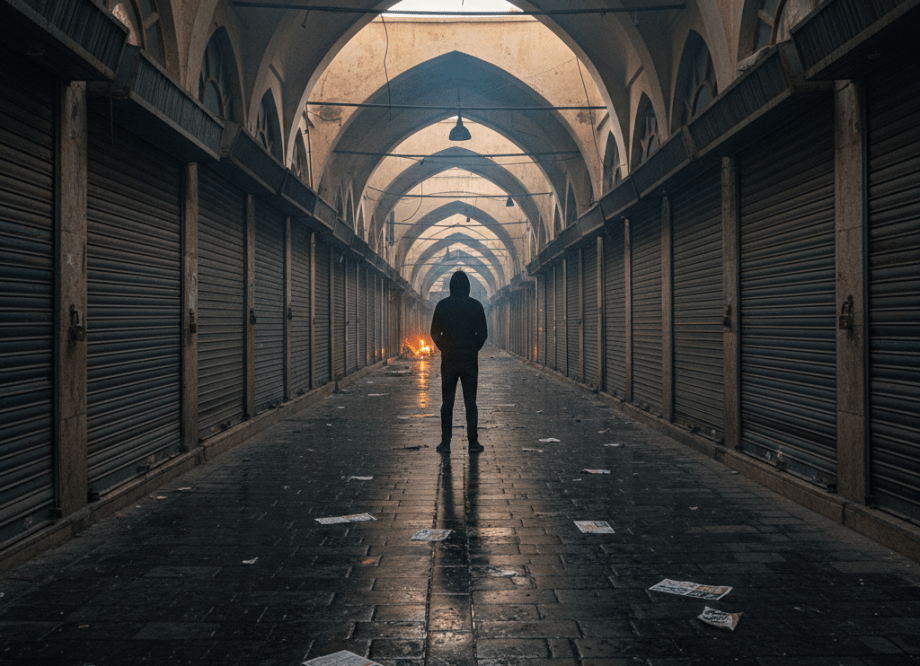
Crowds spill along Jomhuri Street and into Lalehzar. “Azadi”, the freedom chant, rises through winter air bitter with burning tyres. By nightfall it carries across the vast Grand Bazaar, a city within a city, a vaulted labyrinth of saffron, rosewater and diesel fumes where, for five centuries, the fortunes of Iranian commerce and Iranian politics have turned in lock-step.
The suffering behind that chant is so real that it defies further comment. Let the hard facts tell the story. Inflation above forty-two per cent. Food prices up more than seventy. Bread, the flat sangak hauled steaming from stone ovens, its blistered crust the taste and smell of every Iranian neighbourhood, up more than one hundred per cent. A rial so gutted that a Tehran bazaari explains the impossible arithmetic to Al Jazeera: you must sell a television, but by next morning you cannot afford to buy another. The Islamic Republic massacres thousands of its own citizens. Anyone who flinches from saying so plainly has no business writing about it.
Suffering makes populations most vulnerable to manipulation by outside powers. But what the Australian media will not say plainly is this: the economic catastrophe driving Iranians into the streets is not simply caused by the regime’s corruption or mismanagement, real as those are. It is engineered, systematically, over decades, by the United States and its allies.
Trace the accelerants. In 2018, Trump withdraws from the Joint Comprehensive Plan of Action; the nuclear deal painstakingly negotiated under Obama, and reimposes “maximum pressure” sanctions. Iran’s GDP contracts by more than ten per cent. Poverty rises by the same margin. Food prices climb two hundred per cent. Health care costs surge one hundred and twenty-five.
Washington cuts off Iranian banks from SWIFT, the Belgium-based messaging network through which trillions of dollars cross borders daily; our financial system’s central nervous system. Without SWIFT, Iran cannot settle international trades, cannot receive payment for exports, cannot import pharmaceuticals or spare parts or wheat at anything close to market rates.
Nearly all of Iran’s oil revenues are frozen. The rial begins its long death spiral. China, buying more than eighty per cent of Iran’s shipped oil through shadow tankers and settling in yuan via its own CIPS, the Cross-Border Interbank Payment System, Beijing’s own alternative to the dollar architecture, keeps Iran from total economic meltdown, but the lifeline is thin, opaque, and priced at dependency.
Then come the June 2025 strikes. Israel, with American support, bombs not only military and nuclear sites but civilian infrastructure; energy facilities, hospitals, residential neighbourhoods in Isfahan and Shiraz, the state broadcasting building in Tehran. Close to five thousand casualties. The air tastes of phosphorus and the grit of pulverised masonry for weeks.
In September, Britain, France and Germany trigger the UN’s snapback mechanism under Resolution 2231, reimposing Security Council sanctions that freeze Iranian assets abroad and halt arms transactions. The rial loses another forty per cent of its value.
By December, purchasing power for ordinary Iranians has fallen by more than ninety per cent over eight years. Cooking oil triples in a single week. Dairy rises sixfold in a year. Majid Ebrahimi, a cab-driver tells Al Jazeera that dairy prices have gone up six times this year. Other goods over ten times. His cab smells of cracked vinyl, stale tobacco and exhaustion.
He counts himself lucky he can drive his taxi. He is not protesting. He is surviving.
Analysts call it the “rebellion of the de-classed”, a middle class pushed below the poverty line, a Generation Z stripped of any future. Doctors drive taxis. Young professionals lie awake in childhood bedrooms they thought they had left behind, staring at ceilings they can taste the plaster dust of, listening to parents argue about the price of eggs. Before the protests, a bone-weary President Pezeshkian, the weakest president in the Republic’s history, a reformist marooned in a system that has discredited reform, addresses a restive crowd and raises his hands in exhausted despair: where do you expect me to get the money from?
This is not background context. This is the cause. And now the same powers that severed Iran from SWIFT, froze its reserves, starved its hospitals, and bombed its power grid present themselves as liberators of the people they have been slowly strangling. Create the crisis. Amplify the anger. Provide the figurehead. Assemble the fleet. It is not a rescue mission. It is the arson investigator who lit the fire.and it has dollar signs in its eyes.
The choreography barely bothers to whisper. On December 29, one day after the first demonstrations, Israel’s Mossad posts a message in Farsi on X, its tone somewhere between triumphant and predatory, instructing Iranians to go out into the streets, declaring it stands with them not only from a distance but “in the field.” Mossad says the quiet part out loud, and nobody at the ABC thinks this is worth interrogating.
Days later, a visibly gleeful Trump is on Truth Social, misspelling his all-caps-threats as usual but making himself clear: locked and loaded and ready to go. Then the carrier fleet. The USS Abraham Lincoln steams into the Arabian Sea trailing a wake that smells of diesel and geopolitics. The USS Gerald R. Ford, the largest warship ever built, swings east from the Caribbean, its flight deck a grey acre of steel reeking of jet fuel and intent. Two carrier strike groups. F-35 stealth fighters. Tomahawk cruise missiles. The full industrial apparatus of American violence arranged in the Persian Gulf like cutlery around a place setting.
Every regime-change operation in living memory begins with real grievances. Iraq’s people genuinely suffer under Saddam. Libya’s under Gaddafi. Syria’s under Assad. And what does “liberation” deliver? Shattered states, millions displaced, power vacuums filled by warlords, and Western oil companies quietly resuming operations in the rubble. The playbook does not change. Only the target.
Yet something is different now. The carriers circle, but they do not strike; because this is not Baghdad in 2003. The UAE refuses to allow military operations from its territory or airspace. Saudi Arabia calls for diplomacy. Turkey offers to mediate. The BRICS alliance, of which Iran is a member, represents a multipolar world in which the old coalition of the willing is simply not willing. Which makes the propaganda effort all the more essential. If you cannot bomb your way to regime change, not yet, not without costs you are not prepared to bear, you must manufacture consent from the inside out. You need the exile figurehead. The sympathetic media coverage. The demonstrations in allied capitals, fragrant with righteousness and someone else’s grief. In short, a rent-a-revolution.
Iran’s own Tudeh Party, the communist party, operating underground, its members imprisoned and executed by the same regime it refuses to stop criticising, holds the intellectually honest ground: it condemns the regime’s brutality without reservation, and condemns with equal force the overt intervention of US imperialism, observing that the policy of regime change has always served the strategic interests of global imperialism and can never lead to freedom.
That is the tragic clarity, and it will not resolve into comfort. The regime is monstrous. The people deserve freedom. The machinery being assembled to “deliver” it will almost certainly make things worse, as it has every single time before. Human rights do not arrive by airstrike. They are built, slowly, from civic courage, generational pressure, and internal legitimacy; the very qualities foreign intervention tends to annihilate. Bombs do not fall with ballots attached.
Anyone who finds that easy has not understood it.
 Urban Wronski Writes
Good exposition from an open point of view, a rara avis in the clamouring meeja.
Here’s another unacknowledged truth which skewers the Langley VA script – excluding Turks, for the last thousand years the majority religion of the Middle East has been (in accordance with the ageographic, PC ordained nomenclature of West Asia).
Even the source of salafi, wahhabist jihaddis rampaging around the world as shock troops for hire (thanks to petrodollars welfare, ie “go be trouble somewhere else…or lose your head”) Saudi Arabia is 15% Shia.
This matters in myriad ways not even recognised by 9 out of 10 Western voters.
LikeLiked by 1 person
oh for an edit option – “..for the last thousand years the majority religion of the Middle East has been SHIA (in accordance with the ageographic, PC ordained nomenclature of West Asia)..”
LikeLike