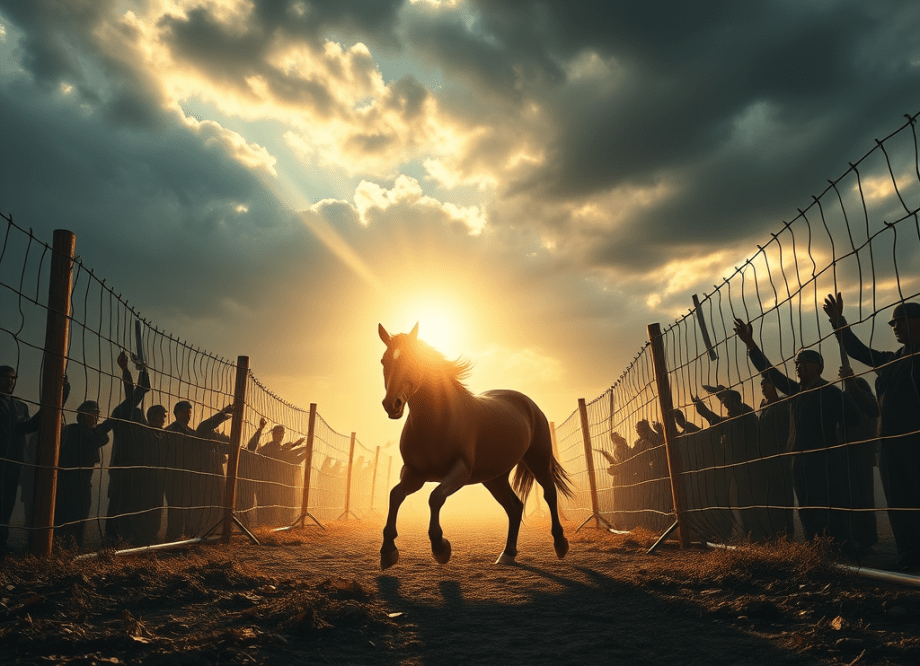
We’re into the straight and Australia pounds against the rails, all muscle memory and destiny, everybody’s favourite, yet going nowhere. Boxed in like Tulloch. Truth, Due Diligence and Duty of Care have been scratched on veterinarians’ advice, leaving Spin, Pious Piffle and Plausible Deniability to romp home unchallenged. And it’s Spin who salutes the judge.
You know the feeling. You’re at the kitchen table, the morning light hitting a half-empty cup. Across the screen, the ABC ticker blurs: a war-cry from Iran, a legislative sprint through Canberra, and the unsolicited arrival of Israel’s titular head of its US-proxy state. Before you’ve even finished pouring your tea, the world has been pre-packaged, buffed and explained by voices that never bothered to ask what you thought.
Something doesn’t quite add up. You watch as grief is distilled into fear, fear is codified into law, and law is performed as ceremonial ritual. By the end of the broadcast, you’re left with a cold realisation: you haven’t been informed, you’ve been wilfully misled; your expectations managed. You’re boxed in, Tulloch-style — pounding against the rails of a fence you can’t quite see.
Let’s check those fences. Together.
Every surge of national energy; every impulse towards independent thought, dissent, or even honest mourning, is today absorbed by the alliance fence, the narrative fence, the moral fence, and now the symbolic fence — complete with its own Envoy for Antisemitism — that is turning Israeli President Isaac Herzog into a national Rorschach test.
Australia is wedged. It is quadruple-wedged; squeezed at once by Washington’s strategic demands, a domestic propaganda environment that converts grief into compliance now called social cohesion, a bipartisan refusal to confront what the UN has formally identified as genocide, and a government that has transformed moral paralysis into political ritual.
Each flying wedge operates differently, yet they move in wicked synchronicity. One demands obedience to empire. Another demands obedience to fear. A third enforces silence. The fourth stages unity as a substitute for thought. Australia no longer shapes its positions; it inherits them. It no longer debates its direction; it recites it.
The US Alliance and the Iran Trap
Picture midnight at The Gap as a gigantic Silver City. Recently vastly and secretly expanded, its tally of satellite radomes (those ball-shaped structures), smaller dishes and antennae at the base is now a record 45, with 25 of the largest housed inside radomes and the other 20 uncovered, according to the latest research by Professor Richard Tanter of the Nautilus Institute. Part Odin’s Ear, part gigantic digital vacuum, The Gap is designed to “catch-it-all.”
Linked remotely from Buckley Space Force Base in Colorado, these new Pine Gap satellite antennas collect vast amounts of intelligence on missile and rocket launches, including location, size, type, likely warhead, range, speed, trajectory, tracking and target location. They are also the central nervous system of the US nuclear warhorse, providing real battlefield intelligence. Satellite dishes tilt and swivel in the desert darkness, their movements invisible to the 26 million people whose lives they may determine.
No debate in parliament. No question time. No headline.
Independent media are clear about Iran’s collapse: its death throes are systemic, not episodic. The US has taken decades to undermine Iran’s currency; the rial is now worthless. Factor in a fractured power structure, add a credibility vacuum and you can see how and why the Islamic Republic is brittle, unpredictable and increasingly despotic in its bid for survival. This is precisely the moment for a thoughtful ally to reassess its exposure, examine tripwires, audit commitments and open the question of where a junior partner’s obligations end and an independent nation’s interests begin.
Instead, Canberra behaves as if the only strategic variable is loyalty. If Washington escalates, every Pine Gap command and control panel will light up like a Christmas tree. Parliament is bypassed. Public consent is a rubber stamp applied well after the machinery has engaged. Political debate? Don’t be silly. We all know what happened to Gough Whitlam.
“Probably bad things could happen?” Now, as “The Lion King,” Donald Trump, takes time out from his racist social media slurs against Barack Obama to hint of an impending US attack on Iran (as if it had a mind of its own), and as Herzog aligns Israel’s “grand regional vision” with Tehran’s instability, Australia risks stumbling into another conflict it hasn’t debated, hasn’t consented to, and cannot survive without great cost. Above all, we lower our standing in our region, our relationship with the Muslim world, and our credibility as anything other than an American garrison state.
Strategic obedience masquerades as strategic clarity. The reflex is automatic; the consequences, once again, will not be ours alone.
The Weaponisation of Bondi
Fifteen people are dead. A ten-year-old girl. A Holocaust survivor who had fled to Australia seeking safety. Two Chabad rabbis. A Syrian-born Muslim father of two, Ahmed al-Ahmed, who charged an armed gunman unarmed and disarmed him — a man whose courage should have been the defining image of that terrible night.
The Bondi shooting of 14 December 2025 should have been a national moment of unqualified mourning. It should have remained what it was: an act of murderous antisemitic terrorism, ISIS-inspired, that horrified every decent Australian and demanded a response commensurate with its gravity.
Instead, the tragedy has been absorbed into something else entirely.
Within weeks, the Albanese government recalled parliament to pass the Combatting Antisemitism, Hate and Extremism Bill 2026, a rash of laws to criminalise hateful conduct, expand visa cancellation powers, and launch a national firearms buyback.
Reasonable people may debate the merits of each provision. What is harder to debate is the speed; the way legislation that compresses criminal law, migration law, and firearms regulation into a single instrument was rushed through with barely a month for public consultation.
The Law Council of Australia warns that “compressed timelines and limited consultation periods increase the risk of drafting errors, inconsistencies and unintended consequences.”
The Australian Human Rights Commission cautions that reforms must remain “proportionate, clearly defined and consistent with Australia’s human rights obligations.”
Meanwhile, the Australian National Imams Council reports a tripling of hostile acts towards Australian Muslims and Islamic institutions in the fortnight following Bondi: vandalism, online abuse, physical intimidation, particularly of women wearing hijabs. The ANIC describes the collective blame levelled at Muslim communities as both unjust and socially corrosive, condemning former Prime Minister and veteran scapegoater Scott Morrison’s call for “wholesale reform” of how Islam is practised in Australia as “reckless, irresponsible, and deeply ill-informed.”
Not to be outdone, the NSW government declares Herzog’s upcoming visit a “major event,” granting police extraordinary powers to restrict assembly rights and cordon off protesters. This is the connective tissue of the trap: the trauma of Bondi has been used to build the legal cage that will now house a controversial state visit, ensuring that dissent is not just unpopular but illegal.
Genocide Denialism as Doctrine
“I think we all know the answer.”
The words belong to Michael Bradley, one of our most respected legal commentators, managing partner of the boutique Sydney firm Marque Lawyers. Writing in Crikey ahead of Herzog’s arrival, Bradley asks whether the visit would heal or divide — and delivers the answer that Canberra’s political class cannot bring itself to utter.
In September 2025, the UN’s Independent International Commission of Inquiry on the Occupied Palestinian Territory, led by former International Criminal Court judge Navi Pillay, released a 72-page report concluding that Israel has committed genocide in Gaza. The Commission found that Israeli forces had committed four of the five acts defined under the 1948 Genocide Convention: killing Palestinians, causing serious bodily and mental harm, deliberately inflicting conditions calculated to bring about physical destruction, and imposing measures intended to prevent births.
The Commission further concluded that Israeli President Isaac Herzog, Prime Benjamin Netanyahu, and former Defence Minister Yoav Gallant had engaged in “direct and public incitement to commit genocide.” The specific finding against Herzog centred on his statement of 12 October 2023 — “It’s an entire nation out there that is responsible” — which the Commission determined could reasonably be interpreted as inciting Israeli security forces to treat all Palestinians in Gaza as collectively culpable.
Herzog has vigorously rejected this characterisation, stating his comments were taken out of context. Israel has categorically rejected the Commission’s report as “distorted and false.” These are contested findings, but they are also the most authoritative UN findings to date — produced by an independent commission, not by activists.
Canberra’s response: silence. When Australian legal groups, including the Hind Rajab Foundation and the Jewish Council of Australia, file a joint complaint calling for Herzog’s arrest, the Australian Federal Police confirm that as an incumbent head of state, Herzog holds “full immunity.” AFP assistant commissioner Stephen Nutt confirmed to a Senate hearing that this immunity extends even to “serious international crimes, including genocide.” The government simply looked away.
This is bipartisan denialism. It treats the findings of international bodies Australia claims to respect as background noise. It is not neutrality. It is moral abdication wearing the mask of prudence. And it operates not through dramatic confrontation but through the quiet bureaucratic art of not-seeing. We see it every day: the minister who declines to comment, the police force that has “no active investigations,” the press conference where the question is never asked.
The Herzog Visit: A Manufactured Unity Ritual
Herzog lands in Australia on 8 February for a five-day visit, invited by PM Albanese to “express solidarity and offer strength” to a Jewish community still reeling from Bondi. The Executive Council of Australian Jewry welcomes the visit as essential to healing.
But the choreography tells a different story. A head of state identified by a UN commission of inquiry as having incited the commission of genocide arrives to serve as a healer. Protesters, whose legal right to assemble is protected by Australia’s democratic traditions, are corralled under new police powers specifically invoked for the occasion — powers born from the very tragedy Herzog claims to be here to mourn.
Meanwhile, the progressive Jewish Council of Australia, a body within the Jewish community, has published an open letter declaring Herzog unwelcome:
“We refuse to let our grief for the Bondi massacre be used to legitimise a leader who has played an active role in the ongoing destruction of Gaza.”
There is nothing simple here. Herzog has become a Rorschach test for Australia’s political conscience; a blot of meaning onto which each faction projects its moral anxieties. For the government, he embodies solidarity and the hard realism of diplomatic protocol. For critics, he embodies the complicity of silence. The symbol has consumed the person, and the person was already consumed by the office.
We are told to feel together rather than to think together. This is the last fence in the yard; the one that turns public grief into political theatre and turns the search for unity into an act of narrative control.
The Vise
Four wedges. One vise.
Washington demands obedience. The Bondi narrative demands fear. Bipartisan silence demands denial. The Herzog choreography demands reverence. Together, they leave no room to think, no space between the rails where an independent nation might pause, draw breath, and ask: Whose script are we reading? And when did we ever agree to read it, at all?
Australia is boxed in on all sides; muscle without motion, conscience without voice. It cannot think clearly about its alliances because the alliance is the one subject that admits no questioning. It cannot speak honestly about its moral obligations because the moral question has been bureaucratically disappeared. It cannot even mourn without being drafted into someone else’s geopolitical script.
The only escape from the vice is refusal. Refusal of the foreign script that demands obedience. Refusal of the domestic script that demands fear. Refusal of the political script that demands denial. And refusal of the symbolic script that demands reverence for visitors whose credentials, under international law, remain profoundly contested.
Bradley asked whether the visit would heal or divide. We know the answer. Because unity built on silence is not unity. And a democracy that can no longer interrogate its alliances, its narratives, or its guests is no democracy at all.
It is a spectator to its own foreign policy.
Boxed in still. Pounding at the rails. Still, even Tulloch found daylight eventually. And when the gap opens, even a sliver, it’s astonishing how fast a country can move once it remembers how to find its rightful form.
 Urban Wronski Writes
Clearly, Tel Aviv is the effective capital of the US and Australia. We pathetically dance to Netanyahu’s and, in turn, Orange Don’s tune. How many of our pollies have made the ‘study tour’ to Israel? How much foreign funding has Advance funnelled through? We may have well-run elections, but lobbyists have the influence. Our pollies’ disingenuous weasel-words mean nothing.
LikeLike