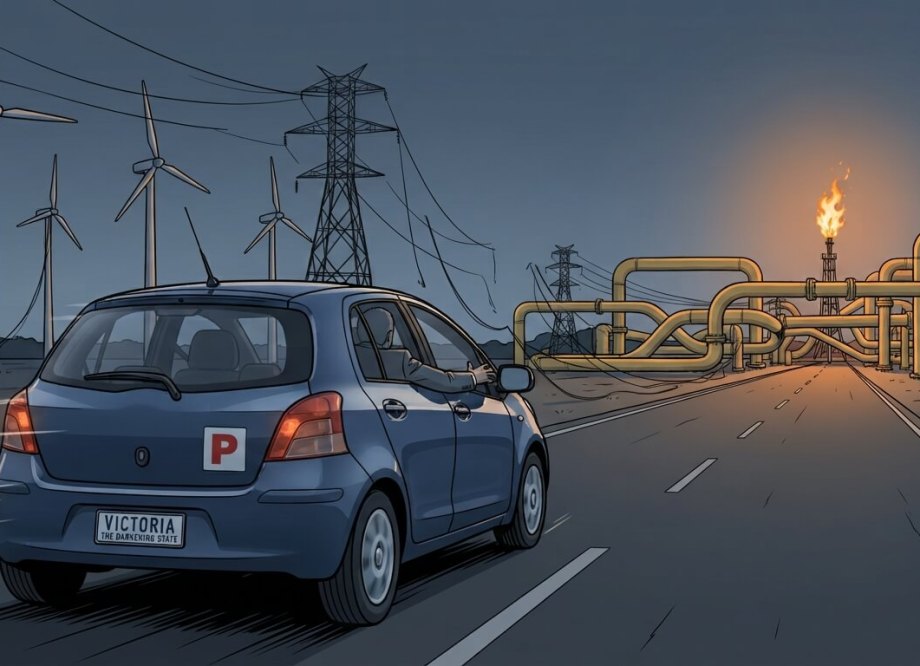
You have to hand it to Victoria’s Liberal Premier, Jessica Kate Wilson, she’s not going to waste time on wind and solar, even if it means a U-turn on renewable energy policy. “Victoria doesn’t need more unnecessary poles and wires that bulldoze through regional communities, it needs more gas and more firm generation.”
Jess Wilson will now cancel VNI West: her new Coalition government, the result of a Labor rout, doesn’t want the high-voltage line needed to carry wind and solar power from the north-west to the rest of the grid.
Suddenly she’s flicked a switch. Will licence plates now read: Victoria, The Darkening State? Flashback: four years ago, in 2022, when Wilson won in Kew, she was all hot to trot, switched on and totally wired:
“We must modernise our transmission system.” Gas, she said then, was a transitional fuel. In a net-zero economy, “it will cease to be part of the mix”. Four years later, she’s pulled the pin. She won’t say why.
Asked by The Age whether her views had changed since the 2022 Kew forum, Jess Wilson said:
“Anyone who’s ideologically opposed to gas just doesn’t understand the realities of the transition.”
True enough, perhaps, if you are Jess Wilson of 2022. Then, gas was a transitional fuel that would “cease to be part of the mix” in a net-zero economy. Now, it is the policy she is “absolutely focused on”.
It is an out with the new and in with the old transition. That’s the “fresh face” of Jess.
And if you question the switch, you are not merely mistaken. You are ideological. You do not understand. You are one of those people who cannot grasp the realities.
That is not an argument. It is a polite way of calling the critic a fool. Or not so polite if you dwell on it.
Arrogant? It is, above all, a false choice. You can accept that gas has a transitional role without accepting that decades of gas dependence should be expanded without scrutiny. You can support renewables, transmission, storage and electrification while still asking why a candidate who once promised to accelerate the transition now wants to “throw open the doors” to new gas projects.
Wilson does not answer that question. She recasts it as incomprehension.
Nifty? Between the two faces of Jess Wilson sits more than a bit of promotion, power-lunching and packaging. Young. Composed. Business-like. A junior Jennifer Westacott.
But has the gas lobby brought her into line?
And even before the vote-counting is finished, is there a trust deficit already?
A “fresh face” worked. On the face of it anyway. On Saturday, Victoria traded twelve years of Labor for the new face while Labor crashed and burnt, lured on to law ‘n’ order and jilted by older, working class blokes voting One Nation in protest, the men John Birmingham went to meet in his Quarterly Essay.
Ben Carroll lost his own seat of Niddrie. Labor lost seats it had held, says pollster Kos Samaras, since federation. Wilson, 36, will be Victoria’s 51st premier and the first woman voters have elected to the job.
She is also a P-plater. Only four years as an MP? Never a minister. Party leader before she had finished her first term. Her fans will say that Steve Bracks and Ted Baillieu had never been ministers either. True.
The missing portfolio is not the problem. The MP’s total inexperience of a world outside politics is the worry.
Wilson’s CV is a corridor. Mont Albert Primary. Strathcona Baptist Girls’ Grammar, her Mum’s workplace and where, as The Age’s Gay Alcorn puts it, Wilson “inevitably” became a prefect.
Monash law. KPMG. Unpaid intern, then adviser, to Josh Frydenberg, to whom her father, Ron Wilson MP, introduced her. Head of energy and climate policy at the Business Council of Australia, under Jennifer Westacott. Then the safe Liberal seat of Kew, then the leadership. And now premier.
The daughter of a Liberal MP, raised in the party, schooled in its youth wing, polished in its offices, she has spent her life inside the Liberal machine. It would never occur to her that anyone might want to get off.
That is what experience is for. Not grey hair. Distance. Perspective. Broad-based networking. Adversity. The years that teach you to ask who is paying for the advice. Wilson has had none of them.
Victoria is no job for a learner. There are 7.15 million of us, and the number climbs faster than anywhere but WA. On current projections we pass eight million inside a decade. Every one of us has to heat a home, cook a meal and keep the lights on, and many do it on wages that are going backwards. According to the ABS, wages rose 3.5 percent in the year to September, while prices rose 4.3. One Australian employee in five has no paid sick or holiday leave. Among the lowest-paid quarter, more than half go without.
Gas used to be a cheap fuel. Since the Gladstone export terminals opened, Melbourne’s household gas price has doubled, the steepest rise of any capital. Each month nearly 80,000 Victorian households now ask for help with a gas bill. The networks sit on billions of dollars of pipes, and every household that leaves them shifts the cost onto whoever is left: the renter, the pensioner, the family that cannot afford a heat pump.
So what does the P-plater bring to the table? More gas.
Scrap VNI West. Pause and review the Western Renewables Link, the Victorian transmission plan and the renewable energy zones. End the ban on gas connections in new homes within 100 days.
“Throw open the door” to new gas exploration. Build an “Energy Security Requirement” around new gas-fired generation. Add a rooftop solar panel bank or two and some batteries, for show.
Does it stack up?
Yallourn closes in 2028, taking 1,480 megawatts out of the system in her term. Environment Victoria says the state has already used 90 percent of its commercially viable gas. What is left costs up to twice as much to drill. Conventional gas exploration is already legal. Fracking stays banned, Wilson has confirmed. So the door she means to throw open was never shut. The Grattan Institute’s Tony Wood says there is no evidence the plan will cut bills or make the grid more reliable, and that the 2045 target cannot be reached if you expand gas.
A net zero target with the wires cut is a ticket for a train that will never leave the station.
In her maiden speech Wilson said her parents had her baptised into “the three great faiths: the Catholic Church, the Liberal Party and the Collingwood Football Club”.
Even that line was second-hand. Months earlier, Anthony Albanese had campaigned his way into the Lodge on his mother’s three great faiths: the Church, Labor and the Rabbitohs.
Did Dr Google deliver it? Somewhere a cursor blinked over “how to mention your faith in a maiden speech without sounding pious”. Add a football club. Why not? It had worked for Albo. Sort of.
Imitation can be flattery. An in-joke, even. But Wilson’s inexperience showed in the delivery, too. The maiden speech came out fast and short of breath. By the end of the campaign she had been coached into pauses and a measured pace. She has learnt to read her lines well. That is not the same as having lines of your own.
Her energy policy suggests a fourth great faith. Promise net zero by 2045. Cancel the line that would get you there. Believe.
The fresh face is a mask. Every P-plater learns from somebody. Ask who taught this one to drive.
It’s no secret. “I would not be here today without the mentorship of Jennifer Westacott,” is in Wilson’s maiden speech. Westacott ran the Business Council of Australia, the peak body of the country’s biggest companies, and hired Wilson in 2017 to work on its energy and climate policy, later making her second in charge.
Before the Business Council came the Institute of Public Affairs. Wilson came up through a Young Liberal world in which the IPA was not a distant think tank but her big brother. Or sister.
In 2016 she held the presidency of the Victorian Young Liberals by six votes. The IPA’s policy director emailed members to keep her there. Aaron Lane, then her fiance and now her husband, was an IPA legal fellow. James Paterson, the IPA’s deputy executive director and soon a senator, was in her corner too. Paterson is now godfather to Wilson’s son. His wife, Lydia, is her deputy chief of staff.
The IPA raised her. The Business Council finished her.
The IPA likes to hide who funds it. We only know the odd sponsor, because a family feud dragged the figures into court. Gina Rinehart’s Hancock Prospecting gave the IPA $2.3 million in 2016 and $2.2 million in 2017, almost half its income in the first of those years and more than a third in the second. The IPA has spent decades doing all it can to put the brakes on climate action.
What the IPA does not hide is its plans. In 2012 John Roskam, Chris Berg and the same James Paterson wrote Be Like Gough: 75 radical ideas to transform Australia, a to-do list for an incoming Abbott government. Privatise the CSIRO. Privatise the Snowy Hydro scheme. It came with advice on timing. The goodwill voters give a new government, the authors wrote, provides “more than enough cover for radical action”, and the cover does not last. Move fast and break things while the crowd is still clapping.
Hold that thought when the gas ban falls inside a hundred days. Hold it when Melbourne’s sewers go to tender on a 90-year lease.
Rinehart does not fund Wilson. She does not need to. A think tank shapes a youth wing. The wing produces a leader. The leader takes office a paragon of IPA doctrine. The IPA, for its part, has welcomed her policies.
Nobody has to be bought. They only have to be raised.
This is the failure we do not name. A democracy is meant to have an immune system. Disclosure laws. A free press. Parties that answer to their members rather than to their money. Ours has let a handful of the obscenely rich fund the think tanks, own the papers, bankroll the campaigns and train the candidates, and then it calls the result a choice. A fortune dug out of the ground pays for the ideas that keep the digging going. That is not a conspiracy. It is a business model, and our democracy has been its most obliging customer.
The question is not whether the IPA runs Jess Wilson. But how can anyone so thoroughly formed by the IPA run Victoria fairly, in the interests of everybody, when everybody includes the people the fortune is burning?
Labor is no cleanskin. In October it approved the Golden Beach gas project and backed Patricia-Baleen. It paused the Western Renewables Link itself after farmers’ protests. Its own cabinet costed a lease of Melbourne Water’s assets, then lost its bottle. Yet Labor was backing towards the exit, slowly and badly. On Saturday the voters showed it the door. Wilson wants to spin around and bolt back in.
Our future will not survive this retreat. Victoria already lives in the climate it was warned about. In late January 2009, Melbourne sat above 43 degrees for three days straight.
In one week, 980 Victorians died, against the 606 expected in an ordinary week. That is 374 extra deaths, a jump of 62 percent, in a single week of heat. Days later, on Black Saturday, Melbourne hit 46.4 degrees. Fires killed 173. Since then there have been floods along the Murray and through Rochester, fire seasons that start in spring, insurers pricing flood-prone towns out of cover.
More of us are elderly, frail and living alone. More of us need power to run an air conditioner on a 45-degree day, or an oxygen concentrator. When the grid fails in a heatwave, it can be fatal, mostly for the old and the poor, mostly out of sight. Every year of delay in building the system that replaces coal adds to that risk. Every year that gas sets the price of power, those least able to pay must pay more.
That is the true complexion of this result.
Not the face of the new premier, but whether her government accepts that the physical limits of the planet bind it as surely as a budget does. A government that backs out is walking away from the oldest duty of any polity: to protect the people it governs from harm everyone can see coming.
Rule by the powerful few is never announced. It arrives through think tanks, donors, personnel pipelines and the calm and ever so reasonable voice of “practical, balanced” energy policy.
On Saturday it arrived with a fresh face.
We may already be too late to save the world we were given. That is no reason to hasten its end.
Victoria has just elected a government that would hasten it. Watch what it does in its first hundred days, and remember who taught it.
Victoria voted on Saturday. The climate did not. It just keeps the score.


The treaty will be gone inside one hundred days as well. A tragedy.
LikeLike