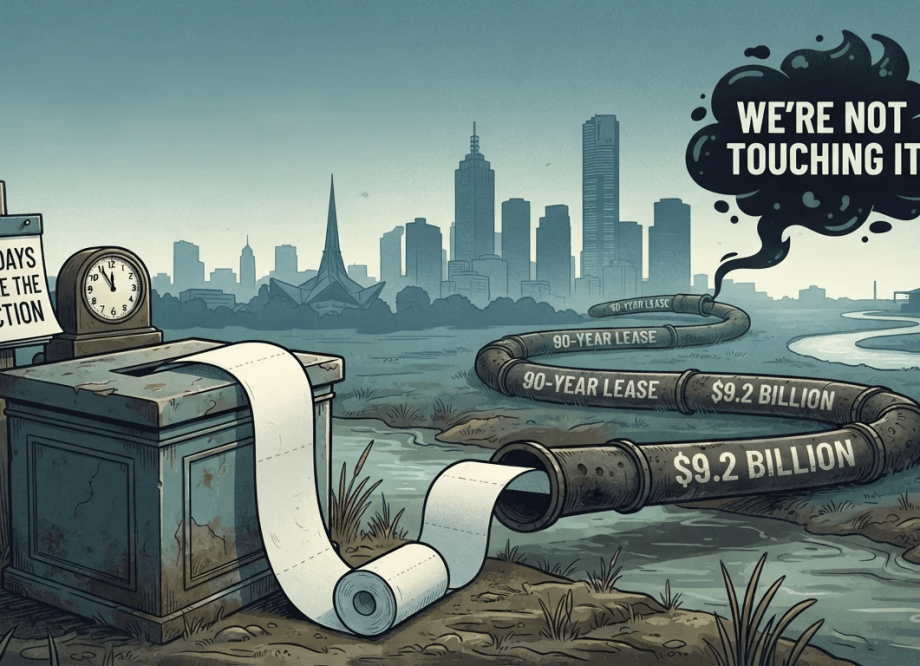
“We’re not touching it.”
Back in August, Jess Wilson was asked by the ABC’s Patricia Karvelas whether a Coalition government would privatise Melbourne Water. She flatly ruled it out. “We have no plans whatsoever. We have not considered it.” Privatising Melbourne Water was not her policy “in any way, shape or form”.
On Thursday, two days before the election, it bobbed up like an unflushable turd: Mungo MacCallum’s enduring description of John Howard. The phrase has outlived its first target.
The Coalition’s costings, released that afternoon, offer a 90-year private lease of the Western Treatment Plant at Werribee, the Eastern Treatment Plant at Bangholme, 400 kilometres of sewers and nine pumping stations. Price: $9.2 billion.
Her promised surplus, now pushed out to the 2032-33 financial year, rests on that one cheque.
At the court of Henry VIII, the Groom of the Stool attended the king on his close stool, and kept the privy purse. The man closest to the royal rear was also closest to the royal spend. Wilson would revive the office.
“We’re not privatising Melbourne Water,” she said on Thursday.
“What we are doing is offering a 90-year lease for the sewerage assets to bring the interest bill down in this state.”
When Wilson ruled out privatisation in August, she explained, she meant selling Melbourne Water in its entirety. Not touching it, it turns out, meant not touching all of it.
Wilson could not resist one more jibe. “Only the Labor Party has costed the privatisation of Melbourne Water.”
Up bobs Project Nerva. The Australian revealed this year that the Andrews and Allan governments approved a 12-month business case, “Project Nerva”, to lease Melbourne Water’s assets for billions. Labor drew up the plan and lost its bottle. Wilson found the lavatory plan and kept it quiet until two million people had voted.
Then, Greens leader Ellen Sandell got a whiff. The plan, she said, “frankly stinks”.
Labor’s Treasurer, Colin Brooks, wants us to think of England. Water privatisation there, he told The Australian, “resulted literally in shit in the rivers and on the beaches.”
By Thursday afternoon more than two million Victorians had already voted. One of them wrote to the ABC’s live blog: “I had taken her assurance not to privatise water assets into account when I voted earlier this week.”
Asked whether it was fair to unveil the plan so late, Wilson said it was “a matter for Victorians”. “We’ve seen millions of Victorians already vote on the information that is there.”
That is exactly the problem. The information that is there was “We’re not touching it.”
The two million Victorians who have voted may well feel they are up shit creek without a paddle.
But what’s new? In 2018, on costings day, the Coalition revealed a plan to sell a 50-year lease of Melbourne’s sewage treatment for about $5 billion; shadow treasurer Michael O’Brien called it “a win-win for Victorians”. In 2022, on costings day again, it was a 50-year lease worth $6.6 billion.
In 2026 the lease has nearly doubled to 90 years, and it surfaced, as always, in the fine print of the last week. The Liberals don’t campaign on selling the sewers. They slip it into the costings and hope nobody reads them before the ballot box shuts.
Wilson swears the bills won’t change. Yeah. Nah. Melbourne Water’s prices are set by the Essential Services Commission, which counts a return on the asset base into what customers pay.
So two queries remain. Will a private lessee’s fees still be set by the regulator?
And will the $9.2 billion it pays become part of the base it is allowed to earn a return on?
The Coalition has not said.
It should.
Why? Because if the payment sits on the regulated base, Victorians will pay a return on it, year after year, for ninety years. The building blocks are the regulator’s own. For 2026-31 the Essential Services Commission adopted a return on equity of 4.1 percent a year in real terms, a nominal cost of debt of 5.59 percent, and a regulatory asset base that opens the period at $15.75 billion and closes at $19.96 billion.
Blend those building blocks and the return on the asset base runs at roughly 3 percent a year in real terms. Melbourne Water’s own price submission values the sewerage assets at about $7.2 billion. Victorians already pay a return on them: $206 million this year, $278 million by 2030-31. Under the lease, that money goes to a private operator. Every year. Until the next century. And the operator pays $9.2 billion for assets the regulator values at $7.2 billion: a $2 billion premium. If the regulator lets it into the base, your bills cover it. If the regulator refuses, the lessee will recover its premium the other way: from the maintenance budget.
A private operator does not hand over $9.2 billion for the joy of public service. It hands it over to get it back, with interest, from you, in the smallest room of your house.
Britain was in it like a rat up a drainpipe in 1989 when Maggie Thatcher sold off the water and sewerage of England and Wales, regulator and all. Thames Water, the biggest of them, spent the next three decades paying dividends and piling up a crock of debt.
Now the Treasury in London is as busy as a cat watching two rat-holes, drawing up rescue plans. In August, Prime Minister Andy Burnham backed away from putting it into special administration. The price of keeping it afloat for 18 months was about £2 billion of public money. The figure came from Thames Water. The owners took the profits. Now the company sends the public the plumber’s bill.
A regulator can cap a price. It cannot unwind a lease. Ninety years outlasts every voter in this election and every parliament they will elect. Whatever a future government needs to do with Melbourne’s sewers in a drought, a heatwave or a pandemic, it will have to negotiate with the lessee first.
The counter-case is straightforward. Labor’s debt is real, and Labor ran it up. By mid-2030 the interest bill is forecast to reach $11.8 billion a year, more than $32 million a day. If $9.2 billion now genuinely beats decades of interest, that is an argument a serious government could make. The Port of Melbourne lease delivered the proceeds. Port users have borne the cost structure ever since: the charges that fund the private operator’s return are ultimately passed through the supply chain.
But that case is only available to a government that makes it in August, in daylight, before a single ballot is printed. Wilson had the argument and buried it. A good case sold after the vote is no longer an argument. It is a con.
None of this acquits Labor. Nor is Labor a stranger to the long lease. In 2016 it leased the Port of Melbourne for 50 years. In 2022 it handed VicRoads’ registration and licensing to a private consortium for 40 years and $7.9 billion, and Tim Pallas swore it was “not a privatisation in anybody’s language”.
Jess has borrowed Tim’s dictionary.
Same plan, different surprise package. There is a world of difference between a bad decision taken in office and a promise broken before you get there. Wilson broke hers two days before polling day.
On Thursday, Wilson called budget management the state’s greatest moral challenge. A moral challenge you dodge in August and reverse in November is not a moral challenge. It is a sales pitch.
An election is meant to be the moment a party lays its program out before the people. It is not a clearance sale held after the customers have gone home.
“We’re not touching it.”
Not until the votes were in.

