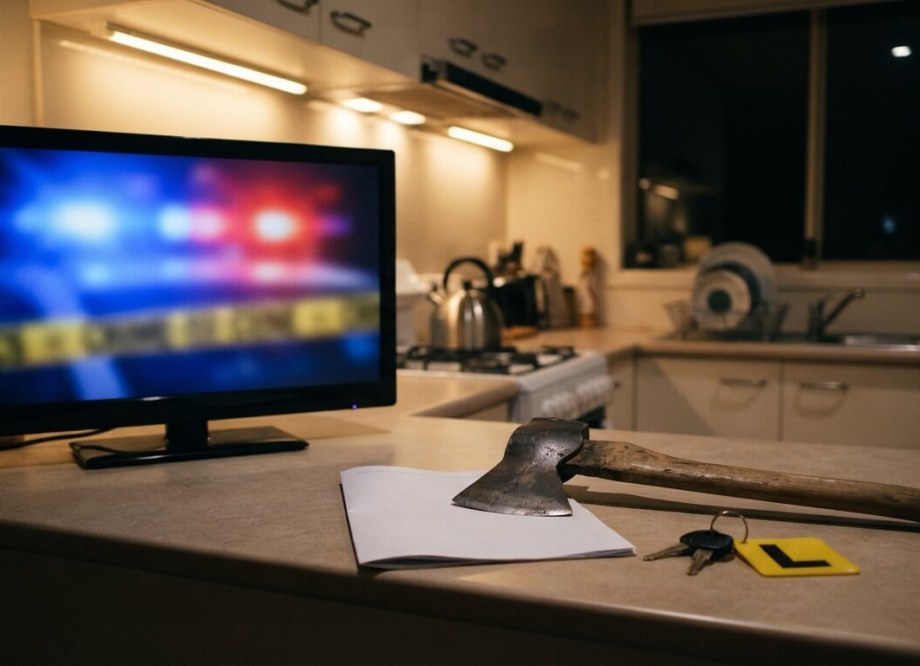
Crime rates in Victoria are falling. You wouldn’t know it from the ABC, our nation’s Clayton’s broadcaster, which has spent election week counting stabbings while Jess the L-plater, fully licensed by the IPA and widely tipped to take the wheel, gets a dream run on the bulletins.
Three stabbings in eight hours. That was the ABC’s Sunday.
By Monday it was a live blog. Community safety was “in election focus after violent weekend in Melbourne”. Cue the lens on the police tape in La Trobe Street and glue it there.
A 21-year-old from Narre Warren did not come home on Saturday. Earlier this month, Feng Jianming, a HungryPanda rider, was stabbed to death near Queen Vic Market.
Nobody writing about crime should forget them.
Nobody should exploit them, either.
Death is big business for a mass media thrashing about in extremis, if not in articulo mortis. The sensation-mongering that fed it so long is starving it to death, yet it cannot stop its compulsive eating. The ABC has no such excuse.
Crime is falling. It’s Victoria’s best-kept secret. In the year to June 2026 Victoria recorded 624,624 offences, 13,360 fewer than the year prior. The crime rate fell 3.8 percent. Serious and violent crime fell 4.1 percent.
Assaults fell 1.9 percent.
These are not Labor’s numbers. The Crime Statistics Agency was set up by statute to keep politicians’ thumbs off the scales. But who polices the police?
Top cops all talk it up. Crime is still 13.2 percent higher than three years ago, Victoria Police says. But look at what is being counted. Offences, not offenders. One incident can carry several charges.
The biggest single category, at 87,257 offences, is breaches of orders: broken bail conditions and intervention orders. Victoria Police puts their rise down to “the proactive interventions by our hard-working police officers”. Check bail more often, record more breaches. None of this erases the climb of the past three years. But a tide that has stopped rising is not a wave. It is a high-water mark, and the water level is subsiding.
Knife crime capital? The title has a pedigree. Sussan Ley, the leader the Opposition had to dump for Angus Taylor, the man with the sound of money in his voice and the keys to the boys’ club in his blazer pocket, pinned “crime capital of Australia” on Melbourne in October last year. The ABC’s daily news podcast put it in an episode title, inverted commas and all, before asking whether it was fair.
There is no league table behind it. Take homicide, for example, the crime least open to fudging. On the Crime Statistics Agency’s own figures, Melbourne’s homicide rate sat at a ten-year low of 2.6 per 100,000 in 2025, down from 8 in 2018, while the use of knives and firearms fell at both state and city level. So writes Macquarie University criminologist Alex Simpson.
Where records are being set is in searching. By mid-November 2025 Victoria Police had seized more than 15,000 knives and machetes, breaking its record for the second year running. Seizures measure how hard police look. Look harder, find more. A record haul is a story about policing dressed up as a story about crime.
So who is keen to break the law? Again and again. By Victoria Police’s own count, 6,600 chronic offenders committed ten or more offences each in the year to September 2025. In the year to March 2026, criminal incidents fell 1 percent while alleged offender incidents rose 8.6 percent. When the crime rate jumped in 2024, the police minister himself conceded that the number of individual offenders had stayed flat.
Fewer crimes. More processing. A small cohort going round and round. The repeat offender. That is a problem of bail, housing, treatment and a youth justice system that hands kids back to the street it took them from. It is not a city under siege. It is a revolving door with an OB camera crew parked outside.
The official charge is knife crime. The real offence lies elsewhere, and the ABC knows it, because the ABC reported it.
On 15 November, under a headline asking whether the campaign was tackling the big issues, it cited a study finding that 43 of an estimated 126 Victorian homicides in 2024 and 2025 were committed by people with psychosis, up from about one in ten a decade earlier.
Pat McGorry told the ABC the mental health royal commission’s recommendations have largely gone unimplemented, and that anyone serious about crime must “get serious about treating mental health”.
That story lives in the analysis columns. The tape on La Trobe Street runs every bulletin.
Why? Because fear is the cheapest content on earth. A study in the Proceedings of the National Academy of Sciences wired viewers in 17 countries to sensors: bad news aroused them more than good, on every continent tested. Good news, its authors observed, is barely news at all.
Murdoch’s tabloids learned that long before the sensors did. If it bleeds, it leads. The hit arrives, the hand goes for the remote, the advertiser pays. The ABC has a charter. It was built to be the antidote to the Herald Sun, not some embarrassing homage or lame tribute act.
Everyone needs to feel safe, and to be safe. Yet ancient as it may be, fear is the MP’s easiest lever. Bulletins are written for the amygdala, the brain’s alarm bell. Crime statistics are aimed at the prefrontal cortex, the part that weighs the evidence, and the prefrontal cortex does not rate. Part of feeling safe is being told the truth about risk by someone with no reason to inflate it. That used to be the ABC’s job. When the public broadcaster chases the tabloid lede, it does not report the fear. It manufactures it, and then it hands the fear to whoever promises the hardest fist.
Labor knows the trade. It has been in it for eight years. In 2018, with an election coming, Daniel Andrews pledged to put semi-automatic rifles in police hands and pushed through laws against association, as the Human Rights Law Centre accused him of pandering to Matthew Guy’s “toxic law-and-order agenda”. In 2025 Jacinta Allan banned machetes and moved to send children as young as fourteen to adult courts for sentencing.
The idea was to take crime off the table. Instead Labor set the table. Every tougher law was a concession that the problem was as bad as the Herald Sun said.
Pollster Kos Samaras, Labor’s deputy campaign director in 2018, has deplored the bandwagon. His reasoning is hard to fault. Every time Labor talks tough, it hands its opponents a free kick, and feeds a conviction already palpable that Victoria is off the scale for violence. It is the one story everybody already has hold of.
You cannot neutralise an issue by agreeing it is the only issue. You cannot outbid the auctioneer. Ben Carroll is still bidding.
Step forward Jess Wilson.
“The level of knife crime in this state is a disgrace,” she said on Monday, pledging to recall parliament before Christmas to pass tough bail and sentencing laws.
The first-term member for Kew has never sat at a cabinet table. She came up through a Young Liberal wing nursed by the Institute of Public Affairs, whose policy director rallied the vote for her in 2016. She is favoured to be premier by Saturday night. And on the bulletins, at least, she is getting an easy ride.
The Australia Institute ran the numbers on her economic plan. Her promised $22 billion in savings from a back-office hiring freeze would mean cutting about 31,700 public service jobs by 2036-37, out of 58,169. Richard Denniss called the savings “implausible” and the surplus by 2032 “not credible”. That is the Institute’s arithmetic on her numbers, not a list of hers. Her own arithmetic has not been published.
Her costings (stop laughing), she says, will be released in full “in the usual way” before the poll. Early voting opened on 18 November. The electoral commission expects six in ten Victorians to vote early. The usual way, then, is after millions have already voted.
And then there is One Nation, polling at 23 percent. Wilson will not wed One Nation in coalition. Confidence and supply she has left on the table. In Prahran, her own sitting member’s how-to-vote card puts One Nation fifth and the Greens last. Fresh start, same preferences. When the bail laws she has promised to ram through before Christmas reach the floor, it may be One Nation deciding how tough is tough enough.
Fresh start is the slogan of a warmed-up leftover fear campaign. But the media can’t get enough of it. Ahead of last year’s Prahran by-election, the Liberals built an attack site under the Greens candidate’s own name. Search for her today and it is still there, close to the first result. Asked by Crikey about negative campaigning, the sitting Liberal MP, Rachel Westaway, had a ready answer. “There is no negative campaign.”
The ABC noticed some of this. Its 15 November analysis conceded that the campaign was fixed on Labor’s twelve years rather than the Coalition’s own detailed proposals. A week later it reported that the costings were still missing and that millions would have voted before they appear. It noticed. It said so, in the analysis columns. Then the bulletins went back to the tape.
On Saturday Victorians will vote on how safe they feel. They have been shown the knife, every night, from every angle. Nobody has shown them the evidence. Nobody has shown them the axe.

