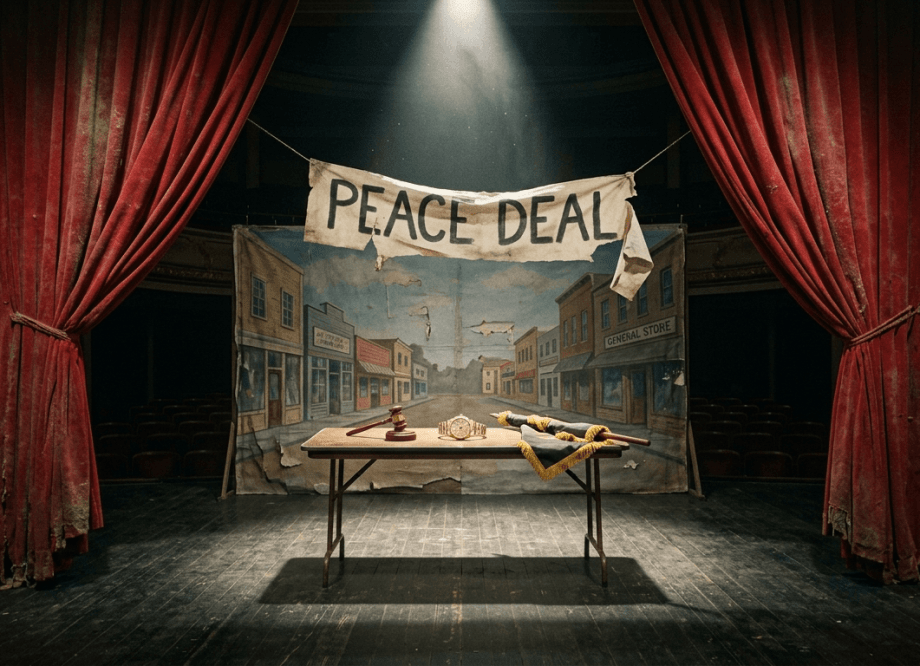
It’s all too easy to be harsh on Donald Trump. Because of his fabulous depravity, his magpie greed, his gift for finding the cruellest option and mistaking it for strength, his colossal, if not grotesque vanity, a man for whom there is no such thing as bad publicity, one can lose all sense of proportion.
So let us be scrupulously fair. Let us grant Trump his single, real achievement. Not his kleptomania. Nor his sordid past. He has killed Truth, Justice and the American Way stone dead, and for that, the republic may one day thank him. Nobody ever believed the trinity anyway. That was always the point.
It was comic book dialogue, a slogan stitched on a cape, the kind of thing you say with a straight face precisely because it means nothing, like your call is important to us, or we value our people, or any mission statement ever screwed to the wall of a firm about to make half of them redundant.
America didn’t live by the trinity. America recited it. There’s a difference, and the difference is the whole country. But a slogan needs a hero to mouth it, and the hero has left the building. In his place a monstrous man-child is flogging watches.
Consider the dynasty’s real creed, the one they live by rather than the one they salute.
Not Truth but the Lie, retailed wholesale, no reasonable offer refused. Not Justice but Impunity, which is justice for people who can afford the lawyers. And not the American Way but the only Way the Trump family has ever known, which is the Sale. An Aladdin’s Cave of tacky merchandise.
The phone. The sneakers. The Bible, God’s word in pleather, fifty-nine ninety-nine, Lee Greenwood included like a set of steak knives. And the jewel of the range, the Trump Victory Tourbillon, a hundred thousand dollars of eighteen-carat gold and a hundred and twenty-two diamonds, limited to one hundred and forty-seven pieces because he is the forty-seventh president.
A watch the website solemnly promises is designed to counteract the effect of gravity, which is a fair description of the whole enterprise. Of the hundred and forty-seven, barely fifteen sold. Even gravity, in the end, declined the offer.
Three pillars, same as Superman’s, and every one of them fake. The mission statement of a going concern that is, on closer inspection, simply going. The art of the schlemiel.
And at the centre, the deal. Always the deal. The man wrote the book on it. Well, a man wrote the book; Donald held it for the photo. The Art of the Deal, and after it the deal of the week, and after that the deal of the century, each one bigger, each one realer, each one arriving like the carnival into a small town and leaving the same way, before the cheques clear.
Until you notice the trick that was the trick all along: the deal is that there is no deal. There was never anything in the box. The only currency this dynasty has ever minted is deception, and they’ve debased even that. They have printed so much of it that it’s not worth the breath to say it any more.
Which is roughly where the markets landed. Michael Wolff has filed four books now from inside the dumpster, four dispatches from a White House that runs the way a kitchen fire runs, and there is a fifth sitting there for whoever is quick enough: Donald Trump, The Art of the Liar. The story of the man who cried Wolff so often that even Wall Street, that congregation of the permanently credulous, finally sat one out. Folded its arms. Priced the panic at zero. As Sun Tzu might have said if he’d been a day trader: All warfare is based on deception. But even deception has its limits.
A Short History of the Peace That Wasn’t
It is worth reflecting on the word deal when it is dressed up in its Sunday best and called a peace deal, because its history is nothing to write home about. The peace deal is the most over-promised product in the human catalogue, and its returns policy is written in blood.
Versailles ended the war to end all wars and incubated the next one inside two decades, a peace so punitive it functioned as a layby plan for fascism. Munich bought peace for our time, and the receipt expired in eleven months. Oslo had a lawn ceremony, a handshake, a Nobel Prize, and a body count that kept rising long after the cameras packed up. The Minsk agreements were signed twice, presumably on the theory that a deal that fails once simply needs a sequel.
The pattern is not incidental; it is the product. A peace deal is an announcement that the shooting ought to stop, dressed as news that it has. It is photographed at the moment of maximum hope and graded, if anyone bothers, at the moment of minimum attention, by which time the principals have moved on to the next ceremony. The signing is the deliverable. The peace was always sold separately. Which is precisely why the genre suits the Trump dynasty so well: it is a transaction whose entire value is realised at the point of sale, in the headline, before a single combatant has been consulted. Caveat emptor was invented for exactly this aisle of the shop.
The View From Centcom (Subtitles Provided)
Here is how a deal works in the dynasty’s dialect. You announce it first. Reality is invited to catch up later, and if reality declines the invitation, well, reality was never on the guest list anyway.
Watch the footwork. We’ve seen this choreography before. Too often. In June last year, after American bombers hit three Iranian nuclear sites, the President announced on Truth Social a “Complete and Total CEASEFIRE” to end what he christened, in capitals, the Twelve Day War, fully agreed, he said, between the two parties, with the world to salute its official end within twenty-four hours.
Epic rhetoric; superbly timed. The only minor flaw in the production was that the parties hadn’t been told. Within hours Iran’s foreign minister Abbas Araghchi denied any agreement existed; the Revolutionary Guard’s Fars news agency went further and called the ceasefire plan entirely false, floated, it said, to divert public attention. The announcement had caught both combatants off guard. A remarkable thing for any bilateral agreement to do to the two parties bound by it. The Trump hack?
No. This is a display of offensive posturing, and like Kabuki, the meaning is in the gesture, not the words. The subtitles from Centcom say peace; the stage says war. Read the gesture, not the line.
And it is never a single day’s work; it is a whole season of it. Extended due to popular demand?
One week Trump posts that he has had a productive call with Netanyahu and that Israel and Hezbollah will stop attacking one another, that Israeli troops will not move on Beirut. Within the day the production falls apart on stage: Netanyahu announces the military will keep striking southern Lebanon as planned, his defence minister Israel Katz flatly denies any ceasefire exists, Iran suspends its talks with Washington altogether on the grounds that the truce has been violated, whereupon Trump contradicts Tehran and insists the talks are, in fact, continuing at a rapid pace.
One announcement. Four contradictions. Before sundown. The eternal next week, the rapid pace toward a destination that recedes as you approach it, the carrot on the stick held by the donkey itself. The deal, in other words, is announced into being. It exists because it was said, the way a thing exists in scripture because it was written. Let there be peace. And there was a press release.
Read the gesture, not the line. What the White House is signalling underneath the subtitles is the oldest message in the racket: nothing here is settled, everything is leverage, and the announcement is not a description of the world but a move within it.
The deal is not the peace. The deal is the saying of the peace: a chip to be cashed at home, a headline to be printed before the denial lands, a distraction timed to the news cycle.
Because that is the other half of the stage, and it doesn’t wear a uniform. It wears a press lanyard. The corporate press, and the rest of the chorus, does not, on the whole, speak truth to power.
Chief among them, Rupert the Renegade Red, the boy who kept a bust of Lenin in his rooms at Oxford and ran the University Labour Club, who by every fond account talked like a tract, all comrade this and dialectical materialism that, and who grew up to give the world Fox News. The apostate who railed against the snobbish British establishment right up until the morning he owned it. BREAKING: the President has announced. BREAKING: a source confirms the announcement. BREAKING: the announcement has been denied, see paragraph nine. The denial always lives in paragraph nine, which is where truth goes to be technically present. The headline did its work hours ago. The retraction arrives like an ambulance to a funeral.
So the deal of the century turns out to be the same as the deal of the week, which is the same as every deal the Trump dynasty has ever struck: an announcement in search of a reality, a cheque written on a closed account, a ceasefire that holds right up until the moment anyone checks whether the shooting has stopped. The art of the deal was always the art of the telling. And the only people still buying are the ones paid to repeat it.
Meanwhile, Down Under (The Deputy Sheriff’s Receipt)
And what of the faithful deputy, the loyal offsider in the antipodes, the nation that signed up to be America’s unsinkable aircraft carrier moored conveniently off the coast of China? Australia, which committed in 2023 to spend A$368 billion over three decades, the biggest cheque the country has ever written, on a fleet of nuclear submarines.
The deal was always a leap of faith: trust the great ally, pay up front, and one day our boat will come in, the way the meek shall inherit the earth. But here’s the twist. The submarines Australia is banking on, the SSN-AUKUS class, are not being built in the US at all. The British, whose shipbuilding glory days are a century ago, are the ones designing and building the new boats.
The same Little Britain whose industrial base is now so stretched that their own first SSN-AUKUS won’t arrive until the late 2030s, and whose shipyard at Barrow-in-Furness is already groaning under the weight of delays and cost overruns. As befits a ship that is becoming a redundant liability.
Australia’s five SSN-AUKUS submarines will be assembled in Adelaide, at the Osborne Naval Shipyard, by a joint venture of ASC and BAE Systems. The first won’t hit the water, or each other, until the early 2040s. In the meantime, the Americans, the supposed industrial titans of the partnership, are flogging us three used Virginia-class submarines, with the option of two more if the SSN-AUKUS program collapses under its own absurdity. The boats are drawn from hulls already in the US fleet and will be handed over six to fifteen years old, against a design life of thirty-three. The third, under the old deal, was to have been a new build. Now it has quietly become a fourth-hand promise like the rest.
Read the gesture, not the line. At the Shangri-La Dialogue in Singapore, at the end of May, the deputy sheriff collected on the promise, and what he came home holding was a receipt for second-hand boats. All three of them. Under the original pathway we were to get two used Virginia-class submarines and one built new; under the revision Marles unveiled in Singapore on 30 May, the new one has quietly vanished and all three are now pre-loved, drawn from the existing US fleet. Block IV hulls, with somewhere between six and fifteen years already on the clock, the transfers themselves still years off, scheduled across the 2030s. Used nuclear attack craft, one careful owner, some wear on the reactor. The joint communiqué calls this “simplifying supply chain management” and “maximising cost efficiencies”. It is the language a used-car yard reaches for when the new model never arrived because the factory cannot build them fast enough to cover even its own navy.
And Richard Marles, a man who could find the silver lining in a mushroom cloud, stood at the microphone and presented the downgrade as significant savings, a streamlining, a triumph of commonality, and asked us to admire how very efficient our humiliation had become.
The critics were less encumbered by the need to keep a straight face: a “slap in the face”, said some; a textbook “bait and switch”, said others, noting the small matter that not all Virginia-class boats are the same, and the new one we were promised would have come from the most recent design block. You really cannot make this stuff up.
This is the same deal in a different ocean. Announce the triumph, deliver the leftovers, and trust the chorus to print the triumph and bury the leftovers in paragraph nine. We were told we were buying the deterrent of the century. What we are getting, for the better part of four hundred billion dollars, is a British-designed, Australian-assembled submarine that won’t arrive for two decades, and a fleet of American cast-offs to tide us over. Mates we may be, and deputy sheriff we were so proud to be deputised, but the badge, it turns out, was the kind you get free in a cereal box.
The deputy’s horse came later, and it came on wheels. Four hundred billion dollars, trundled through the gate to grateful applause, and nobody in Canberra thought to ask whose soldiers were inside.
The only currency the alliance trades in is the same one the dynasty mints everywhere else: the announcement. The deal of the century, again. And the deal, again, is that there is no deal, only a press release, a downgrade, and a deputy out the front of the saloon, badge gleaming, telling the town it’s never been safer.
Coda
So strike the trinity. It was always a costume. Truth has lawyered up. Justice is in arbitration. And the American Way is currently buffering, though if we’re honest, the buffering started years back, somewhere around the four-hundredth rerun of Lassie. The one show that ever kept the promise. Kid down the well, dog comes running, every single week, no markup, no up-sell, no fifth book required.
Turns out loyalty was the family pet the whole time. Not the flag. Never the flag. And never, ever a man in a mask and a cape. Or in tights.
Schlemiel (Yiddish): the born bungler, the luckless fool who upsets the soup. By long tradition he is paired with the schlemazel, the one on whom the soup invariably lands. The distinction is instructive. A schlemiel is a victim chiefly of himself; the rest of us are merely the schlemazels standing too close.
Lee Greenwood: American country singer whose 1984 anthem “God Bless the USA” became the standard-issue soundtrack of Republican flag-waving and a fixture at Trump rallies. He lent his name to the Trump-endorsed God Bless the USA Bible: patriotism and scripture shrink-wrapped together and sold by the unit. The Australian ear may substitute its own purveyor of earnest singalong nationalism to taste.


‘Oslo had a lawn ceremony, a handshake, a Nobel Prize, and a body count that kept rising long after the cameras packed up’
So true David perhaps you have read Tomorrow is Yesterday by Hussein Agha and Rob Malley?
Chapter 10 contains one of the most devastating analysis of US perfidy and stupidity I have ever read.
LikeLike
My only quibble, David, is with your (cheep, boom-boom) indirect shot at the delight that is the magpie. With all other of your comments, I concur wholeheartedly. I’m sure I’m not alone in waking each morning thinking: (a) What has the Orange Agent in the White House done overnight to further stuff the world? And: (b) What contortions will our government have performed in order to comply with our great and powerful friend’s demands? This country is becoming a shocking embarrassment.
Keep on delivering your assessments. Other than on magpies.
All the best,
David
LikeLike