What grew in the space where Iran’s democracy used to stand.
There is nothing new in the world except the history you do not know. — Harry Truman
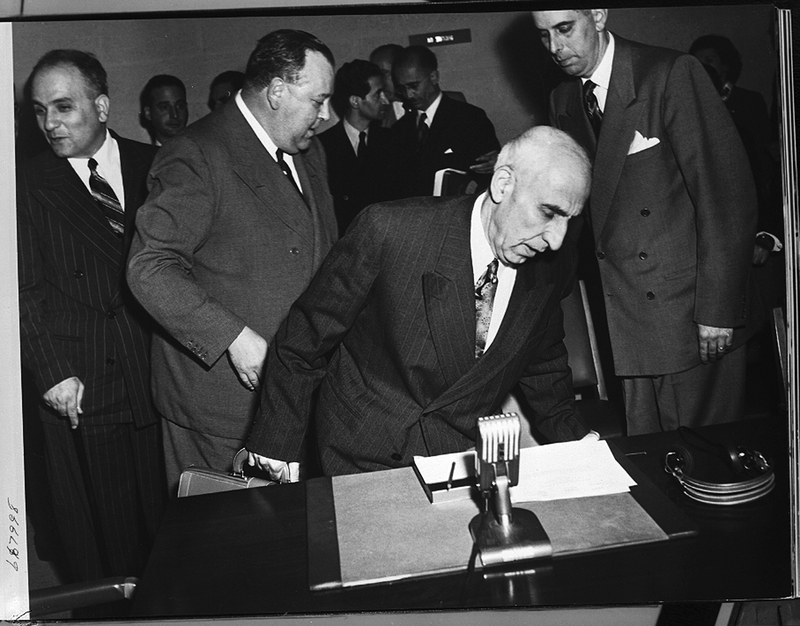
The democrat the US and the UK’s spooks destroyed was not a firebrand. Mohammad Mosaddegh — tall, pallid, sad-eyed, prominent-nosed, shoulders permanently in retreat from the world, looked less like a revolutionary than a scholar who had mislaid his library. He wore pyjamas to parliament. He wept at the podium. He sometimes conducted the business of government from a bed wheeled into the chamber. Iran loved him for it. The Anglo-Iranian Oil Company did not.
The Monster They Made is the story of the 1953 CIA coup in Iran. A Samsonite suitcase of cash. A million dollars of crisp new notes to fund the blood-letting and the drama of regime change. Wrestlers in the streets. Three hundred dead.
And Mosaddegh, the staunch democrat who spent his last years under house arrest, a prisoner of the constitutional monarchy he helped shape, writing the undefeated case for everything that was destroyed.
The coup did not merely sow the seeds for the Islamic Revolution. It constructed the machinery. As the Persian proverb puts it: “The mud that you throw will fall on your own head.”
The CIA and MI6, the Special Relationship, as it is known in the spy trade, did not merely remove an obstinate scholarly obstacle. They ran a combined operation, code-named Operation Ajax on the American side and Operation Boot on the British. Together they liquidated the entire secular, liberal, nationalist infrastructure that might have led Iran in a different direction. They left behind a Shah, a torturer’s charter, and a mosque. Only today, are the UK and the US, at last, paying dearly for their 1953 skulduggery.
The American on the ground was Kermit Roosevelt Jr., a cool customer, already starring in this account, playing the Guys and Dolls number, “Luck is a Lady”, on repeat while ignoring HQ’s orders to abort. Roosevelt did not look like the man who bought a coup. Kim Philby, the Soviet double agent, who met Roosevelt in Washington, describes him as “a courteous, soft-spoken Easterner with impeccable social connections, well-educated rather than intellectual, pleasant and unassuming. In fact, the last person you would expect to be up to his neck in dirty tricks.” Graham Greene’s Quiet American, without the innocence.
The Briton was Norman Darbyshire. A much more colourful character. Head of MI6’s Persia station, fluent in Persian, operating in exile from Cyprus after Iran expelled the British embassy. Darbyshire transported the cash used to bribe members of the Iranian parliament in biscuit tins. He boasted he had extracted vital intelligence from an Iranian army commander for two pounds of Lipton tea. “The coup cost 700,000 pounds,” he said afterwards. “I know because I spent it.” In the 2019 documentary Coup 53, Ralph Fiennes plays Darbyshire. The casting is not a stretch. Greene’s Fowler fits perfectly.
They pay a clergyman to do it. But not directly. The baksheesh passes through the Rashidian brothers; Sayfollah, Ghodratollah, and Asadollah, sons of a British agent, themselves MI6 assets, wealthy Tehran fixers with connections reaching to the Shah’s own family. They are the wire transfer. Kermit Roosevelt, even in his own memoir, could only bring himself to call them “the Boscoe brothers,” maintaining cover in a book about himself. From the Rashidians, US$10,000 passes to Ayatollah Abol-Qasem Kashani, aged sixty-five, former collaborator with German intelligence in wartime Persia, co-founder of the Fadayan-e-Islam, the militant brotherhood whose devotees had already tried to assassinate the Shah and succeeded in killing his prime minister.
CIA operational records cannot confirm the cash arrived. The receipt, as it were, is lost. What is not lost is the outcome: a Nazi-adjacent Islamist terrorist, bankrolled by Langley through a chain of royalist fixers, to destroy a secular democrat on behalf of the monarch he had previously tried to murder.
On August 19, Kashani’s forces were out in full force. The CIA got what it paid for, or possibly didn’t pay for, which is either worse or exactly as bad. After 1953, people in the streets of Tehran dressed dogs as Ayatollah Kashani. Khomeini called him a great anti-imperialist fighter. Iran’s supreme leader was still praising him in 2017.
The Americans acted surprised when the religious extremists inherited the country.
The Shah needed a secret police force. The Americans provided one, and they sent a man with a name. Major General Herbert Norman Schwarzkopf Sr. Founder of the New Jersey State Police, Schwarzkopf had hunted Bruno Hauptmann after the Lindbergh kidnapping. A veteran of two world wars, he trained virtually all of the first generation of SAVAK personnel. His twelve-year-old son, Norman, came to Tehran with him in 1946, learned to shoot there, developed what his biographers call a lifelong interest in Middle Eastern culture. Norman grew up to command Desert Storm.
America’s dynasties of intervention, like its oil contracts, tend to run in families.
SAVAK was set up in 1957. The CIA and French intelligence set it up. Mossad joined the programme as the apparatus matured. Together they built a single institution whose purpose, whatever the official mandate, was the elimination of dissent.
By 1976, Amnesty International identified the Shah’s regime as among the world’s worst human rights violators. The documented methods had a sensory register the language of official reports resists: the hum of a metal table heated to white heat, the slick wet sound of a floor being hosed down, the specific smell of a place where the state has been working on a person for days.
A CIA officer confirmed to the New York Times that a senior agency official had personally instructed SAVAK interrogators in techniques derived from Nazi methods. American diplomats in Tehran received the complaints. They heard the families of the disappeared. They knew. They continued.
The men who ran this system had names and titles. Enter, Reza Baraheni, Iran’s most celebrated poet, a professor of literature at the University of Tehran. In 1973 Baraheni was arrested at a traffic light; an undercover SAVAK agent stepped to his window, pressed a gun into his ribs, and told him to drive. He was held for 102 days. He wrote two poems on his prison cell wall with his fingernails, memorising each stanza, erasing it before the guards came, then scratching the next. His interrogators were Dr Rezvan and Dr Azudi, men who used university titles while administering a curriculum designed in Langley and first taught by Schwarzkopf’s graduates. The book Baraheni eventually published was called God’s Shadow. It is still in libraries.
Stability. Cheap oil. The permanent interests. The internal purges.
SAVAK’s effectiveness in liquidating secular opposition was the theocracy’s best friend. Every liberal, every trade unionist, every secular nationalist who might have led a modern Iran was systematically removed. The mosque was left standing because it was the one institution SAVAK found too difficult to penetrate. Khomeini’s people were the last ones in the room because the CIA had paid to eliminate everyone else.
The monster was not born. It was cleared of competition.
On 28 February 2026, the sky over Tehran turned the jagged, unnatural orange of missile fire and a civilisation seven thousand years old held its breath. The strikes killed Supreme Leader Ayatollah Ali Khamenei. Trump calls it liberation. The Oslo-based Iran Human Rights group had already recorded 190 executions in 2026 before a single American bomb fell.
The Islamic Republic is a repressive theocracy. This is true. It is also true that the United States overthrew Iran’s democracy in 1953, installed the dictatorship that preceded it, trained its secret police in Nazi-derived torture techniques, armed Saddam Hussein when he invaded with chemical weapons, withdrew from the nuclear agreement in 2018, assassinated Iran’s most powerful general in 2020, and is now bombing Iranian cities on the grounds that the government is repressive.
Each step framed as restoring leverage. They mean punishment.
US CENTCOM and its media auxiliaries are selling a compelling fable. The Islamic Republic of Iran is a murderous theocracy. It kills its own people. It jails dissidents, executes protesters, and runs a security apparatus of medieval brutality. Therefore, bombing it into rubble is not merely justified but obligatory. Democracy delivered by ordnance. Liberation at 30,000 feet.
The crimes are real. But the United States helped build that theocracy. Helped design it. Funded its secret police. Trained its torturers in the precise application of pain. Paid the clerics who cleared the democratic field so the ayatollahs could inherit it. And when the bill came due in 1979, tore up the invoice and pretended it had never ordered the full degustation banquet.
“Regime change” produced the Taliban, the Islamic State, and the failed state of Libya. It has never, in the documented history of American military intervention, produced a functioning democracy. The people who design these campaigns know this. The gap between destroying a government and building a successor is not a planning failure. It is a planned absence. What fills that absence is always the most organised, most ruthless, most ideologically coherent force that survives the bombing.
In Iran, in 1953, that force was the Shah. In Iran in 2026 it is whatever the bombing cannot reach. Iran’s mosaic defence doctrine distributes command across 31 autonomous provincial structures, each empowered to keep fighting without orders from Tehran. The Basij operates in tens of thousands of cells embedded in mosques, schools and neighbourhoods across a nation of ninety million people. After Israeli strikes killed the Basij commander Gholamreza Soleimani in March 2026, his forces did not dissolve. They relocated — to highway overpasses, to basement mosques, to pre-positioned caches in mountain villages — because the doctrine had anticipated his death. “Every province is a mosaic, and the commanders have the ability and power to make decisions,” Farzin Nadimi of the Washington Institute told Radio Free Europe. The IRGC controls roughly half the Iranian economy and employs a patronage network that reaches into the rural working class. You cannot bomb a parallel state into democracy. You can only drive it under the nearest overpass.
The United States does not bomb countries into democracy. It bombs them into the next war.
None of this reaches the Australian breakfast news cycle. Not because of conspiracy. There is no smoke-filled room, no Holt Street directive arriving at Ultimo before dawn. The mechanism is industrial, and it runs on something more durable than malice.
At 5am, the cold blue glow of a tablet screen reflects in the eyes of an ABC editor. They scan the News Corp front pages, as they do every morning, as every journalist in the country does every morning. An International Media Concentration Research Project led by Professor Eli Noam of Columbia University found Australian newspaper circulation was the most concentrated of 26 countries surveyed, and among the most concentrated in the democratic world.
The Australian decides what the story is. Everyone else decides how to cover it. The ABC does not take orders from Murdoch. It takes its cues. The distinction matters less than it should.
We saw the mechanism work in real time during the Voice Referendum. Researchers from the Murdoch Referendum Accountability Project documented it with forensic precision: News Corp set an agenda framing the Voice as divisive, and the rest of the media, including the ABC, followed the same script. Apply the same logic to Iran. When the US and Israel strike, the language arriving in every wire service feed is ‘retaliation,’ ‘deterrence,’ ‘self-defence.’ When Iran responds, the word is ‘escalation.’ The Washington Post headlined the assassination of a sovereign head of state as a ‘surprise daytime attack’; the language of military precision and narrative boldness, not the language of extrajudicial killing.
What will not happen, at 5am or any other hour, is the reaching for the 1953 file. The question of why the Islamic Republic exists. The question of who trained SAVAK, who passed ten thousand dollars through the Rashidian brothers to Ayatollah Kashani, what grew in the space where secular democrats used to stand. The history is declassified. It has been sitting there for decades. It does not fit the agenda set before breakfast.
The right of the Iranian people to determine their own future cannot be delivered by Tomahawk missiles, or entire carrier fleets, guided from far away Pine Gap. It could not be delivered by CIA coups in 1953 either.
The monster was made in Langley and Tel Aviv and the Foreign Office. Made in the torture chambers of Evin Prison where men like Dr Azudi; university titles, wire whips, worked on bodies that had names and families and, before August 1953, the reasonable expectation of living in a democracy. One of those bodies had a name: Mohammad Mosaddegh. The democrat, imprisoned by the government he had spent his life building. Made in the mosques that SAVAK left standing while it liquidated everything else. Made in the boardrooms where men decided that a stable, compliant repression was preferable to a messy, inconvenient democracy, because the repression kept the oil on schedule. Why risk democracy?
The arsonist has called the fire brigade. The fire brigade is carrying more petrol.
Iran is a civilisation seven thousand years old. The Elamites were building cities when Rome was a sheep paddock. She has survived Assyrians, Macedonians, Arabs, Mongols, and Ottomans. She will survive the ‘leverage’ of 2026.
The question is what survives with her.
Every morning the production line runs. It tells Australians the bombing is regrettable but the regime is monstrous. It does not explain who built the regime. It does not mention the seven decades of interest being collected on a debt that was never supposed to be repaid.
The bill is still running.
And it is running right now.


One of your best yet, David. Well-researched, to the point. Of course the imprint of the USA is all over it. Just like so many other countries (and I mean that in both senses).
LikeLiked by 1 person