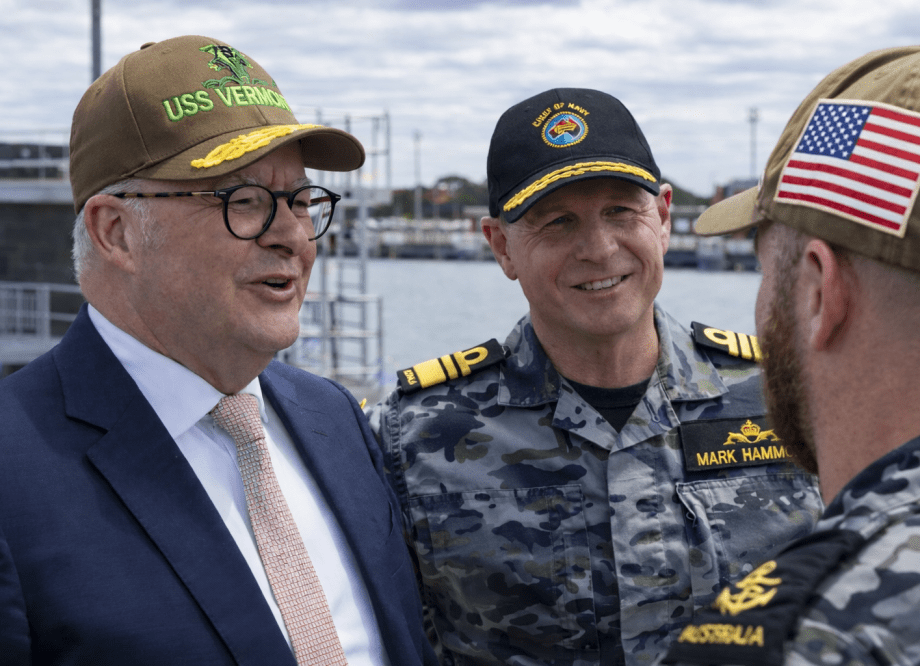
Look at the photo. Anthony Albanese, grinning in his USS Vermont baseball cap like a kid who just won a free submarine from the Pentagon’s lucky dip. Beside him, Vice Admiral Mark Hammond, now our incoming Chief of the Defence Force, in his crisp “Chief of Navy” lid, the two of them bonded like old mates who’ve just kayaked Sydney Harbour together over Christmas and strolled San Diego in matching Souths Rabbitohs caps. It’s not subtle. It’s not strategic. It’s surrender cosplaying as mateship.
This week Albanese confirmed what insiders have long known: Hammond, the submariner true-believer who once tried and failed to charm Paul Keating out of his withering contempt for AUKUS, will run the entire ADF from July. Another submariner, Rear Admiral Matthew Buckley, takes Navy. The navy now owns the top two defence jobs while the $425 billion defence spend over the next decade funnels the lion’s share into undersea warfare “anchored by the AUKUS submarine program.”
Translation: the US military-industrial complex just got the keys to the Australian treasury, delivered by a Labor government that once pretended to care about sovereignty.
Keating, to his eternal credit, wasn’t buying the sales pitch back in early 2023. Picture the scene: Hammond, briefcase locked to his wrist, submarine photos ready for the reveal, deploying the full arsenal of Pentagon charm on a man who had already watched one generation of Americans promise the world and deliver the bill. Keating told Marles and Hammond straight that AUKUS is “failed by design.” You can only keep about one-third of a submarine force at sea against a peer enemy. The rest is just expensive metal rusting in dry dock.
Hammond’s real mission was never to convert Keating. It was to lock in the man who matters: Albanese. Kayak dates, Rabbitohs solidarity, San Diego photo-ops. The power couple of Australian defence was born. Keating went back to his piano.
And even if the submarines arrive, a proposition on which the actuaries are not taking bets, who exactly is going to crew them? Australia has been scrambling to find qualified submariners for years. The training pipeline is thin, the retention rates are worse, and nuclear submarines demand a level of crew specialisation that takes a decade to build and about eighteen months of a better offer to lose. We are proposing to operate one of the most technically demanding weapons platforms in human history with a workforce we currently cannot fill for the vessels we already have. The recruiters are working weekends. The submarines, theoretically, arrive in the 2030s. The crews, theoretically, materialise sometime after that. In the Pentagon’s spreadsheet this is presumably listed under “Australia’s problem.”
It’s an absurdity that needs the comic genius of Clarke and Dawe to illuminate. My goodness, here they are:
Bryan Dawe is interviewing John Clarke, who plays the Minister for Defence Capability Realisation and Forward Submarine Readiness.
Dawe: Minister, the submarines. When do they arrive?
Clarke: They’re on their way.
Dawe: From where?
Clarke: From the future, Bryan. That’s where world-class capability comes from.
Dawe: And the crews?
Clarke: We’re growing those.
Dawe: Growing them.
Clarke: It’s a pipeline. You plant the recruits, you water them with training, and in about a decade you have submariners.
Dawe: And in the meantime?
Clarke: In the meantime we have a very strong commitment to having crews.
Dawe: How far away is the nearest likely conflict?
Clarke: Some distance, yes.
Dawe: Thousands of kilometres.
Clarke: Geography is one of the factors we’re managing strategically.
Dawe: You’re managing geography.
Clarke: We have a plan for it.
Dawe: And how long does it take a submarine to travel several thousand kilometres?
Clarke: It’s not a quick trip, no.
Dawe: So by the time our submarines arrive —
Clarke: They arrive with enormous presence, Bryan.
Dawe: To a war that’s already finished.
Clarke: To a situation that has evolved, yes. But our presence at that point sends a very clear message.
Dawe: What message?
Clarke: That we were coming. That we were absolutely on our way. That the commitment was always there.
Dawe: For $368 billion.
Clarke: Significant figures, yes.
Dawe: Are we getting a discount?
Clarke: We’re getting a partnership.
Dawe: That’s not the same thing.
Clarke: No. But it photographs a lot better.
Then there is the small embarrassment that nobody in the AUKUS salesroom wants to dwell on: submarines are yesterday’s technology. The oceans that once hid them are filling up with sensors, autonomous underwater vehicles, satellite-linked surveillance arrays, and drone systems that can stalk a nuclear submarine across an ocean with the patient indifference of a search algorithm. The acoustic and thermal signatures that once dissolved into the depths are now readable. Add the tyranny of distance that always makes Australia’s strategic situation unique, and we are a long, slow bicycle ride from any plausible theatre of war. By the time a Virginia-class boat lumbers north from Perth or Garden Island, the conflict it was sent to influence has already been decided by hypersonic missiles, drone swarms, and electronic warfare conducted at the speed of light. The submarine arrives, metaphorically speaking, to find the furniture already rearranged and the Americans writing the after-action report.
Meanwhile, every serious military analyst watching Ukraine, watching the Persian Gulf, watching the drone campaigns rewriting the rules of engagement in real time, is drawing the same conclusion: cheap, expendable, autonomous systems are eating the lunch of expensive, crewed, prestige platforms. A drone costs thousands. A Virginia-class submarine costs $3.4 billion American, arrives late, requires a crew we don’t have, takes weeks to reach a fight, and can be tracked by technology already proliferating across the Indo-Pacific. We are buying a Rolls-Royce, with a target painted on its roof, for a road that no longer exists.
Michael Shoebridge of Strategic Analysis Australia put the broader problem bluntly: “Hammond’s elevation signals the Albanese government doubling down on its single bet on AUKUS and deepening Australia’s military reliance on the US as the key source of resupply for everything our military would need to fight an actual war. While Europe, Canada, and every other US ally are frantically rethinking assumptions in the age of Trump’s “America First,” cheap drones, and missile shortages, Australia stands lonely in its refusal to admit the world has changed.” Albert Palazzo, former director of war studies for the Australian Army, asks the obvious question nobody in Russell Hill wants answered: “when the person running the entire defence apparatus comes from the service consuming most of the budget, is there any critical oversight at all?”
Binoy Kampmark puts the whole farce with magnificent precision: Australian negotiators resemble “a facsimile of Bertie Wooster in desperate need of the good advice of his manservant Jeeves.”
There is Bertie, enthusiastic, well-connected at the club, constitutionally incapable of recognising a con, signing documents in San Diego while the manservant, who is Washington, quietly pockets the cheque. We have already funnelled $1.6 billion into US naval yards for what amounts to stealthy proliferation that benefits the American military-industrial complex far more than any sovereign Australian capability.
The Virginia-class boats? The US will keep them when it suits, rotate them through our bases under effective American operational control, and leave us holding the nuclear waste, the recruitment crisis, and the bill. Retired Rear Admiral Peter Briggs calls it a “wasteful folly” headed for a “train smash.” Even Malcolm Turnbull, not a man prone to anti-American sentiment on weekdays, labelled Australia the “rich dummy” subsidising Britain’s creaky program.
This is the dark comedy of it all. Labor, the party that once marched against Vietnam and sneered at Yankee imperialism, has become the most compliant vassal in the Anglosphere. Albanese’s “independent” foreign policy is now measured in how enthusiastically we open our chequebook and our bases. Hammond, the perfect courtier with deep Washington contacts and fearless advice that somehow always aligns with the Pentagon, will ensure there is no awkward questioning of the $368 billion black hole.
While the rest of the world pivots to drones, autonomous systems, and missile defence that actually works in actual wars, we are betting the farm on nuclear-powered prestige projects that may never arrive, or may arrive under effective US operational control, crewed by personnel we are still advertising for, travelling very slowly toward a war that ended while we were in transit.
The men who marched against Vietnam are now the men writing the cheques for the Pentagon. The party that was born in the shearing sheds is now the party that holidays in San Diego. The submariners have taken the wheel of a vessel that costs more than any previous generation of Australians could have imagined, moves slower than the conflicts it was designed to fight, and flies, when you look carefully at the fine print, someone else’s flag.
The caps told us everything. We just didn’t want to read them.
 Urban Wronski Writes
In retrospect, this whole project turns out to be Morrison’s revenge. On Australia, for giving him and his merry pranksters the flick. Remember Australia’s collective sigh of relief that Scotty was gone? The tense apprehension has incrementally returned and grown with every step Albo, Marles and Wong have taken in sucking up to The Orange One, no matter how cringingly awful and dangerous he becomes. Our prospects are not good. We are but a tool of the Fascist Confederacy of America; our ‘opposition’ is fully supportive of that position. As the cliche has it, this will not end well.
Keep up the good work, David.
LikeLike
Thank you, llama.
ScoMo, the unflushable turd? A bit like Tony Abbott. Or John Howard. The hope is that in calling out the stooges of the US Industro-military complex, their capacity to do us harm will be curtailed.
I understand the frustration behind what you’re saying, and you’re certainly not alone in feeling that sense of drift and unease in Australia’s current trajectory.
The contrast between the relief many felt at the end of the Morrison era and the direction of foreign policy since has been striking for a lot of people. There’s a growing perception that, regardless of which major party is in office, the underlying strategic alignment—particularly with the United States—remains largely unchanged, even as the global context becomes more volatile and, at times, more troubling.
That said, I think it’s important to keep holding space for nuance as well as critique. Australia’s position is shaped by long-standing structural alliances and pressures that no government can easily unwind overnight. But that doesn’t mean those choices shouldn’t be scrutinised—on the contrary, public pressure and informed debate are exactly what can shift the boundaries of what’s politically possible.
Your point about bipartisan consensus is especially worth interrogating. If there’s one thing history shows, it’s that when political alternatives appear to narrow, it becomes even more important for citizens, writers, and readers to keep questioning, documenting, and challenging the assumptions driving policy.
It may not be a comforting moment, but it’s one that calls for clear-eyed analysis rather than resignation. That’s where voices like yours matter. Thank you.
LikeLike
I’m with Llama, on ya, David!
This site has given me more food for thought than I can consume. Makes me feel that there might be light at the end of the tunnel after all. UW.com is my first daily port of call, where possible.
LikeLike