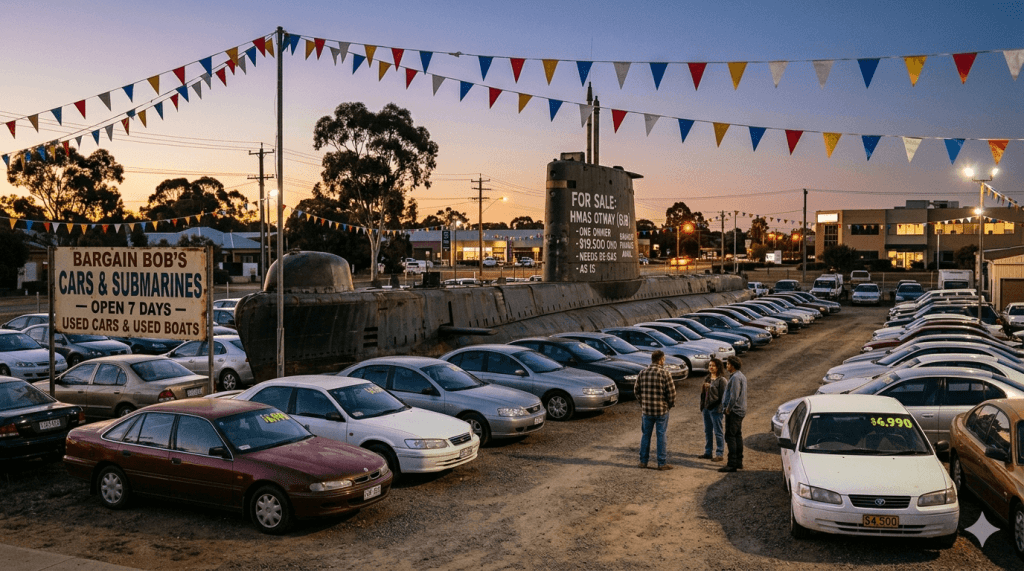
The interview never happened. It should have. John Clarke died in 2017, and the genre died with him: the po-faced minister, the patient interrogator, the absurdity delivered in the flat tones of a man explaining a routine procurement. So here is the sketch he might have written, had he lived to watch us buy three used submarines and call it a defence strategy.
The set is two chairs and a desk. We join them mid-interview.
DAWE: Minister, under the original deal Australia was to receive three submarines. Two second-hand, one brand new.
CLARKE: The new one was the exciting one.
DAWE: And now?
CLARKE: Three submarines, Bryan. The number remains unchanged.
DAWE: But the new one has gone.
CLARKE: The new one has been streamlined.
DAWE: Into what?
CLARKE: Into an older one.
DAWE: So all three are now second-hand.
CLARKE: All three are proven. We’ve placed a premium on simplicity. The brand-new one had never been to sea. We didn’t know it. These, we know everything about. We even know how old they are.
DAWE: How old are they?
CLARKE: Between six and fifteen years.
DAWE: The design life is thirty-three.
CLARKE: So someone’s taken care of the difficult early years. We’ve outsourced the running-in. The Americans have very kindly absorbed the depreciation.
DAWE: The country is paying an extraordinary amount of money.
CLARKE: You could buy a great many doughnuts, Bryan.
DAWE: We’re not buying doughnuts.
CLARKE: No, but it gives you a sense of scale. Warehouses of them. Fresh daily.
DAWE: For three used submarines.
CLARKE: One careful owner. Full service history.
DAWE: When do they arrive?
CLARKE: The first in 2032. And in the meantime, the jobs. That’s what nobody mentions.
DAWE: What jobs?
CLARKE: We have two hundred Australian tradespeople at Pearl Harbor. Skilled people. Working on the submarines.
DAWE: Our submarines.
CLARKE: The American ones.
DAWE: We’ve sent Australian workers to fix the US Navy’s submarines.
CLARKE: To increase their sea days. They’re behind, the poor beggars. Can’t build them fast enough. So we’re helping out.
DAWE: While we wait for ours.
CLARKE: While we wait. It’s the alliance, Bryan. You give a little.
DAWE: We’re paying an enormous sum and supplying labour to build the boats the seller hasn’t finished.
CLARKE: When you put it like that it sounds transactional. This is a friendship. You don’t keep score.
DAWE: Minister, are we any safer?
CLARKE: They’re perfectly safe, Bryan.
DAWE: Safe from what?
CLARKE: From the threat.
DAWE: Which threat?
CLARKE: The one we don’t name. You don’t name it. That’s the whole point of it.
DAWE: But you’ve costed it. You’ve sent two hundred tradesmen to Hawaii over it.
CLARKE: We’ve had to be prudent.
DAWE: About a country you won’t name.
CLARKE: Our largest trading partner, Bryan. You don’t insult a customer.
DAWE: So we’re defending ourselves against the people we sell the iron ore to.
CLARKE: We sell them the iron ore. They sell us the anxiety. It’s a very balanced relationship.
DAWE: And the submarines arrive when?
CLARKE: The first in 2032. The Australian-built ones in the 2040s.
DAWE: Until then?
CLARKE: You’ll always know where they are.
DAWE: Thank you for your time.
A note to readers: this, invented interview is a tribute to the comic genius of John Clarke and Bryan Dawe, their remarkable craft and timing and an act of homage to a tradition of satire that is razor-sharp and yet utterly minimalist. Pared to the essentials. Two chairs, a desk, rather than any set and the truth said plainly enough to be unbearable. There is no greater compliment.
A very close cousin to this text also currently appears in The AIMN under, “Underwater Matters: AUKUS and the Art of the Used Submarine.”