The government of one who pretends to make deals
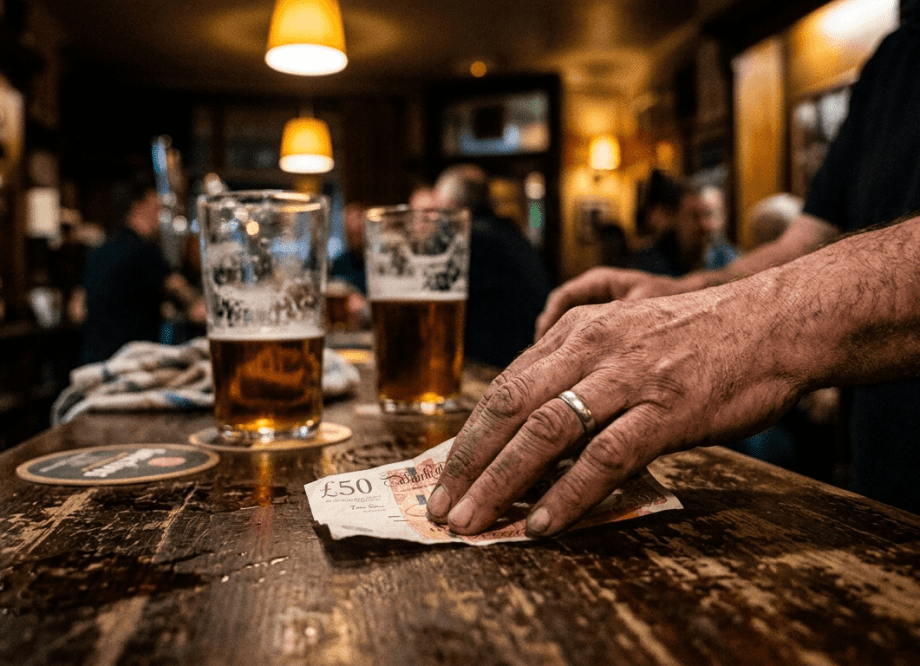
There is a particular kind of man you meet in every pub in Australia. He’s never a stranger, always a mate of a mate. “I’m a bit short this week”, he says, leaning in with the easy warmth of a lifelong friend. Be alright on payday. Could you spot us fifty? And because you are reasonable, and the connection seems real, and it is only fifty, you do.
Later, you see him again at another place entirely, working the other end of the bar, running the same line on some other stranger who also turns out, miraculously, to know someone he knows. Payday, you come to understand, is a country he has no intention of ever visiting. He is not borrowing. He is grazing. And the fifty dollars, yours or anyone’s, is never coming back, because the asking was never a transaction. It was a performance designed to part you from your money while leaving you with the sense you’d done the right thing.
This is the entire foreign policy of the United States of America in the year 2026.
The Liturgy of the Fortnight
The fortnight was consecrated before the present war was even declared. The first of the named Iran wars, the twelve-day affair of June 2025, christened by Trump as the “12 Day War”, began with a White House hedge: the President would decide on Iran strikes within two weeks, citing a “substantial chance” that negotiations may or may not happen. The bombs fell on Fordow within days. The fortnight was never a deadline. It was a fog machine.
And 2025 was emphatically not any beginning. The United States has been at war with Iran, in every sense but the declared one, for half a century: from Operation Eagle Claw in 1980 to the tanker wars of the late 1980s, from the USS Vincennes shooting Iran Air Flight 655 out of the sky (two hundred and ninety dead, most of them pilgrims, and no apology ever quite managed) to Trump’s 2020 drone strike on Qasem Soleimani.
Five decades, four presidents of both parties, one long undeclared war conducted in the dark. What made June 2025 novel was not the violence. It was the branding: the first time Washington stopped pretending and gave the thing a name, a runtime, a christening worthy of a prizefight. Manifest Destiny was the old gospel pointed west; the wars of the twentieth century were it pointed at the world. Trump is it pointed at a mirror.
The fog machine was wheeled out again for the main event. The second of the named wars, and the deadliest by far, began on 28 February 2026, when the United States and Israel launched some nine hundred strikes in twelve hours, assassinated Supreme Leader Ali Khamenei, and, in the course of “Operation Epic Fury,” lobbed a series of three Tomahawk missiles in triple-tap succession into a girls’ school near Bandar Abbas that killed around a hundred and seventy people, most of them children. This was not a fortnight’s work. This was the opening of a war that its architects assured everyone would be over in six weeks.
It was not over in six weeks. And so the liturgy resumed. Having vowed to extinguish Iran’s “whole civilisation,” Trump performed a screeching handbrake turn and announced a two-week ceasefire, conditional on Iran reopening the Strait of Hormuz. Oil dropped sixteen per cent. The markets, ever optimistic, fell for it. The markets always fall for it.
The two weeks elapsed. No deal. The two countries had even met face to face in Islamabad and still produced nothing but a communiqué and a photo opportunity. So the United States did the natural thing for a peacemaker: it imposed a naval blockade on Iranian ports, choking off roughly ninety per cent of the country’s economy.
The two-week pause is not an alternative to war. It is a staging area for war, dressed in the costume of restraint.
The Press Finally Names It
By April, the wire services cracked it. Two weeks is Trump’s favourite interval to buy himself time when making major decisions, says PBS NewsHour. ABC News ran a forensic catalogue under the headline Trump’s pattern of setting unenforced deadlines. And then the commentariat gave him the name he had earned: Donnie Two-Weeks. It has the ring of a minor mafioso, which is fitting, because the whole performance is borrowed from the standover man’s repertoire: the menace, the reprieve, the menace again, the reprieve again, until the mark is so exhausted by the flip-flop that he forgets to ask whether anything was ever real.
The Silver Bullet That Never Fires
To call Trump indecisive is to flatter him with a psychology he does not possess. The sharper reading belongs to Trita Parsi of the Quincy Institute, who identifies the pattern as a delusion that all we need is fresh ammunition. Parsi calls it the “silver bullet” strategy: the recurring American faith that one more decisive act, one more point of pressure, will finally make Iran collapse, capitulate, or bend itself to Washington’s wishes. Each decapitation strike, each bombing campaign, each blockade is announced as the masterstroke, followed by a fortnight’s grace while the next masterstroke is conjured.
“Any time I want it to end, it will end,” Trump lies. He brags that after two weeks of operations there is “practically nothing left to target.” This of a war whose central aim, regime change, had produced not a compliant Iran but the dead leader’s son, Mojtaba Khamenei, installed as the new Supreme Leader and, by most assessments, harder-line than his father.
The man who could end it “any time” had achieved the precise opposite of his stated purpose and called it victory.
The Gospel of the Quiet American
Yet if we treat Trump as an aberration, we will have learned nothing. The man is not a deviation from American tradition. He is distilled from its mainstream: the gospel of American righteousness with the stained glass smashed out, bellowing aloud what the tradition had always preferred to murmur.
That gospel is old. In 1630 aboard the Arbella, John Winthrop, told his shivering Puritans they would be “a city upon a hill,” the eyes of all people upon them. Four centuries later, Madeleine Albright gave the doctrine its modern, secular liturgy: the United States, she said, is “the indispensable nation,” the one that stands taller and sees further.
Between Winthrop’s pulpit and Albright’s State Department runs an unbroken line of conviction: that American power is not merely power but virtue: that what America wants and what is right are, by happy providence, the same thing.
Graham Greene saw the whole catastrophe coming in 1955, and gave it a face. The Quiet American is the story of Alden Pyle, an earnest young Washington man sent to Saigon to nurture a “Third Force” that will deliver Vietnam from both colonialism and communism into the clean daylight of American-style democracy. Pyle is decent. Pyle is sincere. Pyle quotes policy books and means every word. And Pyle arms a warlord whose bomb tears apart a public square full of women and children, and surveys the carnage still convinced of his own goodness.
“I never knew a man who had better motives for all the trouble he caused,” says Greene’s narrator. Pyle is “impregnably armoured by his good intentions and his ignorance.” That could hang over the entire American century: innocence is a kind of insanity.
But Trump is not Pyle. Trump has no innocence left to lose, no policy books, no sincerity to be betrayed. Trump is what Pyle becomes after seventy years: the earnest faith long since rotted away, the good intentions discarded as surplus to requirements, and only the instrument retained. The bomb was always the constant. Pyle merely supplied the sermon that made it feel righteous; Trump has dispensed with the sermon and kept the nuclear football. On display.
The Spoiler in the Room
We have been speaking as though Trump’s government of one were ever truly alone in the room. It is not.
The elephant in the room is Benjamin Netanyahu, a rogue wanted by the International Criminal Court for alleged war crimes. Netanyahu does not want a deal, has never wanted a deal, and has structured his entire position so that no deal can hold. His objection to the emerging Islamabad framework is instructive: he fears that any settlement leaves Iran’s enriched uranium, its ballistic missiles, and its regional proxy network largely intact while easing the economic stranglehold.
For him, anything short of the regime’s annihilation is failure. And so he plays the role of permanent spoiler: every time Trump’s deferral machine drifts toward an actual agreement, Netanyahu escalates, expanding operations in Lebanon, insisting on freedom of action, ensuring there is always a fresh provocation to reset the clock.
The grim comedy compounds: Donnie Two-Weeks, the government of one who cannot decide, is himself being played by a man who has decided everything, who knows exactly what he wants (no deal, ever) and bends the indecisive American to that end fortnight by fortnight. The one man in the drama with a fixed purpose is the one steering it toward catastrophe.
But to call this “the tail wagging the dog” is to miss the point. The dog was bred to be wagged. A superpower that must believe in its own righteousness needs a local avatar to act through, a smaller nation onto which the gospel can be projected and through which the bombs can be delivered. Israel has long served, among its other roles, as precisely this: a proxy for American power in the world’s most combustible region, the indispensable nation’s indispensable client. Netanyahu does not manipulate American exceptionalism. He plays it like a fiddle.
The Donors and the Enforcers
And what keeps an instrument of this kind in tune, decade after decade, administration after administration? The same thing that keeps Woodside’s gas flowing through compliant parliaments: money, disclosed and dark, and the quiet enforcement it buys.
In the 2024 cycle, the American Israel Public Affairs Committee and its affiliated super PAC, the United Democracy Project, spent some $127 million on US elections, making AIPAC the single largest such spender. The strategy is openly bipartisan: by funding members of both parties, the lobby ensures that legislation favourable to Israel passes regardless of who wins. The super PAC’s largest backers (Jan Koum, Bernard Marcus, Paul Singer, Haim Saban) are a matter of FEC filing, not insinuation.
That money buys enforcement. In 2024 the super PAC poured millions into defeating two of Congress’s sharpest critics of Israeli policy, Jamaal Bowman and Cori Bush, and succeeded. The message to every other member was unmistakable: stray from the line and the war chest comes for your seat.
Follow that thread and the whole structure stands revealed as a single circuit. The gospel of the indispensable nation supplies the why. Israel-as-proxy supplies the how. And the donors and enforcers (pro-Israel PACs in Washington, gas dividends in Perth, defence contractors everywhere) supply the current that keeps the lights on, fortnight after fortnight, war after war.
The Cracks
And yet the machine is, for the first time, throwing sparks, and, from an unexpected quarter. Not from the anti-war left, whose objections were priced in from the start, but from Trump’s own side.
No one has watched that ice longer or more closely than Michael Wolff, the veteran biographer who has spent years getting inside Trump’s psyche and who remains a reliable guide to the man we are likely to get. On his podcast Inside Trump’s Head, Wolff has begun describing not a wobble but a thaw: the early collapse of the whole edifice.
“This Trump enterprise is coming apart,” he tells co-host Joanna Coles in early June; Trump will remain “mendacious and dangerous and damaging,” but his grip is loosening, and we are “right at the beginning of this,” a disintegration we will watch “on an almost day-by-day basis.” Why? Trump is losing power for the simple reason that he cannot change even if he wanted. The qualities that won him the prize (the impulse, the loyalty cult, the contempt for expertise) are the very qualities now drowning him.
Impulse, Wolff argues, has eaten strategy whole; the president’s style of decision-making no longer functions as power at all, but as a series of self-laid traps. Above all, he surrounds himself with a cabinet whose members are calculatedly inept.
Wolff compares a possible MAGA turn against the war to Walter Cronkite’s famous 1968 verdict on Vietnam: the moment the anchorman’s quiet doubt told Lyndon Johnson he had lost middle America. If Trump has lost Tucker Carlson in that way, Wolff suggests, the loyalty of the whole MAGA nation is suddenly an open question. And here the melting becomes visible at the edges: the isolationist base that was promised no foreign wars, “no American boys sent nowhere”, watching their man bogged in precisely the kind of overseas quagmire “America First” was supposed to abolish. The ice cap of MAGA realpolitik, that frozen certainty that Trump’s instinct was always strategy, that the cruelty was the point, has begun, at last, to show melt-water.
The evidence has now reached the floor of the House. On the third of June, in the Republican-controlled chamber, a war powers resolution directing Trump to cease hostilities passed 215 to 208, the clearest institutional rebuke of the war yet, and the first time either house had done such a thing since the fighting began. Four Republicans crossed: Massie, Barrett, Davidson, Fitzpatrick. That number matters less than its trajectory. When an almost identical measure came up in April, exactly one Republican had broken ranks. One in April; four in June. A rebellion, of sorts, is underway.
And it is not confined to self-pitying libertarians. Nancy Mace, a MAGA loyalist, walked out of a classified briefing and told reporters the committee had been misled, that the answers weren’t there, and that every day the thing drags on, the less Republican support remains. That is not principled pacifism. That is a soldier of the cause concluding that the general is a fool. Which is, for a government of one, whose only real currency is the appearance of strength, the most destabilising verdict of all.
The Ledger
And thus, to the question the farce is designed to fudge. Who profits? Follow the money out of the Strait of Hormuz and a good deal of it washes up on Western Australia’s beachfronts. When Iran closed the strait, global gas prices did not merely rise; the International Energy Agency called it the largest supply disruption in the history of the oil market. For consumers from Perth to Pennsylvania, that meant pain at the bowser and another turn of the interest-rate screw.
But for the gas exporters, it meant Christmas.
Australia’s energy sector posted a record quarter. And at the head of the pack, as ever, stood Woodside, the great gilded engine of WA Inc., the company whose history is so entwined with the WA political establishment that you’d need a forensic accountant to tell where the state ends and the corporation begins. As the missiles fell on Bandar Abbas and the strait choked shut, Woodside’s share price climbed some twenty per cent.
A girls’ school is flattened near a naval base; a hundred and seventy people, most of them children, are killed in a single strike; ninety million Iranians are sealed inside a blockaded economy, and in Perth, the share price goes up.
And here is where we must stop talking about them (the Americans, the Israelis, the distant warmongers) and look in the mirror. The company cashing in on this carnage is no foreigner. It is one of the largest single donors to both of our major political parties, and it has been buying that access, for two decades. Across the seventeen years to 2024-25, Woodside tipped some $3.19 million into the coffers of Australian political parties: roughly $1.50 million to Labor, $1.43 million to the Liberals, the balance to the Nationals. Forty-seven per cent to one side, forty-five to the other: a split so studiously even it could only be the work of a company that does not care who wins, because it has already, prudently bought both runners in the race. Insurance.
And that is merely the money we can see. Woodside has also paid top-dollar for top-tier membership of both Labor’s Federal Business Forum and the Liberals’ equivalent; fees that buy intimate, repeated, off-the-record access to ministers and shadow ministers alike, and which the parties are under no obligation to disclose. Roughly a third of all political donations in this country flow from sources we are never permitted to identify. Woodside need not lurk in that shadow. It can afford to donate in the daylight and in the dark, and it does both, because influence at this scale is not a transaction but a climate. This is the meaning of WA Inc.: the phrase coined in the 1980s for the unholy marriage of state and corporate adventurism that ended in royal commissions and gaoled men. The culture that scandal was meant to cauterise never died. It put on a tie and bought a table at both fundraisers.
The Regression
We should be precise about what we are watching, because it is not merely a clownish president. It is a regression in the very form of statecraft: a collapse from process to whim, from institution to impulse, from the deliberative machinery that at least pretended to weigh consequences down to the gut of one elderly man who governs by deferral, steered by a foreign leader who will not surrender and underwritten by industries that profit from the stalling.
The American republic was fastidiously designed to frustrate exactly this: the rule of one man’s mood. Checks, balances, the separation of powers, all of it built to ensure that no single will could move the machinery of state on a whim. The encouraging news, such as it is, is that the old architecture is stirring: a House that has finally voted to cry “enough”, a party beginning to wonder aloud whether the man at the controls knows what he is doing. The discouraging news is that none of it has yet stopped a thing. The resolution is symbolic. The blockade came and went on Trump’s word, not the Congress’s.
And so the true bill comes due. Every “two weeks” is settled in somebody else’s currency: ninety million Iranians sealed inside a starved economy, a girls’ school turned to rubble, a region pushed nearer the brink, the rule of law itself spent down to small change, while the deal that was always two weeks away recedes once more into the comfortable middle distance.
The man in the pub is only after fifty dollars, and only yours. When this man leans in and says he’ll be right on payday, just reopen the strait, just hand over the uranium, just give it two weeks, the tab he is running is a war, and payday never comes, and the round is being shouted by a tableful of toss-pots who would very much like the drinking to continue.


Great stuff David and yes that Tucker Carlson interview The Holocaust with the UK doctor and the realities of Gaza reveals Israel’s occupation and genocide is an eyeopener. Not for its content, which we all know, or should, but because it was Tucker revealing those truths to his followers.
I think we are watching the fracturing of capitalism, which is being misrepresented by the MSM as the destruction of liberal democracies.
But as Sue Barrett points out almost every day there are ways of fixing the political system. Then we could begin work on a new and better economic system.
LikeLike