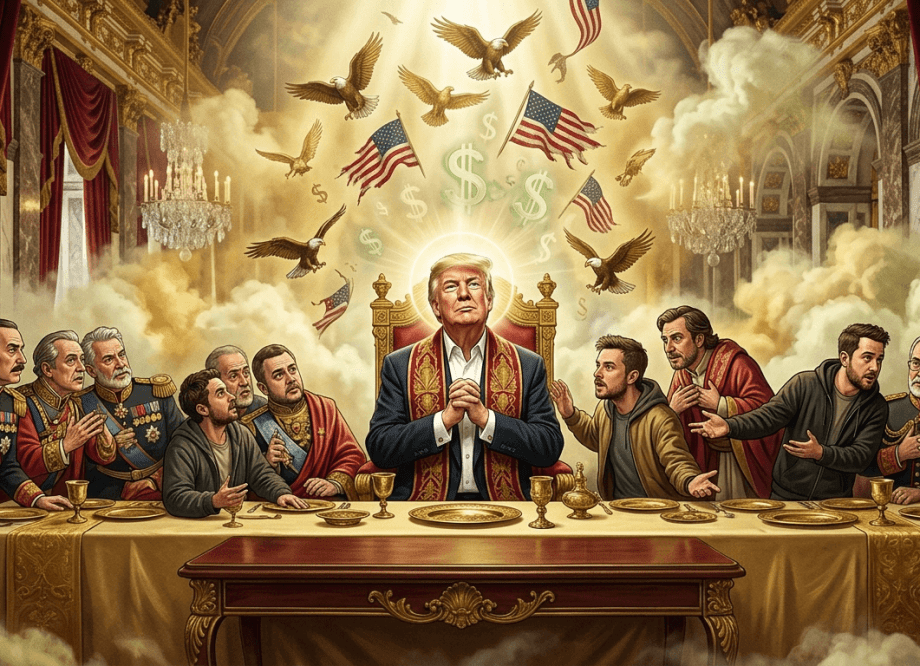
This piece is written in homage to the late, great Martin Amis. It borrows, in spirit and sharpness, from his satiric wit and his razor‑sharp edge; a style that skewered the powerful, the pretentious, and the self‑deluded with equal relish and unblinking clarity.
Not an image but a symptom
The other day, Donald Trump did not just post a picture. He posted a symptom.
The image appeared on the screen like a mirage: the President, AI‑rendered, haloed in a soft, sickly light, hands hovering over a recumbent patient, the whole thing layered with eagles, flags, and the kind of beatific glow that usually belongs to the Sistine Chapel, not to the Truth‑Social feed of a man who cheats at golf and lies a hundred times before breakfast.
Within hours it became obvious: this was not kitsch. It was theatre. The Trumpian cult‑of‑self had annexed the cult of Christ. The Emperor had become both head of state and head of the church, the commander‑in‑chief and the chief executor of divine favour. The only thing missing was the confession box and the offering plate.
The backlash came, of course. The Pope frowned. The pious shifted. The always‑frowning commentariat raised an eyebrow high enough to graze the stratosphere, deflecting Artemis’ fiery return to earth.
Trump’s response was the punchline. “No, no,” he said. “It’s me as a doctor. Just a doctor. Making people better.”
The joke, as Martin Amis would hear it, is that he meant it. He really believed he was a doctor. A healer. A saviour. The man who “makes America well.” The joke, however, is also on the rest of us, the audience who watched him fumble the joke, then double‑down on the delusion. The image is removed from all social media.
The Court of the Very Important Petulant Child
Picture the cabinet room as a stage for the power‑mad, the fearful, and the fawning.
The long mahogany table, the heavy chairs, the aides hovering like staff‑sergeants in purgatory, the generals with medals that look like fishing lures. The President sits at the head, half‑asleep, half‑furious, the body sagging under the weight of age and habit, the mind still racing down the same track it has always run: insult, insult, response, violation, escalation.
Around him, the courtiers perform the ritual. They don’t call it a ritual—they call it “protocol”—but the function is the same. Each one must out‑venerate the last.
“Sir, your great leadership, in this moment…”
“Mr President, the huge courage you’re showing in confronting Iran…”
“Sir, nobody understands the deep state like you…”
The sentences are like offerings at a shrine, the speakers like priests without the doctrine and the shame. They are not debating policy. They are auditioning for the right to be in the room, the right to breathe the same air, the right to survive the next outburst.
The Emperor’s petulance grows visible as the meeting wears on. He slumps, he yawns, he snaps, he threatens. One wrong word, one misjudged nuance, and the sentence is issued: sanctions, war, “obliteration,” the erasure of memory.
Because this is how it has always been: Trump does not threaten like a statesman; he erects the prospect of annihilation like a tantrum. He does not just want compliance. He wants cowed deference, the kind of fear that makes grown men genuflect before an AI‑generated halo.
The Ballroom‑Temple: A Dance to the Music of Time (revised)
The ballroom does not just resemble a temple. It is a temple. The ballroom‑temple. The ballroom, that great glassed‑in box on the East Side of the building; the side where the offices once helped America minister to its poor and needy, the side where social‑service workers tended to the suppurating wounds of inequality, injustice and deprivation, has been ripped out, stripped, gutted, turned into a sanctum for the devout donors.
Now, as we watch the tiny hands and the tiny feet of Donald Trump and his courtiers, shuffling, swaying, posturing under the crystal chandeliers, it is hard not to think of Powell’s Dance to the Magic of Time—only this time Macho Man is not so subtle, the steps are not graceful, and the dancers are not even aware that they are in a painting, let alone one that will outlive them.
They are performing the old ritual of power, the same choreography that has been danced in Versailles, in St Petersburg, in the Soviet Congress halls, in the Roman atriums: the courtiers circling the throne, the ruler pretending to generosity, the supplicants pretending to piety, the donors pretending to philanthropy, the generals pretending to patriotism, the tech bros in the designer stubble of everyman; a true humility hack. The steps are familiar, the costumes merely updated. The music is the same.
And beneath the ballroom‑temple, of course, is the cellar. The bomb shelter. The shelter for the rulers, the protectors, the messiahs, the saviours. The builders of today, we know, always have the best designs and the best materials for bomb‑proofing the rulers of tomorrow, while the rest of the population make do with cheaper concrete, cheaper walls, cheaper promises. The ballroom above them is gilded and sealed, the ballroom where the dance goes on, even as the world outside stumbles toward war.
At the door, however, there is one last stage direction. Beside the guest‑book lies the collection box, a Trump speciality. The choice is as elegant as the décor. You may drop a cheque into the slot labelled Pre‑Loved Children’s Charity, where the optics say “philanthropy” and the optics are all that matter. Or, for the true believer, the direct line: the Trump‑Coin donation tap, the family‑funded, family‑operated, family‑promoted digital‑currency funnel that looks like a cryptocurrency and smells like a Ponzi scheme with the Trump seal of approval.
One path leads to the illusion of charity, the other to the illusion of investment. Both lead, inevitably, back to the same vault: the Trumpian court of perpetual tribute, where even the collection box is part of the sacrament.
The Merchandising of Divinity
The Trump Store is a shrine‑shopping mall devoted to the cult of the self, the omphalos of the Narcissist Kingdom of the USA.
The hats, the shirts, the mugs, the Bibles, the digital trading cards, the wines, the “vintage” political‑issue clothing, the limited‑edition “Trump‑as‑Doctor‑Messiah” NFT‑drops; all of it arranged like relics of the faith. The AI‑Jesus‑Trump becomes a premium‑edition collectible, a digital icon for the digitally‑faithful.
The old imperial cults sold statues and coins; this one sells merch and memes. The currency is faith, the product line is personality, the dividend is influence. The cult‑of‑personality‑state becomes a brand‑extension operation in the Oval Office, the ballroom, and the boardroom.
J.G.A. Pocock’s “Machiavellian moment,” the moment of republican virtue guarding a fragile republic from the corrupt court, has been turned into a punchline. The armed citizens protecting the republic are now conscripted into the cult‑court‑brand‑state. The court has become a corporate‑theocratic‑shopping‑club, where the stock ticker is a kind of liturgical chant, and the bottom‑line is the new morality.
Roy Cohn, Epstein, and the Emperor’s Fear of the Reaper
Behind the stage lighting and the merch tables, two figures haunt the court like cruel providence: Roy Cohn and Jeffrey Epstein.
Cohn is the ghost that Trump has proudly invited to dinner. He is the patron of the Trumpian ethos: deny everything, attack your enemies, never admit a mistake, and then accuse them of the very thing you are guilty of. The Emperor venerates Cohn as if he were a saint of the new order, the model of the man who lies, steals and wins, and never pays his bills, the moral zero‑point from which every new outrage is calibrated.
Epstein is a different kind of ghost. He is the stain that refuses to wash out. The memory of the man whose name is whispered but never quite uttered, the courtier who knew too much, the broker who trafficked not in ideas, but in bodies, secrets, and leverage. Epstein’s shadow reminds us that the Trumpian court is not just a cult of personality; it is a corporate‑theocratic brothel, where the sacred and the sordid trade hands in the twilight.
The Emperor, for all his swagger, begins to look fragile. The eyelids droop during meetings, the naps grow longer, the tantrums more frantic, the threats grander, the accusations wilder. His incontinence more troubling. He lashes out at the world, the press, his rivals, the Pope, the Deep State, the Iranians, the Democrats, the Chinese, the “global elites,” as if by shouting loud enough he can drown out the echo of the ticking clock. He dreams of firing a Tomahawk at MTG who has also turned against him recently.
He knows, somewhere in the sparse, unholy, clutter of the attic of his mind, that the reckoning is coming. The maker, the judge, the ultimate auditor, the reader of the final ledger, all are waiting. The Messiah‑Emperor is terrified that when he finally arrives at the Gate, the reception committee will not be impressed.
“Sorry, Donald. You got it from Venezuela? We’re not sure this counts.”
The joke, as Amis would say, is that he is right to worry.
The Petulant Messiah With a Habit of Threatening Civilisations
Trump’s default mode of power is not statesmanlike negotiation; it is petulant escalation.
He does not threaten like a politician. He threatens like a child denied an ice cream, only with the power to erase civilisations. One moment he is complaining about a poll, the next he is threatening to “obliterate” Iran, wipe out Iraq, flatten Gaza, “deal with” the whole Gulf. The scale of the threat grows with the petulance, the fury, the fear.
The world treats him like a joke, but he is not a joke. He is a petulant sovereign with the keys to the pyres of civilisation. The cult of the personality, the branding of the cult, the merchandising of the Messiah, the ballroom‑temple, the tech‑bro‑priesthood, the ghost of Cohn, the stain of Epstein, the escalating war‑cries against Iran; all of it coalesce into a grotesque spectacle.
Martin Amis, in his prime, would have treated this as a satirical horror‑show of the contemporary age, the grotesque apotheosis of the narcissist ruler, the cult of the self, the cult of the brand, the cult of the war. The crass vulgarity of everything Trump. He would have written it like a black‑comedy epic, the tale of the naughty boy who became emperor, then saviour, then Messiah, then war‑lord, all while the rest of the world laughed, watched, and failed to notice that the joke was on them.
The joke is on all of us
And in the end, how can we be sure the joke is not on us, all of us, dancing as ever, to the music of time—American style—while the Messiah‑Emperor fumbles the halo, the cabinet room quivers with fear, the ballroom‑temple hums with donor‑hush, and the missile‑clocks tick down quietly somewhere else?
The joke, Martin Amis would say, is not funny.
 Urban Wronski Writes
Another outstanding contribution, David!
LikeLike
Llama, thank you. I am blessed with discerning readers. Your positive response means a great deal to me.
LikeLike
Roy Cohn of McCarthy trial fame, fixer for Italian mob & then Russian mafia in NYC, Trump who also allegedly shared him with Rupert Murdoch.
LikeLike
Thanks, Andrew. There’s a reference in Michael Wolff’s first book on Trump and I’ve come across the connection before but it’s not as widely known as it should be. You are right that the notoriety needs a bit of a mention. Also overlooked is how when Cohn was dying of AIDS, Trump basically turned his back on his mentor and left him alone with his suffering and his poverty – as I recall Cohn was broke by the end of his life.
LikeLiked by 1 person
There’s an awful lot of interesting analysis on Murdoch offshore, just on his Russian links, since ’80s, then his new wife and Kushner……
Ayn Rand had a similar experience to Cohn in her twilight years after supporting Hayek’s Bastard’s and implicitly Buchanan’s ‘segregation economics’ vs the state and public services; she became dependent upon social security.
LikeLike