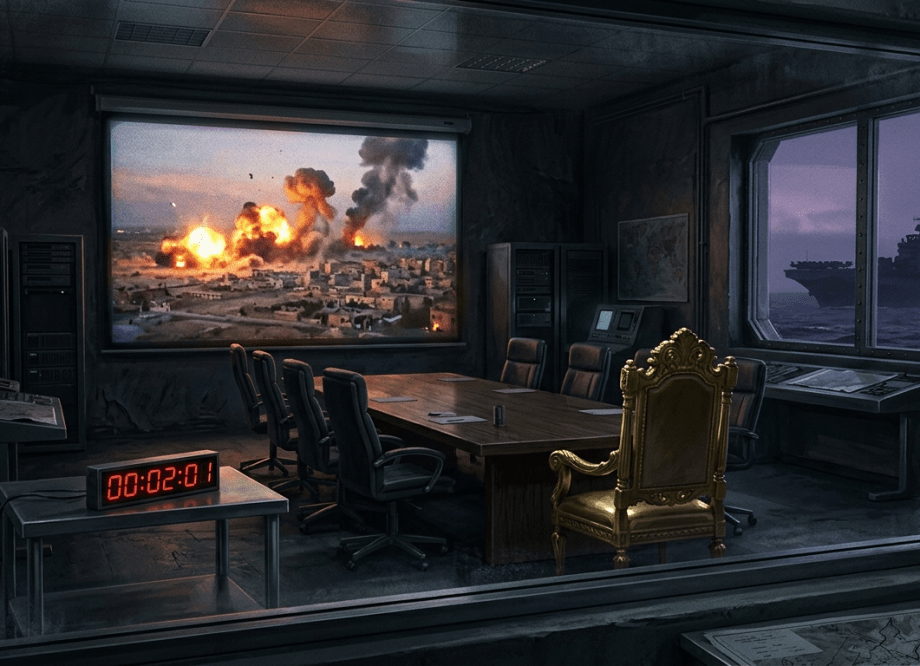
The announcement comes, as always, with impeccable timing. Ten minutes after the S&P 500 closes on its worst single trading day since the war began, Donald Trump posts on Truth Social that he is extending his pause on “energy plant destruction” by ten more days, until Monday April 6 at 8pm Eastern Time. “As per Iranian Government request,” he writes.
Another outright lie. Talks were going “very well.” The markets sighed. Oil dipped. Then snapped back. Brent crude settled at $107 a barrel.
This is the operating system. Not diplomacy. Not strategy. Useful idiocy. A witless grifter watching the markets, the courts and the clock, adjusting deadlines, managing increasingly bizarre appearances, while the ships keep moving.
The boots are already in the water.
The Anatomy of a Fake Pause
This is the second extension Dong Wang, (King of Knowledge or know-all) as they call Trump in China, has announced since he issued his original 48-hour ultimatum demanding Iran reopen the Strait of Hormuz or face the destruction of its power grid. No-one knows how to deliver an ultimatum like Trump.
The first pause came on Monday. The second came Thursday. Both arrived at market-sensitive moments, both were framed as responses to Iranian requests, and both were flatly denied by Iran. Iran’s Foreign Minister Abbas Araghchi scathingly describes the exchange of messages through intermediaries as not constituting “negotiations.”
Iran’s Parliament Speaker Mohammad Bagher Ghalibaf calls the whole show “fake news used to manipulate the financial and oil markets and escape the quagmire in which the US and Israel are trapped.”
He is not wrong. The backchannel activity is real enough: Pakistan, Egypt and Turkey have been relaying messages between Washington and Tehran, and there is genuine mediating pressure from Islamabad to convene a face-to-face meeting. But the gap between what is actually happening and what Trump is describing to the American public is the gap between a fax or Telegram arriving at a foreign ministry and a signed ceasefire.
Iran rejects Trump’s 15-point plan outright and tables its own five conditions, including war reparations and formal recognition of Iranian sovereignty over the Strait of Hormuz. That is not a negotiating position that converges with Washington’s in ten days. Not in twenty. In fact it’s a dark parody of Trump’s style of negotiation which is to issue an ultimatum. Iran is signalling its contempt.
So what is the April 6 deadline actually for? The mediators themselves have identified the core problem: the Iranians “suspect that the US is tricking them again.” True. The pause is not buying time for diplomacy. It is buying time for deployment.
What Is Actually Moving
Two Marine Expeditionary Units are converging on the Persian Gulf from opposite ends of the Pacific: the Tripoli Amphibious Ready Group out of Japan and the Boxer Amphibious Ready Group out of San Diego. Combined, they bring between six and seven thousand Marines and sailors to the approximately fifty thousand US personnel already in the region. Somewhere. Many US bases in the region have suffered damage from Iranian missile attacks.
Additionally, the Pentagon has ordered roughly two thousand soldiers from the 82nd Airborne Division to move from their base in North Carolina to the Middle East. These are the troops trained for rapid-response amphibious landings, assault missions and airborne raids. They are not deployed to facilitate phone calls through Pakistani intermediaries.
On Wednesday, Iran’s Parliament Speaker Ghalibaf posts a warning that deserves attention precisely because of what it does not say. “Based on some intelligence reports,” he wrote, “Iran’s enemies are preparing to occupy one of the Iranian islands with support from one of the regional states. Our forces are monitoring all enemy movements, and if they take any step, all the vital infrastructure of that regional state will be targeted with relentless, unceasing attacks.”
He does not name the island. He does not name the regional collaborator. A warning that specific about an operation, that vague about the target, is not a general statement of defiance. It is the signature of intelligence tracking something imminent.
The obvious candidate has always been Kharg Island, which handles ninety percent of Iran’s crude oil exports and has already been subjected to preparatory US airstrikes. But Kharg is heavily defended. Iran has been moving additional troops, air defence systems and shoulder-fired MANPAD missiles there for weeks. US officials themselves acknowledge the casualty risk is severe.
Former US Navy intelligence officer Malcolm Nance has disclosed that US wargames previously modelled a first-phase assault focused instead on Larak Island, Hormuz Island, Qeshm Island and Hengam Island: the smaller, less-defended islands that directly command the shipping lanes of the strait itself. Iran has already established an alternative shipping channel running north of Larak. That is not coincidental geography. That is the operational terrain.
Kharg may be the name being spoken in the press conferences. The actual target, when the order comes, may be something smaller, less expected and more strategically direct. A feint is only useful if the other side is watching the feint.
The Ignoramus in Chief
Into this unfolding catastrophe, the elephant in the room is the question of who is actually making the decisions and on what basis.
NBC News reports this week, citing three serving US officials and one former official, that since the war began, military handlers have been compiling a daily video briefing for Trump consisting of the biggest, most successful strikes against Iranian targets over the previous 48 hours. The “greatest hits” shows run for two minutes. One official describes each daily video as a series of shots in which “something explodes.” It does not include civilian casualty figures, strategic assessments, Iranian resilience data or the views of the intelligence community on war aims. It is what is known in the world of TV, as a “highlight reel”.
Two minutes of edited highlights? Per day. This is the informational basis on which “Ole Bone-Spurs”, a former draft evader who shirked national service five times, but who is now the de-facto commander of the world’s largest military, is conducting a war.
Panic stations? Trump’s got his own allies, in a lather. The worry, as NBC delicately puts it, is that Trump “may not be receiving, or understanding, the complete picture of the war.” Trump’s former national security adviser, John Bolton, is on record to the effect that Trump “hardly ever reads briefing notes” and when he does “cannot make sense of them,” and that he had “not thought through the implications or laid the groundwork” for a longer conflict with Iran.
Trump’s biographer Michael Wolff, who has known him as well as any journalist alive, goes further in a recent Daily Beast podcast.
“It’s not just unpresidential, it’s incoherent. It’s the language of an ignoramus.” He added: “He doesn’t know what he’s talking about. It just comes out of his mouth, out of self-justification, need, fear, aggression.”
And this, delivered with the precision of a man who has spent years watching: “He’s a vacancy in the middle of his own world, and yet a vacancy that is fully in charge. The situation could not be more dire.”
Wolff has noted that Trump describes himself, proudly, as an “ad-lib guy.” That is fine at a rally. It is not fine when the ad lib involves amphibious assault groups converging on a strait through which twenty percent of the world’s oil supply passes.
Slate’s military analyst identifies the strategic void at the centre of the operation with Clausewitzian clarity: Trump’s delusion stems from a fundamental misunderstanding that war is entirely about destroying targets. CENTCOM has struck more than five thousand targets.
But wars are fought for political objectives, and Trump has proclaimed so many contradictory objectives, shifting from regime change to nuclear disarmament to resource acquisition to Hormuz control with no discernible logic, that his own advisers do not know what they are working toward.
“The problem,” the analysis concludes, “is that Trump doesn’t know what his objectives in this war are. Or, worse still, he has proclaimed many objectives, some of them contradictory, because he has no policies and no strategies.”
A vacancy in the middle of his own world, fully in charge. Making it up as he goes. What could possibly go wrong?
Murdoch’s Man at the Pentagon
Nature abhors a vacuum. The vacancy does not stand alone. It is surrounded by people who have their own reasons for filling it.
Defence Secretary Pete Hegseth is an ex-Fox News jock who got given the largest military budget in history. A former Guantanamo guard with no command experience beyond a National Guard deployment, Hegseth spent the years between his military service and his cabinet appointment performing patriotism on Murdoch’s flagship cable network, aka Faux News, where hawk-talk is part of the job profile and any hint of restraint is seen as weakness, wokeness or treachery.
Hegseth arrived at the Pentagon with dreams that his TV-show persona had done nothing to temper. At a press conference this month he declared that US forces would show “no quarter, no mercy for our enemies.”
Ryan Goodman, professor of law and co-editor of national security journal Just Security, tells Axios this would constitute a war crime under the Pentagon’s own Law of War Manual. Hegseth also used the occasion to attack the press for failing to be “an actual patriotic press,” citing the headline “Mideast war intensifies” as proof of disloyalty.
This is the man with the power to unleash Armageddon. The former Gitmo guard has been dreaming of this moment since his first green room at Fox and Friends. His senior commanders, with real combat experience and an understanding of asymmetric warfare, warn against a ground operation. The Centre for Naval Analysis concludes that reopening the strait without ground troops requires tolerating continued Iranian attacks on shipping. Experts who actually know the Persian Gulf terrain have warned of years, not weeks. Hegseth has watched too much of his own network’s coverage to take any of that seriously.
Behind Hegseth, behind Trump, the hand that has been pushing this from the beginning.
Bloomberg reported on March 21, citing “people familiar with private conversations”, that those pressing Trump to strike Iran included not only Netanyahu but Rupert Murdoch, the ninety-five-year-old chairman emeritus of News Corp and Fox Corp. Murdoch instructed Trump several times, personally urging the president, he once called a “fucking idiot” to take on Tehran. This was not casual chat. Responsible Statecraft cites sources close to Trump as far back as June 2025, that “Levin and Murdoch are all over Trump all the time,” lobbying hard against diplomatic negotiations with Iran and in favour of war. Murdoch had reportedly been “privately complaining to confidants” about Trump’s envoy Steve Witkoff and his attempts at negotiation.
When the bombs started falling on February 28, the New York Post’s front page read “DEATH TO THE DEVIL.” Subsequent editions ran “DON GETS LAST LAUGH” and “NO MERCY.” The Wall Street Journal has since called for ground troops. Fox News has been, in the words of Crikey’s media analyst, the loudest global advocate for the war, running the same cheerleading operation it ran for Iraq in 2003, right down to the retired generals on the panel and the American flag in the corner of the screen.
Even within Murdoch’s own empire, the revulsion has broken through. Former Fox host Megyn Kelly, no dove, is scathing:
“We now learn that Rupert Murdoch was one of the main people goading Trump into this war. Rupert Murdoch, who is ninety-five years old, he’ll be dead soon. And he too is acting as if our troops are expendable cattle.” Republican Congresswoman Anna Paulina Luna used the same phrase, “expendable cattle,” without any prompting from Kelly. Senator Lindsey Graham had just told Fox News Sunday, without embarrassment, that the Marines could take Kharg Island because “we did Iwo Jima.”
Six thousand, eight hundred and twenty-one Americans died in the battle for Iwo Jima. Nineteen thousand, two hundred and seventeen were wounded.
Graham does not have children. He is not sending anyone.
The Fracture Nobody Is Talking About
There is one more element that complicates the picture and which has been ignored in the mainstream coverage of the war. Washington and Tel Aviv are no longer fighting the same war.
Even The Carnegie Endowment for International Peace is on to it. Trump appears to favour the Venezuela model: align with a pragmatic insider within the Iranian regime, access the oil and gas resources, declare victory and exit. Netanyahu prefers what Israeli strategists call “mowing the grass”: maximum target destruction, indefinite conflict management, no exit required and no exit planned. These two approaches are not reconcilable. They are direct opposites dressed in the same uniform.
Naturally, the rift or lovers’ tiff has already gone public. On March 18, Tel Aviv’s terrorists struck Iran’s South Pars gas field without US authorisation or knowledge. Netanyahu confirmed: “Israel acted alone against the Asaluyeh compound. President Trump asked us to hold off on future attacks, and we’re holding off.” Trump confirmed the strike was uncoordinated and said Israel would not hit gas infrastructure again. The relationship between the two men who began this war together is now one of competing narratives and barely suppressed recrimination. Senior Iranian leaders’ death threats against Trump can’t be helping.
Former Israeli ambassador Alon Pinkas tells Al Jazeera that Trump’s pivot toward negotiations, apparently over Netanyahu’s objections, may signal that the US president has finally grasped that Netanyahu “may have duped him on how quick and resounding a victory would be, and how viable regime change is.” Israeli political scientist Ori Goldberg delivers the verdict without the turd polish: “Is it a defeat for Netanyahu? Hell, yes. It’s Trump essentially ditching Israel.”
Netanyahu, facing ICC arrest warrants, corruption charges and a national inquiry into October 7 that he has spent two years postponing, has his own reasons to keep the war going. He has killed the head of the IRGC navy, Alireza Tangsiri, this week. He continues to bombard Lebanon. He continues to strike Iranian infrastructure. He is mowing. He has no intention of stopping. And if US ground forces go ashore at some Persian Gulf island in the next forty-eight hours, Netanyahu’s mowing gets a great deal easier, and the war gets a great deal longer.
The Boots Are Already in the Water
Let us be clear about what we are watching. A president who cannot distinguish between a war briefing and a movie trailer is extending fake diplomatic deadlines while an amphibious task force closes on the Persian Gulf. His Defence Secretary is a television performer who has never commanded anything larger than a National Guard unit and whose understanding of strategic warfare was formed on a Fox News set. Behind both of them, a ninety-five-year-old media magnate with no democratic mandate and a perfect record of warmongering for profit has been personally lobbying the President of the United States to go to war.
Iran knows the boots are coming. Ghalibaf said so, in public, this week. Iran’s ground forces commander Brigadier General Ali Jahanshahi told his troops:
“Every inch of Iranian territory is being protected with the vigilance and readiness of our forces. All enemy movements along the borders are closely monitored, and we are prepared for any scenario.” That is not rhetoric. That is a force standing to.
The senior US military commanders who actually understand asymmetric warfare have warned, carefully and on the record, that a ground operation to secure the Strait of Hormuz could drag on for years. Iran, in the words of one analyst, is “masterful at asymmetric warfare” and has had the geographic gift of the strait for four decades. The Centre for Naval Analysis says plainly that “zero attacks on shipping” requires boots on the ground, and that once you are on the ground, you are there for a long time.
None of that has reached the man watching the highlight reel.
Trump’s April 6 deadline is not diplomacy. It is a ten-day window. The Marines are not sailing toward the Persian Gulf for a holiday. The ad-lib guy is about to ad-lib a ground war, on Murdoch’s advice, through Hegseth’s ambition, against the judgment of every senior military officer who has studied the terrain, while Iran waits on the shore with anti-ship missiles and the memory of every foreign army that has ever tried to hold Persian ground.
History does not repeat. But it does rhyme. And this particular rhyme sounds very much like the opening bars of something we have heard before, in another desert, in another decade, with another president who did not read the briefings.
Watch for the announcement. It will come, as always, just after the markets close.
 Urban Wronski Writes
And the real estate developer, envoy and now fund manager for Gulf States* especially Saudi, Jared Kushner, who was mentored by Murdoch.
Kushner is well connected with leadership circles of Trump, Netanyahu, Putin, MBS and Murdoch….
The latter’s Russian links go way back to 1980s sharing NY mob lawyer Roy Cohn with Donald Trump.
*It would be delicious to see MBS et al (threaten to) divest from Kushner’s fund?
LikeLiked by 1 person