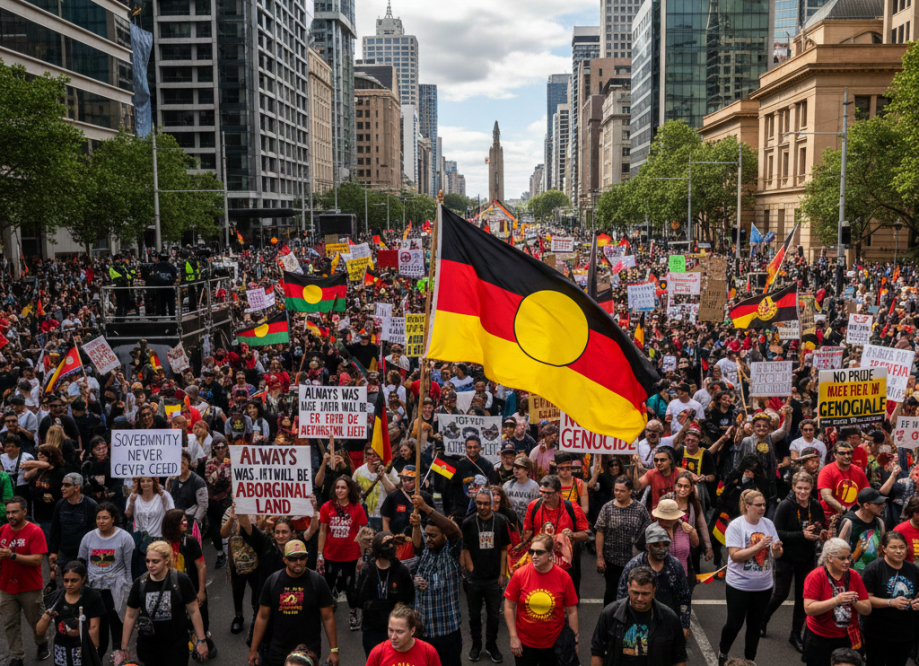
Every January 26, Australia throws itself a birthday party. Tens of thousands of First Nations people turn up with a message: the house was never yours to begin with.
Nothing new here. Back in 1938, while white Australia was toasting 150 years of “progress,” Aboriginal leaders gathered in Sydney for the first Day of Mourning. Their accounting of that progress made uncomfortable reading: stolen land, stolen wages, stolen children, segregation masquerading as protection. The party rolled on regardless. So did the uninvited guests with their inconvenient truths.
Eighty-seven years on, we’re still running the same script. Just flashier costumes.
When truth becomes a traffic problem
This summer’s rallies stretched from Naarm to Meanjin, from Gadigal to Kaurna. Same demands, always; end deaths in custody, return land, recognise sovereignty, dismantle the machinery that keeps grinding through Indigenous lives. Why haven’t the demands evolved?
Nothing’s ever been delivered.
Governments respond with the vocabulary of crowd control. Protests welcome, so long as they don’t interrupt the morning flat white run or force a tram reroute. Dissent is fine. Just keep it away from the CBD.
Gomeroi activist Paul Silva cut through the bureaucratic fog in Sydney: they criminalise our voices because they fear the truth we speak. That fear isn’t some abstract anxiety. It’s got line items in state budgets, consultant firms on retainer, social media strategies designed with surgical precision, to keep Indigenous justice exactly where it’s been parked for two centuries: in the too-hard basket.
The Voice: death by a thousand focus groups
The Voice to Parliament didn’t die from public sentiment. Professional money killed it.
Groups like Advance and their dark-money associates didn’t mount an opposition campaign. They carpet-bombed the information landscape. “Division.” “Special rights.” “Woke elites.” A third chamber. A modest advisory body got repackaged as civilisational threat. Undecided voters swallowed the lot.
Albanese’s mob wandered into that ambush assuming decency and bipartisan goodwill would see them through. Quaint. Or poorly prepared? They got out-spent, out-organised, and comprehensively pantsed by operators who understand that fear travels faster than hope, resentment costs less than reason.
What lesson did Canberra learn from the rout? Fight harder next time? Try again with better messaging?
Not even close. The lesson was: never again. Now we get consultation processes that consult about consultations, working groups generating frameworks for conversations about whether to consider thinking about justice sometime down the track. Maybe. If the focus groups look promising. Yes Minister, meets John Clarke and Bruce Dawe or an episode of Utopia.
The gap keeps widening. But everyone’s being frightfully respectful about it.
Juukan Gorge: reconciliation meets the bottom line
In 2020, Rio Tinto blew up the Juukan Gorge caves. One blast. Gone: 46,000 years of continuous human occupation, irreplaceable archaeological evidence, sacred ceremony sites stretching back to the Pleistocene.
The company had legal permission. State government signed off. Shareholders collected their dividend.
Spin doctors call it a tragic mistake. To the rest of us it’s the colonial project with a mining engineering degree and corporate governance training. Same old logic as 1788; new paperwork. We’ve swapped muskets for mineral leases, missions for ESG committees. The mathematics haven’t changed: profit trumps Country, extraction beats culture, shareholder value erases 46 millennia of human memory.
We’ll kneel in sorrow after the blast. We just won’t stop the trucks beforehand.
That’s reconciliation in one controlled detonation: we’ll acknowledge your culture right up until it gets between us and the quarterly results. Then it’s aggregate.
The numbers: still colonial, freshly updated
Call colonisation “history” if the euphemism helps. The statistics know better.
Life expectancy gap: a decade. Infant mortality: double the non-Indigenous rate. Child removal: vastly higher, because apparently the Stolen Generations needed a sequel. Youth detention: Indigenous kids make up less than 6% of the population but over half the children in cages. For Aboriginal women, family violence risk runs thirty-one times higher than for non-Indigenous women.
Ancient history? These figures get manufactured fresh every budget cycle. Every time a premier discovers getting “tough on crime” plays well in the suburbs. Every time Canberra redesigns welfare programs that just happen to land hardest on communities with high Aboriginal populations.
The gap survives because we keep feeding it.
The unspoken cost: what colonisation did to the coloniser
Here’s the part of the story we don’t like telling. While Indigenous peoples were being dispossessed, enslaved, and systematically dehumanised, something else was happening; something to the colonisers themselves. The Martinican poet Aimé Césaire is blunt: colonisation dehumanises even the most civilised man.
You can’t spend generations treating human beings as less than human without it doing something to your soul. The coloniser, needing to justify theft and violence, learns to see the colonised as animals. Gradually, through habit and necessity, he becomes what he pretends to see. The brutality required to maintain the fiction coarsens him, cheapens him, strips away the very civilisation he claims to represent.
Tunisian writer, Albert Memmi, calls it the Nero Complex. The more the coloniser oppresses, the more he recognises the atrocity of his chosen role. The colonised person’s existence becomes unbearable; not because of what they do, but because their humanity exposes his inhumanity. So he escalates. More violence, more dehumanisation, trying to fix a cognitive dissonance that can never be resolved while the system continues.
Frantz Fanon, psychiatrist and revolutionary, documented the clinical reality: colonialism leaves psychological scars that persist long after formal independence. It distorts consciousness, warps relationships, corrupts institutions. The damage doesn’t stop at the border or the generation. It embeds itself in the structures that survive decolonisation.
This is why Césaire argued that a civilisation which justifies colonisation is already morally diseased, progressing inexorably from one denial to another until it calls forth its own Hitler, not as aberration, but as culmination. Hitler’s crime, in European eyes, wasn’t genocide. Genocide had been standard practice on the colonial periphery for centuries. His crime was applying those methods to white people.
The distance mattered. Out on the periphery, whether Africa, the Pacific, or the Australian interior—the rules that supposedly governed civilised society simply evaporated. Colonial administrators could commit atrocities that would scandalise London or Paris, secure in the knowledge that distance provided moral insulation. The further from the metropole, the more savage the civilising mission became.
Cashless cards: the ration system gets an upgrade
That moral coarsening didn’t end with the Menzies era. It just learned to fill in the correct paperwork.
Want to see colonial control with a digital interface? Meet the cashless debit card.
Official description: race-neutral welfare technology designed to reduce harm. Actual implementation: overwhelmingly targets communities with high First Nations populations. Your Centrelink payment loads onto a card that decides what you can buy, where you can shop, whether you’re permitted to hold your own cash. The everyday freedom to manage your money, granted to every other Australian, is quietly confiscated.
Picture explaining to your kids why you can’t give them lunch money like other parents. Picture fronting up at the local shop that’s kept your community fed for three decades, only to discover they lack the approved EFTPOS terminal for surveillance money. Picture maintaining your dignity when the entire checkout queue watches you fumble with the card that tars: this person requires government supervision to buy groceries.
The contemporary version of flour, sugar, and tea delivered to the mission station. Just with better branding.
The state calls it support. The people wearing the electronic tag know what it actually is: a daily reminder that some Australians get trusted to be adults. Others? Try paternalism. Take a wild guess which class you’re in.
Césaire saw colonisation as “thing-ification”; reducing people to objects, to problems requiring management rather than citizens deserving respect. The bureaucrat administering the cashless card system doesn’t need to consciously hate Indigenous people. The system does the dehumanising for him, wraps it in neutral policy language, calls it evidence-based intervention. His humanity gets to stay intact while the violence continues.
Queensland’s miracle cure: more cages
Both big parties in Queensland have cracked the cause of youth crime. Lock up more children. Genius.
That these children are disproportionately Aboriginal and Torres Strait Islander gets treated as an unfortunate statistical quirk. Not a policy scandal. Not a moral catastrophe. Just one of those things.
Walk into any Queensland youth detention centre. You’re standing in a monument to bipartisan imagination failure. These kids aren’t accidents of the system. They’re products of it; manufactured by deliberate choice.
Every tough-on-crime press conference, every police powers expansion, every budget that cuts youth services while boosting corrections. These aren’t problems to be disappeared behind razor wire. They’re human beings systematically denied housing, health services, schools that function, communities that haven’t been economically gutted then blamed for their own destitution.
Building a decent school takes time, money, expertise, cross-portfolio cooperation. Building a cage? Easy. And come election time, you can brag about how many you locked up. Call it being tough on crime.
The cruelty here isn’t incidental. It’s structural. The same Manichaean logic that allowed colonial administrators to view Indigenous people as less than human now operates through policy, through legislation, through ministerial press releases that frame Indigenous children as threats rather than as victims of multi-generational trauma.
The system doesn’t require individual racism when institutional racism does the work so effectively.
Past the calendar: what justice actually costs
The mainstream debate circles the safest question imaginable: should we change the date?
Masterful misdirection. Centuries of struggle over land, law, sovereignty—collapsed into an argument about when to schedule the barbecue.
Many First Nations leaders have a different question. Not which day makes white Australia comfortable. But whether this country’s willing to surrender anything real. Yorta Yorta leader Lidia Thorpe keeps hammering the point: we don’t want a new date for your party. We want justice, sovereignty, a seat at the table as equals.
Meaning what, precisely?
Returning land in meaningful scale. Not the bits nobody wants; the bits worth something. Embedding Indigenous law and decision-making into institutions that actually govern this place, not just the ones that organise the NAIDOC Week morning tea. Ending punitive welfare and carceral policies that treat First Nations communities as problems requiring management rather than human beings requiring justice. Confronting the dark money operations that make Indigenous recognition politically radioactive.
Accepting that any serious movement toward equality will cost somebody something. Someone’s profit margin. Someone’s sense of unexamined entitlement. Someone’s electoral strategy.
The current arrangement; acknowledgements before meetings, carefully curated national narratives, Welcome to Countries at the corporate awards night, symbolism without redistribution, isn’t compromise. It’s a holding pattern. Colonial scaffolding with a fresh coat of paint and better lighting.
Real decolonisation would require something far more difficult: confronting what colonisation did not just to Indigenous peoples, but to us. Acknowledging that the casual cruelty embedded in our institutions isn’t aberration but inheritance. Recognising that the moral coarsening Césaire described didn’t end when the last mission closed; it just learned to speak the language of social policy and evidence-based practice.
The reflection in the mirror
True reconciliation requires more than a didgeridoo at the school assembly. It requires sharing power, returning land, accepting that the comfortable national story; plucky pioneers, a fair go, she’ll be right mate—is a lie we can no longer afford.
It requires understanding that colonisation damaged both parties to the colonial relationship, and that damage persists in the reflexes of our institutions, the assumptions of our policy-makers, the cognitive dissonance we maintain between what we say we value and what we actually do.
Until that reckoning begins, January 26 remains what it’s always been. Less a day of national pride, more a mirror held up to a country terrified of its own reflection.
The crowds in the streets aren’t the problem. They’re the reminder. This nation is unfinished business, built on theft that never ended, violence that just changed uniforms and learned to file the correct paperwork. The coloniser’s moral coarsening didn’t die with the frontier, it evolved into bureaucratic indifference, into systems that destroy lives while their administrators sleep soundly, convinced they’re just doing their jobs.
Here’s the choice. Keep managing the discontent at the edges; traffic diversions, police barriers, ministerial statements about respecting all perspectives. Or finally accept that justice costs something. Not a new date and a prettier story. Land. Power. The very definition of who this country belongs to.
And perhaps most difficult of all: accepting what we’ve become in the process of taking it. Césaire warned that no one colonises with impunity, that a civilisation which justifies colonisation is already sick.
We’re still living with that sickness, still pretending the symptoms are someone else’s problem, still insisting that if we just manage the issue better, consult more thoroughly, show more respect in our language, we can avoid the reckoning.
The party’s been running 237 years. The original owners are still waiting for an invitation that means something. Maybe it’s time to hand over the keys. Face what we became when we stole them in the first place.
Continue the Conversation
What are your thoughts on Invasion Day and Australia’s unfinished business? Leave a comment below or share this piece if it challenged your thinking.
Support independent Australian political commentary: Urban Wronski operates without corporate backing or advertising revenue. If you value this kind of fearless analysis, consider supporting my work.
Never miss a piece: Subscribe to the Urban Wronski newsletter for weekly political analysis delivered to your inbox.
Related Reading
- The Voice Referendum: How Dark Money Won
- Labor’s Failure on Indigenous Justice
- Mining vs. Country: Australia’s Extractive Addiction
 Urban Wronski Writes
Colonisation lessons come home – whether intentionally or by osmosis is moot, actuality rules.
Class was, and remains, domestic colonisation – exemplified in Britain and the supposedly defunct titular aristocracies on the Continent. The division in the USA is monetary but has long ago morphed into their version of our bunyip aristocracy.
When Peel introduced policing to London it was a way of using the demobbed from the Napoleonic campaigns rather than have battle hardened men trained in arms at a loose end in the countryside. Later recruitment routinely used those used to the techniques honed in the Raj or elsewhere that the sun never set. (As the old saw put it, because God couldn’t trust the British in the dark.)
Post (?discuss!) Empire, the ‘Troubles’ of the 1970s in Northern Ireland were regarded as ideal training for ‘low intensity warfare’ on the soi-disant “mainland”.
The occupation of Iraq resulted in vast quantities of excess equipment (see Ike’s Farewell address) being gifted/dumped on local law enforcement. The emergence of robo-cops on downtown streets from NYC to Hogsfart, Iowa was as inevitable as intended – to someone with a hammer, everything is a nail.
As for this cashless debit card, no probs. – it couldn’t happen here, to real people like us.
Ya reckon? The Bill last year to compel acceptance of cash has a 3yr limit and already has more holes than Emmental.
Wonder why now, not when it’s too late.
It’s already later than we admit.
LikeLiked by 1 person