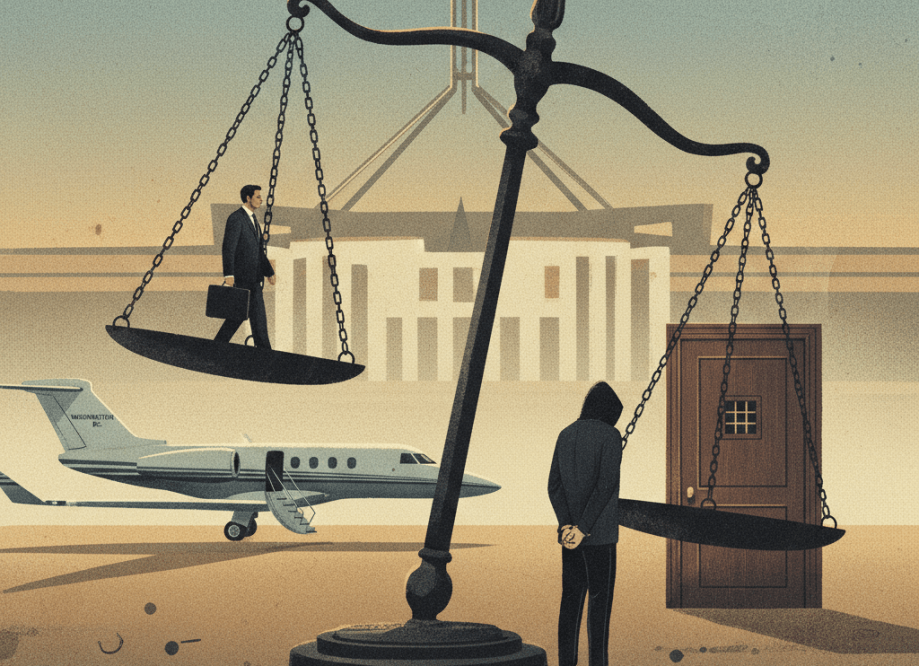
Greg Moriarty’s plum job posting sends a clear message about how Canberra looks after its own.
Washington isn’t a demotion; it’s the prize. Greg Moriarty’s nomination as Australia’s next ambassador to the US isn’t the act of a government cleaning house; it’s the system congratulating itself on resilience. In Canberra, failure rarely disqualifies. It just moves you sideways until the heat cools, or upward, if the optics align.
In a bureaucracy obsessed with process, protection is paramount; the process to protect: protect the insiders first, accountability second; if accountability, (in Canberra, always a slow train coming), arrives at all.
The Canberra reflex
No-one is fussed about Moriarty’s credentials. He is eminently qualified; the boffin’s boffin. He was Australia’s Ambassador to Indonesia (2010–2014) and Ambassador to Iran (2005–2008), giving him “on-the-ground” experience with political Islam, even if Mossad and CIA hit squads mean his speed-dial will need updating.
Moriarty spent his first decade (1986–1995) as a regional analyst in the Defence Intelligence Organisation. DIO. This is the agency responsible for providing intelligence to the Australian Defence Force.
During the first Gulf War, as the 1991 United States’ oil war with Saddam Hussein has become known, Moriarty served as a uniformed Captain in Saudi Arabia, providing intelligence briefings directly to General Norman Schwarzkopf at US Central Command. The “liberation of Kuwait” was a hollow slogan used to mask a war fought to ensure the US remained the sole “policeman” of the world’s energy supply.
Clandestine Diplomacy? Also Greg’s bag. He was Australia’s Ambassador to Iran (2005–2008) at a time when the US had no diplomatic presence there. He was one of the few Westerners with a deep, “inside” view of Tehran, eventually briefing President George W. Bush in the Oval Office, a rare gig, for an Australian diplomat.
Counter-Terrorism Coordinator? If the cap fits. Moriarty was the inaugural “czar” of Australia’s counter-terrorism efforts, whose brief was to bridge the gap between ASIO (domestic spies) and ASIS (foreign spies).
But there’s more. Not only is he a veteran of very complex and challenging foreign postings, but Moriarty served as the International and National Security Adviser and Chief of Staff to Prime Minister Malcolm (Fizza) Turnbull, an all-leather jacket-no-naff-elbow-patches-man. A man of means, Turnbull’s million dollar punt on his own campaign makes him easily the best self-saucing pudding to get into The Lodge.
As a former PM, Turnbull’s become a fearless critic of the Liberal Party, now that he’s free to focus on its internecine wars, its dud policy and its hapless leader, from time to time, as minding his stock portfolio allows. But he’s always put in a good word for Greg. Turnbull often highlights Moriarty’s history with the U.S. (specifically his service with U.S. Central Command). This background helps explain why Prime Minister Anthony Albanese has just appointed Moriarty to succeed Kevin Rudd as Ambassador to the United States.
Turnbull’s trust in Moriarty helped pave the way for Greg to become one of the architects of AUKUS and the primary point of contact for the Trump circus. Scott Morrison may quibble but, success has many fathers.
Above all, Moriarty was the key figure responsible for coordinating Australia’s counter-terrorism arrangements in 2015. He is a primary architect of the controversial strategy that views groups like Hizb ut-Tahrir, as “ideological threats” to national security, even if they fall short of the violence threshold.
So it isn’t about experience or qualifications. It’s about reflex. Canberra’s muscle memory. When faced with scandal or exposure, Canberra’s instinct is to pull the shutters down, shield its own; tidy paperwork later.
Consider Kathryn Campbell. During Senate estimates, Jacqui Lambie pressed Moriarty about his role in placing Campbell; already publicly associated with the Robodebt debacle, in a senior AUKUS‑related Defence post reportedly worth close to $1 million. It wasn’t a technical error; it was a deliberate continuity move.
As Moriarty told estimates, on 14 June 2022 PM&C Secretary Glyn Davis called to see whether there might be a new role for Campbell, who was likely to be moved from DFAT. Moriarty said yes; a spot was waiting in Defence’s nuclear submarine taskforce.
He later argued the appointment pre‑dated the Royal Commission, but that defence misses the point. By mid‑2022, Robodebt’s unlawfulness was already public, and Labor had pledged a Royal Commission in its campaign. To claim no one foresaw reputational risk is bureaucratic fantasy.
When the Commission handed down its findings on 7 July 2023, its condemnation of Campbell was withering. She was suspended without pay three days later and later resigned.
The dance of consequence
Robodebt victims got debt notices. Its architects got transfers, new job titles and soft landings. Now, one of those who helped arrange the landings gets the softest one of all; Washington.
It’s the same four-step, fox-trot, slow-slow-quick-quick; every time:
- Stage an internal review that names no names.
- Reassign personnel; call it “continuity.”
- Reward resilience with promotion.
- Rebrand privilege as professionalism.
The deeper problem isn’t Moriarty or Campbell. It’s a political culture that treats accountability as a PR problem, not a democratic obligation.
Rudd’s Washington, Labor’s shadow
The symbolism matters. Kevin Rudd is already ensconced in Washington; the combative intellectual whose presence projects Labor gravitas abroad. Pairing him with Moriarty, a defence establishment stalwart, doesn’t suggest renewal. It suggests consolidation: a bipartisan comfort zone that flatters Washington and quietens Canberra’s internal dissent.
For the capital’s insiders, it’s a neat arrangement: diplomacy as factional equilibrium, the AUKUS consensus safely intact. From afar, it looks like statesmanship. Up close, it feels more like an internal settlement; a tidy arrangement between power’s two halves.
The politics of timing
And then, there’s the timing.
Moriarty’s appointment, like so many immaculate Canberra announcements, coincides with turbulence elsewhere, this time, the government’s controversial Hate Speech bill. The bill risks criminalising intent: targeting individuals or groups perceived as being about to breach the law, rather than those who actually do.
For activist networks and civil‑liberties advocates, this language turns dissent into pre‑crime; policing inclination rather than action. It marks a profound step away from Labor’s democratic heritage, recasting expression and dissent as potential threats.
Seen in that light, the Moriarty announcement looks like misdirection with diplomatic varnish: a moment of “look over there” politics, the shiny distraction to guillotine discussion of a policy that capitulates to vested interests and tightens the screws on public dissent.
From moral promise to managerial power
That such manoeuvres now define a Labor government reveals a deeper malaise. Once the party of conscience and reform, Labor has become the steward of institutional self‑preservation.
Its careful managerialism has replaced conviction with calibration: a leadership so fearful of political contrast that it mirrors its rivals’ caution. Labor now defends power in the same tone it once denounced it; smooth, deferential, procedural.
Moriarty’s Washington role crystallises that decline. Accountability becomes reversible. Reputation becomes currency. Integrity becomes optional.
A tale of two Canberras: Witness K and the well‑protected
If Moriarty’s quiet elevation reveals one Canberra, the case of Witness K exposes the other; the mirror image that shatters the illusion of fair process.
K was prosecuted under the Intelligence Services Act, which Moriarty’s agencies help oversee.
Witness K, the intelligence officer who revealed Canberra’s secret bugging of East Timor’s cabinet during oil‑and‑gas negotiations, wasn’t rewarded, reassigned, or quietly retired. He was prosecuted. His crime was fidelity to the public interest; exposing the misuse of state power for commercial advantage.
While the architects of Robodebt walk into promotions and public honours, Witness K is stripped of livelihood, identity, and dignity. The contrast isn’t incidental; it’s structural. Canberra protects those who serve power and punishes those who expose it. The same machinery that cushions the powerful, crushes the principled.
The lost emblem of Labor justice
This inversion should wound Labor’s conscience most deeply. The movement’s founding creed — a fair go for all — was meant to make justice neither partisan nor selective. It promised reciprocity between labour and capital, a moral balance between power and people.
Yet modern Labor’s Canberra has inverted that balance. The official who shields wrongdoing gets a seat at the diplomatic table; the whistleblower who defends integrity gets a criminal record. The party of the worker has become the party of hierarchy, a managerial class fluent in empathy’s language but deaf to its meaning.
Witness K, David McBride, and Bernard Collaery are not outliers; they are mirror‑bearers. Through their punishment, we glimpse the metastasis of power that Labor’s founders would have called betrayal.
The moral whistle
Viewed together, Moriarty’s promotion and Witness K’s prosecution form a parable of inversion: success without merit, punishment without crime. One side floats above consequence; the other is buried beneath it.
Labor once saw itself as the party that tilted the scales toward fairness; worker against boss, citizen against imperial power, truth against propaganda. Now it manages the scales, ensuring they never tilt too far.
The irony is cruel. The Australia that once enshrined the “fair go” now punishes those who live by it. To call things by their right names, once the moral duty of Labor’s pioneers, has become grounds for exile.
Accountability, inverted
Canberra will insist that promoting Moriarty is pragmatism: the steady hand, the safe pair. But Australians watching from below see something else; a governing circle where the guilty always escape justice.
Accountability in Canberra remains a one‑way mirror: the public gets watched; the powerful get reassigned.
If Labor truly wants to rebuild faith in government, it must break its habit of rewarding failure and punishing conscience. Responsibility must cost something again. Until then, power will keep protecting itself; and the “fair go” will remain a slogan embalmed in Labor’s history, rather than a principle alive in its governance.
Two Canberras
This isn’t just a job swap; it’s a parable of the Two Canberras.
In one Canberra, the “Safe Pair of Hands” is rewarded for a career spent managing the optics of illegal wars, secret submarine deals, and the protection of disgraced colleagues. In this Canberra, accountability is a one-way mirror: the public is watched, but the powerful are merely reassigned.
In the other Canberra, those who actually serve the public interest—the Witness Ks, the David McBrides, and the Bernard Collaerys—are crushed. Their “fidelity” earned them prosecution, not a promotion. Their “integrity” earned them a criminal record, not a diplomatic passport.
Moriarty’s flight to Washington reveals the grim reality of modern Labor governance. By rewarding the managers of wrongdoing while punishing the whistleblowers who expose it, the “Fair Go” has been embalmed and put on display as a museum piece. In today’s Canberra, the stream does not rise higher than its source; and the source is a closed loop where power exists only to protect itself.
Responsibility has no cost for the inner circle; it is a tax paid only by the principled. Moriarity’s pragmatic promotion demotes, depletes and pointedly disregards the notion of Australia as the land of the fair go.
 Urban Wronski Writes
Initially I misread the title as FLAILING Upwards which seemed apposite.
“It’s a political culture that treats accountability (read GOVERNMENT) as a PR problem, not a democratic obligation.”
As for Fizza, Talcum was his usual nick-name when CRIKEY still had sentient commenters (yearns for the bye-gone daze and throws another book on the hearth, no-one knows what to do with woodpulp & sooty water anymore).
LikeLiked by 1 person
Surely under the now unfolding circumstances happening in Minniappolis we would be far better not sending any ambassador. Showing the absolute disgust at what is now happening. We will have no say in any matter no matter what position we have in the so called tent.
Tell them to stick their fake subs in their own bathtub, Evict them from bases in this country, refuse any trade with them, and all diplomatic ties. Until they wake up to themselves. We do not need America at all.
LikeLiked by 1 person
And let’s not forget Duggan, still in line for rendition to that bastion of justice, the US. Labor’s actions are in complete contradiction of its founders’ principles.
An excellent article, Urban.
David
LikeLiked by 1 person
“Once the party of conscience and reform, Labor has become the steward of institutional self‑preservation.”
Along with the shameful treatment of Witness K, Bernard Collaery & David McBride whilst ‘Labor’ was both silent AND complicit, the scales fell from my eyes in 2007 when the exhausted and revolted electorate’s eyes & hopes rested on the cherubic visage of Kevin07.
He launched the Party manifesto which included a promise reform the whistle blower laws and end the persecution of the Customs w/b who had been charged by the Howard government for revealing its burying of two confidential reports written in 2005 detailing the poor security of the recently privatised Sydney airport.
Of course, once in office he did no such thing and remained shtumm during the 2009 trial & conviction of the officer, despite evidence presented by the Crown that the reports had been logged into the Customs intel system and shared with the AFP before Shapelle Corby was tried in Bali.
When head honcho, the ever obsequious Mick Keelty, swore that there was no evidence of corruption and drug smuggling amongst the baggage handlers at Sydney airport – domestic and international – he either knew that was untrue or monumentally incompetent.
Or both.
LikeLiked by 1 person
Moriarty and this ‘Australia’s counter-terrorism arrangements in 2015’…..
In 2015 Abbott & Dutton own ABF Terror Unit planned something like what we see with ICE in the US, but targeting Melbourne, where else?
Media coverage was minimal, except ABC, who probably wouldn’t both nowadays?
‘ABC Controversial Australian Border Force visa checks, Operation Fortitude cancelled.
Key points:
Operation Fortitude cancelled after public backlashBorder Force had planned to check visas in Melbourne’s CBDVic Government criticises Border ForceMP compares Tony Abbott to Soviet dictator Joseph Stalin
A major policing operation planned for Melbourne’s CBD over the weekend has been cancelled after a backlash over plans to include Australian Border Force (ABF) officials in the crackdown’
No one in skip Oz media inc RW MSM, indie and left understood, or called this out, left to NGOs to describe it as racial profiling (and one assumes Dan Andrews, the real target, had shouty phone calls with Fed govt. and ABF).
It’s what we observe in the risible Anglosphere RW MSM using the above to blame, attack and try pummel the centre, because that’s all that the right has left…..pardon the pun.
In parallel universe, same influencers behind Koch Heritage Project Esther with Israel, attack the pro-Palestine centre, universities and disappear the right, even better, we see centre on centre arguments….too easy….
LikeLike
The land of the fair go, aesthetically balanced by the myriad of protection rackets for the ethically challenged.
Sickening, all of it.
LikeLike