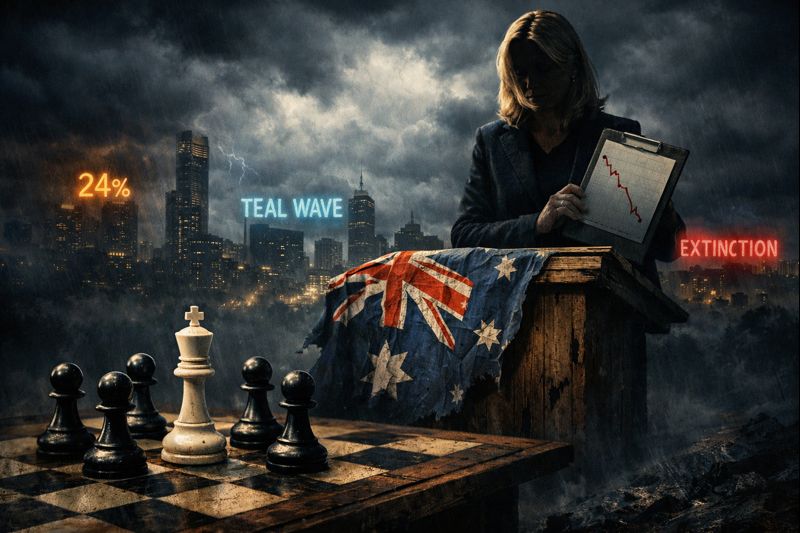
In Part 2 of The Blue Bacillus: An Anatomy of the Liberals’ toxic DNA, the focus shifts to the arithmetic of decline, to borrow a John Howard phrase—and the numbers are shocking. When voters see through the Liberal Party’s facade of serving the “forgotten people” to its unswerving fealty to the business class, outwitted, outmoded, and out of arguments, the party doubles down on negativity, setting themselves up for continuing defeat by the Teals who offer action on climate, integrity, environment, and gender equity; issues the Liberals have openly mocked, sabotaged, trivialised, and denied.
The Liberal Party isn’t just shagged out, to quote the Monty Python sketch. It’s a dead parrot. The only question is who will bury it, and what will rise from its grave. This is the story of a party that once governed a continent, now reduced to 18 MPs, outflanked by the far right, abandoned by women and urban voters, and humiliated by a wave of Teal independents who exposed its hollow core.
The latest Roy Morgan polling tells the tale: the Liberals’ primary vote has collapsed to 24%, while One Nation surges to 21% and the Teals hold the balance of power in the cities. The party’s response? Weaponising the Bondi tragedy. Echoes of Tim Wilson’s weaponised, divisive campaign in Goldstein that backfired spectacularly, proving voters want substance, not slogans and smears.
But the real autopsy isn’t just in the numbers. It’s in the independent media ecosystem—Crikey, The Saturday Paper, New Matilda, Michael West Media, Independent Australia, The AIMN, and The Conversation—where the Liberals’ collapse has been chronicled, dissected, and predicted with a clarity the Murdoch press and the party’s own spin machine couldn’t obscure. These outlets didn’t just report the decline; they explained it: the opaque funding networks, the climate denial, the corporate capture, and the cultural irrelevance of a party still fighting the battles of the 1950s.
The Night Watch: Ley’s Midnight Reckoning
At 3 a.m. on a Tuesday in January 2026, as the rest of Australia slept, Sussan Ley sat in her Parliament House office, staring at the latest polling. The numbers were a death notice: 24% primary support, One Nation at 21%, the Teals entrenched in the cities, and the Nationals walking out of shadow cabinet over her floundering authority. This wasn’t a political party anymore. It was a hospice, and Ley was the night nurse, keeping vigil over a patient that had already flatlined.
The Liberals’ collapse isn’t just about the numbers, though the numbers are damning. It’s about a party that has nothing left to offer but fear, nostalgia, and the fur-lined slippers of a relaxed and comfortable past that never existed for most Australians. The actual Liberal Party of Menzies’ imagination, not the Queensland mongrel cross called the LNP, not the Nationals masquerading under borrowed legitimacy, now holds precisely 18 seats in the House of Representatives. Eighteen.
That number is extraordinary. This is a party that held government for two-thirds of the post-war period, that claimed to speak for the “forgotten people,” that built its mythos on middle-class aspiration, middle-class welfare, and the entrepreneurial spirit, all shrewdly boosted with the divisive politics of racism, sexism, and xenophobia. Now? It has been wiped off the map in South Australia and Tasmania entirely. It holds three seats in Sydney, three in Melbourne, one in Perth, and the rest scattered across WA’s safest enclaves. The Liberals’ corporate DNA—mining giants, opaque donation flows, Business Council proxies—was always a veil for boardroom rule. But voters have seen through it.
The latest Roy Morgan poll puts One Nation at 21%, just three points behind the Liberals, as disillusioned conservatives flee to the “authentic” brand of Hanson’s bigotry. The voter base isn’t shifting; it’s fleeing. Why vote for bigotry-lite when you can buy the original brand?
The Teal Wave: How the Liberals Lost Their Heartland
The Liberals’ collapse isn’t just about One Nation. It’s about the Teal independents, who have systematically dismantled the party’s urban strongholds. In 2022, the Teals stormed six blue-ribbon seats—Goldstein, Kooyong, Mackellar, North Sydney, Wentworth, and Curtin—adding to Indi and Warringah, which had already fallen in 2019. By 2025, they held seven seats, with incumbents like Monique Ryan, Allegra Spender, and Sophie Scamps entrenched. Their success wasn’t a fluke. It was a rejection of the Liberals’ climate denial, their culture wars, their corporate capture.
Nowhere was this clearer than in Goldstein, where Tim Wilson’s 2025 campaign to win back the seat from Zoe Daniel became a masterclass in what voters don’t want. Wilson, the architect of the Liberals’ franking credits scare, ran a weaponised, hyper-partisan campaign: attacking Daniel as a “fake independent,” leaning into wedge issues, and flooding the electorate with negative ads. It backfired. Daniel’s grassroots “Gen Zoe” movement, targeting younger voters with climate action and integrity, out-organised and out-messaged him. Wilson’s narrow “victory” after a recount and redistribution that handed him friendlier turf wasn’t a mandate. It was a fluke, a statistical anomaly in a seat that had become a knife-edge marginal after decades of Liberal complacency.
The Teals’ rise is a triple threat to the Liberals:
- Policy: They offer action on climate, integrity, and gender equity, issues the Liberals have mocked or sabotaged.
- Demographics: Their candidates are overwhelmingly women, appealing to urban, educated voters repelled by the Liberals’ boorish, blokey culture.
- Tactics: They run hyper-local, volunteer-driven campaigns, while the Liberals rely on tired slogans and Murdoch megaphones.
The result? The Liberals are now a regional party, their urban base eroded by a movement that proved conservatism without compassion is a losing proposition.
The Arithmetic of Annihilation
Every Liberal MP faces an existential question: if this polling holds, how many of those 18 seats survive? A uniform swing of 6–8%, exactly what 24% primary support implies, would render virtually all of them marginal or lost. Even the safest blue-ribbon fortresses, like Perth’s western suburbs, are vulnerable. Analysts estimate 10–12 of the 18 would fall on current numbers.
That leaves six to eight seats. Not six to eight marginal seats. Six to eight seats total. The entire Liberal Party, reduced to the population of a country town council.
You can’t run a shadow ministry with eight MPs. You can’t maintain factional balance. You become a Western Australian protest movement with delusions of national relevance.
The Queensland Confusion and the Nationals’ Cynical Waltz
“But what about Queensland?” the rusted-on supporters cry. “What about the LNP’s seats?”
Here’s the reality: the Liberal National Party of Queensland is not the Liberal Party. It’s a shotgun marriage of convenience, a political chimera created in 2008 when the Queensland Liberals were too weak to survive alone. Those 16 LNP members in Canberra? They caucus with either the Liberal or National party rooms, their allegiance determined by ambition, not philosophy.
When we talk about the Liberal Party as a national institution, we’re talking about those 18 seats. That’s the real number. That’s the actual Liberal Party, stripped of its Queensland costume jewellery and National Party fig leaves.
Now the Nationals have got the hump again. On January 20, 2026, senators Bridget McKenzie, Ross Cadell, and Susan McDonald resigned from the shadow ministry after defying Ley on the hate speech bill. This isn’t principle; it is electoral calculus. They see One Nation’s surge in their own polling and calculate that “freedom” rhetoric plays better in the bush than Ley’s flaky authority.
The Nationals have cheered on decades of executive power mission creep. Ironically, their sudden, novel embrace of individual liberty rebellion highlights the Liberals’ authoritarian drift: even the Coalition’s most rusted-on authoritarians can’t swallow Labor’s hastily compiled hate speech laws.
The Corporate DNA Problem
The Liberals’ collapse is less a sudden implosion than a long, methodical estrangement from the country it once claimed to represent. A party that prided itself on “sound management” and “sensible centrism” has bled relevance by clinging to culture-war reflexes and a nostalgia most voters no longer share. As Paul Keating put it: “The Liberal Party is the party of business in parliament.”
But here’s the rub: Labor is just as captured. Woodside, BHP, and Rio Tinto fund both sides. The difference? Labor still has electoral viability because it retains a threadbare connection to its working-class base. The Liberals never had that ballast. They were always the creatures of corporate Australia—and now that their corporate masters have decided both major parties are easier to control than one effective opposition, the Liberals have become redundant.
What Extinction Looks Like
Political extinction doesn’t happen overnight. It’s a slow-motion car crash, visible in the data long before the final impact.
First, you lose the cities. The Liberals haemorrhaged Adelaide, Sydney, and Melbourne because educated urban voters recognised the emptiness beneath the slogans. The Teals took the blue-ribbon seats not through superior campaigning, but because those seats’ residents finally noticed their party had been hollowed out by mining money and culture-war grifters.
Then you lose the margins. Tasmania, once Liberal heartland, clear-felled. South Australia, gone. The party now exists almost entirely in Western Australia—and even there, it’s on borrowed time.
Finally, you lose internal coherence. When your parliamentary party fits in a minibus, factionalism becomes farce. The moderates, the hard right, the whatever-Angus-Taylor-is crowd—they’ll tear each other apart fighting over eight seats, because that’s all that will be left.
The Final Count
So, of those 18 Liberal MPs, how many are marginal at current polling?
The honest answer? All of them.
When your primary vote is 24% and One Nation is breathing down your neck at 21%, when Labor maintains a big leadand even your safest seats are starting to look shaky, “marginal” becomes a polite fiction. You’re not defending margins anymore. You’re fighting for survival as a federal political entity.
Six to eight seats. That’s the floor. That’s what extinction’s opening act looks like.
And if the next election were held tomorrow? The Liberal Party would wake up as a Western Australian regional party with Canberra ambitions, a political curiosity, a historical footnote, a warning about what happens when you let the boardroom write your principles.
Sussan Ley can talk all she wants about a “strong and functioning opposition.” But when you’re presiding over 18 MPs, with 10 to 12 of them eyeing the lifeboats, you’re not leading an opposition. You’re managing a political hospice.
The Liberal Party isn’t dying. It’s already dead. We’re just waiting for someone to call the time of death.
 Urban Wronski Writes
The Libs downfall has been the lazy adoption of imported fossil fueled nativist policies from the US promoted by local think tanks and geriatric managed RW MSM.
Was doable for the Libs decades ago with a heaving mass of skip dominated silent gens and boomers, but the bottom half of the boomers are more educated, diverse and liberal.
Australia has changed since the ’80-’90s, or in Howard and Murdoch’s case, the fifties and white Australia?
LikeLike
Andrew, you are spot on. And there’s a whole article in demographic changes: —And the demographic piece is the quiet killer that the Libs keep pretending isn’t real.
Australia in the 2020s isn’t the Australia the Howard-era culture-war machine was calibrated for. Back then, you could run a reliable electoral business model off a big “Silent Gen + older Boomer” bloc, a narrower media diet, and a politics of anxiety delivered through two papers, one commercial network, and talkback. That market has shrunk, aged, diversified, and—crucially—split.
The Liberals’ long slide has, indeed, been accelerated by the lazy importation of US fossil-fuelled nativism: a cocktail of grievance, border panic, “anti-woke” theatrics, and endless dog whistles. It’s pushed here by the same local ecosystem; think tanks, lobby groups, and Pope Paul and “The Catholic Boys’ Daily-led right-wing media, that still imagines the electorate is a black-and-white photograph with a Hills Hoist in the background. How good is Sheridan’s love for Trump, BTW.
But demography doesn’t care about nostalgia.
Boomers aren’t a single tribe. The bottom half of the cohort is materially more educated, more socially liberal, more metropolitan, and far less responsive to the old “moral panic → strongman → vote conservative” loop. Many of them have adult kids and grandkids (I certainly do) who are even more diverse and more progressive again—and that changes how “race panic” and “culture war” lands at the kitchen table.
Millennials and Gen Z aren’t “coming”—they’re already here. They vote in large numbers now, they live with the economic consequences of over-priced housing and insecure work, and they don’t have the same sentimental attachment to the Liberal brand as a party of competent managers.
Australia’s mainstream identity has shifted. (It only ever was a work in progress) “Multiculturalism” or diversity isn’t a novelty. It’s the lived reality of suburbs, workplaces, schools, and sporting clubs. The “demographic change” story isn’t a threat narrative for most people; it’s simply Australia. When the Libs treat it as a problem to be “managed” or “slowed,” they advertise that they’re a party of yesterday, suspicious of today.
The climate “wars” are over for most voters. Not in policy detail—governments still dither—but in cultural legitimacy. A party that still sounds like it’s arguing with 2006 is going to keep haemorrhaging educated, urban, professional and younger voters—and, increasingly, their parents.
So yes: Australia has changed since the ’80s and ’90s. For Howard and Murdoch (and the people who learned politics from them), it sometimes feels like it hasn’t changed since the 1950s—right down to the reflexive fear of “outsiders” and the belief that the country can be talked back into White Australia by sheer repetition.
But here’s the practical point: when your political strategy is built on resisting demographic reality instead of governing it, you don’t just lose elections—you lose relevance. The Teals didn’t appear out of thin air; they’re the electoral expression of a modern, educated, civically-minded constituency that used to tolerate the Liberals until the party decided to become a Sky News audition tape.
If the Libs want to stop collapsing, they’ll have to choose: be a modern centre-right party that can live in contemporary Australia, or keep cosplaying a US Republican franchise and blame “demographic change” for the consequences of their own imported culture war.
LikeLiked by 1 person
Yes, and we also have the demographics age wise, ie. a stretched electorate, from 16-18 to now 90-100+ years of age; many of the latter still vote, bully for them, if they consider the future….
LikeLike
I fail to see a resurgence of the Liberal party and it’s decline will be followed by a decline within Labor. Reason, the electorate has lost faith in the political duopoly, many are just resigned to our fate. The life blood of Australian politics has turned to water, our politicians aren’t about taking on the world, they’d rather fight amongst themselves!!
LikeLike