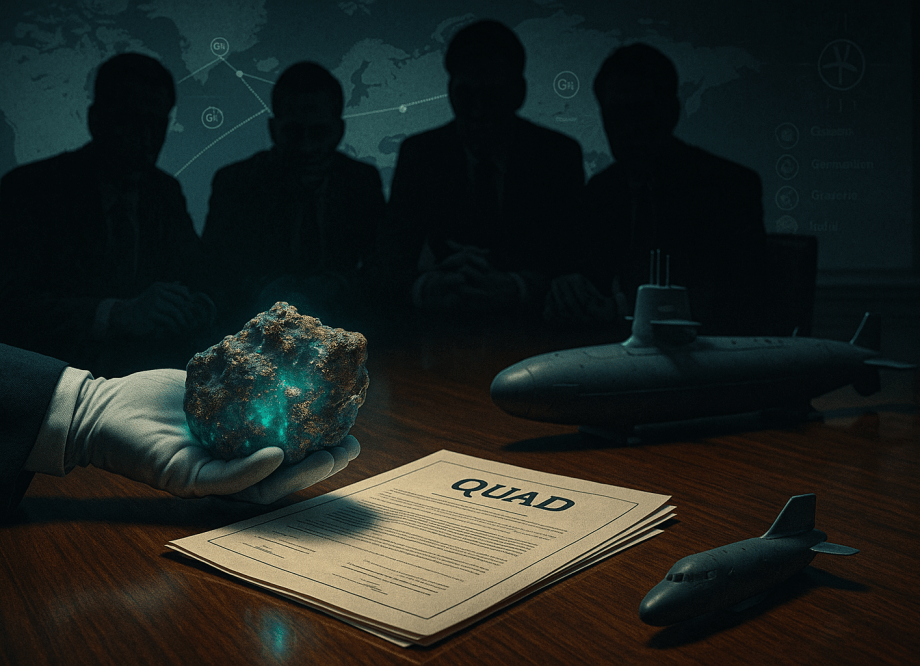
What Albo Should Be Negotiating and What Miller, Vought and Vance Actually Care About
Nobody in Canberra gets the Trump 2.0 administration. Not really.
It’s not that power hides behind the curtain; that part’s obvious enough. Miller, Vought and Vance run the machine while Trump supplies the theatre and the posts. Everyone knows this. What nobody seems to grasp is what they actually care about.
Here’s what they don’t give a damn about: submarines.
What they care about, obsessively, the thing that keeps them awake at 3am scrolling through supply-chain models, is breaking China’s chokehold on critical minerals. That’s Project 2025. That’s the file that matters. Not Australian defence procurement. Not alliance symbolism. Not photo-ops on the South Lawn with awkward handshakes and flags.
Supply chains. The rare stuff that makes the modern world spin; the metals that power semiconductors, missiles, satellites and the clean-energy transition everyone claims to want. That’s the real negotiation. That’s where Australia actually has leverage.
Albo should carry that into Washington like a live wire.
He won’t.
China’s Grip. Or How Beijing Ate Everyone’s Lunch
Here’s what Beijing actually controls: 19 of the 20 most critical minerals, with an average 70% global market share. The top three producers now control 86% of critical-mineral markets. That’s not competition; it’s a cartel with flags.
China produces roughly 60% of the world’s germanium, 80% of gallium and close to four-fifths of antimony. Gallium and germanium go into chips and infrared tech; antimony hardens munitions and high-temp alloys; graphite keeps the EV revolution rolling. One offshore wind turbine gulps four tonnes of rare-earth magnets. Now multiply by tens of thousands. See the trap?
And Beijing has shown it will weaponise that dominance with export controls when it suits; usually on a Tuesday, without warning, just to make the point.
Outside China, few jurisdictions want the mess of rare-earth refining and its toxic by-products. The US remains heavily reliant on Chinese processing, which is a bit like outsourcing your ammunition factory to the country you’re worried about fighting. Awkward, that.
This isn’t merely a supply issue. It’s a strategic vulnerability; a weapon disguised as trade. China spent decades pouring state money upstream, stitching up offtakes and joint ventures, and eventually said the quiet part out loud: Western dependence on Chinese supply chains is a national-security asset. It worked. The West talks diversification at conferences; China owns it in reality.
The American Response: Massive, Co-ordinated, Surprisingly Not Stupid
The Trump inner circle gets this, and they’re acting. The Pentagon has put serious money into rare-earth production; the US Development Finance arm is building a multi-billion-dollar minerals facility; and EXIM has started using no-cost warrants to take equity stakes, securing long-term supply without upfront budget pain. Even the Department of Energy has taken small equity positions in lithium to lock in domestic access.
This is industrial policy on steroids: aggressive, inventive, unapologetically interventionist. The kind of thing Australia would call “picking winners” and then refuse to do because some think tank in 1987 said markets know best.
That template is already turning towards Australia. Because it has to.
Australia’s Edge; The One We’ll Probably Flub
RZ Resources securing finance from the US Export-Import Bank is a quiet milestone; the first Australian critical-minerals firm to get EXIM backing in more than a decade. RZ’s Copi Mine in south-western NSW hosts a major deposit of rare earths, zircon and titanium feedstocks. At the 2025 Quad Summit it was flagged as a project of “global significance”, which in diplomatic language means “we actually need this”.
Western Australia brings established infrastructure, a skilled workforce and political stability. We’re not going to nationalise the mines or arrest the CEO because he tweeted something awkward. That matters more than most people think.
Australia solves problems that China creates. We’re the obvious answer. Which means we’ll probably cock it up.
20 October: The Meeting That Actually Matters
When Albo hits Washington on 20 October, the evening news will bang on about AUKUS. The press gallery will file breathless updates about submarine timelines and alliance solidarity. Everyone will nod seriously.
The real conversation will be minerals. Should be, anyway.
Canberra’s toying with floor prices and a $1.2 billion strategic reserve to steady investment and attract allied capital. The scaffold is there: EXIM backing, Quad recognition, a policy runway that could actually work. All Albo has to do is use it.
The smart move? Walk in with a minerals partnership so concrete it makes the submarine talk look like the decorative sideshow it is.
The realistic prediction? We’ll talk submarines, because it sounds serious and fits the brief and nobody has to explain rare-earth processing to a focus group.
What a Real Deal Would Look Like. If Anyone Had the Spine
US equity stakes: 5–10% in Australian projects via no-cost warrants to lock in supply.
Guaranteed offtakes: long-term contracts at floor prices to de-risk revenue and crowd in private finance.
Processing in Australia: joint refineries to end China’s near-monopoly downstream and create actual jobs that aren’t in hospitality.
Quad co-ordination: braid in Japan and India; share risk, share supply, stop pretending we can do this alone.
Technology transfer: share processing know-how; build sovereign capability instead of shipping ore overseas like it’s 1823.
G7 price-floor mechanism: guard against China dumping prices to kill competitors, which they will absolutely do the moment we get serious.
This isn’t tribute. It’s partnership. It’s leverage. And Australia is uniquely placed to offer it, if we could stop genuflecting long enough to notice.
Why Miller, Vought and Vance Actually Care
Stephen Miller is the zealot-in-chief, writing the purge script and making lists. Russell Vought drives the administrative-state overhaul and the economic-sovereignty file. JD Vance bangs the drum for supply-chain nationalism and means it. None of them care about diplomatic flourishes or alliance symbolism or how things look in the Financial Review.
They care about minerals. The bedrock of Project 2025. Break China’s stranglehold on supply chains and you secure the platform for American power for the next generation. That’s the file. That’s what matters. Everything else is theatre.
The Pitch That Would Work. Why We Won’t Make It
“We’re not vassals. We’re suppliers. You need what we have. China won’t sell it to you; they’ll use it against you. We will—as partners, not supplicants.”
That’s the pitch that would cut through. That’s what Miller and Vought and Vance would actually hear, because it solves their problem and doesn’t require them to pretend to care about our feelings.
Instead, we’ll almost certainly talk nuclear submarines; because it sounds serious and makes good television and fits neatly into the talking points. We’ll offer tribute and call it strategy. We’ll mistake obedience for influence, again, and wonder why nobody blinks.
Minerals vs Submarines. A Comparison About as Useful as a Screen Door on a Submarine
Submarines: The US builds its own and exports to others. Australia pays for the privilege of getting in the queue. Completely irrelevant to China’s minerals chokehold. Makes good photos.
Critical Minerals: Few reliable suppliers outside China’s orbit—Australia is ideal. The US cannot source enough at home and won’t for decades. Already weaponised by Beijing, with demonstrated willingness to tighten the screws. Central to economic sovereignty and Project 2025. Solves the actual strategic problem.
Only one of these is real leverage. Hint: it doesn’t have a periscope.
The Strategic Blind Spot. Or Why Canberra Keeps Getting This Wrong
Canberra still treats obedience as influence. Show up, salute, sign the papers, smile for the cameras. It’s the diplomatic equivalent of bringing a fruit basket to a knife fight.
But leverage means offering something the other side needs and can’t get elsewhere. Australia has that: minerals, stability, democracy, the Quad, the capacity to process onshore, and a legal system that won’t seize assets because the wind changed. We keep waving submarines and wondering why nobody takes us seriously.
What Australia Could Actually Gain. If We Weren’t Allergic to Leverage
Break China’s processing near-monopoly and reduce everyone’s strategic exposure.
Build mutual dependence with the US; partners, not supplicants. The kind where they need us, not just the other way around.
Lock in long-term offtakes and stable prices that make mining investment bankable instead of a casino bet.
Attract allied investment from Japan and India, who are equally desperate to diversify away from Beijing.
Create downstream jobs and sovereign capability; the kind that don’t evaporate when China sneezes.
Shape the reality of Project 2025, rather than be shaped by it or find out about it on Twitter.
Become central to allied economic security, not just defence optics and military pageantry.
The Real Deal. The One That Won’t Happen
Picture it: Albo opens the folder and lays down a partnership that actually breaks China’s leverage. Equity stakes, joint refineries, Quad co-ordination, tech exchange, price floors. The whole apparatus. Trump gets a win. Vought gets his supply chains. Miller gets to claim victory over China. Vance gets to talk about economic sovereignty on podcasts.
And Albo? Albo gets a real one. Australia gets prosperity with purpose, leverage with staying power, and a seat at the table that matters.
That’s negotiation. That’s leverage. That’s what statesmanship looks like when it’s not just theatre.
And it has absolutely nothing to do with submarines.
Final Word. Or Why Future Historians Will Wince
The new contest is minerals, not missiles. China leads because it understood this first, invested accordingly, and played the long game while everyone else argued about tariffs. America is scrambling to catch up, throwing money and policy at the problem with unusual seriousness.
Australia can be the hinge: the honest broker with the ore, the science, the rule of law, and the political stability that means contracts signed today will still mean something in 20 years. We’ve got everything needed to break Beijing’s minerals monopoly.
If we see it. If we seize it. If we stop mistaking attendance for strategy.
History’s question: “Why didn’t Australia use its leverage when it had the chance?”
Answer: Because we mistook loyalty for strategy, obedience for influence, and theatre for power.
And because talking about submarines is easier than explaining gallium processing to the evening news.


Super, let’s add more primary products to the export gift list from our primitive economy in hope the US remembers who we are and even though Russia and other countries have large reserves of critical minerals to help China out with. We won’t process at scale, we won’t manufacture at scale for our own future in a world where self-reliance matters as societies disintegrate, conditions become highly prejudicial to life. You could have said, flip sides, export to the new hegemon, or to no one except on condition of growing self-sufficient infrastructure (hard and digital) with tech transfer conditions. We’re a tiny fragmented country facing season after season of blacksummer fires. China meanwhile will maintain its leads in so many areas no matter what the US tries now and we’ll be on the wrong side of the final chapters of human history.
LikeLike
You’re not wrong about the risks, and I appreciate the pushback; it’s sharper than most of what passes for debate in Canberra.
The piece isn’t arguing for primitive extraction and export. It’s arguing for processing in Australia; joint refineries, tech transfer, sovereign capability; as the price of access. That’s explicit: “Processing in Australia: joint refineries to end China’s near-monopoly downstream and create actual jobs that aren’t in hospitality.” The whole point is leveraging what we have to build what we need, not shipping ore overseas like it’s 1823.
You’re right that Russia and others have reserves. But reserves aren’t the chokepoint; processing is. China refines 19 of the 20 most critical minerals. Russia’s reserves don’t help Beijing much if they can’t refine at scale, and China’s already shown it will weaponise export controls against anyone, including Moscow when it suits. The US knows this, which is why they’re throwing money at the problem and why Australia has actual leverage if we demand the processing stays here.
Your point about self-reliance in a disintegrating world is the strongest one. I’d counter that a tiny, fragmented country of 27 million facing catastrophic climate risk cannot go it alone. We don’t have the population, the capital, or the time to build a fully sovereign industrial base from scratch while the Black Summer fires repeat. We need partners. The question is whether we use our mineral advantage to extract tech transfer, processing infrastructure, and mutual dependence; or whether we just dig holes and hope for the best.
Exporting to “no one except on condition of self-sufficient infrastructure” is the principled position, and I respect it. But it’s also a position that ends with us processing nothing, building nothing, and remaining extractive because we don’t have the scale or capital to go solo. The choice isn’t between purity and vassalage. It’s between strategic partnership that builds capability, or continued drift while China owns the supply chains and we own the dirt.
As for backing the wrong horse in the final chapters—maybe. But sitting this one out while China and the US fight over supply chains doesn’t make us neutral; it makes us irrelevant. And irrelevant countries in a fragmenting world don’t get self-reliance. They get carved up.
The piece argues for leverage, not loyalty. If you’ve got a better path to sovereign industrial capability for a country of our size and resources, I’m genuinely interested. Because doing nothing guarantees we stay exactly where we are: digging, shipping, hoping someone remembers we exist.
LikeLiked by 1 person
Digging, shipping and hoping is the most likely ‘strategy’, I fear. Anything for a smooth ride with tRump. My hopes, based on our historical caving to Uncle Sam’s whims and desires, are not high.
LikeLiked by 2 people
It seems Trump has outsmarted our Albo with regard to rare minerals. America is putting up two $billion while we are contributing !one $billion, so we won’t even be joint shareholders. As for the submarines, no change, we might get one or two in ten or twenty years time.
I was happier when Albo and Trump weren’t meeting.
LikeLike
Jonangel. You’re right. It’s the art of the asymmetrical handshake. Australia stumps up a billion dollars for “partnership,” yet we’re more like a punk valet holding open the door while Washington drives off in our ute. The Americans get supply chain control, strategic leverage and PR about “shared prosperity”; we get to say “thank you” for being included in our own industry.
Submarines? Up periscope. Scanning. Yes, the mirage still shimmers on the horizon. One or two in twenty years if we’re lucky, and by then they’ll be as dated as dial-up. Frankly, Albo looked safer when he wasn’t shaking hands with Trump’s ghost.
LikeLiked by 1 person
Strategic leverage sounds nice. I just can’t remember a single industry that Australia has used in this way in the past. Our cultural cringe famously dictates that we sign all our resources away,usually for not much at all. Maybe this time will be different? I fear it already isn’t.
LikeLike
I visit here as an uneducated peasant with a need to make “sense of it all”, as the world spins in ever more perilous wobbles. Creditable, refreshing comments all. Enough for my humble grey matter to process upon my return from daily walks with my canine companion, amongst the treasures of mother nature.
Mark Twain is credited with my favourite quote. “The more I learn about people, the more I like my dog”.
Please continue.
LikeLiked by 2 people