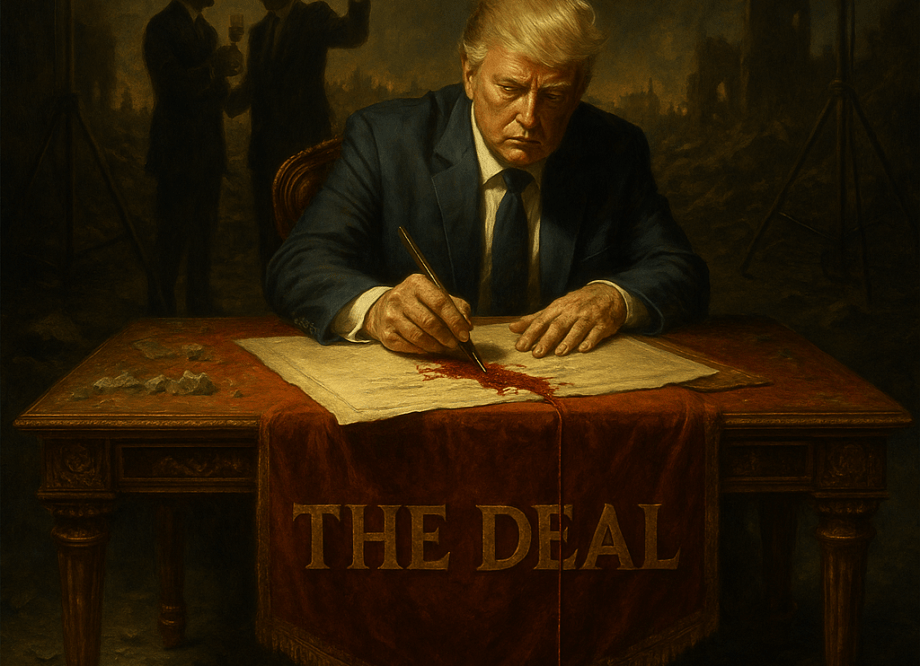
The architect isn’t a statesman. He’s a franchiser who built his brand on the ruins of the contractors he stiffed.
Politics as Performance; Peace as Product
Call it what it is: a peace treaty drafted by a malignant narcissist fluent only in the language of self-regard. In a sane age, its authors would have faced inquiry and shame; today, they bask beneath the klieg lights of a post-reason monarchy whose crown jewel is a folie à deux, a shared madness. Trump’s shitshow of a peace deal is like Sam Goldwyn’s verbal contract, not worth the paper it’s written on.
If governance was once meant to resolve conflicts, this connerie, treats them as consumable content; a press stunt staged with the lighting of a reality show and the moral imagination of a ribbon-cutting at a casino opening. Trump’s ‘Temu Peace Deal’ was tacked together for one reason: to be bought, licensed, and monetised. A tribute to trash merchandising, its clauses are less policy than packaging.
Or a self-saucing pudding. The plan’s ostensible successes; hostage releases, temporary pauses, absurdly over-long, photo-ops, are trumpeted as triumphs. But this confuses the trailer for the Disney feature: duplicity with diplomacy, glitter for genocide. It’s the political equivalent of bronzer on a corpse.
You just can’t polish a turd. A raft of analysts warns the arrangement furnishes no credible, durable vision for Palestinians; it is a ceasefire on paper, not a programme for justice in practice.
A Treaty Written in Greed and Non-Payment
This treaty is not just Napoleonic in its narcissism; it is Trumpian in its business model. It elevates his track record of exploitation into the architecture of geopolitics. This is the man whose ‘luxury’ empire was built not on mutual success, but on the systematic ruin of the small contractors who trusted him. The USA Today investigation found over 200 liens, judgements, and lawsuits from people alleging they were never paid for their work; the dishwashers, the marble installers, the painters. Donald John Trump, (your middle name matters in court), had a simple modus operandi: consume the service, dispute the invoice, and force the vulnerable into a legal war of attrition they could not afford.
The ‘Peace Deal’ is the same grift, scaled up. It promises stability; so long as ‘stability’ means the indefinite policing of an asymmetry where one people are permitted sovereignty and another are assigned to managerial extinction. The legalese reads like one of his old dishonoured contracts: “Includes: removal of inconvenient boundaries; optional humanitarian grants sold separately; one (1) permanently denationalised population; conditions apply.”
This isn’t satire; it’s the hard political arithmetic of a man for whom non-payment is a core strategy. Experts have already warned the plan’s mechanisms are ambiguous, fragile, and built to fail. Why would a durable peace be the goal? Donald John Trump has never settled his debts in full.
Guarantor of Asymmetry
A genuine peace requires symmetry: mutual obligations, accountability, credible enforcement. This treaty institutionalises its opposite. The promise of ‘stability’ in the text translates materially into checkpoints, diktats, and a long twilight of limited rights for the dispossessed. What the deal offers Palestinians is not sovereignty, but a precarious and conditional pause, making them permanent tenants in someone else’s political project. They are the new subcontractors on a project they will never own, waiting for a final payment that will never come. Being shot at when they are forced to beg for food in the street.
The Franchise Model: How Avarice Produces Perpetual War
Why would a man who treats leadership as a brand broker a durable peace? Durable peace removes drama, and drama is the commodity. Especially in the age of the monetised attention-span. More importantly, a finished project means the final invoices are due. For the contractor who left the Friel family cabinet business bankrupt after they built the bases for his Taj Mahal casino, the goal was never a mutually beneficial partnership; it was value extraction followed by strategic abandonment.
The deal is structured to keep the lights on for the franchise: the occasional hostage exchange for a ratings spike; targeted ‘incidents’ to remind the audience of the show’s necessity; humanitarian concessions priced so donors and contractors keep cashing in.
This is the genius of the arrangement for its architects. It guarantees a market for security contractors, reconstruction firms, and donor-led ‘development’ programmes; all cash cows that fatten on the indefinite liminality of a people kept in permanent emergency, just as his casinos’ bankruptcies left bondholders and suppliers with pennies on the pound.
Razed Territories, Relocated People: The Silent Clause
Read the treaty through its economic incentives, not its prose, and it becomes brutally simple: the plan makes large swathes of Palestinian life non-viable and quietly normalises relocation as policy. When infrastructure is rendered uninhabitable; by blockade, pressure, or grotesque neglect; forced displacement ceases to be an emergency but becomes an outcome. Reports of catastrophic civilian harm and mass displacement make that eventuality a plausible denouement.
We must call this by its true name: a policy architecture that produces permanent dispossession, a catalogue of human ruin sold under the euphemism of ‘stability.’ Where Swift proposed landlords eat infants to solve poverty, this modern recipe ends with populations cleared, borders softened, and plunder legitimised by legal documents and televised handshakes. The difference is only stylistic: once, the cannibalism was rhetorical; now it’s contractual, drafted by a man whose signature is most often found on a lawsuit from an unpaid artisan.
Who Benefits? Follow the Money (and the Strings)
The domestic patrons; oligarchs, donors, platform magnates; profit from the spectacle. The foreign patrons; autocratic financiers and geopolitical rent-seekers; profit from a weakened Palestinian polity that can no longer effectively resist their influence. And at the centre sits a personality who has always conflated office with opportunity, a man who will trade a people’s future for a photo op and a licensing deal, just as he once traded a family’s livelihood for a better margin on a casino fit-out.
It is no surprise the deal has the air of being quietly leased. The patronage map is public: foreign capital, private contractors, and geostrategic players whose main interest is not justice, but leverage. They are the new consortium of creditors, and the Palestinian people are the latest in a long line of contractors about to be stiffed on the final bill.
Conclusion: The Campaign That Never Ends
Do not be fooled by the soundtrack of diplomatic bromides and celebrity snapshots. A treaty that guarantees the structural conditions for asymmetrical warfare; substituting conditional aid and security contracts for rights and statehood; is not a peace; it is a business plan with body counts as externalities.
This is a franchise deal that sells relief in instalments, packages dispossession as stability, and leaves a people as an adjunct of other nations’ politics. The celebrity-in-chief didn’t broker peace; he found a way for the cameras to keep rolling, for the invoices to keep clearing, and for the story to never, ever resolve.
That is his genius, and America’s shame. America didn’t elect a president; it underwrote a programme run by a con-man whose most consistent legacy is the broken contractor and the unpaid bill.
 Urban Wronski Writes