On 27 February 2026, the night before the bombs fell, Oman’s foreign minister, Badr bin Hamad Al Busaidi, announced that a breakthrough had been reached. After months of back-channel diplomacy, Iran had agreed to never stockpile enriched uranium, to full IAEA verification, and to irreversibly downgrade its existing stock to the lowest possible level. Peace, he said, was “within reach”. Technical talks were scheduled to continue in Vienna the following week.
Fourteen hours later, at 7:00 AM Tehran time on 28 February, the first wave of missiles arrived. China had been working to improve Iran’s situational awareness. It did not matter. The attack came without warning. Reports from Arab media, undenied by Tehran, claimed that Esmail Qaani, commander of the IRGC’s Quds Force, had been arrested and executed as a Mossad agent.
Within twelve hours, the United States and Israel had conducted more than 900 strikes. Two hundred Israeli aircraft, the largest combat sortie in its history, dropped over 1,200 bombs on 500 sites across western and central Iran. US Tomahawk missiles, launched from destroyers in the Arabian Sea, hit leadership compounds, missile factories, naval installations, and the National Security Council offices where Ali Khamenei was meeting his senior advisers. They knew he was there. Netanyahu had personally briefed Trump on the location days earlier. Khamenei was above ground, in daylight, when the strike came. He was dead before midday.
Forty-eight hours later, US forces had flown more than 1,700 sorties and struck over 1,250 targets across 29 of Iran’s 31 provinces. The first six days of Operation Epic Fury cost the United States more than $11 billion.
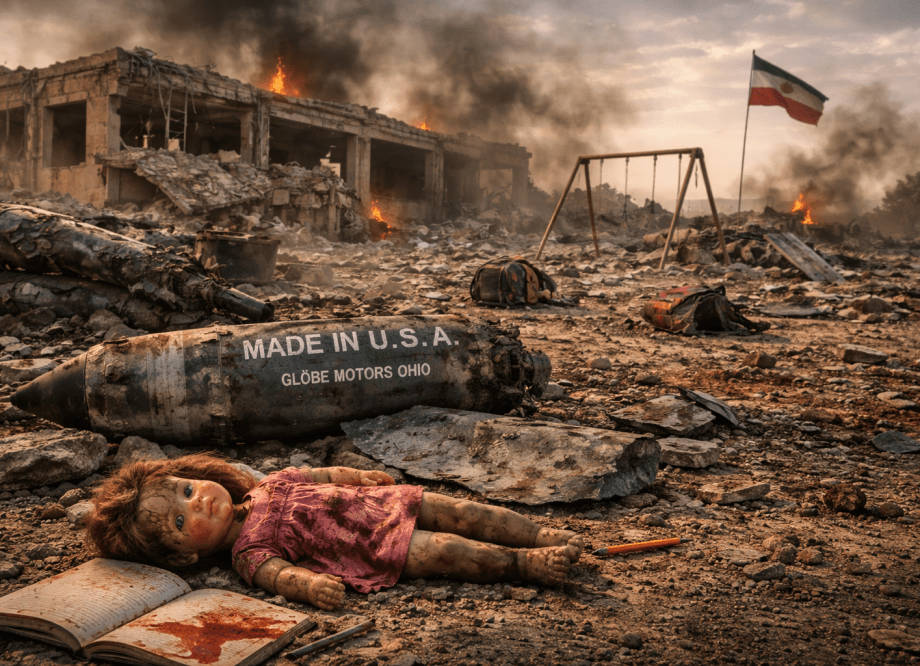
In that same period, Amnesty International confirmed that a US Tomahawk missile struck a girls’ primary school in Minab. Debris bearing the inscription “Made in USA” and the name “Globe Motors, Ohio” was recovered at the site. At least 170 people were killed. Most were children aged seven to twelve.
Then Donald Trump, in the second year of his second term, appeared on Truth Social to claim the war was about freedom.
The Lobbyists and the Lie
The question corporate media has avoided is simple. Who wanted this war, and how did they get it?
The Washington Post reports that Trump acted after sustained lobbying from Israel and Saudi Arabia. Crown Prince Mohammed bin Salman urged him to strike. Netanyahu’s government pressed the case repeatedly. Their interests converged. Israel sought to restore deterrence and reshape a regional order drifting beyond its control. Saudi Arabia saw an opportunity to weaken a rival it had failed to contain by other means. Together, they found a willing president.
The deeper breach was internal. Pentagon briefers told congressional staff on 1 March that Iran was not preparing to attack US forces or bases unless Israel struck first. The intelligence did not support the war. It was set aside. This was not a failure of information. It was a decision to ignore it.
US intelligence had already assessed that Iran was not pursuing nuclear weapons and would not have the capacity to build one before the end of the decade, even if it chose to do so. The IAEA had affirmed it. At the same time, Badr Al Busaidi was moving between delegations, and Iran’s chief negotiator was describing the talks as the most substantive in years. A framework for Vienna was in place. Technical teams were on standby.
Inside the administration, advisers discussed the advantages of letting Israel strike first to create a cleaner pretext for US entry after Iranian retaliation. That is not strategy. It is sequencing. Diplomacy was not the alternative to war. It was its cover.
Behind the push stood the familiar architecture of American intervention. Senator Lindsey Graham. The Foundation for Defense of Democracies. The American Enterprise Institute. Donor networks that have spent decades advocating regime change in Iran. They did not invent the policy. They sustained it, funded it, and waited for a president prepared to act on it.
Trump supplied the rest. On different days he has offered regime change, nuclear prevention, Iranian freedom, mineral security, and the Venezuela model as justification. None align. That is because the rationale followed the decision, not the other way around.
Congress, meanwhile, has largely abdicated its role. War powers have withered into ritual complaint. Democratic leadership has offered little more than procedural discomfort. The constitutional check on executive war-making is now political theatre, observed and ignored.
Illegal, Immoral and Known to Be Both
The legal position is clear. The UN Charter permits the use of force only with Security Council authorisation or in self-defence against an armed attack. Neither condition applied. Iran had not attacked the United States or Israel. The Security Council had authorised nothing. The strikes began during active negotiations.
Ben Saul, the UN special rapporteur on counterterrorism, called it what it is: a crime of aggression. Oona Hathaway described it as “blatantly illegal”. The European Council on Foreign Relations reported broad consensus among legal scholars that no valid justification exists. This was not a contested case. It was an unambiguous one.
No European leader has argued the war is lawful. Spain condemned it as unilateral escalation. Norway stated plainly that it breached international law. Britain hesitated, then accommodated, which tells its own story.
Australia aligned itself with Washington. Anthony Albanese supported the strikes as preventing Iran from acquiring a nuclear weapon, a claim contradicted by the intelligence his own government would have seen. For three decades, Australian governments have invoked a rules-based order as the foundation of foreign policy. This is what that commitment looks like when tested. Pine Gap tracks the targets. Canberra supplies the language. Others absorb the consequences.
Within the United States, dissent has come from the margins of power. Rashida Tlaib. Alexandria Ocasio-Cortez. Bernie Sanders. They are not describing a grey area. They are describing what the law already recognises.
What the Bombs Actually Did
In the first forty-eight hours, the IRGC Malek-Ashtar headquarters in Tehran was destroyed. The National Security Council compound was levelled. Khamenei’s residence on Pasteur Street was obliterated. A ballistic missile facility inside Tehran was eliminated. Mehrabad International Airport came under sustained attack. The Atomic Energy Agency headquarters was struck. Research facilities at Parchin were hit. Cultural heritage sites, including the Sassanian-era Falak-ol-Aflak fortress, were damaged.
By 7 March, the Iranian Red Crescent reported 6,668 civilian units damaged or destroyed. The United States employed double-tap strikes, targeting rescuers arriving at the scene of earlier attacks. Civilian areas were hit repeatedly.
Casualty figures climbed rapidly. By mid-March, more than 3,000 people had been killed, including over 1,300 confirmed civilians. Iran’s Health Ministry reported at least 1,444 dead and more than 18,000 injured. Victims ranged from infants to the elderly. The UN estimated that 3 million people had been displaced. UNICEF reported more than 1,100 children killed or injured. Hospitals were struck. Refineries burned. A desalination plant supplying civilian populations was destroyed.
And then there was Minab. A US Tomahawk missile hit a girls’ primary school on the first day of the war. At least 170 people were killed. Satellite imagery confirmed the strike. Weapon fragments identified its origin. Amnesty International attributed responsibility. Asked directly, Trump denied it and suggested Iran was to blame.
There was no apology. There was no investigation. There was a press conference about naval victories.
Iran has responded with its own violations, including the use of cluster munitions and strikes on civilian areas across the Gulf. These acts deserve condemnation. But sequence matters. Iran did not initiate this war. It responded to it.
The Catastrophe in Progress
Three weeks in, Brent crude has stabilised above $110 a barrel. Goldman Sachs projects sustained elevation through 2027. Traffic through the Strait of Hormuz, which normally carries a fifth of global seaborne oil, has collapsed. Iranian officials now question whether it will reopen at all.
This is not a regional disruption. It is a global economic shock. Energy prices feed directly into inflation, into transport, into food. The cost of this war will not be confined to the battlefield. It will be paid at petrol stations, in grocery aisles, and in central bank decisions across the world.
The United States has already lost personnel. More than 230 service members have been wounded. The Pentagon is seeking a further $200 billion from Congress. Additional troops are being deployed even as the administration speaks of winding down. The objective remains undefined.
Senator Thom Tillis has asked the only question that matters. What are we trying to accomplish?
There is no coherent answer because coherence was never the point. This is the Venezuela model applied to a country four times larger, with a military doctrine built to resist precisely this kind of intervention, and a political system shaped by decades of confrontation with the United States. The architects of this war designed Iraq. The pattern is familiar. The outcome will be too.
Beyond the region, the consequences are structural. The war has drawn Russia and China closer to Tehran. It has fractured Gulf alignments. It has accelerated moves away from dollar-denominated trade. It has signalled, again, that international rules are contingent on power, not principle. That message will not be forgotten.
The Lobbied War and Its Legacy
The task now is to call out what happened. Cut through all the turgid spin.
A sitting American president was lobbied into a war of aggression, attacking mainly civilian targets, innocent men, women and children. He launched it during active negotiations. He did so knowing the intelligence did not support the threat he claimed. The result has been thousands of deaths, millions displaced, and the formal commission of a crime recognised under international law.
It has strengthened the very regime it purported to weaken. It has expanded the conflict it claimed to contain. It has exposed the limits of American power and the erosion of its credibility.
Trump did not invent this tradition. He embodies it. For decades, American policy in the Middle East has treated the region as an arena for demonstration rather than a place where consequences accrue. This is what that approach produces when pursued to its logical end.
This is what a lobbied war looks like when it finally arrives. Not strategy. Not security. Not freedom.
A primary school in Minab.
That is the policy.


The fact that the Middle Eastern war has ben propagated by Israel and the USA, casts a shadow on Democracy., But what is far worse, is the fact that so called Democracies do nothing to stop it!!!
Democracy, like religion, is just a feel good concept that shrouds evil from public view.
LikeLike