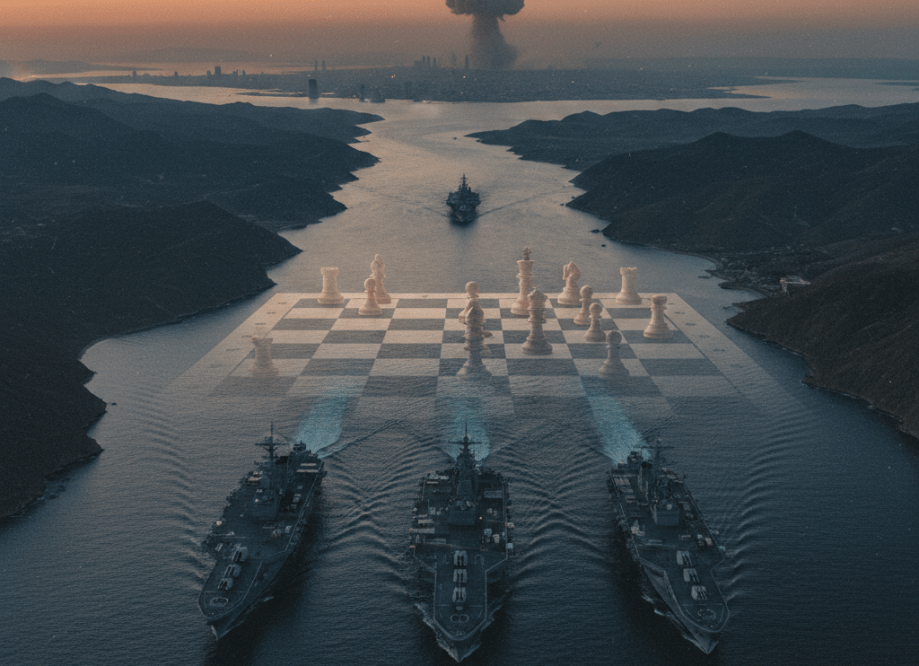
The hard mathematics of depleted arsenals, a CRINK alliance forged in necessity, and the most dangerous question nobody in Washington wants to answer
On 2 January 2026, at 2:58 am, Donald Trump jabbed at his phone and fired a message onto Truth Social that would have read as an act of war in any previous administration.
“If Iran shots and violently kills peaceful protesters, which is their custom, the United States of America will come to their rescue. We are locked and loaded and ready to go.”
Six months earlier, Trump had done exactly that, not for protesters, but for Israel and its nuclear ambitions, and the consequences are still reverberating from the Persian Gulf to the Taiwan Strait. The bravado is vintage Trump. The military reality underneath it is something else entirely.
The Strike That Already Happened
To understand why the second blow hasn’t landed, you have to reckon with the first one. The Twelve-Day War, 13 to 24 June 2025, was a seismic event that rewrote the strategic map of the Middle East and exposed, simultaneously, both American military supremacy and its alarming structural limits.
Israel launched Operation Rising Lion in the early hours of 13 June 2025, bombing military and nuclear facilities across Iran in a surprise attack that assassinated prominent military leaders, nuclear scientists, and politicians. The United States joined on 22 June, bombing three Iranian nuclear sites. Iran retaliated with over 550 ballistic missiles and more than 1,000 suicide drones. A ceasefire was brokered under US pressure on 24 June.
The declared objective, destroying Iran’s nuclear program, was claimed as a triumph. The Pentagon’s spokeswoman described Operation Midnight Hammer as “the total obliteration of Iran’s nuclear ambitions.”
Intelligence assessments are less upbeat. An early CIA assessment determined that US strikes on Iran’s nuclear facilities likely only set the program back by months; not years, not permanently. Iran retains enriched uranium stockpiles and, more damningly, retains the knowledge and the will. You can destroy centrifuges. You cannot bomb physics.
The Empty Magazine Problem
Twelve days of war cost a fortune, and exposed a bluff. After spending approximately 150 THAAD interceptors and 80 SM-3 missiles defending Israel during the Twelve-Day War, the Pentagon faces a stark reality. Its stockpiles are depleted, its production lines cannot keep pace, and another major conflict with Iran would require an air defence umbrella America can no longer fully provide.
The numbers are sobering. The United States fired 150 THAAD interceptors, about 25% of its total stockpile, and 80 SM-3 interceptors. During Operation Midnight Hammer, the US also used 14 GBU-57 bunker-busting Massive Ordnance Penetrator bombs, a significant quantity of scarce munitions. To defend Al Udeid Air Base in Qatar against Iranian retaliation, US troops fired 30 Patriot PAC-3 interceptors.
Producing quick replacements is not an option. THAAD interceptors are built at a rate of twelve per year. Replacing the 150 fired during the Twelve-Day War will take more than twelve years at current production rates. CSIS analysts warned in late 2025 that no new THAAD interceptors would be delivered until 2027.
The Pentagon’s response? An emergency $2 billion injection into THAAD procurement, authorised through an existing contract with Lockheed Martin. At $12.7 million a unit, that sum barely replaces what was expended in twelve days of fighting.
From a narrowly military standpoint, as analyst Sidharth Kaushal of RUSI observes, “the Chinese are absolutely the winners in that these last almost two years in the Middle East have seen the US expend pretty substantial amounts of capabilities that the American defense industrial base will find pretty hard to replace.”
The same depleted stockpiles needed for a second Iran strike are the ones needed if China moves on Taiwan. Washington cannot afford to fight on two fronts at once.
Beijing knows it.
Why “Locked and Loaded” Keeps Getting Holstered
The Trump administration’s formula is familiar: maximum rhetoric, measured action. Carrier deployments provide leverage; sanctions and tariffs have expanded; diplomatic and military signalling has intensified. But strikes, despite the scale of civilian killing in Iran’s domestic crackdown, have not materialised. As for his “Help is on its way”, no-one, not even Donald Trump takes Trump at his word.
The strategic constraints are structural and multiple. First, the arsenal problem above.
Second, escalation risk dominates the calculus. Tehran makes clear that any US strike would trigger retaliation across multiple theatres: Israel, American bases in the region, and potentially global energy routes. The prospect of asymmetric escalation, through ballistic missiles, proxy warfare, cyber operations, or disruption of the Strait of Hormuz, carries profound economic and security consequences.
Third, and critical to Trump’s political arithmetic, Operation Iron Strike was authorised by the Israeli security cabinet in January 2026 but has not been executed. The 2025 National Security Strategy reiterates an America First approach, prioritising US interests while explicitly seeking to avoid committing American forces to conflicts that risk metastasising into “endless wars.”
Trump ran against endless Middle Eastern wars. Launching another, especially before the 2026 midterms, with petrol already up and air defences running low, is too costly even for Team Trump.
Fourth, the Oman talks. The United States and Iran resumed negotiations on 6 February 2026, in Muscat, with delegations led by Steve Witkoff and Iranian Foreign Minister Abbas Araghchi. Whether this is genuine diplomacy or, as critics note of the June 2025 talks that Israel bombed mid-round, another strategic timeout while arsenals are rebuilt, remains the defining question of the moment.
The CRINK Complication: An Axis of Necessity
The Twelve-Day War was supposed to isolate Iran. Instead it accelerated a process already well underway: the consolidation of China, Russia, Iran, and North Korea, the CRINK alignment, into something more coherent and more dangerous than any of them intended. Not an alliance of ideology. An alliance of survival.
Beijing and Moscow both called for a ceasefire and de-escalation during the Twelve-Day War, and later voiced strong condemnations of the US bombing of Iran; but overall stayed on the sidelines of the actual fighting. Russia did not come to Iran’s rescue when the bombs fell. China did not either. Iran drew the lesson. And the lesson, paradoxically, has pushed Tehran closer to Moscow, not further away.
Tehran’s most urgent task is now to reduce the risk of further Israeli and US airstrikes, and Russia’s role as a deterrent is more multifaceted than simply supplying weapons. During the Twelve-Day War, Israel avoided striking Russian targets. The more Russian enterprises and infrastructure present on Iranian territory, the more “safe zones” there are that Israel would be reluctant to hit intentionally.
The Su-35 fighter jets, the S-400 negotiations, the January 2025 Comprehensive Strategic Partnership; all of this is Iran buying not just weapons but insurance, using Moscow as a human shield dressed in diplomatic clothing.
Meanwhile, Russia and China have deepened economic and security ties with Iran and North Korea, moving from active supporters of nonproliferation to aggressively blocking international attempts to limit the nuclear programs and military buildup of both states. Russia now opposes US counter-proliferation efforts entirely and refuses to leverage its ties with Iran and North Korea to facilitate multilateral negotiations.
This is not, to be clear, NATO. There is no Article 5 for the CRINK. China has been, as analysts note, “desperate to clarify that it is not a trilateral alliance with Russia and North Korea.” Beijing carefully manages its exposure. But desperation to clarify is, itself, a form of acknowledgment. The gravitational pull of shared adversarial interest keeps drawing these states together even as each one hedges against the others.
The Nuclear Calculation Nobody Speaks Aloud
Which brings us to the darkest corner of this analysis: is there a faction within the US military-strategic complex that views a strike on Iran not just as a counter-proliferation exercise, but as a potential trigger to force China and its allies into a confrontation America believes it can win, or survive, on its own terms, while it still retains nuclear and conventional superiority?
It would be irresponsible to present this as established policy. It is not. But it would be equally dishonest to pretend the question has no analytical foundation.
The Bulletin of the Atomic Scientists’ Doomsday Clock opened 2026 at just 89 seconds to midnight. Great-power competition is driving new nuclear risks as existing powers seek to increase their stockpiles or carry out new tests. Gone is the Cold War-era balance of terror, as is the post-Cold War stasis when the US and Russia pledged to reduce their stockpiles by more than 80%. The architecture of arms control accords has unravelled entirely.
The logic of preventive war, strike now while the correlation of forces still favours you, has been articulated before, in different contexts, by voices within the American strategic establishment. The window of conventional superiority over China narrows every year. North Korea’s nuclear arsenal grows. Russia has suspended New START. Trump has ordered new nuclear tests if others such as Russia and China test. China is expanding its test site at Lop Nur.
Any US attack on Iran that escalated into direct confrontation with the full CRINK alignment would be catastrophic. Iran alone, even degraded, could close Hormuz, push oil toward $150 a barrel, and trigger economic shocks that would dwarf anything since the 1973 embargo. A CRINK-wide response would threaten American bases across the region, expose Taiwan’s vulnerability, disrupt global supply chains, and potentially, at the extreme end of the escalation ladder, cross nuclear thresholds that have not been crossed since 1945.
The counter-argument made in some Washington circles is that deterrence requires credibility, that the CRINK alignment must be broken before it fully consolidates, and that the United States retains strategic advantages that will not exist in a decade. This is the logic that historically produces catastrophic miscalculations. It also cannot be entirely dismissed when you observe that the Twelve-Day War itself was launched, as Iranian Foreign Minister Araghchi put it, as “a betrayal of diplomacy,” in the middle of active negotiations that critics across the political spectrum described as either a deliberate ruse or a process Israel cynically sabotaged.
The Verdict
Vulnerability, not virtue, is still what holds the second strike back. Trump’s “locked and loaded” is a bluff backed by genuine intent and, simultaneously, genuine incapacity. The THAAD batteries are running short. The SM-3 production line cannot replenish what twelve days consumed for over a decade. The Oman talks provide cover. Operation Iron Strike sits authorised on a shelf, waiting for conditions that have not yet aligned. Is it already past its use-by date?
Realpolitik matters. The CRINK alliance, for all its transactional limits and internal tensions, grows more coherent with every American strike, every new sanction, every diplomatic ambush. Iran is buying Russian jets and Russian air defence systems and Russian infrastructure precisely because it learned in June 2025 that it cannot survive alone. Russia is deepening those ties because Iranian drones keep its Ukraine operation running. North Korea watches and notes that nuclear weapons are the one deterrent that works; the lesson Tehran is almost certainly drawing too.
The question is not whether the next explosion happens. In this neighbourhood, with these actors, at these temperatures, it is almost certainly coming. The question is whether, when it does, the chain reaction can be contained before it reaches weapons and consequences that cannot be walked back.
Eighty-nine seconds to midnight, and counting.


One thought on “Locked, Loaded, and Stuck: Why the Second Iran Strike Won’t Come Easy”
Comments are closed.