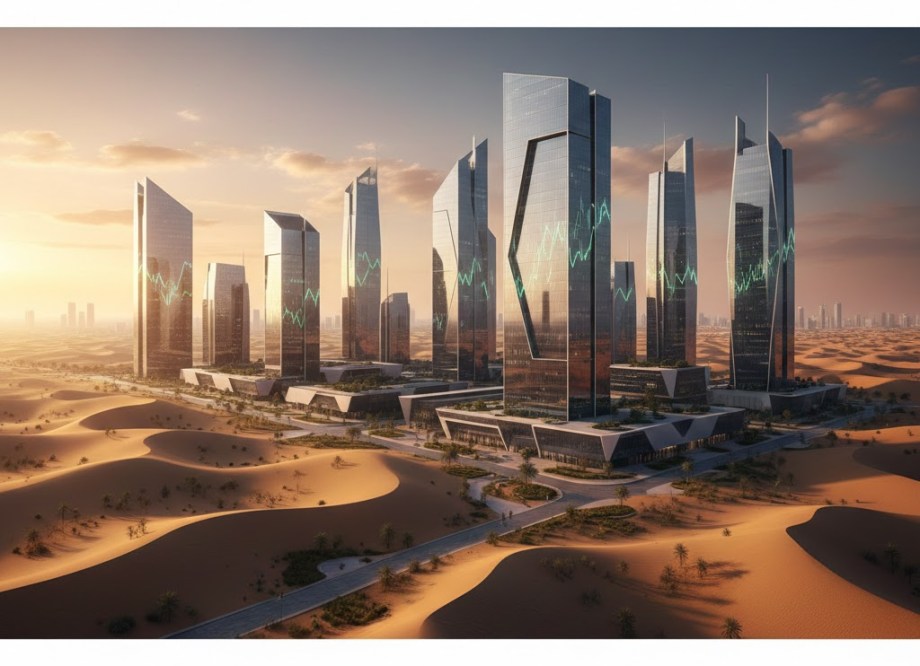
The Markets are Nervous, So Someone Must Pay the Ultimate Price
When princes flinch, missiles tend to fly.
Another war with Iran is on the horizon. It will be Israel who leads the strike, but the U.S. will be quick to unearth the hatchet it never truly buried, before you can even say the word: “Tomahawk.”
The US Fifth Fleet, headquartered in Manama, Bahrain is sitting smack-dab in the middle of the Middle East. The dollar is twitchy and the price of oil is softening; hovering dangerously near the US$60 floor that makes Western shale look like a bad bet. Warmongers do not only run Washington; they have the world over a barrel.
But not the Saudis. We all know how war and oil and empire dance the salsa together. It is not the old excuse-me waltz in the military-industrial complex handbook; it is something with far more brio; far more volatile. And flashy.
The American rules-based order has one inflexible rule: comply or bleed. Venezuela learned. Iran is about to be reminded. Saudi Arabia is taking notes. Across the Americas, the “order” looks more like a fracture: Mexico and Canada are caught in the cross-hairs of aggressive tariff threats, while team Trump admires South American lithium and Greenland’s mineral wealth with the eyes of a smash and grab raider.
Oil, Empire, and the Market’s Salsa
Salsa fits our era: fast, seductive, improvisational; flashy if not slightly tacky chaos sold as choreography. But the trick is that every flourish returns to the basic step: forward, back; forward, back. Oil politics is the same. Forward: new fields, pipelines, alliances. Back: crashes, sanctions, coups, embargoes.
The dance doesn’t end because the band never leaves the stage. The music—demand—keeps playing, even as the dancers reach for their ceremonial swords and gunboats. And here’s the part they don’t mention in the financial press: the United States always leads. Change partners or improvise your own steps, and you’ll find yourself dancing alone while the room empties and the lights go out.
Next thing, you are in muffs and a blindfold, just as in early images of Nicolás Maduro. It’s to protect your head from exploding, as powerful microwaves boil your blood. Behold the Emperor’s new weapons. Directed Energy Weapons, (DEW). The raid on Caracas tells the world the US is ready to use them.
Be afraid. Be very afraid. DEW may have changed the nature of warfare forever. At least, that’s how it’s hyped. But that’s not why even the Saudis are wary of their ally; rapidly hedging their bets.
In the last few years, Saudi Arabia’s sovereign wealth machine, the Public Investment Fund (PIF), has been quietly shedding the very U.S. equities it once hoarded like tech-sector trophies. It’s a surgical retreat: roughly $3 billion in U.S.-listed stocks peeled away in a single fiscal quarter, with major stakes in giants like BlackRock, Carnival, and NextEra Energy liquidated or slashed.
To most financial journalists, it’s a standard “rebalancing” or “diversification.” To anyone with a memory longer than a market cycle, it’s storm furniture: you move the valuables away from the windows when you know the glass is about to go.
The capital isn’t just sitting idle; it’s being funnelled into the Tadawul, the Saudi exchange, where the kingdom can conjure $100 billion in value from a regulatory whisper, like a magician producing a dove from a sleeve lined with petrodollars. By moving their chips from Wall Street back to Riyadh, they aren’t just investing in Vision 2030; they are insulating their wealth from the reach of Western sanctions and the “jurisdictional overreach” that turned Russian and Venezuelan assets into worthless paper.
From Caracas to Riyadh: The Petro-state Cautionary Tale
Saudi Arabia once watched Venezuela, which co-founded OPEC in 1960, with professional curiosity. Now it watches in horror. If this is how “Kaiser Donald” treats a sovereign oil producer when interests diverge, the House of Saud knows its own gold-plated chair is only as stable as its compliance.
Caracas didn’t just stumble. It was invited to the banquet, handed a chair, and then punished the moment it tried to change the seating plan. Now it is the ghost of Banquo at Riyadh’s feast. Oil wealth gave Venezuela a type of machismo, the kind that lets a petro-state imagine it can dance with the big powers as an equal. But the instant it tried to lead the choreography, the music stopped.
The lesson for Riyadh is written in the soot of Venezuelan refineries: if you don’t keep the wheels of global finance oiled to Washington’s liking, the markets will be turned into weapons. When oil prices collapsed in 2014, the “democracy promotion” narrative for Venezuela conveniently accelerated. By 2019, billions in assets were frozen. Caracas failed to maintain the “reliability” the West demanded, so Washington changed partners. Forcibly. With flash new weapons that may revolutionise warfare.
Why Saudi Royals are Moving the Furniture
Riyadh isn’t just diversifying for a post-oil future; they are insulating themselves against the Venezuela Treatment. By “conjuring” $100 billion in value within their own regulatory borders, they are building a financial fortress. They are betting that if the Strait of Hormuz turns into a “kinetic” zone, a massacre framed as a “market correction”, they need their wealth within reach of their own swords, not sitting in a New York brokerage subject to a sudden freeze.
The central lie—and it is a lie—is that a “nice little war” with Iran could ever be neat or economically rational. Iran is not Iraq in 2003. It has 80 million people and the capacity to disrupt the Strait of Hormuz, where 20% of the world’s petroleum passes through a gap only 21 miles wide. Every algorithm on Wall Street would soil itself. Oil prices would not magically stabilise, it would have a whiplash effect.
But that’s the thing about marking your dancing card while you keep a loaded gun under the table: eventually, someone has to get shot. The next war with Iran will not be a tragic accident. It will be a policy decision, taken in boardrooms and justified by people who have taught themselves to call war by any other name.
The salsa will go on. The bodies will pile up. And somewhere, in a palace overlooking the desert, a Saudi prince will watch the news and quietly move another billion dollars closer to home.
The Coda: The Force Majeure of the Accomplice
Let us not mince words. We are not watching a tragedy of errors; we are watching a deliberate, strategic architecture of demolition.
The current escalation is not some random spark in the Tinderbox of the Levant. It is a sovereign decision made in Jerusalem, but signed, sealed, and delivered by a Washington that has traded the “rules-based order” for the brazen opportunism of a protection racket. When the Israeli government decides to “mow the grass” this time, it won’t be using any Makita cordless shears. It will be wielding the F-15IA Eagle II, the KC-46A Pegasus for midair refuelling of a long-range strike, and the terrifying payload of precision-guided bunker busters, the “big guns” that don’t just hit targets; they erase them.
Washington provides more than just the hardware. It provides Israel with the Arrow 3 and David’s Sling missile shields, the high-altitude “umbrellas” that allow a striker to throw a punch without fearing the return. This is not “defensive aid.” It is an enabler of offensive impunity.
Yet despite the sheen of invincibility, the Arrow 3 and David’s Sling are not foolproof. In the real-world trials of 2024 and 2025, the choreography faltered. During the massive Iranian barrages of late 2024, at least 32 missiles reportedly breached the saturation point at the Nevatim Airbase alone. In mid-2025, even with the US-operated THAAD (Terminal High Altitude Area Defense) standing as a second line of defense, a “technical glitch” allowed a Houthi-launched missile to strike near Ben Gurion Airport.
These aren’t just technical failures; they are a warning that the “basic step” of the dance; the assumption that you can strike without being struck back, is a high-stakes gamble.
The 2026 Arsenal: The “Big Guns” of Impunity
The US isn’t just sending “aid”; it is supplying the specific keys to an offensive kingdom. The 2026 US Defence Budget has carved out over $500 million specifically for these systems, shifting money away from the “defensive” Iron Dome to the “strategic” high-altitude interceptors. Here are the “big guns” that make the next strike possible:
Arrow 3 Interceptors: Designed to kill ballistic missiles in space, before they even re-enter the atmosphere. Washington has allocated $100 million for joint production of these this year alone.
THAAD (Terminal High Altitude Area Defense): Now permanently deployed on Israeli soil and manned by US troops. It serves as the ultimate fail-safe, intercepting targets at altitudes up to 150 km.
KC-46A Pegasus: The “silent enabler.” These advanced tankers are the “long-legged” support that allows Israeli strike packages to reach Tehran and back without needing to land in a third country.
The F-15IA Eagle II: The heavy lifter of the 2026 arsenal, capable of carrying the massive, precision-guided “bunker busters” needed to reach fortified underground facilities.
The Force Majeure Card
When these systems fail, as they did in the Tel Aviv breaches of June 2025, the US doesn’t scale back. It doubles down. The deployment of US personnel to man THAAD batteries is the ultimate Force Majeure. It signals to the region that an attack on the “shield” is an attack on the United States itself.
It is the perfect trap: an offensive strike is launched under a “defensive” umbrella, and if the umbrella breaks, the US enters the war to “defend” its own troops. We are all accomplices to this logic, watching the US play its hand as if it were an act of God rather than a deliberate policy of kinetic intervention.
“Kinetic intervention?”
Let us translate that bloodless, three-syllable piece of Orwellian jargon for what it actually is: The industrial-scale pulverisation of human beings to settle a ledger.
It is the clinical term used by men in air-conditioned rooms to describe the moment a mother in Isfahan or a student in Shiraz is vaporised by a $2 million precision-guided firework because some algorithm in a New York basement predicted a 2% dip in the futures market.
It is the language of the butcher who has convinced himself he is a surgeon. and peace-maker.
When we say “kinetic,” we mean the wet, percussive reality of bone hitting concrete. We mean the “calculated cruelty” of launching a strike from behind an American-manned THAAD battery, knowing full well that when the retaliatory fire comes, it won’t hit the generals in the Pentagon. It will hit the “collateral” people; the shopkeepers, the women and the children and the grandparents with their grandchildren, who are treated as nothing more than rounding errors in a strategic simulation.
The Great Deception of the Shield
The most devastating inhumanity lies in the false promise of the “umbrella.”
We are told that Arrow 3 and David’s Sling are about “security.” But in 2026, we know the truth: these systems are the enablers of a coward’s war. They allow any state pumped up on hubris, to reach out and destroy its neighbour while hiding behind a high-altitude screen, safe in the knowledge that if a single missile leaks through the “Iron Dome,” the US will invoke its Force Majeure card to burn the rest of the region to the ground in “defence.”
It is a game with no final victor because it is built on a fundamental lie; that you can bomb your way to a “stable market.” You can’t. Every “kinetic strike” is just a high-interest loan on future vengeance. You can move the furniture, you can repatriate the billions, and you can hide behind the “big guns” of the American arsenal, but you cannot hide from the black hole of your own inhumanity.
We are all accomplices because we have allowed the merchandised language of war to become the language of the brochure. We have accepted “kinetic” over “killing,” “intervention” over “invasion,” and “deterrence” over “despair.” We are watching a civilisation trade its soul for a stable oil price, and in the end, we will find that the price of “stability” was everything we ever held dear; or claimed to value.
 Urban Wronski Writes
One thought on ““Kinetic Strikes and Cotton Socks: How Markets Cheer on the Next War With Iran””
Comments are closed.