A Note from the Editor
Readers should be warned that this piece pays deliberate homage to Evelyn Waugh. Waugh’s exquisitely appropriate fondness for long, winding sentences and his unrivalled capacity to report the facts with deadpan solemnity when our top brass parody themselves most enthusiastically. As Napoleon is said to have observed, one should never interrupt the enemy when he is making a mistake; here, the Defence Minister has been left entirely uninterrupted.
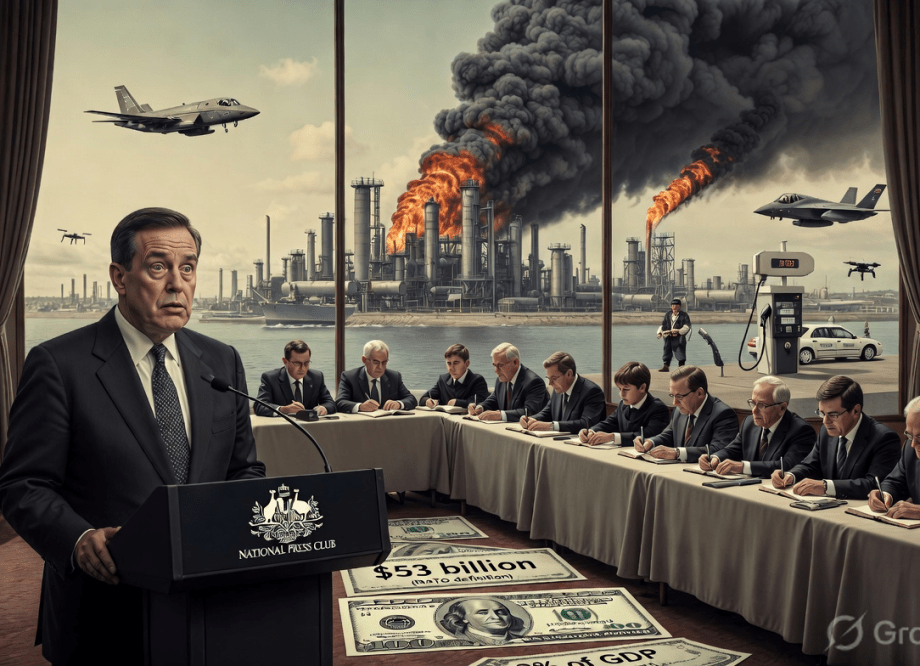
Being a faithful account of Australia’s National Defence Strategy, 2026, as delivered to the National Press Club, Canberra, on a Thursday, during a fuel crisis, while the Geelong refinery burned.
At ten o’clock on the morning of Thursday the sixteenth of April, in the year of our Lord two thousand and twenty-six, with one of Australia’s two remaining oil refineries still smouldering in Geelong, with the nation’s fuel reserves declining toward five weeks of supply, with the Prime Minister in Malaysia asking Petronas if they had any spare diesel, Defence Minister Richard Marles took to the podium at the National Press Club in Canberra and announced the biggest peacetime increase in defence spending in Australia’s history.
The assembled journalists wrote this down.
Mr Marles, his brow furrowed in the manner of a man who has just remembered an important but elusive appointment, said Australia faced its most complex and threatening strategic circumstances since the end of World War Two. He said international norms that once constrained the use of force and military coercion continued to erode. He said the government was pursuing every avenue of increasing defence capability quickly, mostly through bigger defence appropriations but also through accessing private capital. He said delivering the strategy was not only about investing more. It was about spending better.
The assembled journalists continued to write this down, their pens moving with the solemnity of altar boys recording the responses at High Mass.
An extra fourteen billion dollars, Mr Marles said, would be spent on defence over the next four years. An additional fifty-three billion would be set aside over the next decade. By 2033, Australia’s total defence spending would reach three percent of GDP.
A hand went up at the back. Michelle Grattan of The Conversation wished to note that the three percent figure was calculated using the NATO definition of defence spending, which could include certain tangential items not traditionally considered defence expenditure, and that in effect this made the defence spend appear larger than it was.
Mr Marles said it was not only about investing more. It was about spending better.
A Distinguished Pedigree in Spending Better
It should be noted, for the benefit of those unfamiliar with the history of Australian defence procurement, that the tradition of “spending better” has a distinguished pedigree in this country.
The Australian War Memorial in Canberra is a monument of considerable architectural grandeur, though its construction budget was exceeded by some margin and it was completed eleven years late. The Collins-class submarine program, conceived in the 1980s to provide Australia with a world-class underwater capability, delivered vessels that were described by their own crews as the finest submarines money could produce — provided that money was prepared to wait for parts, accept considerable noise levels, and develop a philosophical attitude toward the relationship between the planned number of operational submarines at any given moment and the actual number.
The Joint Strike Fighter program, now in its third decade of development, has produced an aircraft whose software upgrade was described by the Pentagon’s own Director of Operational Test and Evaluation as “predominantly unusable” throughout the entirety of fiscal year 2025, requires pilots to perform the in-flight equivalent of pressing Ctrl+Alt+Delete to reboot its radar, and achieved precisely no new combat capabilities in the year Australia was asked to order more of them.
Australia currently has seventy-two F-35s on order.
Mr Marles said it was not only about investing more. It was about spending better.
Lessons from the Iran War
The Iran War, which began on February 28 and which Mr Marles described as having “greatly complicated” the strategic landscape, has offered several observations about the future of air power that the defence establishment has received with the equanimity of institutions that have already ordered seventy-two aircraft.
The F-35 is a stealth aircraft. Its stealth characteristics are effective against radar. Heat-sensing surveillance, which Iranian forces employed with some enthusiasm in the early weeks of Operation Epic Fury, detects aircraft by their engine exhaust rather than their radar profile — a distinction the stealth coating does not address. Iranian air defences destroyed several F-35s in the opening weeks of the conflict. The United States Air Force confirmed a smaller number of these losses than Iran reported, and a larger number than CENTCOM’s initial press releases suggested. The investigation into the precise figure is ongoing.
The drone, meanwhile, costs approximately twenty thousand dollars. It is not stealthy. It does not require a software upgrade. It does not need to reboot its radar. It has been used to considerable effect by every party to every recent conflict, and Mr Marles announced on Tuesday that billions of extra dollars would be allocated to drones and counter-drone measures over the next decade.
One notes that the drone allocation comes after the F-35 allocation. One notes further that the counter-drone allocation comes after the drone allocation. One observes that this sequence describes, with considerable precision, the nature of arms races. The fifty-three billion dollars earmarked over the next decade will, in the fullness of time, generate its own counter-counter-drone requirement, which will presumably feature in the 2030 National Defence Strategy — also to be delivered at the National Press Club, also while something is on fire somewhere.
Mr Marles said the strategy would put Australia on a path to strong defence self-reliance.
Self-reliance should not, he clarified, be confused with self-sufficiency. Alliances, especially with the United States, would always be fundamental to Australia’s defence.
The Alliance in Action
The United States is currently conducting a naval blockade of the Strait of Hormuz, which it cannot safely enter, using destroyers that have already turned around once after being addressed firmly by an Iranian drone. This is in pursuit of a strategy that has been rejected by a forty-nation coalition including most of Australia’s other allies.
Australia’s contribution to the alliance this week has been a Wedgetail surveillance aircraft based in the Gulf. The Wedgetail is doing, by all accounts, excellent work.
It is perhaps worth pausing here to consider the three armed services whose budgets Mr Marles was expanding. The Royal Australian Navy, the Australian Army, and the Royal Australian Air Force each maintain their own headquarters, their own command structures, their own procurement offices, their own traditions, their own ceremonial requirements, their own disputes with each other about which of them is more fundamental to national defence, and their own opinions about the optimal allocation of the fifty-three billion dollars.
The question of whether three separate armed services, each with its own administrative apparatus and officer class, represents the most efficient use of the defence budget in an era of joint operations and drone warfare is a question that has not been asked at the National Press Club today.
Mr Marles said it was not only about investing more. It was about spending better.
AUKUS and the Long Wait
The AUKUS submarine agreement, under which Australia will acquire conventionally armed, nuclear-powered submarines from the United States at a cost currently estimated at between two hundred and three hundred and sixty-eight billion dollars (depending on which estimate one consults and on which day one consults it), was described in the announcement of Vice Admiral Mark Hammond’s appointment as Australia’s new ADF chief as a project toward which he would “continue to bring valuable insight.”
The first submarine is expected to arrive sometime in the 2040s. Mr Hammond will have retired by then. Mr Marles will have retired by then. The children currently in primary school in Australia will be in their thirties by then — at which point they will receive a nuclear-powered submarine and a defence budget representing three percent of GDP calculated using the NATO definition.
In the interim, Australia’s fuel reserves stand at less than five weeks. The Geelong refinery, which supplies ten percent of the nation’s fuel and fifty percent of Victoria’s, is still being assessed for damage after Wednesday night’s fire. The last tanker carrying pre-war jet fuel is scheduled to dock on Sunday.
The fifty-three billion dollars is allocated over ten years.
Opposition Leader Angus Taylor said that creative accounting did not defend a single Australian.
Mr Marles said it was not only about investing more. It was about spending better.
The assembled journalists packed up their notebooks.
Outside, on Canberra’s Capital Circle, a government vehicle filled up at the pump. The price per litre was a figure that would have seemed improbable eighteen months ago and now seems, given current trajectories, almost nostalgic.
The National Defence Strategy runs to one hundred and twelve pages. It does not mention the Liquid Fuel Emergency Act 1984, which is also a kind of strategy, and which is sitting in the drawer.


Deft demo job.
LikeLike