Twelve nations put a price on Israel’s illegal settlements. Canberra sat at the table for months, then remembered it had a Security Council seat to win.
Do we have principles?
Strutting what it sees as the high moral ground of the world stage, Australia is wont to pose as the honest broker, champion of the underdog and even warden of the mystical rules-based order, a form of words that rivals the Nicene Creed for opacity and is chanted with the same glazed piety, loudest by those least inclined to live by it.
Hypocrisy? If we don’t like our principles, as Groucho almost said, we have others.
This month twelve nations put their names to trade sanctions on Israel’s illegal settlements in the West Bank: the UK, France, Canada, Denmark, Finland, Iceland, Ireland, Norway, Poland, Portugal, Spain and Sweden.
Four diplomatic sources told the ABC that Australia stayed in the talks until close to the end. One EU official had seen an earlier draft with Australia written in.
Whether Canberra ever agreed to be there, nobody will say.
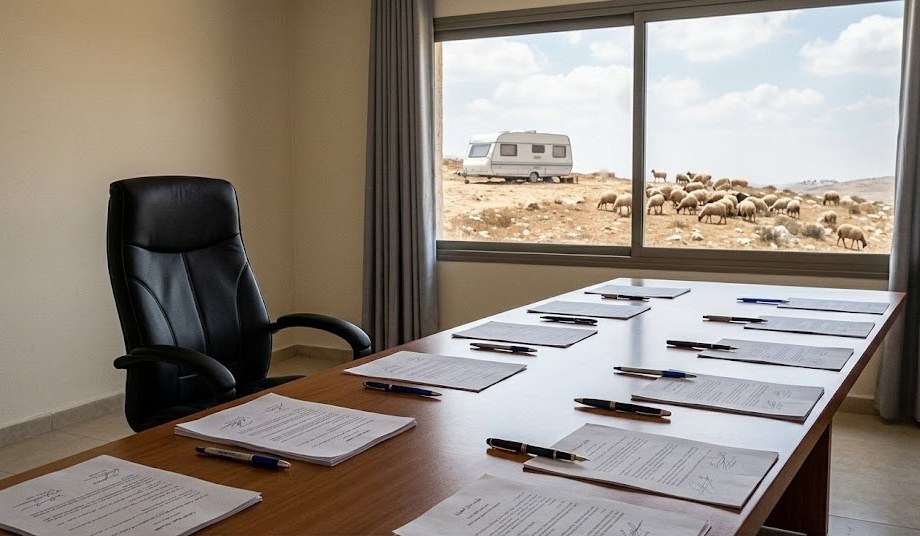
Then the pens came out and Australia remembered a pressing engagement elsewhere.
Two EU officials were “surprised”. Another was “disappointed”. A Nordic official said Canberra had “missed an opportunity”.
That is how you talk about a mate who didn’t show.
We are not so much walking back our stance against illegal settlements as not walking the talk at all.
Before we go there, let’s look at what hides behind the benign euphemism of the word settlement.
What the word hides
The settlements are Israeli civilian towns built on land Israel captured in 1967.
Article 49(6) of the Fourth Geneva Convention forbids an occupying power to move its own civilians into the territory it occupies. In July 2024 the International Court of Justice found the occupation itself unlawful and said the settlements must be evacuated.
Some settlements are cities with shopping malls and council rates. Others are one caravan, one flag and a flock of sheep on a hilltop.
Both do the same job.
Take Ras Ein al-Auja, a Bedouin village in the Jordan Valley. This is innovation. Who needs a bulldozer?
In late December 2025 settlers set up an outpost beside it. They ploughed the village land, tore up the road and cut the power cables. They blocked the canal and the grazing grounds.
They drove their herds to people’s doorsteps and gathered in groups at night.
On 8 January, 26 households, more than 100 people, left in a single day, +972 Magazine reports.
“They threatened to kill us, chased us, beat us,” said Abu Taleb al-Omari, 75. “In the end, they said they would slaughter us here if we didn’t leave.”
Muhammad Eshaq Rashid, 55: “I’ve never cried in my life until today.”
The settlers’ parting words, as one resident recalls them: “You lost. Wherever you go, we’ll come.”
Ras Ein al-Auja is not an aberration.
Amnesty International counts 117 herding and Bedouin communities fully or partly driven out between January 2023 and April 2026. That is 5,910 people. Of 363 unauthorised outposts, 212 went up under the present government.
Then the suburbs.
Ma’ale Adumim is a city of red roofs and ring roads a short drive east of Jerusalem. Between the two lies an empty ridge the planners call E1.
On 19 August the Netanyahu government opened a tender for 1,234 homes there. Bids close on 19 October, eight days before Israel goes to the polls.
That ridge is the last gap joining the northern and southern West Bank. Build on it and a Palestinian state comes in two pieces with Israeli housing in between.
Finance Minister Bezalel Smotrich puts it plainly: E1 “practically erases the two-state delusion.”
Smotrich needs no interpreter.
On 9 April the government approved 34 new settlements in one sitting, 103 since it took office. The new homes, he promised, would have “lights on and running water.”
Ten days later he cut the ribbon at Sa-Nur, a settlement Israel itself evacuated in 2005, and called the day “burying the idea of a Palestinian state.”
Some 700,000 settlers now live in the West Bank and East Jerusalem.
That is the enterprise the twelve set out to squeeze. That is what Australia declined to touch.
The official excuse
Naturally, we have a few pressing practical constraints. And ample precedent.
Our sure pair of hands turns into Butterfingers whenever Washington frowns. Gutlessness alone can do that to any US butler pretending to be a middle power. Or vice-versatility. Integrity fatigue?
Yet even industrial-strength Canberran hypocrisy is tested when it invokes pragmatism to weasel out of a principled agreement.
Wait. Make that talk of an agreement.
Then the foghorn of vacuity.
A blanket import ban, says the Department of Foreign Affairs and Trade, presents “practical challenges, including how to ensure they do not inadvertently harm Palestinian businesses, workers and livelihoods.”
Penny Wong told the Senate that Australia would pursue “further targeted measures in coordination with international partners.”
Which measures. Against whom. By when. The Senate was not told. Neither were we.
A touch of the reverse Robin Hood. We won’t tax the people taking Palestinian land, out of tender concern for the Palestinians whose land is being taken.
No-one’s buying the government guff.
The British package was never only a blanket ban. When London announced it, the ABC reported that it included action “against specific companies and individuals who provide services such as construction, infrastructure, financing, or real estate for settlement expansion.”
Targeted measures. The very thing Canberra says it prefers. They were on the table. Canberra left them there.
And the targeted measures we already have?
In June 2025 Australia joined Britain, Canada, New Zealand and Norway in sanctioning Itamar Ben-Gvir and Bezalel Smotrich. Good.
Now look at what that leaves. We sanction the man who runs the settlement project, then decline to touch the project.
The foreign policy equivalent of thoughts and prayers.
Wong is not confused about the stakes. She has said that settlement growth, E1 and “flagrant settler violence” are “extinguishing the possibility of a two-state solution.”
The Foreign Minister has read the death notice. She is still deciding on flowers.
Nor is the law in doubt. The ICJ told every state to refrain from aid or assistance in maintaining the occupation, and to take steps to prevent trade or investment relations that help keep it going.
Trade relations. The Court named the lever. Twelve nations have pulled it.
The domestic alibi
So why walk? The ABC’s sources point home.
On 14 December 2025, gunmen killed 15 people at a Hanukkah celebration at Bondi Beach. That was antisemitic terror and the grief is real.
A royal commission followed. Its report is due on 18 December.
Several diplomats told the ABC that the pressure on Albanese since Bondi may have shaped Canberra’s decision.
Here is what the government will not say.
Jewish Australians are not the Israeli cabinet. A Hanukkah gathering on Bondi Beach is not a caravan on a hilltop in the Jordan Valley. A tariff on settlement goods is not an act against a faith.
Treat it as one and you accept the settlers’ own case: that the settlements belong to every Jew, everywhere.
Plenty of Jewish Australians see the difference. The Jewish Council of Australia, a progressive group sharply critical of Israeli government policy, wants settlement goods banned.
“Once again,” said its executive officer Bart Shteinman, “Australia is at the back of the pack when it comes to upholding our international law obligations.”
Jewish Australians call for the ban. The government cites Jewish Australians as its reason to refuse it.
Canberra is choosing which Jews to hear.
In London, Ed Miliband announced Britain’s measures and was promptly called antisemitic. Miliband is Jewish, as Rachel Withers notes in Crikey.
A charge that fits everyone is no guide to policy.
The seat
Withers offers a further motive.
Australia wants a seat on the UN Security Council for 2029 and 2030. The ballot falls in mid-2028, and a win needs some 128 votes.
Days after the walkout, the bid was launched under the slogan “We listen. We partner. We protect.” The government, Withers suggests, is keeping its powder dry.
Count the room.
In September 2024, 124 nations voted in the General Assembly to give Israel twelve months to end the occupation. Australia abstained.
That is almost exactly the majority Canberra now needs. Those are the voters. They watched us abstain then. They watched us walk out now.
Launching the bid, Wong said: “A safer world is one governed by rules, not power and force alone.”
So the government passed up a chance to uphold international law to improve its odds of a seat on the body charged with upholding it.
This is not pragmatism. It is farce.
The receipts
Then there is what we do, as distinct from what we decline to do.
“We are not supplying weapons to Israel,” says Defence Minister Richard Marles.
Yet the ABC found that 31 of the 35 active defence export permits for Israel cleared after review fall under Part 1 of the Defence and Strategic Goods List: items designed for military use.
Parts for the F-35, the jet Israel flies over Gaza, move through Australian supply chains.
“Parts of weapons are weapons,” said Greens senator David Shoebridge.
The habit is old. In January 2014, asked whether the settlements breach international law, Foreign Minister Julie Bishop replied: “I would like to see which international law has declared them illegal.”
Ten years later the ICJ showed her.
We talk like a principled middle power. When it costs something, we act like a client state.
The test
The test for Canberra is simple and it is public.
Name the companies. Name the banks. Name the builders on E1.
Tell us whether Australian super funds hold a single dollar of settlement construction, and what happens to it. Give a date.
If the targeted measures are real, show them. If they stay unnamed, the explanation is exactly what it looks like.
In Ras Ein al-Auja, 26 households packed up and left in a single day.
In Canberra, the government couldn’t find a pen.
We listen. We partner. We protect ourselves.


An excellent piece of analysis, David. Australia’s ducking and weaving is utterly shameful, cringeworthy. The malign influence of the Zionist lobby has our major parties cowed, despite their fine, meaningless statements. When it comes to Gaza, West Bank and occupied territories, we stand for nothing.
LikeLike
Thank you, llama. Seems to be a reluctance to spell it out but as one or two have said, surely all of this abject failure of will is not remotely worth the *temporary* sinecure on the Security Council? All for a gig when we will be told how to vote anyway?
LikeLike
Is it worse that they don’t even attempt to defend their perfidy?
“What? Where? Who?”
As for “When or Why?“, fuggeddit!
LikeLike