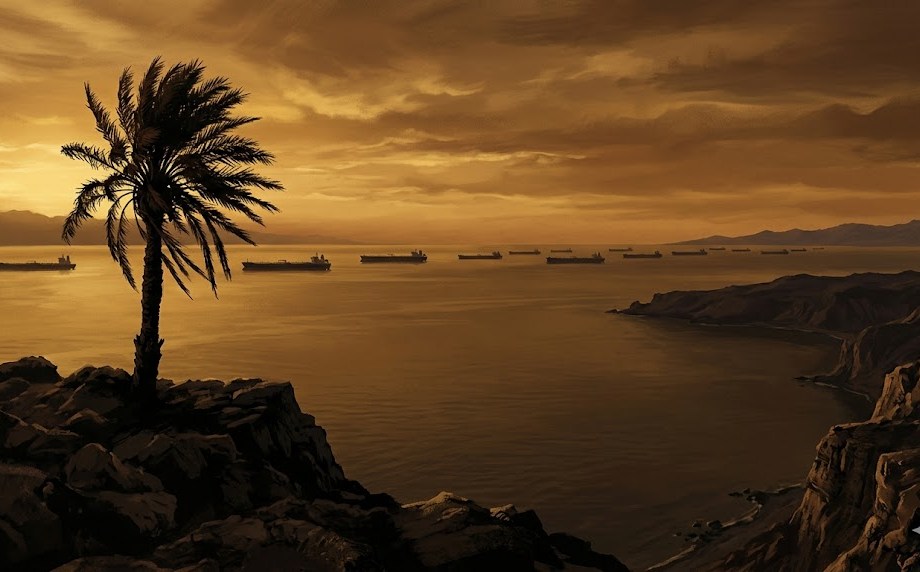
The Arabic name for the strait is Maḍīq Hurmuz. One theory derives “Hormuz” from the local Persian word Hur-Mogh, meaning “Place of Dates,” but the dominant scholarly etymology traces it through Middle Persian to the Zoroastrian god Ahura Mazda, Hormazd, making it, literally, “the Strait of God.”
In the Middle Ages , the Kingdom of Hormuz was so famed for wealth that Arab traders coined a saying: “If all the world were a golden ring, Ormus would be the jewel in it.” Take your pick. Each of these is perfect.
The world’s most strategically vital waterway is a jewel named either for God or for the humblest fruit of the desert, the date palm that fed civilisations before oil was dreamed of and will outlast it when the last barrel is scraped. Empires have sailed past those fronds for four thousand years. The palm bends in the shamal wind and does not break.
Through this Place of Dates, through this passage consecrated to divinity or survival depending on your etymology, now flows twenty percent of the world’s seaborne oil, or rather, it did.
In March 2026, Iranian forces reduced traffic through the strait by ninety-seven percent. The biggest disruption to global oil supply in history, measured in the language of shipping data, is also the moment the world learned that a name can be a prophecy.
In the annals of great powers stumbling into self-inflicted apocalypses, the 2026 Strait of Hormuz crisis now claims pride of place, right between Britain’s Suez Crisis and America’s Iraq sequel, but with added flair: exploding oil prices and a nuclear ultimatum served on a silver platter by Iran’s newly minted supreme leader, Ayatollah Mojtaba Khamenei. Admirable efficiency, were it not for the body count and the petrol-pump despair spreading outward from the Persian Gulf like an oil slick across the global economy.
Not even three months into the second year of President Trump’s second term, and Tehran has turned a war of “choice”, Washington’s diplomatic-speak for “oops”, into a masterclass in asymmetric checkmate. Mines in the Strait. Missiles over the Gulf. Demands that read like a rejected Batman script: U.S. troops out now, sanctions lifted within sixty days, or Tehran formalises the nuclear option and deepens its embrace of Moscow and Beijing. Charming. Audacious. And, given the arithmetic of leverage, entirely rational.
The Empire’s Oil Slick Slide
Picture the scene: U.S. and Israeli jets decapitate Iran’s old guard, bomb its infrastructure into smithereens, and declare mission accomplished faster than you can say “weapons of mass destruction.”
Cue the Islamic Revolutionary Guard Corps, those paragons of strategic patience and gravitas, who respond not with futile human waves but by applying a choke-hold to the world’s carotid artery.
Tankers tank. Prices spike to levels that make 1973 look like a rounding error. Suddenly every SUV petrol-head from Melbourne to Milwaukee is an unwitting IRGC recruit, financing Tehran’s leverage at the bowser. This isn’t lashing out; it’s a leveraged buyout.
Iran has flipped the script, making every American base in the region a liability and every barrel of Brent crude a hostage. The hegemon that once bombed nations into democracy now begs for safe passage past Iranian buoys. Achilles, drowning in his own hubris-laced bathwater, would recognise the sensation.
Pass the bath salts.
Mojtaba Khamenei, inheriting the supreme leadership from his martyred father, has ditched his old man’s chess for poker, all in on a hand bolstered by rising oil leverage, coordinated nods from Beijing and Moscow, and a nuclear ambiguity one press conference from going full Oppenheimer.
“Compensation for economic damages,” he demands, as though auditing decades of sanctions with a slide rule forged in Qom. Fail, and its Hormuz closure formalised, defence pacts inked, and deterrence declared. China and Russia chimed in within hours, just enough “restraint” to plausibly deny complicity while their tankers rerouted like geopolitical Jenga masters.
Meanwhile four-fifths of the strait’s normal traffic has been heading east; to China, India, Japan, South Korea. The Americans lit the fuse; Asia is choking on the smoke.
Satire of the Strategists
And where would be without the punditry. Corporate media frames Iran as the “regime” just as North Korea will be forever, “the hermit kingdom” a curious oddity, just as Iran is never a government, while its leaders can be parodied as the mad mullahs, conveniently forgetting who lit the fuse. Or who perfected chess.
Mad King Donald of Mar a Lago would be tickled pink to learn that the Persian word “Shah” (King) is the origin of the term “checkmate” (from Shah Mat, “the king is dead”) Just as the US is being de-throned as world’s mightiest potentate by a state that it can’t decapitate.
“Global volatility,” hacks and flacks wail, as though sanctions, murders, assassinations and illegal invasions were mere weather events requiring an umbrella rather than a reckoning. Independent analysis cuts through: this is blowback from a policy of “maximum pressure” that maximumly backfired.
Trump’s war room briefs on “surgical strikes” while petrol hits seven dollars a gallon, eroding the very MAGA base that cheered the opening salvos. The useful idiot who promised to end endless “stupid” wars has authored the mother of all energy crises, with IRGC mines accomplishing overnight what no green energy agenda managed in a decade: strangling fossil fuel flows at source.
Dark humour peaks in the ultimatums. Iran, once the sanctioned pariah, now dictates timelines like a banker foreclosing on Empire Inc. Sixty days for sanctions relief? That’s shorter than the average congressional recess. Nuclear pivot? A reminder that deterrence isn’t exclusively a NATO amenity.
And compensation. You can just see Treasury wiring funds to Tehran while the cable news studios implode. It is Wile E. Coyote architecture: Washington drops the anvil, Iran sidesteps, and the United States flattens itself. Yet the jest demands its counterweight; this tests not just resolve but reality. Can a unipolar dinosaur accommodate a multipolar world’s ground rules, or will it thrash until the place burns?
The Date Palm’s Lesson
Return to the Place of Dates. The date palm has been cultivated in the Persian Gulf region for at least five thousand years. It fed armies. It sweetened the otherwise bitter. In years of drought and siege, it was all people had to ward off the grim reaper. The palm asks almost nothing of the soil and gives back almost everything to those who tend it. It is not a tree that can be bombed into submission. Its root system goes thirty metres down into the earth; its trunk bends forty-five degrees in a storm and straightens when the wind drops. Civilisations discovered this and built around it. Empires that ignored it, that came through the strait with their gunboats and their absurd moral certainties, found the palms still there when they left.
The date is also, fittingly, the fruit of slow time. You cannot rush a date palm. It takes between seven and ten years to bear fruit from seed. There is no shock-and-awe horticultural strategy. The Americans came to the Persian Gulf as if it were already theirs; surgical, decisive, asymmetrically technological.
Iran answered with the logic of the date palm: patience, depth, a root system that goes down deeper than any bunker buster can augur itself into reinforced concrete.
Mojtaba Khamenei’s 12-minute address to the world is not bluster. It is a rulebook rewrite, forcing Washington to choose between retreat and ruin. The IRGC has structural tailwinds. Oil is at record highs, allied leverage is ascending, American over-reach, incurable and catastrophic.
What began as military retaliation has become something more durable: a living demonstration and timely reminder that the geography of the Persian Gulf has always belonged to those who live beside it. Indigenous people everywhere understand that. The Strait named for God, or for dates, does not belong to whoever happens to be sailing through it at any particular moment in history. The Portuguese understood this eventually. Even the British got it in the end. But the understanding always comes at a price.
Armageddon’s Fruit
A humbled hegemon is a better bet than a radioactive Persian Gulf. History does not lack for empires that confused firepower with leverage and ended as cautionary footnotes. The satire writes itself: in chasing regime change, Washington has delivered regime recharge: a new Iranian leadership with more legitimacy, more regional authority, and more nuclear credibility than the one it replaced.
The date palm, meanwhile, does not comment. It bends. It straightens. It fruits in its own time. At the mouth of the strait named for it, or for God, take your pick, the etymologists are still arguing; the tankers wait, the mines drift on their cables, or hug the sea-bed to be released as heat-seeking missiles by the sound of a tanker’s hull and the world discovers once again that geography can always beat air power.
The Place of Dates has been around vastly longer than the failed experiment in democratic self-government the United States of America. It will be here when whatever comes next has also had its turn at the maps.
Time for Uncle Sam to learn what the date farmers always knew: some straits you navigate by patience, not by force. The alternative, as the palm benders have always understood, is simply to be the thing that breaks.
 Urban Wronski Writes
If you didn’t know it, you’re a poet – the first half of this essay sang.
It will be an arabesque lament in the Future, if any.
Small edit in the first line of the last para. of Place of Dates – “Not even three months into President Trump’s second term...” pretty sure that you meant “Not even three months into THE 2nd YEAR of President Trump’s second term…” (LAST, hopefully).
Just wanted to add that small point before enjoying the remainder – just sipping it as with a fine single, aged malt.
LikeLike
Thank, you, Amphibious. I’ll fix the typo. Appreciate your comment.
LikeLike
Superb exposition.
You’ve pinged it.
Any comment would be otiose.
LikeLiked by 1 person